 Reviewed by
In short
Grief is the emotional, physical, and social response to loss; bereavement refers to the experience after someone dies. Coping can include practical support, daily routines, remembrance, and talking with people you trust. Grief has no fixed timetable. Seek professional support when distress overwhelms daily life or you want help carrying the loss.
Key facts
- Grief is a normal response to loss and can affect feelings, thoughts, the body, and behavior. Bereavement specifically follows a death. National Cancer Institute: Grief and bereavement.
- There is no fixed timeline or "correct" sequence of stages; grief is different for everyone. Some people experience reactions outside the familiar stages entirely. NHS: Grief after loss.
- Most people gradually adjust over time, though painful moments can return long after a loss. Reminders and significant dates can bring back strong feelings. National Cancer Institute: Common grief.
- When grief stays intense and disabling, support or treatment can help. Adult prolonged grief disorder requires at least a year since the death plus other clinical criteria; support can begin earlier. American Psychiatric Association: Diagnosis and support.
What is grief?
Grief is the deep sorrow and range of reactions we feel after losing someone or something important. It can affect sleep, concentration, relationships, and your ability to manage ordinary responsibilities. Bereavement refers specifically to the period of grief and mourning after a death, and mourning is the way we outwardly express that loss, shaped by culture, faith, and personal style. While the death of a loved one is the most familiar cause, grief can also follow other major losses, such as the end of a relationship, a serious illness or diagnosis, infertility or pregnancy loss, or the loss of a job, home, or sense of safety.
Grief is one of the most universal human experiences. Almost everyone will lose someone they love at some point, and the intensity of grief often reflects the depth of the bond. There is no single feeling that defines it. People can move between sorrow, numbness, anger, and even moments of relief or peace, sometimes within the same day, and all of these can be part of a healthy response to loss.
Grief deserves care, patience, and space to be expressed. As the UK's National Health Service puts it, "There's no right or wrong way to feel" after a loss. It is a natural part of being human, and support can help you gradually adapt and carry the loss in a way that lets you keep living.
The National Cancer Institute, part of the National Institutes of Health, describes several forms grief can take. Anticipatory grief can begin before a death when a loss is expected, for example during a serious illness. Normal or common grief gradually eases as a person adjusts to life after the loss. Complicated or prolonged grief is more intense and lasts much longer, and it can benefit from professional support. Recognizing which kind you may be experiencing can help you know what to expect and when extra help might be useful.
What grief feels like
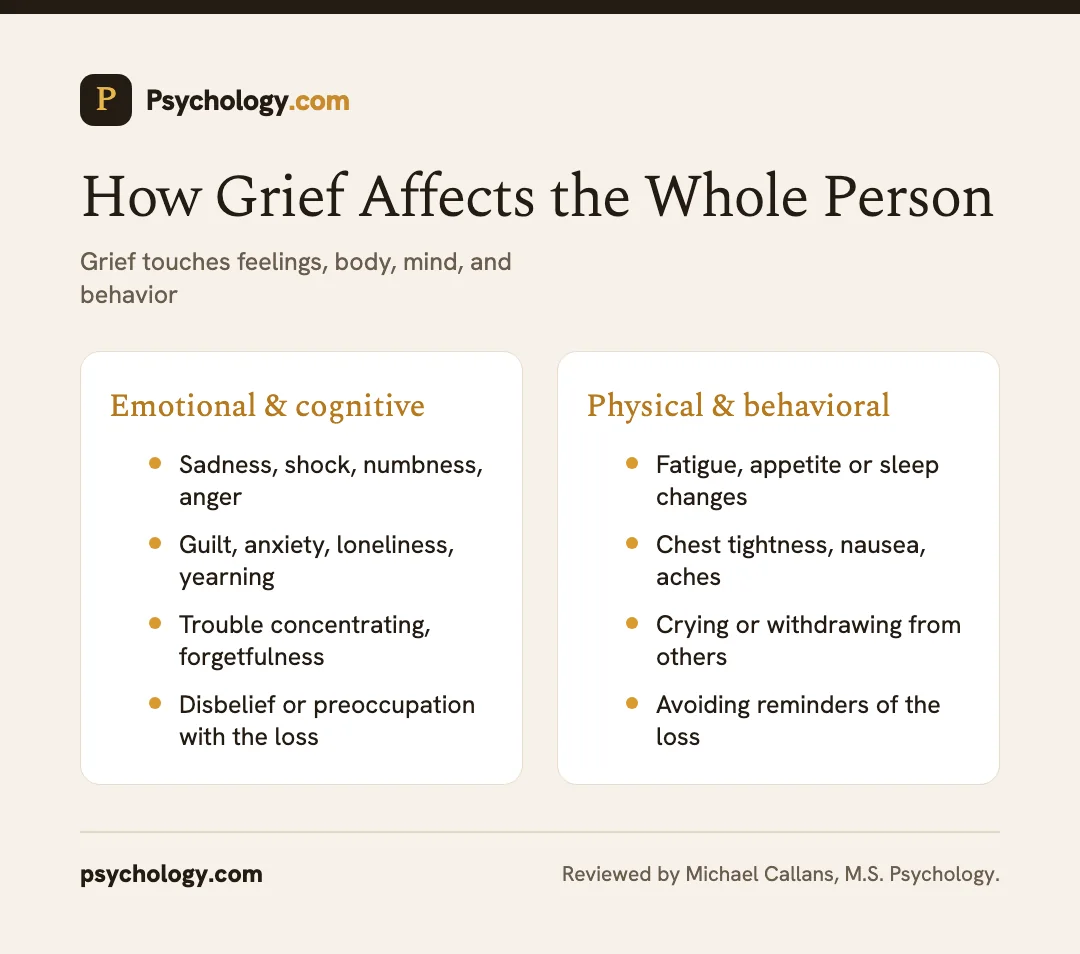
Grief affects the whole person, and reactions vary widely from one individual to the next. Common experiences include:
- Emotional: sadness, shock, numbness, anger, guilt, anxiety, loneliness, yearning, or even relief.
- Physical: fatigue, changes in appetite or sleep, tightness in the chest, nausea, a weakened immune response, or aches and pains.
- Cognitive: trouble concentrating, forgetfulness, disbelief, confusion, or preoccupation with the loss.
- Behavioral: crying, withdrawing from others, restlessness, trouble with everyday tasks, or avoiding reminders of the loss.
These feelings often come in waves, easing and returning, sometimes triggered by anniversaries, places, songs, or memories. The NHS notes that although grief can feel "chaotic and out of control," for most people these feelings gradually become less intense over time. The familiar "stages of grief," denial, anger, bargaining, depression, and acceptance, are a helpful way to describe common reactions, not a checklist. People move through them in their own way and order, skip some, or revisit them, and there is nothing wrong with grieving differently from someone else.
Ways to cope
“Your grief might feel chaotic and out of control, but these feelings will eventually become less intense over time.”
There is no way to rush grief, but some approaches can make it more bearable and help you support your own healing over time:
- Allow yourself to feel: grief takes the time it takes, and there is no need to "stay strong" or hide it for the sake of others. Naming what you feel can take some of its edge off.
- Lean on support: talk with people you trust, accept practical help, or join a bereavement support group where others understand what you are going through.
- Care for your body: try to keep up with sleep, food, movement, and routine, even in small ways, since grief is physically draining.
- Mark the loss: rituals, photos, writing, and ways of honoring the person or what you lost can give grief somewhere to go.
- Go easy on coping that backfires: leaning heavily on alcohol or drugs tends to make grief harder, not easier.
- Be patient with yourself: grief is not linear, and difficult days, even much later, do not mean you are failing or going backward.
How to support someone who is grieving
If someone you care about is grieving, you do not need the perfect words. Often the most helpful thing is simply showing up. Acknowledge the loss rather than avoiding it, say the person's name, and let your friend talk (or sit in silence) without trying to fix their pain or rush them toward "moving on." Offer specific, practical help, such as bringing a meal, running an errand, or handling a chore, rather than a vague "let me know if you need anything." Keep checking in over the weeks and months after the funeral, when other support often fades but the grief is still raw, and remember anniversaries and birthdays, which can be especially hard.
4%-15%of bereaved adults experience the persistent symptoms of prolonged grief disorder; most people grieve without developing itAmerican Psychiatric Association
1 yearmust have passed since a loss before prolonged grief disorder is even considered in adultsAmerican Psychiatric Association
8.3%of U.S. adults had a major depressive episode in 2021; depression can overlap with grief and is treatableNIMH
When grief becomes complicated
For most people, the sharp pain of grief gradually softens over time, even though the loss is always felt. For some, grief stays intense, constant, and disabling well beyond the early months. Mental health professionals now recognize this as prolonged grief disorder, sometimes called complicated grief. Signs include an inability to accept the loss, persistent intense longing or preoccupation with the person who died, deep emotional pain, withdrawal from life, numbness, or feeling that life has lost its meaning, lasting for many months and far beyond what is expected given social and cultural norms. The NHS suggests speaking with a primary care doctor if grief is still severe many months on, for example if you cannot carry out normal activities or feel life is not worth living.
Grief can also overlap with, or develop into, depression or anxiety, which are treatable conditions. A clinician can help tell ordinary grief apart from depression or prolonged grief disorder, and grief-focused therapy can help when grief gets stuck.
There is no fixed timeline for grief, and the length of a grieving reaction varies widely from person to person. Time alone cannot determine whether someone has prolonged grief disorder or a trauma-related condition. The American Psychiatric Association describes prolonged grief disorder as persistent, disabling grief assessed in relation to cultural expectations and other symptoms. A clinician can evaluate grief, depression, and trauma symptoms together and recommend grief-focused care, trauma treatment, or another approach based on that assessment. You can seek help whenever you need it.
Free tools and worksheets
Practical, printable exercises from our free library that people managing grief & bereavement often find useful. No signup needed.
Does this sound familiar? Grief looks different for everyone, and none of these reactions mean you are grieving wrong. If you would like a gentle way to reflect on where you are, these prompts may help.
Free, with a plain-language result and a PDF you can bring to a professional. Complete it at your own pace and review the privacy information before sharing personal details. A screening is not a diagnosis.
| Typical grief | Prolonged grief disorder |
|---|---|
| Comes in waves that slowly soften over months | Stays intense, constant, and disabling for many months |
| Painful moments return around anniversaries and reminders | Persistent longing and preoccupation with the person who died |
| You gradually re-engage with daily life | Withdrawal from life, with daily functioning still impaired |
| Acceptance grows over time, even as sadness remains | Ongoing disbelief or inability to accept the loss |
| Your sense of who you are stays intact | Feeling that part of yourself has died with them |
| Support from loved ones is usually enough | Grief-focused therapy and professional support can help |
When to seek help
Consider reaching out to a doctor or mental health professional if grief feels overwhelming for a long time, keeps you from daily functioning many months after the loss, leads to heavy use of alcohol or drugs, or brings thoughts of harming yourself. Seeking support can help you care for yourself while honoring the person you lost and the relationship you shared. Talking therapies, support groups, and, where needed, treatment for depression can all help. If you have thoughts of suicide, get help right away: in the US, call or text the 988 Suicide & Crisis Lifeline any time, or call 911 if you are in immediate danger.
Frequently asked questions
How long does grief last?
There is no set timeline. Acute grief often softens over months, but waves of sadness can return for years, especially around anniversaries. What matters is whether you are gradually able to re-engage with life over time. You can seek support at any point, especially if sleep, self-care, or everyday responsibilities feel difficult to manage. A difficult anniversary alone does not establish a disorder.
Are the five stages of grief real?
The stages, denial, anger, bargaining, depression, and acceptance, are a useful way to describe common reactions, but they are not a fixed sequence. People experience them in different orders, skip some, or revisit them. The model does not predict how long grieving will take or require you to reach acceptance. Your relationship, culture, and circumstances shape your experience, and support can be useful wherever you are.
Is grief the same as depression?
No. Grief is a natural response to loss and tends to come in waves. Depression is a persistent condition affecting mood, body, and thinking. The two can overlap, and a professional can help tell them apart if you are unsure. Persistent hopelessness, loss of interest across your life, or difficulty functioning deserve assessment. Bereavement does not prevent someone from also experiencing a depressive episode or benefiting from treatment.
What is anticipatory grief?
Anticipatory grief is mourning that begins before a death, often during a long or serious illness. You may grieve the future you expected, changes in your relationship, and the many small losses that come with caregiving. It can reflect love, worry, and the strain of caregiving, and grief after the death may still bring different feelings and needs. Support groups and honest conversations can make this in-between time gentler.
Is it normal to feel relief when someone dies?
Yes. Relief is common after a long illness, a complicated relationship, or a period of intense caregiving, and it often sits right beside deep sadness. Feeling relieved does not mean you loved the person any less. Grief has room for many feelings at once, and naming them honestly, to yourself or someone you trust, usually softens the guilt that can come with them.
How do I help a grieving friend who does not want to talk?
Stay present without pressing. Send a short message that expects no reply, drop off a meal, handle a practical errand, or simply sit with them in silence. Say the name of the person who died rather than avoiding it, and keep checking in during the months after the funeral, when other support often fades. Your steady presence matters more than finding perfect words.
Related conditions
- Depression
- Anxiety
- PTSD
- Loneliness Statistics 2026
Therapists who specialize in grief and bereavement
Connect with a licensed therapist on Psychology.com who works with grief and bereavement.
- A FAMILY MATTER
- Advance Thru Psychotherapy and Family Development
- Amy Keller
- Anne Ciota
- Arlyn P. Stern LCSW
- Asktheinternettherapist.com
Finding the right help
When you are ready to take the next step, these guides walk you through finding and starting with the right therapist.
- Getting started with therapy
- How to find the right therapist
- Find a therapist who takes insurance
- Free & low-cost therapy
References
- National Health Service (NHS). Get help with grief after bereavement or loss.
- National Cancer Institute (NIH). Grief, Bereavement, and Loss (PDQ) - Patient Version.
- National Institute of Mental Health (NIMH). Depression.
- 988 Suicide & Crisis Lifeline. Free, confidential 24/7 support.
- American Psychiatric Association: Prolonged grief disorder
- NIMH: Major depression

Using grief worksheets at your own pace
Grief worksheets offer prompts for remembering someone, describing difficult feelings, and identifying support. Choose a prompt that feels manageable, leave questions blank when needed, and stop if writing becomes overwhelming. You can bring a worksheet to a therapist or use it to explain what you need to someone close to you.
The grief self-assessment can help organize what you are experiencing, but its result cannot establish a diagnosis or tell you how you should feel. For support options, compare group therapy with individual counseling. The conditions hub also explains concerns that can occur alongside grief.