
 By
By Reviewed by
NIMH estimates that 2.8% of U.S. adults had bipolar disorder in the past year and 4.4% at some point in their lives, based on interviews conducted from 2001 to 2003. Beyond that headline number, estimates differ across diagnostic definitions, countries and study designs. National surveys describe how common it is, while clinical cohorts describe outcomes among people receiving care. Reading these findings together requires attention to who was studied and when. The figures below distinguish lifetime history, past-year experience and observations during follow-up. Sources were checked again on September 16, 2026; the review date does not turn historical survey results into new observations.
Last full review: September 16, 2026 · sourced from NIMH, WHO, the Global Burden of Disease study, national surveys and peer-reviewed meta-analyses.
Ten numbers that define bipolar disorder in 2026
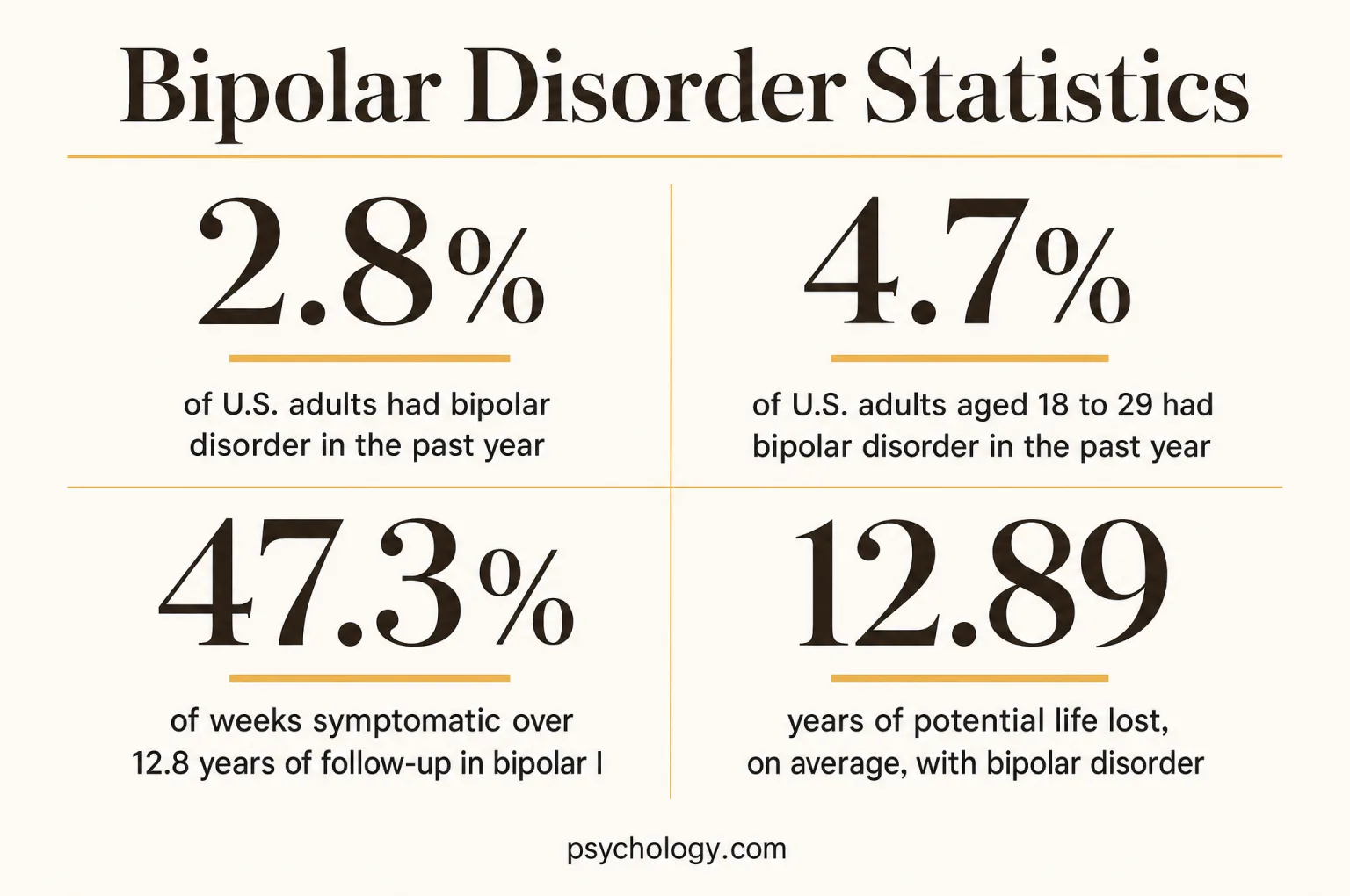
- NIMH’s summary of the 2001 to 2003 NCS-R estimates that 2.8% of U.S. adults had bipolar disorder in the past year, and 4.4% meet criteria at some point in their lives. NIMH, NCS-R data from 2001 to 2003
- 36 million people worldwide, about 1 in 226, were living with bipolar disorder in WHO’s estimate for 2023, published on September 11, 2026. WHO, 2026
- In Bolton and colleagues’ 2021 review, 14 studies supported a three-group onset pattern in which 45% of participants belonged to the early-onset group, whose mean onset age was 17.3 years. Bolton et al., 2021
- Scott and colleagues’ 2022 review reported a median diagnostic delay of 6.7 years across study estimates; definitions of illness onset and delay varied. Scott et al., 2022
- Hirschfeld and colleagues’ 2003 report found that 69% of 600 respondents to a 2000 support-group survey reported an initial misdiagnosis, most often unipolar depression; those misdiagnosed saw a mean of 4 physicians before an accurate diagnosis. Hirschfeld et al., 2003
- Dong and colleagues’ 2020 meta-analysis estimated lifetime suicide-attempt prevalence at 33.9% among people with bipolar disorder in the included studies; this group estimate does not predict an individual outcome. Dong et al., 2020
- Chan and colleagues’ 2022 meta-analysis estimated an average of 12.89 years of potential life lost among people with bipolar disorder; estimates varied by setting and method. Chan et al., 2022
- In Judd and colleagues’ 2002 report of a cohort of 146 patients with bipolar I followed for a mean of 12.8 years, symptoms occurred in 47.3% of weeks; depressive symptoms occupied more than three times as many weeks as manic or hypomanic symptoms. Judd et al., 2002
- Merikangas and colleagues’ 2007 analysis of the 2001 to 2003 NCS-R found that 67.3% of U.S. adults with past-year bipolar I reported treatment for emotional problems during that year; 25.0% received medication classified as appropriate by the study. Merikangas et al., 2007
- Bessonova and colleagues’ 2020 review estimated annual U.S. bipolar disorder costs above $195 billion in 2018 dollars, with 72 to 80% attributed to indirect costs such as unemployment and lost productivity. Bessonova et al., 2020
How common bipolar disorder is
Prevalence depends on what a survey counts and the time period it asks about. Bipolar I, bipolar II and subthreshold bipolar presentations are distinct categories. A lifetime estimate includes earlier episodes, while a past-year estimate covers a shorter window. The national surveys below also used different diagnostic criteria, which limits direct comparison.
of U.S. adults had bipolar disorder in the past year
That is the National Institute of Mental Health's headline estimate, drawn from the National Comorbidity Survey Replication (data collected 2001 to 2003). Lifetime prevalence is 4.4%, so more than 1 in 25 American adults meet criteria at some point. The rate is almost identical in women (2.8%) and men (2.9%).
- 4.4%Lifetime prevalence among U.S. adults
About 1 in 23 adults, based on the 2001 to 2003 NCS-R. Lifetime prevalence estimates the share who met survey criteria at any point before the interview, including earlier episodes.
- 36MPeople living with bipolar disorder worldwide in 2023
About 1 in 226 people, or 0.4% of the global population, including approximately 32 million adults.
- 2.1%Lifetime DSM-5 bipolar I among U.S. adults (2012 to 2013 data)
NESARC-III (36,309 adults) found 12-month prevalence of 1.5% and lifetime prevalence of 2.1%. Lifetime estimates for men (2.2%) and women (2.0%) did not differ significantly.
- 3.9%Weighted prevalence of bipolar spectrum disorders in youth
The 2019 review combined 19 studies and 56,103 young people; bipolar I alone was 0.6%. It found no evidence of higher U.S. rates or increasing prevalence within the included studies.
| Subtype | NCS-R lifetime (U.S., 2001 to 2003) | NCS-R 12-month | Source |
|---|---|---|---|
| Bipolar I | 1.0% | 0.6% | Merikangas 2007 |
| Bipolar II | 1.1% | 0.8% | Merikangas 2007 |
| Subthreshold bipolar disorder | 2.4% | 1.4% | Merikangas 2007 |
| Whole spectrum | 4.4% | 2.8% | NIMH, NCS-R 2001 to 2003 |
Why prevalence estimates differ
Bipolar I requires a manic episode. Bipolar II involves hypomania and major depression, without a history of mania. The NCS-R also counted subthreshold presentations, which did not meet its full bipolar I or II criteria. Its subtype estimates are rounded separately, so adding them need not reproduce the rounded overall total. WHO's estimate counts people living with bipolar disorder in 2023; comparing it directly with a U.S. lifetime percentage would mix populations, time frames and methods. The WHO fact sheet does not say that its count is restricted to bipolar I.
Who bipolar disorder affects
U.S. survey estimates were similar in men and women, but differed by age. The NCS-R found the highest past-year prevalence in adults aged 18 to 29. That age pattern cannot by itself establish why rates differ between generations. Family and twin studies address inherited liability using different measures from population prevalence.
of U.S. adults aged 18 to 29 had bipolar disorder in the past year
In the 2001 to 2003 NCS-R, the rate was 4.7% among adults aged 18 to 29, 3.5% at ages 30 to 44, 2.2% at ages 45 to 59 and 0.7% at age 60 or older. The youngest adult group had about 6.7 times the prevalence of the oldest. The survey compared age groups at interview; it did not follow the same individuals as they aged.
- 2.9%Lifetime prevalence among U.S. adolescents aged 13 to 18
The NCS-A (2001 to 2004) found 2.9% of adolescents had bipolar disorder and 2.6% had severe impairment. Rates rise from 1.9% at 13 to 14 to 4.3% at 17 to 18.
- 3.3MAdolescents aged 10 to 19 living with bipolar disorder worldwide in 2023
Almost 1 in 11 of the global total, in WHO's 2023 estimate.
- 60.4%Heritability of bipolar disorder in the Swedish Twin Register
In the 2019 analysis of 804 affected and 91,604 unaffected twins, genetic differences accounted for an estimated 60.4% of variation in liability within the studied population. The study found no evidence of sex-specific genetic effects.
- 32%Offspring of a parent with severe mental illness who develop one by adulthood
The 2014 review pooled 33 family studies with 3,863 offspring. Parents had schizophrenia, bipolar disorder or major depression, and the outcome included any of those disorders. The estimate was more than twice that in control offspring (risk ratio 2.52). It should be interpreted as a broader mental-illness risk estimate.
- 3.3% versus 2.6%Lifetime bipolar disorder prevalence in female and male U.S. adolescents, respectively
NIMH’s adolescent table reports these estimates for ages 13 to 18 from NCS-A interviews conducted from 2001 to 2004. The female estimate was higher in this adolescent survey, whereas adult past-year estimates were similar by sex. The surveys use different age groups and reference periods, so the contrast cannot establish a change in sex differences as individuals age.
Differences between women and men
Past-year prevalence is 2.8% in women and 2.9% in men, and NESARC-III found the same parity for bipolar I. Women attempt suicide more often (34.4% versus 26.4% lifetime, per Dong et al., 2020) and are more likely to have rapid cycling (10.9% versus 7.24% in a 2023 cohort of 1,261 patients). In a U.S. inpatient sample of 593,257 admissions, women were less likely than men to have alcohol or drug abuse recorded but more likely to have anxiety (odds ratio 1.663) and PTSD (2.253). Treatment differences depend on the population and measure used; an inpatient admissions dataset cannot establish treatment access in the wider population.
Onset, symptoms and course
Bipolar disorder often begins during adolescence or early adulthood, and depression may precede recognizable mania or hypomania. Clinical cohorts describe substantial time with depressive symptoms, but their averages vary with recruitment, follow-up and bipolar subtype. The course for an individual can include periods of remission as well as recurring episodes; cohort averages do not establish the proportion of every person’s life spent unwell.
of weeks symptomatic over 12.8 years of follow-up in bipolar I
In the NIMH Collaborative Depression Study (146 patients enrolled 1978 to 1981), people with bipolar I spent 31.9% of weeks with depressive symptoms, 8.9% with manic or hypomanic symptoms and 5.9% cycling or mixed. Subsyndromal and minor symptoms (29.9% of weeks) were nearly three times as common as full episodes (11.2%). The illness is mostly lived below threshold, and mostly on the depressive side.
- 17.3Mean onset age in the early group of studies supporting three onset groups
The 2021 review included 21 studies and 22,981 participants overall. The three-group pattern came from 14 studies with 13,626 participants: mean onset ages were 17.3 years (45%), 26.0 years (35%) and 41.9 years (20%). Other studies supported different patterns.
- 13 wksMedian duration of a bipolar I mood episode
In a cohort followed for up to 25 years, more than 75% recovered from an episode within a year; recovery was slower after severe onsets.
- 53.9%Weeks symptomatic in bipolar II over 13.4 years of follow-up
In this 2003 study of 86 patients, depression accounted for 50.3% of all follow-up weeks and hypomania for 1.3%. These are averages in a particular cohort, and do not describe every person with bipolar II.
- 63%Lifetime prevalence of psychotic symptoms in bipolar I
A review of 54 studies with 23,461 participants reported pooled lifetime estimates of 63% in bipolar I and 22% in bipolar II in studies of at least moderate quality; bipolar I inpatients had an estimate of 71%. Point prevalence was 57% in manic episodes and 13% in depressive episodes. Point prevalence measures symptoms present at the time assessed.
- 22.3%One-year prevalence of rapid cycling (four or more episodes a year)
Lifetime prevalence pooled at 35.5% across 18 reports. Rapid cycling is more common in women and in bipolar II, and is linked to suicide attempts and poor response to mood stabilizers.
Relapse after childbirth
A meta-analysis of 37 studies (5,700 deliveries in 4,023 women) put postpartum relapse risk at 35% among women with bipolar disorder, a history of postpartum psychosis, or both. For women with bipolar disorder, relapse was 66% among those who were medication-free during pregnancy and 23% among those who continued prophylactic medication (Wesseloo et al., 2016). The 2025 Lancet seminar cites a 39% postpartum relapse risk. More than 60% of people with bipolar disorder report a stressful life event in the six months before an episode (StatPearls, 2023).
A daily diary card provides space for daily observations that can support a conversation at an appointment. The behavioral activation worksheet places experiences alongside everyday activities. These records describe a person’s observations; they do not establish bipolar disorder, identify a subtype or replace a professional assessment.
Impact: health, mortality and cost
Bipolar disorder is associated with impaired daily functioning, additional health conditions and premature mortality. Economic studies also describe costs to patients, families and employers. These estimates come from different populations and years. Neither a mortality average nor a symptom percentage can predict the outcome for one person.
years of potential life lost, on average, with bipolar disorder
A 2022 meta-analysis included 13 studies with 128,989 patients for years of potential life lost, and 11 studies with 96,601 patients for life expectancy. Pooled life expectancy was 66.88 years: 70.51 for women and 64.59 for men. Separate cause-specific estimates were 5.94 years lost to natural causes and 5.69 to unnatural causes; these are not a complete additive breakdown of the overall 12.89-year estimate. WHO reports that people with bipolar disorder die 13 years earlier on average. These population estimates vary substantially across settings and do not determine an individual lifespan.
- 82.9%Adults with past-year bipolar disorder rated as seriously impaired
NIMH reports 82.9% serious impairment and 17.1% moderate impairment among U.S. adults with past-year bipolar disorder in the 2001 to 2003 NCS-R, using the Sheehan Disability Scale. The percentages refer to the categories used in that survey.
- 33.9%Lifetime prevalence of suicide attempts
The 2020 review included 79 studies overall; 75 studies with 32,477 participants contributed to the lifetime estimate (95% CI 31.3 to 36.6%). Subgroup estimates were 34.4% in women and 26.4% in men, 37.0% in the Americas, and 47.0% with rapid cycling versus 30.2% without, using the results table. Estimates varied greatly across studies.
- 164Suicide deaths per 100,000 person-years
The 2015 ISBD Task Force review pooled research from January 1, 1980 to May 30, 2014. Male suicide mortality was 1.7 times female mortality. Estimates of the share of all suicide deaths involving bipolar disorder ranged from 3.4 to 14% across studies.
- 2.05xAll-cause mortality versus the general population (standardized mortality ratio)
The 2015 review included 31 studies and 305,859 people, with data collected from 1935 to 2010. Suicide SMR was 14.44, circulatory disease 1.73 and respiratory disease 2.92. The review found no evidence that relative all-cause mortality improved across the decades examined.
- $195B+Estimated annual U.S. economic burden in a 2020 review (2018 dollars)
The review covered research published from 2008 to 2018. About 25% of costs were direct medical expenses and 72 to 80% were indirect costs. A separate model estimated total bipolar I costs at $202.1 billion in 2015, including $119.8 billion in excess costs compared with people without bipolar disorder.
- $20,846Adjusted annualized direct health care costs: $20,846 in the bipolar cohort versus $11,391 in matched controls
Published in 2023, this analysis used the 2020 U.S. National Health and Wellness Survey. Of 3,583 eligible bipolar respondents, 3,285 were matched to 6,570 general-population respondents. Adjusted indirect costs were $14,795 versus $9,274, six-month hospitalizations 0.53 versus 0.30, and EQ-5D scores 0.69 versus 0.79. Costs were annualized estimates.
| Cause of death | Ratio vs general population | Sample | Source |
|---|---|---|---|
| All causes | 2.05 | 31 studies, 305,859 people, data 1935 to 2010 | Hayes et al., 2015 |
| Suicide | 14.44 | 15 studies | Hayes et al., 2015 |
| Circulatory disease | 1.73 | Meta-analysis | Hayes et al., 2015 |
| All causes, Hong Kong 2008 to 2018 | 2.60 | 12,556 patients | Chan et al., 2021 |
| Unnatural causes, Hong Kong 2008 to 2018 | 8.63 | 12,556 patients | Chan et al., 2021 |
Work and income
A 2022 review of 74 studies across mood-spectrum conditions reported employment rates of 40 to 75% in bipolar samples. One included study estimated earnings about 36% below those of people without affective disorders, while one survey found 41% feared losing their job because of their emotional state. These were separate study results. In Swedish register data published in 2021, 45% were employed three years before a first registered bipolar diagnosis and 34% five years afterward; participants were working-age adults diagnosed from 2006 to 2013.
The suicide-risk figures above describe research groups, not any one person's future outlook. A written safety plan can list personal warning signs, coping steps and people to contact before a crisis escalates. In the United States, call or text 988, the Suicide and Crisis Lifeline, at any hour.
Treatment and the care gap
Treatment studies measure different outcomes, including recurrence, symptom response and mortality. Structured psychotherapy alongside medication was associated with lower recurrence odds in randomized trials. Population surveys separately describe access and medication use. These are complementary questions: the effect of an intervention among study participants does not show how many people in the community receive it.
of U.S. adults with past-year bipolar I reported treatment for emotional problems in the NCS-R
The 2001 to 2003 survey, published in 2007, recorded past-year treatment contact in 67.3% of bipolar I cases, 65.8% of bipolar II cases and 36.7% of subthreshold cases. Treatment contact included several provider types and did not necessarily mean bipolar-specific care. Among all past-year cases, 25.0%, 15.4% and 8.1%, respectively, used medication classified by the study as appropriate. The study definition included mood stabilizers, anticonvulsants and antipsychotics; these historical classifications should not be read as a current prescribing recommendation.
- 44%Non-adherent to psychotropic medication (pooled across 10 bipolar studies)
The figure was 49% across all major psychiatric disorders. A large U.S. database study found about half of patients non-adherent with lithium and maintenance medication over 12 months.
- OR 0.13Suicide-death odds with lithium versus placebo in a 2013 mood-disorder review
Four trials contributed to OR 0.13 (95% CI 0.03 to 0.66), within a review of 48 trials and 6,674 participants with several mood disorders. Eight trials contributed to all-cause mortality OR 0.38. This was not a bipolar-only estimate. A 2022 randomized-trial review found the suicide evidence inconclusive.
- OR 0.56Recurrence odds with manualized psychotherapy plus medication versus control interventions
The review included 39 trials and 3,863 participants; 20 two-group trials contributed to OR 0.56 (95% CI 0.43 to 0.74). Family or group psychoeducation with guided skills practice had OR 0.12 versus individual delivery. An odds ratio is not the percentage of patients who avoid relapse.
- 52%Prescribed an antidepressant in a 12,824-patient cohort, 2017 to 2022
Nearly half were prescribed an antidepressant without a concomitant mood stabilizer. The study authors noted that most clinical guidelines caution about this use. Black patients (OR 0.70) and those seen in primary care (0.21) were less likely to receive lithium.
| Intervention | Effect | Evidence | Source |
|---|---|---|---|
| Lithium versus placebo, suicide deaths in mood disorders | OR 0.13 | 4 RCTs within a 48-trial review | Cipriani et al., 2013 |
| Lithium versus placebo, all-cause deaths in mood disorders | OR 0.38 | 8 RCTs | Cipriani et al., 2013 |
| Manualized psychotherapy plus medication versus control interventions, recurrence | OR 0.56 | 20 two-group trials within a 39-trial review | Miklowitz et al., 2021 |
| ECT, response in bipolar depression | 80.2% | Swedish registry, n=1,251 | Lancet seminar, 2025 |
| ECT, response in mania | 84% | Swedish registry | Lancet seminar, 2025 |
Hospital care
A 2018 analysis of the U.S. Nationwide Inpatient Sample covered 593,257 admissions with a primary bipolar disorder diagnosis from 2010 to 2014 (Patel et al., 2018). These are hospitalizations, so a person admitted more than once can contribute multiple records. The study describes hospitalized patients and cannot estimate the share of all people with bipolar disorder who need hospital care.
For a conversation about ongoing support, Psychology.com’s directory can help people find a licensed therapist. The access statistics above measure different services: a recorded visit, a prescription and participation in psychotherapy are distinct outcomes. A directory listing cannot show whether someone receives the range of care described in a clinical study.
Trends in prevalence and prescribing
GBD models estimate more people living with bipolar disorder over time, while the all-age standardized prevalence rate changed little in the 2019 analysis. Prescribing patterns also changed in U.S. psychiatrist visits from 1997 to 2016. Newer health-system data cover 2017 to 2022, but do not represent every U.S. patient.
people living with bipolar disorder worldwide in 2019, up 59.3% from 24.8 million in 1990
Lai and colleagues' analysis of GBD 2019, published online in 2023 and in a 2024 journal issue, estimated 3.4 million new cases in 2019, up from 2.2 million in 1990, and 8.5 million years lived with disability, up from 5.3 million. Global age-standardized prevalence changed little. WHO's estimate of 36 million people in 2023 comes from a later data release; differences across releases should not be interpreted as a measured decline or explained by a supposedly bipolar-I-only definition.
- 48.8MPrevalent cases in 2013 (GBD 2013), up 49.1% from 32.7 million in 1990
Bipolar disorder accounted for 9.9 million DALYs in 2013, 0.4% of all DALYs worldwide, peaking in people's twenties.
- 25.28MPeople aged 15 to 49 with bipolar disorder in 2021, up from 16.74 million in 1990
The 2026 analysis reports 1.63 million new cases, 5.50 million DALYs and a prevalence rate of 640.27 per 100,000 in this age band in 2021. These are modeled estimates; the rate should not be compared directly with an all-age prevalence percentage.
- +49%Growth in prevalent cases among women aged 15 to 49, 1990 to 2021
The 2025 model-based analysis estimated 13.05 million women aged 15 to 49 living with bipolar disorder in 2021, with 826,397 new cases and 2.81 million DALYs. Those are historical modeled estimates; projections to 2041 are forecasts.
- 51.4%U.S. psychiatrist visits for bipolar disorder with an antipsychotic prescribed, 2013 to 2016 (up from 12.4% in 1997 to 2000)
Mood stabilizer prescribing fell from 62.3% to 26.4% of visits over the same period, and antidepressants without a mood stabilizer rose from 17.9% to 40.9%.
- 27%Patients prescribed lithium in a large U.S. health system, 2017 to 2022
A modest increase over the period, alongside a slight decrease in antidepressants, which still reached 52% of patients.
| Measure | 1990 | Latest | Change | Source |
|---|---|---|---|---|
| Prevalent cases, all ages (GBD 2019) | 24.8 million | 39.5 million (2019) | +59.3% | BJP, 2024 |
| Incident cases, all ages (GBD 2019) | 2.2 million | 3.4 million (2019) | +51.1% | BJP, 2024 |
| Years lived with disability (GBD 2019) | 5.3 million | 8.5 million (2019) | +59.0% | BJP, 2024 |
| Prevalent cases, all ages (GBD 2013) | 32.7 million | 48.8 million (2013) | +49.1% | Ferrari et al., 2016 |
| Prevalent cases, ages 15 to 49 (GBD 2021) | 16.74 million | 25.28 million (2021) | Prevalence-rate AAPC +0.119% a year | GBD 2021 analysis, 2026 |
Interpreting trends across studies
An increase in case counts can occur alongside little change in standardized rates because the population grows and its age structure changes. The GBD 2019 analysis found little change in global all-age standardized prevalence, while the later analysis of ages 15 to 49 reported a small increase in prevalence rates. These results use different populations and model rounds. The 2015 Hayes mortality review found no evidence of narrowing relative mortality across the decades it studied, and the Hong Kong cohort covering 2008 to 2018 found all-cause SMR 2.60. A 2019 pediatric meta-analysis found no evidence of increasing prevalence in its included studies; that does not establish whether diagnostic activity has changed since publication.
Diagnosis delay and misdiagnosis
Diagnosis may be delayed when depressive symptoms appear before recognizable mania or hypomania, when symptoms are not reported, or when access to assessment is limited. Studies also start the clock at different points: first symptoms, first episode or first specialist contact. Those definitions matter when comparing the length of a reported delay.
years: median reported diagnostic delay across studies in a 2022 review
Scott and colleagues reviewed 59 studies with more than 40,000 participants. The median reported estimates were 3.5 years for delayed help-seeking, 6.7 years for delayed diagnosis and 5.9 years for untreated bipolar disorder, with 20 studies contributing diagnostic-delay estimates. These are overlapping measures from different study sets, so they should not be added into a single patient journey. The review described onset peaking at ages 15 to 25 and diagnosis or guideline treatment often occurring at 25 to 35. A separate 2017 meta-analysis of 27 studies and 9,415 patients estimated 5.8 years between onset and initial management.
Scott et al., Acta Psychiatrica Scandinavica, 2022; Dagani et al., Canadian Journal of Psychiatry, 2017
- 69%Survey respondents reporting an initial misdiagnosis
The first 600 responses to a 2000 NDMDA support-group survey were analyzed. Among respondents who reported misdiagnosis, a mean of four physicians were consulted before the correct diagnosis. Over one third of respondents reported waiting at least ten years. This was a selected, retrospective sample.
- 88.15%Hungarian cohort with a nonzero delay after first specialist mental-health contact
Among 8,935 patients, 1,059 (11.85%) were diagnosed at first specialist contact, leaving 88.15% with a nonzero delay (calculated). Mean delay was 6.46 years and median delay 6.85. The study measured elapsed time after first specialist mental-health contact. Records covered 2004 to 2016, with first qualifying bipolar diagnoses in 2015 or 2016.
- 17%Pooled unrecognized bipolar disorder among primary-care patients managed for depression
Ten studies with 3,803 patients produced an estimate of 17% (95% CI 12 to 22%). Assessment methods varied, including questionnaires and clinical interviews; this is not a claim that 17% of every practice's depression patients have a confirmed bipolar diagnosis.
- 22.5%Adults with major depression who developed bipolar disorder in long-term follow-up studies
The 2017 review reported 22.5% in adults in studies with mean follow-up of 12 to 18 years; transition was most frequent in the first five years. Family history of bipolar disorder (OR 2.89) and psychotic symptoms (OR 4.76) were associated with transition. These selected cohorts do not establish a universal conversion rate.
- 11.9Years from symptoms to first psychiatric contact with a first mood episode before age 18, versus 7.2 with later onset
A Finnish cross-sectional study summarized by Levit and colleagues in 2026 found longer help-seeking delays in the group whose first mood episode occurred before 18. This is an association in that study; it does not establish that early onset always causes a longer wait.
- 14%Women whose first psychiatric contact fell in the first postpartum month and who were later diagnosed with bipolar disorder
The 2012 Danish study included 120,378 women. Within 15 years of first psychiatric contact, cumulative conversion was approximately 14% for contact during the first postpartum month and 4% for contact unrelated to childbirth.
- 17.8%Adults screening positive in England who reported a professional bipolar diagnosis
OHID’s April 8, 2026 report summarizes APMS 2023 to 2024: 1.9% of adults screened positive, and 17.8% of that screen-positive group reported a professional diagnosis. This is a self-reported diagnosis measure among screen-positive respondents; it cannot establish that everyone else had undiagnosed bipolar disorder. Screening and diagnostic assessment identify different groups.
Screening and modeled costs
A 2022 decision model evaluated a particular screening algorithm in a hypothetical health system of one million users, including 15,000 adults seeking help for depression. At the threshold optimized to reduce misdiagnosis, the model projected 680 versus 260 misdiagnoses at five years and savings of $21.3 million, or $1,423 per modeled patient. The projections apply to the modeled algorithm and population; they have not been demonstrated for Psychology.com tests. StatPearls, updated February 20, 2023 reports sensitivity of 80% and specificity of 70% for the Mood Disorder Questionnaire; performance depends on setting and threshold. Screening indicates when a fuller assessment may be useful.
Psychology.com’s bipolar test and mania test organize questions about experiences for discussion with a professional. Screening results do not establish a clinical diagnosis, and the cost savings from the research model above have not been demonstrated for these tests. Reported diagnostic delays also depend on when each study starts measuring elapsed time.
Common questions
How common is bipolar disorder?
NIMH estimates that 2.8% of U.S. adults had bipolar disorder in the past year and 4.4% had experienced it during their lifetime, using NCS-R interviews from 2001 to 2003. WHO estimates that 36 million people worldwide, about 1 in 226, were living with bipolar disorder in 2023. These figures describe different populations, time frames and methods. The WHO fact sheet covers bipolar I and II and does not identify its global estimate as a bipolar-I-only count.
What is the difference between bipolar I and bipolar II in the numbers?
The 2001 to 2003 NCS-R estimated lifetime prevalence at 1.0% for bipolar I and 1.1% for bipolar II. In clinical cohorts published in 2002 and 2003, participants had symptoms during 47.3% and 53.9% of follow-up weeks, respectively. Depressive symptoms occupied 31.9% and 50.3% of weeks. Manic or hypomanic symptoms occupied 8.9% of weeks in bipolar I; hypomanic symptoms occupied 1.3% in bipolar II. These separate cohort averages cannot predict an individual course or be treated as a direct comparison of severity.
At what age does bipolar disorder start?
Onset often occurs during adolescence or early adulthood, with later onset also possible. Bolton’s 2021 review included 21 studies and 22,981 participants. Across 14 studies supporting three onset groups, with 13,626 participants, the early group comprised 45% and averaged 17.3 years; other means were 26.0 and 41.9 years. Studies used different definitions and some supported two groups. NIMH’s 2001 to 2004 adolescent survey estimated lifetime prevalence at 1.9% for ages 13 to 14 and 4.3% for ages 17 to 18.
Why does bipolar disorder take so long to diagnose?
Depression can precede recognizable mania or hypomania, and symptoms may go unreported or be interpreted as another condition. A 2022 review reported a median diagnostic-delay estimate of 6.7 years, with definitions varying across studies. In a selected 2000 support-group survey, 69% of 600 respondents reported an initial misdiagnosis. These figures describe different samples and cannot establish today's misdiagnosis rate. A 2019 review estimated unrecognized bipolar disorder in 17% of primary-care patients managed for depression, with uncertainty related to assessment methods and study differences.
How high is the suicide risk in bipolar disorder?
Bipolar disorder is associated with elevated suicide risk. A 2020 meta-analysis estimated lifetime suicide-attempt prevalence at 33.9% in the included studies, with substantial variation. A separate 2015 review estimated 164 suicide deaths per 100,000 person-years. These group estimates do not predict an individual outcome. Treatment and support are available; evidence for lithium's specific effect on suicide differs across reviews. If you or someone you know is in crisis in the United States, call or text 988, the Suicide and Crisis Lifeline, at any hour.
How well does treatment for bipolar disorder work, and how many people get it?
Miklowitz’s 2021 psychotherapy review found recurrence odds of 0.56 for manualized therapy plus medication versus controls, from 20 two-group trials within a 39-trial review. Absolute benefit depends on the underlying recurrence rate. In the 2001 to 2003 NCS-R, 67.3% of adults with past-year bipolar I reported treatment for emotional problems; 25.0% received medication classified as appropriate by the study. In a single health-system cohort from 2017 to 2022, 27% were prescribed lithium and 52% an antidepressant. These measures describe different aspects of care.
How much does bipolar disorder cost the U.S. each year?
A 2020 systematic review estimated the U.S. economic burden of bipolar disorder above $195 billion in 2018 dollars, with 72 to 80% of that total attributed to indirect costs such as unemployment and lost productivity rather than direct medical care. A separate 2018 model estimated total bipolar I costs at $202.1 billion in 2015, including $119.8 billion in excess costs compared with people without bipolar disorder. Both figures are modeled estimates, not measured government spending.
How we compiled this
This edition was reviewed on September 13, 2026 against agency pages, journal articles and indexed abstracts. Sources include NIMH, WHO, the National Comorbidity Survey Replication, NESARC-III, Global Burden of Disease analyses and peer-reviewed reviews. All ten findings, seven headline figures and data rows were checked for population, time period and measurement. Where a publisher blocked access, Europe PMC abstracts or available full-text records were consulted. Historical surveys and clinical cohorts are labeled by their study or publication period. Prevalence estimates distinguish lifetime history from past-year experience; treatment figures identify contact, prescribing or outcomes. GBD results are model estimates, and comparisons across releases require caution. Clinical studies vary in recruitment and follow-up, so pooled results do not predict individual outcomes. This page provides educational context. A licensed clinician can assess individual care needs. On September 16, 2026, WHO, NIMH and the published GBD 2019 analysis were fetched again. The newer OHID report adds English screening and reported-diagnosis context without replacing U.S. prevalence estimates. Every existing citation was requested again; publisher or repository access challenges prevented full re-verification of some historical research, whose figures remain unchanged. New values were added only after reading their publisher text. The adolescent sex comparison is historical and should not be presented as a new survey. Last full review: September 16, 2026.
Journalists and researchers may reuse any statistic with attribution to the original source and a link to Psychology.com.
Cite this source
Fontane Pennock, S. (2026, September 13). Bipolar Disorder Statistics 2026. Psychology.com. https://psychology.com/bipolar-disorder-statistics/
References
- National Institute of Mental Health. (n.d.). Bipolar disorder: statistics. nimh.nih.gov
- World Health Organization. (September 11, 2026). Bipolar disorder: fact sheet. who.int
- Merikangas, K. R., et al. (2007). Lifetime and 12-month prevalence of bipolar spectrum disorder in the National Comorbidity Survey Replication. Archives of General Psychiatry, 64(5), 543-552. pmc.ncbi.nlm.nih.gov
- Blanco, C., et al. (2017). Epidemiology of DSM-5 bipolar I disorder: results from the National Epidemiologic Survey on Alcohol and Related Conditions-III. Journal of Psychiatric Research, 84, 310-317. pubmed.ncbi.nlm.nih.gov
- Van Meter, A., Moreira, A. L. R., & Youngstrom, E. (2019). Updated meta-analysis of epidemiologic studies of pediatric bipolar disorder. Journal of Clinical Psychiatry, 80(3). psychiatrist.com
- Bolton, S., et al. (2021). Bipolar disorder: trimodal age-at-onset distribution. Bipolar Disorders, 23(4), 341-356. pmc.ncbi.nlm.nih.gov
- Scott, J., et al. (2022). A systematic review and meta-analysis of delayed help-seeking, delayed diagnosis and duration of untreated illness in bipolar disorders. Acta Psychiatrica Scandinavica, 146(5), 389-405. pubmed.ncbi.nlm.nih.gov
- Hirschfeld, R. M., Lewis, L., & Vornik, L. A. (2003). Perceptions and impact of bipolar disorder: how far have we really come? Results of the National Depressive and Manic-Depressive Association 2000 survey. Journal of Clinical Psychiatry, 64(2), 161-174. pubmed.ncbi.nlm.nih.gov
- Dagani, J., et al. (2017). Meta-analysis of the interval between the onset and management of bipolar disorder. Canadian Journal of Psychiatry, 62(4), 247-258. pubmed.ncbi.nlm.nih.gov
- Judd, L. L., et al. (2002). The long-term natural history of the weekly symptomatic status of bipolar I disorder. Archives of General Psychiatry, 59(6), 530-537. pubmed.ncbi.nlm.nih.gov
- Dong, M., et al. (2020). Prevalence of suicide attempts in bipolar disorder: a systematic review and meta-analysis of observational studies. Epidemiology and Psychiatric Sciences, 29, e63. pmc.ncbi.nlm.nih.gov
- Hayes, J. F., et al. (2015). A systematic review and meta-analysis of premature mortality in bipolar affective disorder. Acta Psychiatrica Scandinavica, 131(6), 417-425. pmc.ncbi.nlm.nih.gov
- Chan, J. K. N., et al. (2022). Life expectancy and years of potential life lost in bipolar disorder: systematic review and meta-analysis. British Journal of Psychiatry, 221(3), 567-576. cambridge.org
- Schaffer, A., et al. (2015). Epidemiology, neurobiology and pharmacological interventions related to suicide deaths and suicide attempts in bipolar disorder: Part I of a report of the ISBD Task Force on Suicide in Bipolar Disorder. Australian and New Zealand Journal of Psychiatry, 49(9), 785-802. pubmed.ncbi.nlm.nih.gov
- Cipriani, A., Hawton, K., Stockton, S., & Geddes, J. R. (2013). Lithium in the prevention of suicide in mood disorders: updated systematic review and meta-analysis. BMJ, 346, f3646. pubmed.ncbi.nlm.nih.gov
- Miklowitz, D. J., et al. (2021). Adjunctive psychotherapy for bipolar disorder: a systematic review and component network meta-analysis. JAMA Psychiatry, 78(2), 141-150. pubmed.ncbi.nlm.nih.gov
- Bessonova, L., et al. (2020). The economic burden of bipolar disorder in the United States: a systematic literature review. ClinicoEconomics and Outcomes Research, 12, 481-497. pubmed.ncbi.nlm.nih.gov
- Rhee, T. G., et al. (2020). 20-year trends in the pharmacologic treatment of bipolar disorder by psychiatrists in outpatient care settings. American Journal of Psychiatry, 177(8), 706-715. pubmed.ncbi.nlm.nih.gov
- Hunt, G. E., et al. (2016). Prevalence of comorbid bipolar and substance use disorders in clinical settings, 1990-2015: systematic review and meta-analysis. Journal of Affective Disorders, 206, 331-349. pubmed.ncbi.nlm.nih.gov
- Wesseloo, R., et al. (2016). Risk of postpartum relapse in bipolar disorder and postpartum psychosis: a systematic review and meta-analysis. American Journal of Psychiatry, 173(2), 117-127. pubmed.ncbi.nlm.nih.gov
- Singh, B., et al. (2025). Bipolar disorder. The Lancet, 406(10506), 963-978. pmc.ncbi.nlm.nih.gov
- Lai, J., et al. (2024). Mapping the global, regional and national burden of bipolar disorder from 1990 to 2019: trend analysis on the Global Burden of Disease Study 2019. British Journal of Psychiatry, 224(2), 36-46. Published online December 11, 2023. cambridge.org
- Levit, A., Lam, F., Nunez, J.-J., & Morton, E. (2026). Factors influencing delays in the diagnosis and treatment of bipolar disorder in adolescents and young adults: systematic scoping review. BJPsych Open, 12(3), e143. PMC full text
- Nabi, Z., et al. (2022). Effects of lithium on suicide and suicidal behaviour: a systematic review and meta-analysis of randomised trials. Epidemiology and Psychiatric Sciences, 31, e65. PubMed abstract
- Cloutier, M., et al. (2018). The economic burden of bipolar I disorder in the United States in 2015. Journal of Affective Disorders, 226, 45-51. pubmed.ncbi.nlm.nih.gov
- National Institute of Mental Health. (n.d.). Bipolar disorder statistics, Figure 3: lifetime prevalence among adolescents by sex, NCS-A 2001 to 2004. nimh.nih.gov
- Office for Health Improvement and Disparities. (April 8, 2026). Estimated prevalence of severe mental illness in England: report. Comparison with APMS 2023 to 2024 bipolar screening and reported professional diagnosis. gov.uk
More statistics and related pages
Talk it through with a licensed therapist
If any of this is close to home, a licensed therapist can help you work out what applies to you. Browse license-verified therapists on the internet's original directory.
This page is educational information, not a diagnosis or a substitute for professional care. If you are in crisis, call or text 988 (U.S. Suicide & Crisis Lifeline), any time.