
 By
By Reviewed by
SAMHSA estimated that 19.0% of U.S. adult men experienced a mental illness in 2023. The household survey describes the civilian, noninstitutionalized population and excludes substance use and developmental disorders from this measure. Population statistics also describe who receives care and where preventable harm occurs, with patterns varying by age, circumstances and the question asked. A man can experience difficulties while continuing to work, parent and spend time with others.
Last full review: September 16, 2026 · sourced from CDC, SAMHSA, NIMH, NIAAA, original surveys and peer-reviewed research.
Ten numbers that define men's mental health in 2026
- SAMHSA estimated that 19.0% of U.S. adult men had a mental illness in 2023, a substantial share across everyday settings. SAMHSA, 2024
- SAMHSA estimated that 6.3% of adult men experienced a major depressive episode in 2023, compared with 10.5% of women. SAMHSA, 2024
- SAMHSA reported that 45.9% of men with a mental illness received mental health treatment in 2023, compared with 59.3% of women. SAMHSA, 2024
- CDC reported that 22.7 per 100,000 was the male age-adjusted suicide rate in 2023, close to four times the female rate of 5.9. CDC, 2025
- NIAAA reported that 12.9% of adult men had alcohol use disorder in 2024, compared with 8.0% of women. NIAAA, 2025
- Cleveland Clinic's 2025 MENtion It survey found that 66% of men said they had sought or would seek support from a mental health professional, combining past behavior and stated willingness. Cleveland Clinic, September 3, 2025
- The Survey Center on American Life found that 15% of men reported no close friendships in a 2021 U.S. survey, a historical snapshot of social connection. Survey Center on American Life, 2021
- CDC reported that 27.7% of male high school students reported persistent sadness or hopelessness in 2023, showing substantial distress among boys. CDC, 2024
- CDC reported that 27.3% was the decrease in the male age-adjusted overdose death rate from 2023 to 2024, an encouraging change in preventable mortality. CDC, 2026
- CDC reported that 76.5 years was male life expectancy at birth in 2024; the female advantage narrowed to 4.9 years. CDC, 2026
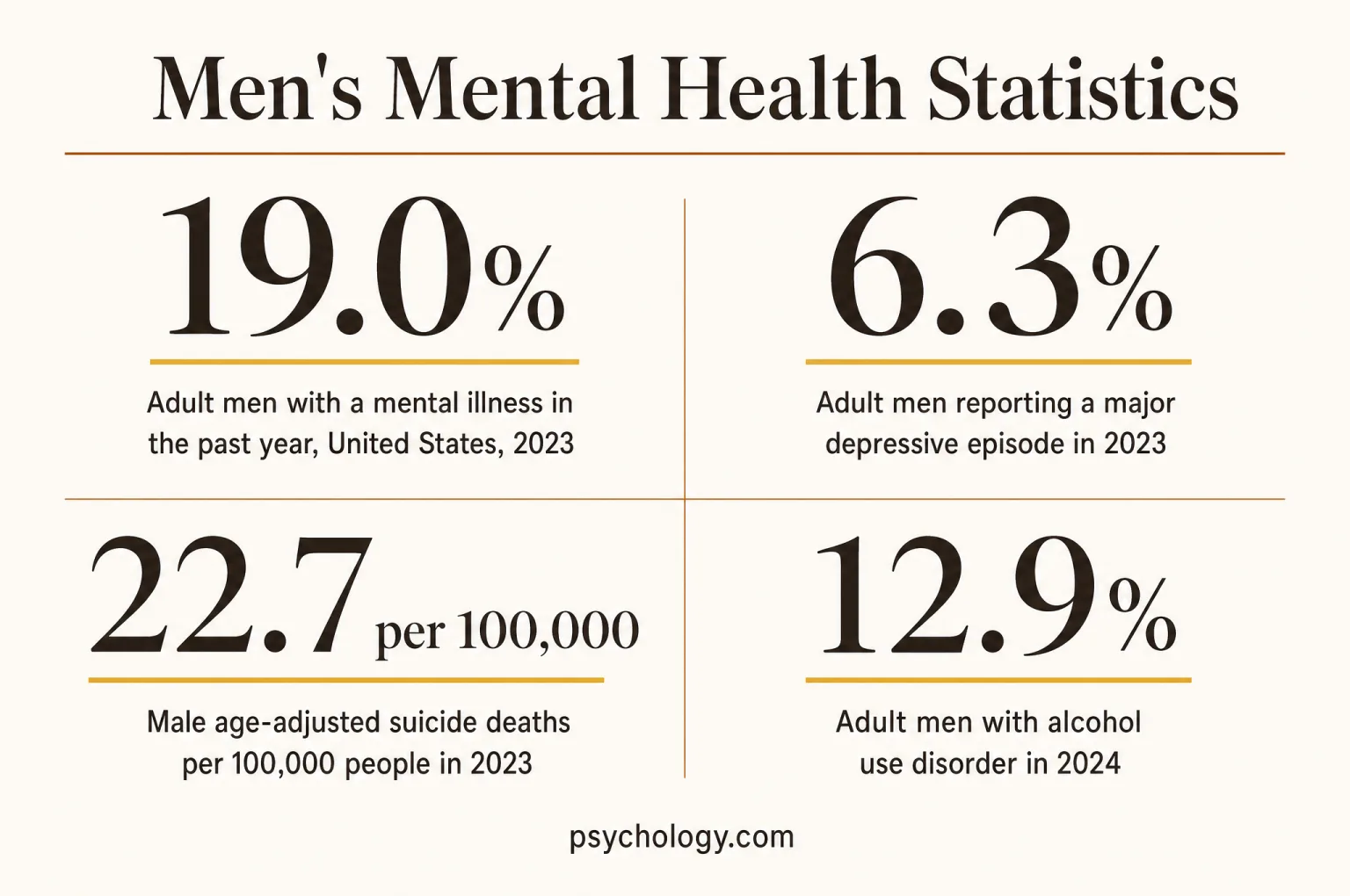
How common mental health conditions are in men
Mental health conditions affect men across ages and circumstances. Broad illness estimates include several diagnoses, while condition-specific surveys use narrower questions and reference periods. Studies of fathers, veterans, students and people in custody describe particular populations. Their results help identify care needs without defining any man's identity or future.
Adult men with a mental illness in the past year, United States, 2023
SAMHSA estimated past-year any mental illness in 19.0% of men aged 18 and older. This category covers diagnosable mental, behavioral or emotional disorders and excludes developmental and substance use disorders. The estimate comes from a predictive model applied to survey responses, rather than a clinical examination of every respondent. It represents men living in the civilian, noninstitutionalized population, so it does not fully describe men in hospitals, prisons or unsheltered settings.
- 26.4%Adult women with any mental illness, 2023
The comparable female estimate was 26.4%, using the same past-year framework as the male estimate. That difference describes reported and modeled illness in a household survey; it does not measure which sex experiences greater hardship across every aspect of life.
- 6.3%Adult men with a major depressive episode, 2023
The 6.3% estimate concerns an episode during the previous year, with a defined combination and duration of symptoms. Depression is part of the broader mental-illness category, so adding these percentages would count some of the same people twice.
- 11.1%Males with drug use disorder, 2023
Among males aged 12 and older, 11.1% met the survey's past-year drug-use-disorder definition. This includes adolescents as well as adults and concerns a separate diagnostic category from the any-mental-illness estimate, making the denominators and definitions different.
- 8.75%Depression during the first year of fatherhood
A 2020 international meta-analysis, searching literature through July 1, 2018, pooled postpartum depression prevalence at 8.75% in fathers. Differences in instruments, countries and assessment timing limit how precisely this historical estimate describes fathers in the United States today.
- 6%Lifetime PTSD among male veterans, 2012 to 2013
VA's professional summary attributes the 6% lifetime PTSD estimate among male veterans to NESARC-III, which surveyed U.S. adults in 2012 to 2013. It describes PTSD at some point in life. This historical estimate does not measure current symptoms or all mental health conditions.
VA National Center for PTSD, Epidemiology and Impact of PTSD
- 0.42%Lifetime binge-eating disorder among adult men, 2012 to 2013
A nationally representative U.S. study using 2012 to 2013 NESARC-III interviews estimated lifetime binge-eating disorder at 0.42% and lifetime anorexia nervosa at 0.12% in men. These historical diagnostic estimates establish that eating disorders affect men while leaving current prevalence uncertain.
| Population and measure | Estimate | What the figure describes |
|---|---|---|
| Male high school students, persistent sadness or hopelessness | 27.7% | Past-year symptoms in the 2023 school survey. CDC YRBS, 2023 data |
| Male high school students, frequent poor mental health | 18.8% | Always or most of the time during the previous month in 2023. CDC YRBS |
| Male state prisoners, serious psychological distress | 13.8% | Previous 30 days in the 2016 prison survey. BJS, 2021 report |
| People experiencing homelessness who identified only as a man or boy | 59.6% | Gender composition of the January 2024 count, including children. HUD, 2024 |
Who household surveys can miss
The custody and homelessness figures highlight differences in population coverage. A prison survey measures people inside institutions, while the national household survey generally excludes them. HUD's point-in-time count records people staying in shelters and unsheltered locations on a particular night; its male share is a demographic measure and does not establish how many have a mental illness. Experiences of unstable housing, detention and illness can overlap without being interchangeable. Reports also use different sex and gender questions, which limits direct comparisons across these sources.
Psychology.com's men's issues resources provide background on the concerns represented here, including the relationships and circumstances that population averages cannot fully describe.
Depression and anxiety in men
Depression statistics answer different questions depending on whether researchers count a past-year episode, symptoms during recent weeks or a previous diagnosis. Anxiety measures vary in the same way. Men generally report lower prevalence than women in these surveys, while the male estimates still describe a sizeable group experiencing difficulties.
Adult men reporting a major depressive episode in 2023
The 2023 NSDUH estimated past-year major depressive episodes in 6.3% of men and 10.5% of women aged 18 and older. This estimate can include people whose episode had ended before their interview. CDC's symptom surveys take a shorter view, asking about recent weeks. A lower figure in an annual episode measure than in a recent symptom measure is possible because the diagnostic thresholds differ. These measures capture related aspects of depression and should be read with their definitions attached.
- 10.5%Major depressive episodes in adult women, 2023
The female estimate was 10.5% under the same NSDUH definition. Comparing men and women within this survey avoids the mismatch that would result from using a different screening tool or age range for either group.
- 10.1%Males meeting the NHANES depression threshold
During August 2021 to August 2023, 10.1% of males aged 12 and older scored at or above the report's depression threshold. This recent-symptom measure includes adolescents, and screening classification does not require an earlier professional diagnosis.
- 16.0%Females meeting the same NHANES threshold
The comparable estimate was 16.0% for females aged 12 and older during August 2021 to August 2023. Both figures use the same questionnaire and observation window, making this a more meaningful comparison than combining results from separate surveys.
- 14.3%Depression symptoms among males aged 20 to 39
NHANES estimated 14.3% in this age group during August 2021 to August 2023. The report did not find a statistically significant difference between males and females within this age band, despite an overall sex difference across all ages.
- 14.8%Adult men with anxiety symptoms in 2022
In the 2022 National Health Interview Survey, 14.8% of men reported at least mild anxiety symptoms over the previous two weeks. Including mild symptoms makes this measure broader than a count of diagnosed anxiety disorders.
- 18.0%Adult men with depression symptoms in 2022
The same NHIS report classified 18.0% of men as having at least mild depression symptoms during the previous two weeks. This threshold is broader than the NHANES depression threshold, explaining part of the difference between the estimates.
| Severity | Anxiety symptoms | Depression symptoms |
|---|---|---|
| Mild | 9.7% | 12.2% |
| Moderate | 3.1% | 3.7% |
| Severe | 2.0% | 2.1% |
Source: Terlizzi and Zablotsky, 2024, NHIS severity tables. These are percentages of all adult men, divided into mutually exclusive severity categories within each condition. A person can appear in both the anxiety and depression columns, so the columns cannot be added to estimate the number experiencing either condition.
Depression, body image and family life
Men's distress can appear in contexts that receive less attention in broad prevalence tables, including becoming a father and concerns about food or body image. The historical paternal-depression estimate and eating-disorder estimates above describe specific research questions; they cannot determine whether an individual experience fits a diagnosis. Symptom measures also differ in whether and how they capture impairment. Someone can report a difficult period without crossing a survey threshold, while another person can cross that threshold without having accessed care.
Psychology.com's depression questionnaire provides a separate self-report resource; an individual score and a population prevalence estimate serve different purposes.
The anxiety questionnaire is a related self-report resource for readers exploring anxiety symptoms. The daily diary card offers space to record observations over time; neither resource turns a population estimate into an individual diagnosis.
Suicide and the male mortality gap
Men account for a large share of suicide deaths, and the difference from women persists across national mortality records. Suicide is preventable, and these population rates do not predict an individual's future. Age-specific rates help describe where prevention and support need attention without reducing a death to a single cause.
Male age-adjusted suicide deaths per 100,000 people in 2023
CDC's final 2023 data give a male rate of 22.7 and a female rate of 5.9 per 100,000, making the male rate close to four times the female rate; CDC describes the male rate as three to four times the female rate across the period it examined. These rates adjust for age using a standard population, allowing a fairer comparison when age distributions differ. They are distinct from counts of deaths, reports of suicidal thoughts and attempts. The gap is a population finding that calls for prevention, accessible support and attention to the circumstances of men's lives; it cannot identify which person will experience a crisis.
- 5.9 per 100,000Female age-adjusted suicide rate, 2023
The corresponding female rate was 5.9 deaths per 100,000. Both sex-specific rates use the same standard population and year, so the difference is not simply a reflection of men and women having different age distributions.
- 39,046Male suicide deaths recorded in 2023
CDC recorded 39,046 male deaths by suicide. A count conveys the number of lives lost and families affected, while a rate accounts for population size; neither establishes the personal circumstances behind every death.
- 29.8 per 100,000Men aged 25 to 44, suicide rate in 2023
The rate was 29.8 per 100,000 men in this age group. This age-specific figure describes a narrower population than the overall age-adjusted rate and supports attention to prevention throughout early and middle adulthood.
- 29.2 per 100,000Men aged 45 to 64, suicide rate in 2023
The rate was 29.2 per 100,000. Midlife remains important in prevention research, but mortality records alone cannot separate the roles of health, relationships, finances, substance use and access to support in any individual death.
- 40.7 per 100,000Men aged 75 and older, suicide rate in 2023
At 40.7 per 100,000, this group had the highest rate among the male age groups in the CDC report. A higher group rate does not make suicide an expected part of aging; preventable harm deserves attention in later life too.
- 14.1%Male students reporting serious suicidal consideration, 2023
In YRBS, 14.1% of male high school students said they had seriously considered attempting suicide during the previous year. This is a self-reported experience among students attending school, a different outcome and population from death-certificate data.
CDC, Mental health and suicide risk among high school students
| Age group | Deaths per 100,000 | Source |
|---|---|---|
| 15 to 24 | 21.2 | CDC final mortality data |
| 65 to 74 | 26.5 | CDC final mortality data |
| 75 and older | 40.7 | CDC final mortality data |
Interpreting a preventable outcome
A rate describes deaths recorded across a population during a year. It does not mean the same percentage of men who experience depression, unemployment or loneliness will die by suicide. Survey measures of distress and mortality records also capture different people at different times. They cannot be combined to assign a single explanation to the male mortality gap. The prevention context matters whenever these figures are reused: suicide is preventable, support is available, and a history of difficulty does not determine the future.
Substance use and deaths of despair
Substance use disorders form a significant part of men's mental health picture. Alcohol-use-disorder prevalence, drug-use-disorder prevalence and overdose mortality measure different outcomes. Recent mortality data show improvement, alongside a continuing male disadvantage. The historical term 'deaths of despair' groups several causes of death; it is not a psychiatric diagnosis.
Adult men with alcohol use disorder in 2024
NIAAA's summary of the 2024 NSDUH reports alcohol use disorder in 12.9% of men aged 18 and older, compared with 8.0% of women. AUD is defined by a pattern of symptoms and consequences, rather than alcohol use alone. The adult-only estimates differ from those for everyone aged 12 and older because including adolescents changes the denominator. Alcohol and drug use disorders can overlap, so their prevalence figures should not be added to produce a total number of affected men.
- 16.7 millionMales aged 12 and older with alcohol use disorder, 2024
The estimated count was 16.7 million. This population includes boys as well as men, and the count covers past-year AUD of differing severity rather than only people receiving treatment.
- 11.8%Past-year AUD among males aged 12 and older, 2024
The prevalence estimate was 11.8%. Keeping the age range visible prevents confusion with the higher adult-only male percentage presented above; both estimates come from the same survey year.
- 7.6%Past-year AUD among females aged 12 and older, 2024
The comparable female estimate was 7.6%. This comparison uses the same minimum age and definition as the male estimate, making the sex difference interpretable within this survey.
- 8.0%Past-year AUD among adult women, 2024
NIAAA reports 8.0% among women aged 18 and older. The adult comparison indicates a male excess in AUD prevalence, while leaving considerable variation within both populations.
- 11.1%Past-year drug use disorder among males, 2023
SAMHSA estimated 11.1% among males aged 12 and older. The diagnostic measure covers drug-related disorder, rather than the broader category of everyone who used a drug during the year.
- 8.1%Past-year drug use disorder among females, 2023
The matching female estimate was 8.1%. It uses the same reference period and age range as the male estimate; neither percentage indicates how many people subsequently experienced an overdose.
What deaths-of-despair research established
Case and Deaton's 2017 analysis examined historical changes in mortality across sex, education and racial groups. For White non-Hispanic men aged 45 to 54, age-adjusted all-cause mortality increased by 9 per 100,000 between 1998 and 2015. That is a specific historical comparison, rather than a current rate for all men. Their work considered suicide, drug-related deaths and alcohol-related liver mortality alongside other causes, and did not establish a single economic explanation for every death. Overdose deaths are preventable; the recent decline shows that mortality patterns can improve even while substantial harm remains. Case and Deaton, 2017.
Help-seeking, stigma and the treatment gap
Receiving care involves more than deciding to ask for help. Surveys capture willingness, previous treatment, current use of services and the availability of professionals. These measures consistently show gaps for men, although they do not explain every barrier. Cost, service design, personal preferences and stigma require different kinds of evidence.
Men with a mental illness who received treatment in 2023
Among adult men with past-year any mental illness, 45.9% received mental health treatment in the 2023 NSDUH. The measure includes several forms of care, including counseling, medication and telehealth. It does not show that everyone counted received a sufficient course of care or that everyone outside the count wanted the same service. The female estimate was 59.3% under the same definition. This comparison identifies a gap in receipt of care among people with measured illness, rather than simply comparing all men with all women.
- 59.3%Women with any mental illness receiving treatment, 2023
The 59.3% female treatment estimate is higher than the corresponding male estimate. These are percentages within each group of people with AMI, rather than the share of all treatment appointments accounted for by women or men.
- 65%Men hesitant to seek professional mental health help
Cleveland Clinic's 2023 MENtion It survey of 1,000 U.S. men aged 18 and older, fielded June 1 to 13, 2023, found 65% were hesitant about professional help for concerns such as stress, anxiety and depression. This commissioned online poll measures an attitude, rather than observed avoidance of an appointment.
- 44%Men reporting they do not take care of their mental health
In the same 2023 survey, 44% gave this response. The wording captures men's own assessment of their habits and priorities; it is broader than a measure of whether they received therapy.
- 33.2%Males with depression receiving counseling or therapy
NHANES found 33.2% among males aged 12 and older with depression during August 2021 to August 2023. The question concerned counseling or therapy in the previous year, so it is narrower than the NSDUH treatment measure.
- 43.0%Females with depression receiving counseling or therapy
The comparable NHANES estimate was 43.0%. Both groups met the same recent-symptom threshold, but the survey does not establish whether their reported counseling specifically addressed depression.
- 28%Male share of the U.S. psychologist workforce, 2023
APA Division 51's Mirror Initiative labels its U.S. psychologist gender breakdown as 2023 and reports a male share of 28%, citing APA's Center for Workforce Studies. This is the year assigned to the estimate by the source. The estimate covers psychologists, rather than every profession that provides therapy.
- 66%Men who had sought or would seek professional mental health support, 2025
Cleveland Clinic’s survey combines previous help-seeking with willingness to seek help, so it cannot establish treatment receipt or a change from its differently worded 2023 hesitation question.
- 16% vs 22%Men versus women likely to turn to a mental health professional, 2024
Pew asked whether respondents would be extremely or very likely to turn to a professional for emotional support if needed; this threshold describes stated preference rather than actual service use.
| Population | Received treatment | Source |
|---|---|---|
| Men | 41.6% | NIMH, 2022 NSDUH |
| Women | 56.9% | NIMH, 2022 NSDUH |
| All adults | 50.6% | NIMH, 2022 NSDUH |
What voluntary screening tells us
Mental Health America reports that 349,057 men used its screening program in 2025, and that three out of four male screeners scored at risk for a mental health condition. People choosing an online screen are a self-selected group, so this result cannot estimate prevalence among all men. It does show that many men actively seek information about their mental health. Workforce representation is another distinct issue: the proportion of male psychologists does not establish that a man requires a male therapist or that matching by sex improves outcomes. MHA male screening results.
People exploring professional support can use Psychology.com to find a licensed therapist and read about areas of practice. A survey percentage cannot identify which professional, service or form of support will fit a particular person, and preferences vary within the male population.
Loneliness, friendship and work
Friendship counts, emotional support and loneliness are related but distinct. A man can have several friends and still feel unsupported, or have a small circle that meets his needs. Work can provide social contact as well as pressure, making employment changes relevant to connection and mental health without explaining every difficulty.
Men reporting no close friendships in the 2021 U.S. survey
The Survey Center on American Life reported that 15% of men had no close friendships in May 2021. This finding remains widely cited, but it is a pandemic-period observation rather than a measurement of men in 2026. 'Close friend' depended on respondents' own understanding. The center also compared its findings with an earlier telephone survey; differences in interview mode may affect how readily people report having few friends. The result identifies a gap in connection without implying that every man in that group felt lonely.
Survey Center on American Life, Men’s Social Circles are Shrinking
- 27%Men with six or more close friends, 2021
The survey found 27%, compared with 55% in the 1990 comparison survey. These were different samples interviewed using different methods, so the decline is not a direct account of individual men losing friendships.
Survey Center on American Life, Men’s Social Circles are Shrinking
- 21%Men receiving emotional support from a friend, 2021
Only 21% reported receiving such support during the previous week. This measure concerns a recent exchange, which may depend on whether someone needed support that week as well as whether a friend was available.
Survey Center on American Life, State of American Friendship
- 30%Men sharing personal feelings with a friend, 2021
The estimate was 30% during the previous week. A private conversation is one form of connection; the question does not capture every way men express care or maintain friendships.
Survey Center on American Life, State of American Friendship
- 48%Men satisfied with the number of friends they had, 2021
The share who were very or completely satisfied was 48%. Satisfaction adds information beyond a simple friend count because people differ in the size and kind of social circle they want.
Survey Center on American Life, State of American Friendship
- 54%Adults who met a close friend through work, 2021
Among adults with close friends, 54% had met one at their own or their spouse's workplace. This is an all-adult estimate, illustrating the social role of work without establishing a male-specific percentage.
Survey Center on American Life, State of American Friendship
- 0.19Mental health symptoms associated with unemployment
A 2025 review of longitudinal studies from 1990 to 2024 found a standardized mean difference of 0.19 between unemployed and regularly employed adults. This small pooled difference covers both sexes, and the authors rated the evidence as low certainty.
- 38% vs 54%Men versus women likely to turn to a friend for emotional support, 2024
In Pew’s survey conducted from September 3, 2024 through September 15, 2024, these shares were extremely or very likely to turn to a friend, distinguishing support preferences from friendship counts.
- 86%Men reporting stress, anxiety or mental exhaustion in a typical week, 2025
Cleveland Clinic’s combined question describes a broad experience of strain; it cannot estimate the prevalence of diagnosed anxiety or be directly compared with the 2023 question about stress over six months.
Stress and changes in daily connection
Cleveland Clinic's 2023 survey found that 83% of men had experienced stress during the previous six months. That broad question can include ordinary pressures as well as more persistent difficulties. It does not establish how much stress came from work, friendship or family responsibilities. The employment review found substantial variation between studies, so its pooled association cannot forecast the effect of a particular job loss. Friendship findings likewise describe patterns across respondents rather than a prescription for an ideal social circle. Cleveland Clinic, 2023.
Psychology.com's loneliness questionnaire addresses the experience of disconnection separately from the number of friends someone reports.
For readers interested in recording pressures from work, relationships and daily life, the stress diary provides a structured place for personal observations. Such a record describes one person’s experiences and has a different purpose from a national survey of how often people report stress.
Pew’s newer survey also found broadly similar reported loneliness and close-friend availability among men and women, alongside differences in who they would approach for support. That finding prevents interpreting the older male friendship statistic as evidence that men are invariably lonelier than women. Pew’s survey report describes the question wording and sampling methods.
Trends 2019 to 2026
Recent indicators move in different directions. Male life expectancy rose and overdose mortality fell in the latest final data included here, while earlier symptom surveys recorded increased distress. Full-year results for 2026 are not yet available. Each trend therefore ends at the latest observation in the relevant source, rather than at the edition year.
Male life expectancy at birth in the final 2024 data
CDC reports male life expectancy at 76.5 years in 2024, up from 75.8 in 2023. This is a period life-table estimate based on mortality rates for that year, rather than a prediction of an individual man's lifespan. It reflects deaths from all causes, so the increase cannot be assigned to mental health care alone. Suicide and overdose contribute to the broader mortality picture alongside physical illnesses and other injuries. The final report was released on January 29, 2026.
- 75.8 yearsMale life expectancy at birth, 2023
The final estimate was 75.8 years. This provides the immediately preceding comparison for the 2024 figure and replaces provisional estimates that may use incomplete death records.
- 81.1 yearsFemale life expectancy at birth, 2023
The female estimate was 81.1 years in the same final report. Comparing both sexes within one year's life tables keeps the mortality period and calculation method aligned.
- 5.3 yearsFemale advantage in life expectancy, 2023
The gap was 5.3 years. This difference summarizes all-cause mortality patterns across the lifespan and does not estimate how many years are attributable specifically to mental illness.
- 4.9 yearsFemale advantage in life expectancy, 2024
The gap narrowed to 4.9 years. A smaller gap can coexist with continuing disadvantages for particular male age groups or communities, which a national average cannot fully display.
- 27.3%Decrease in male overdose mortality, 2023 to 2024
The age-adjusted male overdose death rate decreased by 27.3%. These final records document improvement in a preventable outcome without identifying how much of the change came from any particular policy or intervention.
- 15.0%Adult men with depression symptoms in 2019
NHIS recorded 15.0% with at least mild symptoms, compared with 18.0% in 2022. The report identifies a significant increase, using the same recent-symptom framework; it does not establish that the increase continued after 2022.
CDC NCHS, Symptoms of anxiety and depression among adults, Table 2
Young men and the online environment
Movember's 2025 report surveyed young men aged 16 to 25 in Australia, the United Kingdom and the United States between May and July 2024. It found that 63% watched men-and-masculinity influencers, while 27% of viewers reported feelings of worthlessness, compared with 23% of young men who were not following these influencers. These are pooled multinational survey results, rather than estimates for all U.S. men. The association cannot establish that viewing caused the reported feelings, since men with existing difficulties may seek particular content. It also does not establish that every kind of fitness, relationship or identity content has the same relationship with health. Movember findings; full report and survey methods.
Common questions
How common are mental health conditions in men?
SAMHSA's 2023 survey estimated that 19.0% of U.S. adult men had a mental illness during the previous year. That broad category excludes substance use and developmental disorders. Condition-specific figures answer narrower questions: 6.3% of adult men had a major depressive episode in the same survey. These categories overlap, so their percentages cannot be added. The survey covers the civilian, noninstitutionalized population and does not fully represent men living in prisons, hospitals or unsheltered settings. SAMHSA, 2023 data.
Are men less likely than women to receive mental health treatment?
Yes, in the 2023 NSDUH, 45.9% of men with a mental illness received treatment, compared with 59.3% of women. The measure includes multiple forms of mental health care and does not show whether treatment was sufficient for each person. Cleveland Clinic separately found that 65% of men in its 2023 survey were hesitant about seeking professional mental health help. An attitude survey and a treatment-receipt survey measure different parts of access. SAMHSA; Cleveland Clinic.
Why do depression estimates differ across surveys?
Surveys differ in age coverage, reference period and the threshold used to identify depression. NSDUH estimated past-year major depressive episodes in 6.3% of adult men in 2023. NHANES found a 10.1% recent-symptom prevalence among males aged 12 and older during August 2021 to August 2023. NHIS includes mild symptoms in its broader symptom measure. These differences prevent a simple ranking of the estimates or an interpretation that their differences represent a change over time. CDC NHANES.
Do the friendship statistics show that most men are lonely?
The widely cited 15% figure describes men reporting no close friendships in a 2021 U.S. survey. It does not measure the percentage of all men who feel lonely, and it is not a current 2026 estimate. The same research program asked separately about satisfaction with friendships and recent emotional support. Those questions help explain why counting friends alone gives an incomplete picture: a small circle may feel supportive, while a larger circle may still leave someone disconnected. Survey Center on American Life.
Can fathers experience postpartum depression?
Yes. A 2020 international meta-analysis estimated depression prevalence at 8.75% during the first postpartum year among fathers. The review searched studies available through July 1, 2018, and the included populations and measurement methods varied. It provides a historical pooled estimate rather than a precise current rate for U.S. fathers. The finding establishes that the transition to parenthood can involve significant mental health difficulties for fathers as well as mothers, without predicting the experience of a particular family. Rao and colleagues.
What do the suicide statistics mean for someone worried about a man in their life?
The male suicide rate was close to four times the female rate in the final 2023 U.S. data (22.7 compared with 5.9 per 100,000), but population averages cannot determine an individual's future or explain a crisis on their own. Suicide is preventable, and support is available. In the United States, anyone experiencing a suicidal crisis or concerned about someone else can call or text 988 to reach the Suicide and Crisis Lifeline. The figures describe a public health concern rather than an inevitable outcome. CDC final data.
How we compiled this
Figures were checked against original federal reports, research abstracts and survey publishers on September 13, 2026. Data years differ from publication years and are retained in the text. Nationally representative household surveys, mortality records, voluntary screening programs and commissioned polls are identified separately. Archived SAMHSA tables preserve the original source when direct access is unavailable. Eating-disorder and paternal-depression estimates retain their historical definitions and study periods. Percentages use each source's denominator; death rates specify adjustment and population. Associations from observational research are not treated as proof of causation. Conflicting figures within NIMH's serious-mental-illness summary were excluded. The title identifies this edition, rather than claiming complete data for 2026. Source pages were fetched again on September 16, 2026. New Pew figures retain the 2024 fieldwork year, while the Cleveland Clinic additions use 2025 fieldwork. Their different questions and response thresholds prevent treating willingness, hesitation and treatment receipt as a single time series. Newly located SAMHSA tables and several CDC pages could not be retrieved in this pass, so their existing estimates retain the original observation years. Last full review: September 16, 2026.
Journalists and researchers may reuse any statistic with attribution to the original source and a link to Psychology.com.
Cite this source
Fontane Pennock, S. (2026, September 13). Men's Mental Health Statistics 2026. Psychology.com. https://psychology.com/mens-mental-health-statistics/
References
- Substance Abuse and Mental Health Services Administration. (2024). 2023 NSDUH detailed tables: 5.4B, 6.1B, 6.21B and 6.37B. Official report
- National Institute of Mental Health. (n.d.). Mental illness: 2022 NSDUH prevalence and treatment estimates. NIMH
- Brody, D. J., & Hughes, J. P. (2025). Depression prevalence in adolescents and adults: August 2021 to August 2023. NCHS Data Brief 527. CDC
- Terlizzi, E. P., & Zablotsky, B. (2024). Symptoms of anxiety and depression among adults: United States, 2019 and 2022. National Health Statistics Reports 213. CDC
- Garnett, M. F., & Zehner, A. M. (2025). Changes in suicide rates in the United States from 2022 to 2023. NCHS Data Brief 541. CDC
- Centers for Disease Control and Prevention. (2024). Mental health and suicide risk among high school students and protective factors: YRBS, 2023. MMWR. CDC
- National Institute on Alcohol Abuse and Alcoholism. (2025). Alcohol use disorder in the United States: Age groups and demographic characteristics. NIAAA
- Garnett, M. F., & Miniño, A. M. (2026). Drug overdose deaths in the United States, 2023 to 2024. NCHS Data Brief 549. CDC
- National Center for Health Statistics. (2024). Mortality in the United States, 2023. Data Brief 521. CDC
- National Center for Health Statistics. (2026). Mortality in the United States, 2024. Data Brief 548. CDC
- Cleveland Clinic. (September 6, 2023). Cleveland Clinic survey examines the current state of men's health in America. Survey release
- Cox, D. A. (June 8, 2021). The state of American friendship: Change, challenges, and loss. Survey Center on American Life. Original survey
- Cox, D. A. (June 29, 2021). Men's social circles are shrinking. Survey Center on American Life. Sex-specific findings
- Mental Health America. (n.d.). Harry's partnership: Male screening results for 2025. Program data
- Movember. (2025). Young men's health in a digital world: Findings from the 2024 survey. Report findings
- Udo, T., & Grilo, C. M. (2018). Prevalence and correlates of DSM-5 eating disorders in a nationally representative sample of U.S. adults. Biological Psychiatry, 84, 345-354. Udo and Grilo, Biological Psychiatry, 2018
- VA National Center for PTSD. (n.d.). Epidemiology and impact of PTSD: NESARC-III, 2012 to 2013. VA
- Maruschak, L. M., Bronson, J., & Alper, M. (2021). Indicators of mental health problems and treatment reported by prisoners: Survey of Prison Inmates, 2016. BJS report
- de Sousa, T., & Henry, M. (2024). The 2024 Annual Homelessness Assessment Report to Congress, Part 1. Appendix B. HUD report
- APA Division 51. (n.d.). The Mirror Initiative: More male psychologists, better care for men. Workforce summary
- Case, A., & Deaton, A. (2017). Mortality and morbidity in the 21st century. Brookings Papers on Economic Activity. PMC full text
- Rao, W.-W., et al. (2020). Prevalence of prenatal and postpartum depression in fathers: A comprehensive meta-analysis of observational surveys. Journal of Affective Disorders, 263, 491-499. NCBI abstract
- Sterud, T., et al. (2025). Mental health effects of unemployment and re-employment: A systematic review and meta-analysis of longitudinal studies. Occupational and Environmental Medicine, 82, 343-353. NCBI abstract
- Goddard, I., & Parker, K. (January 16, 2025). Men, women and social connections. U.S. survey conducted from September 3, 2024 through September 15, 2024. Pew Research Center.
- Cleveland Clinic. (September 3, 2025). MENtion It survey findings on mental health, exercise and help-seeking. Online fieldwork from June 3, 2025 through June 5, 2025. Publisher survey release.
More statistics and related pages
Talk it through with a licensed therapist
Psychology.com's therapist directory includes professionals who work with concerns involving mood, relationships, stress and substance use. Profiles describe each therapist's practice and areas of focus.
This page is educational information, not a diagnosis or a substitute for professional care. If you are in crisis, call or text 988 (U.S. Suicide & Crisis Lifeline), any time.