
 By
By Reviewed by
NIMH reports that 1.2% of U.S. adults had OCD in the preceding year and 2.3% had experienced it during their lives, based on the 2001 to 2003 National Comorbidity Survey Replication. These historical estimates distinguish a diagnosis from occasionally experiencing an unwanted thought or repetitive behavior. Sources were checked again on September 16, 2026. The research below distinguishes symptom improvement from remission and treatment documentation from access to care; population statistics do not establish an individual diagnosis.
Last full review: September 16, 2026 · sourced from NIMH, the IOCDF, WHO, national registers and peer-reviewed research.
Ten numbers that define OCD in 2026
- NIMH reports that 2.3% of U.S. adults had lifetime OCD and 1.2% had past-year OCD in the 2001 to 2003 National Comorbidity Survey Replication (NCS-R). NIMH (NCS-R, 2001 to 2003 data)
- The International OCD Foundation’s overview, accessed September 16, 2026, describes lifetime OCD as affecting about 1 in 40 adults. IOCDF, Who gets OCD? (accessed September 16, 2026)
- NIMH reports that in the 2001 to 2003 U.S. NCS-R, past-year OCD was more than three times as common in women (1.8%) as in men (0.5%). NIMH (NCS-R)
- Ruscio and colleagues’ 2010 NCS-R report found that the mean age of onset in the U.S. NCS-R was 19.5 years; nearly a quarter of affected males reported onset before age 10. Ruscio et al., 2010
- Ruscio and colleagues’ 2010 NCS-R report found that 90% of U.S. NCS-R respondents with lifetime OCD met criteria for another lifetime mental disorder, including an anxiety disorder in 75.8%. Ruscio et al., 2010
- Ruscio and colleagues’ 2010 analysis of the U.S. NCS-R found that 65.3% of past-year OCD cases reported severe role impairment; past-year cases averaged 45.7 days unable to carry out normal activities. Ruscio et al., 2010
- Among 100 German outpatients in a 2021 PLOS One study, the reported mean delay was 12.78 years from symptoms to diagnosis and 1.45 years from diagnosis to treatment. PLOS One, 2021
- Ruscio and colleagues’ 2010 NCS-R report found that 30.9% of severe past-year OCD cases received OCD-specific care that year, while 93.0% received some mental health treatment. Ruscio et al., 2010
- In Feusner and colleagues’ 2022 JMIR observational study of 3,552 adults receiving video ERP, mean symptom scores fell 43.4% and 62.9% met response criteria, with a mean 10.6 therapist hours. Feusner et al., JMIR 2022
- The 2024 BMJ study by Isomura and colleagues found that a Swedish cohort of people diagnosed with OCD had an 82% higher adjusted hazard of death than matched peers (HR 1.82); both natural and unnatural causes were elevated. Isomura et al., BMJ 2024
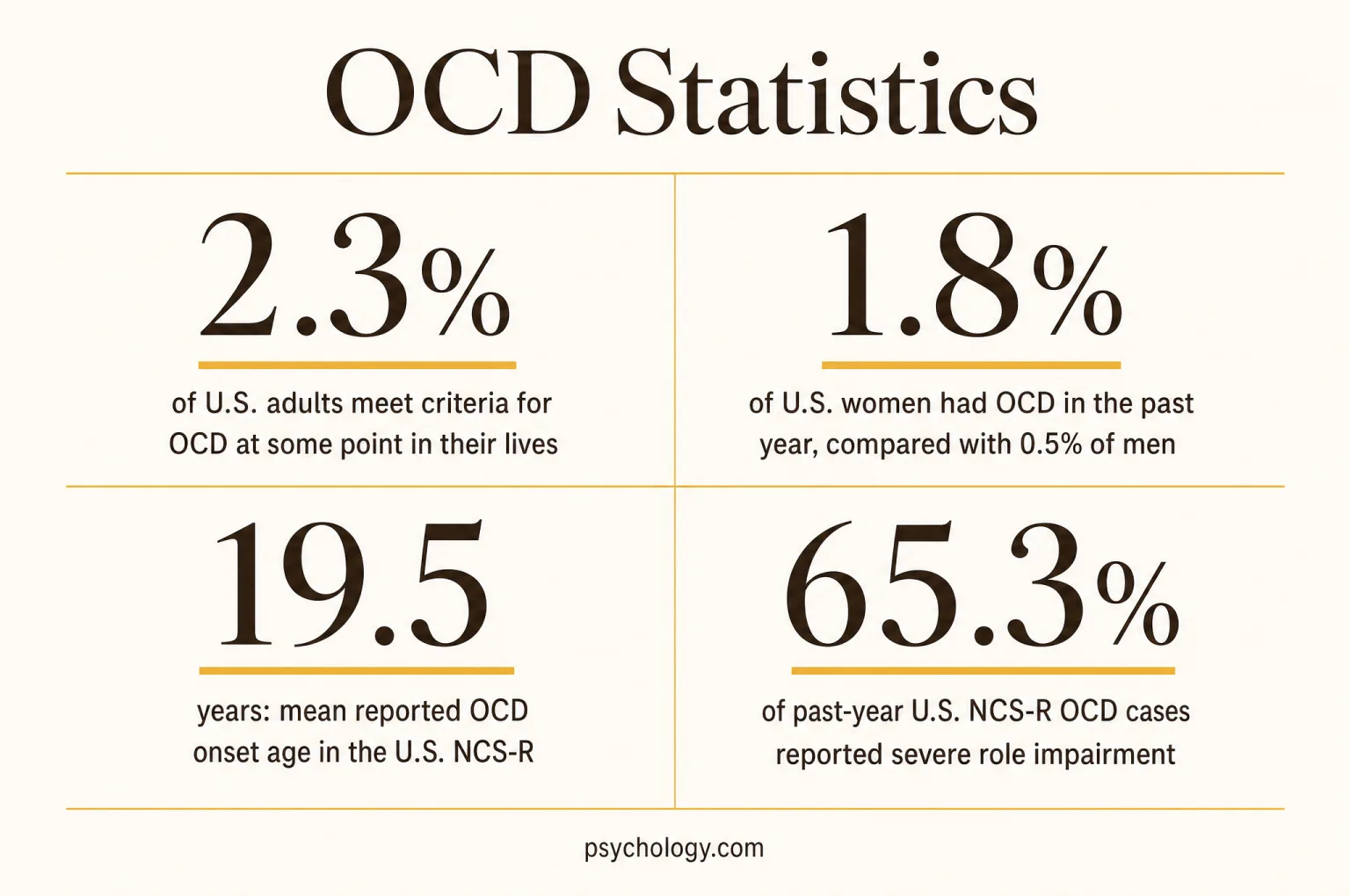
How common OCD is
The U.S. estimates most often cited by NIMH come from interviews conducted between 2001 and 2003. Worldwide reviews produce different estimates depending on the populations, diagnostic criteria and time periods included. Lifetime prevalence includes any qualifying episode before assessment; past-year prevalence describes the preceding 12 months.
of U.S. adults meet criteria for OCD at some point in their lives
NIMH reports a lifetime prevalence of 2.3% from the NCS-R, conducted between 2001 and 2003. Past-year prevalence was 1.2%. These estimates describe adults interviewed in that survey; they are not a count of current U.S. cases or evidence that the same proportion has remained constant since then.
- 1.2%U.S. adults with OCD in the past year
The 2001 to 2003 NCS-R estimate is about 1 in 83 adults; NIMH classified 50.6% of past-year cases as seriously impaired.
- 1 in 40Adults who have OCD or will develop it
The IOCDF presents this as an approximate lifetime estimate. Its underlying NCS-R source reports 2.3%; it should not be interpreted as current prevalence.
- 28.2%Adults who have ever had obsessions or compulsions
In the 2001 to 2003 NCS-R, this included respondents with and without OCD. Checking (15.4%), hoarding (14.4%) and ordering (9.1%) were common reported symptoms.
- 1.3%Pooled lifetime prevalence worldwide
A 2020 review of 34 adult community studies reported pooled current, period and lifetime estimates of 1.1%, 0.8% and 1.3%, respectively; different study sets contributed to each measure.
- 3.21%Modeled global lifetime prevalence under DSM-5
Published July 8, 2026, the review included 112 studies across OCD and related disorders. Modeled OCD lifetime estimates were 2.28% under DSM-IV, 2.57% under ICD-10 and 3.21% under DSM-5.
- 1.1%One-month prevalence in Great Britain (2000 survey)
From 8,580 adults in the British National Psychiatric Morbidity Survey; 55% of cases had obsessions only.
- 2.2%Adults in England meeting survey criteria for past-week OCD, 2023 to 2024
NHS England’s APMS used the CIS-R interview in adults aged 16 and over; its 95% confidence interval was 1.7% to 2.8%. This past-week estimate uses a different geography and reference period from the historical U.S. figures.
Why the estimates disagree
Diagnostic definitions are one reason prevalence estimates differ, alongside sampling, interview methods, age composition and statistical uncertainty. The 2026 model estimated lifetime OCD across all ages, whereas the 2020 review summarized adult community studies. The 28.2% NCS-R symptom figure includes both people who met OCD criteria and those who did not. Symptoms alone therefore do not establish the diagnosis.
The OCD test is a screening resource for organizing experiences. A clinical assessment also considers distress, interference and other possible explanations. A screening result and a survey prevalence estimate have different purposes; neither can determine a diagnosis on its own.
Who OCD affects
Adult population studies generally find higher OCD prevalence among women, while very early onset cases often include more boys. Childhood and adulthood estimates come from different samples and assessment methods. Family and twin studies also find a genetic contribution to variation in OCD susceptibility, alongside environmental influences.
of U.S. women had OCD in the past year, compared with 0.5% of men
In the 2001 to 2003 U.S. NCS-R, past-year prevalence was 1.8% in women and 0.5% in men. A separate analysis of lifetime onset found an odds ratio of 2.1 for women compared with men. These are different measures: an odds ratio is not the same as the ratio of prevalence percentages.
- 1.6xWomen are 1.6 times more likely than men to have OCD
The 2020 meta-analysis of 34 adult community studies reported lifetime estimates of 1.5% in women and 1.0% in men; its modeled comparison was approximately 1.6 times.
- Nearly 1 in 4Males with OCD who had onset before age 10
In the 2001 to 2003 U.S. NCS-R, males predominated among very early cases and females accumulated cases fastest in adolescence; few recalled onset after the early 30s.
- At least 1 in 100Kids and teens with OCD
The IOCDF gives this approximate estimate for children and adolescents. Its overview describes common onset periods at ages 7 to 12 and in the late teens or early adulthood.
- 0.25%UK children aged 5 to 15 with OCD (1999 survey)
A nationwide assessment of 10,438 children found 25 cases, with prevalence rising exponentially with age.
- 0.84%Danish youth cohort prevalence, summarized in a 2021 review
The review cites a 2015 Danish registry study of more than one million young people. This is cohort prevalence, which is not directly comparable with a one-month survey estimate.
- 47%Heritability of OCD
A 2013 Swedish study identified 24,768 diagnosed people in registers; a separate twin analysis involving 16,383 twins estimated 47% heritability (95% CI 42% to 52%).
- 5.7%People aged 16 to 24 in England meeting past-week OCD criteria, 2023 to 2024
APMS reported a 95% confidence interval of 3.3% to 9.6% for this age group. The wide interval signals uncertainty around the estimate; it does not describe the prevalence among younger children.
| Group | Rate | Source |
|---|---|---|
| U.S. women, past year | 1.8% | NIMH (NCS-R) |
| U.S. men, past year | 0.5% | NIMH (NCS-R) |
| Women worldwide, lifetime (34 studies) | 1.5% | Fawcett et al. 2020 |
| Men worldwide, lifetime (34 studies) | 1.0% | Fawcett et al. 2020 |
| UK children 5 to 15 (1999) | 0.25% | Heyman et al. 2001 |
| Danish youth, registry cohort (2015; 2021 review) | 0.84% | Frontiers in Psychiatry 2021 |
| U.S. past-year cases with serious impairment | 50.6% | NIMH (NCS-R) |
Genetic research
A Nature Genetics study published May 13, 2025 combined 53,660 OCD cases with 2,044,417 controls of European ancestry and identified 30 independent associated loci and 249 potential effector genes. Case identification varied across cohorts and included self-reported diagnoses. These associations help investigate biology; they do not provide a diagnostic genetic test or determine whether an individual will develop OCD. The 47% twin estimate describes variation in susceptibility within a studied population, rather than the share of any one person’s OCD caused by genes. Strom et al., Nature Genetics 2025. Twin analysis, 2013.
Onset, symptoms and course
OCD often begins before adulthood, but onset ages vary across people and studies. In the U.S. NCS-R, checking was the most frequently reported symptom theme among lifetime cases. Unwanted thoughts can also concern harm, sex, religion or relationships, and some compulsions take place mentally.
years: mean reported OCD onset age in the U.S. NCS-R
The NCS-R, conducted between 2001 and 2003, reported a mean onset age of 19.5 years. Nearly a quarter of affected males recalled onset before age 10, while the steepest accumulation of female cases was during adolescence. Separately, 100 German outpatients in a 2021 study reported mean ages of 18.72 at first symptoms and 31.71 at diagnosis.
- 11 vs 23Mean onset age in early- vs late-onset OCD
A 2011 review using latent-class analyses of nine datasets identified early-onset (mean 11) and later-onset (mean 23) groups; 76% of analyzed cases were classified as early onset.
- 9 to 10Childhood onset peak described in a 2021 review
The review describes a childhood peak around ages 9 to 10 and another in the early 20s. It estimates that about two-thirds of affected youth start between ages 7 and 12.
- 5.9 hHours per day occupied by obsessions in past-year cases
Past-year NCS-R cases separately estimated 5.9 hours occupied by obsessions and 4.6 hours engaging in compulsions each day. These averages should not be added because the experiences can overlap.
- 50.3%Lifetime NCS-R cases also meeting past-year OCD criteria
In the 2001 to 2003 survey, 50.3% of lifetime cases also reported OCD in the preceding 12 months. This cross-sectional ratio does not measure uninterrupted illness or the chance of future recovery.
- 30.7%Past-year cases rated severe on the Y-BOCS
The adapted Y-BOCS classified 65.6% of past-year NCS-R cases as moderate and 3.7% as mild. Poor insight was reported in 29.5% of severe versus 3.3% of moderate cases.
- 26.7Median age at first OCD diagnosis in Sweden
In the 2024 Swedish register study of 61,378 people diagnosed between 1973 and 2020, 26.7 was the median age at first recorded diagnosis, rather than symptom onset.
| Symptom theme | Share of lifetime cases | Source |
|---|---|---|
| Checking | 79.3% | Ruscio et al. 2010, Table 1 |
| Hoarding | 62.3% | Ruscio et al. 2010 |
| Ordering and symmetry | 57.0% | Ruscio et al. 2010 |
| Moral obsessions | 43.0% | Ruscio et al. 2010 |
| Sexual or religious obsessions | 30.2% | Ruscio et al. 2010 |
| Contamination | 25.7% | Ruscio et al. 2010 |
| Harming obsessions | 24.2% | Ruscio et al. 2010 |
| Undiagnosed illness in self or others | 14.3% | Ruscio et al. 2010 |
Respondents could report several themes, so these percentages overlap. The survey used DSM-IV-era definitions, including hoarding symptoms; this is not a prevalence table for the separate diagnosis of hoarding disorder.
Sudden-onset OCD in children: PANDAS and PANS
Acute-onset syndromes require careful definitions. In a 2017 study of 136 pediatric OCD clinic patients, 5% met proposed PANDAS and/or PANS criteria. A separate U.S. primary care record study covering 2017 to 2019, published in 2023, identified 13 cases among 95,498 children aged 3 to 12 and estimated annual PANDAS/PANS incidence at 8.5 per 100,000 (95% CI 5 to 15). The cases had a mean age of 6.0 years, which is not necessarily their age at symptom onset. These estimates apply specifically to proposed acute-onset syndromes within the studied populations. PANS does not require a documented streptococcal trigger, and these observational findings do not show that infection causes ordinary OCD. Pediatric clinic study, 2017; Primary care study, 2023.
The Pure O test is a screening resource for experiences involving intrusive thoughts and mental rituals. The cognitive defusion worksheet offers a format for reflecting on those experiences. They are educational resources, and the treatment results above do not establish outcomes for using a worksheet independently.
Health, disability and economic impact
OCD can interfere with relationships, school, employment and daily activities. Survey measures of impairment, registry measures of mortality and economic models each capture part of that burden. Elevated risks in a study describe groups over a defined period and do not predict what will happen to a particular person.
of past-year U.S. NCS-R OCD cases reported severe role impairment
In the 2001 to 2003 NCS-R, 65.3% of past-year OCD cases reported severe interference in at least one Sheehan Disability Scale domain during their worst month. Across past-year cases, the average was 45.7 days unable to work or perform normal activities. Cases classified as severe on the adapted Y-BOCS averaged 129.4 such days, compared with 4.7 for moderate cases. Symptom severity and role impairment are separate measures.
- HR 1.82Adjusted all-cause mortality hazard ratio in a Swedish cohort
Among 61,378 people diagnosed with OCD between 1973 and 2020, crude mortality was 8.1 per 1,000 person-years versus 5.1 in matched peers. Adjusted hazard ratios were 1.31 for natural and 3.30 for unnatural causes (2024 study).
- HR 16.36Hazard of receiving a disability pension
In Sweden, 16,267 people diagnosed in specialist care at ages 16 to 64 during 2001 to 2013 had adjusted hazard ratios of 16.36 for disability pension, 3.07 for long-term sickness absence and 1.72 for long-term unemployment.
- 13.5%Pooled lifetime prevalence of suicide attempts in OCD
In a 2020 review, 52 of 61 eligible studies contributed the attempt estimate. Separate study subsets estimated current suicidal thoughts at 27.3% and lifetime thoughts at 47.3%. Results varied substantially across studies.
- OR 9.83Unadjusted suicide mortality odds ratio versus matched controls
In 36,788 Swedish patients diagnosed during 1969 to 2013, 545 died by suicide and 4,297 had a recorded attempt. Unadjusted odds ratios were 9.83 and 5.45, respectively; adjustment for comorbidity reduced these associations.
- £5.1BEstimated annual societal cost of OCD in the UK
A 2023 model estimated £378,356,004 in annual NHS costs and £5,095,759,464 from a societal perspective. Lost productivity through absenteeism drove societal costs; presenteeism and caregiver productivity were additional scenarios.
- n = 26,015Participants across 13 quality-of-life studies
A 2016 review found lower quality of life in adults with OCD than healthy controls: moderate effects for global quality of life and large effects in work/social, emotional and family domains.
Interpreting the cost estimates
The 2023 UK model estimated annual care costs of £174 per person with mild OCD, £365 with moderate OCD and £902 with severe OCD. A scenario adding treatment for comorbid depression increased treatment costs by 132%; this is not a measured increase for every individual with depression. A Swedish study published online in 2021 and in a 2023 issue compared 152 children aged 7 to 17 with OCD with 768 controls. It estimated annual costs of €11,941 versus €6,380, an adjusted marginal difference of €5,560 and a national pediatric burden of €94.3 million. Currency, valuation methods and included costs differ, so the country totals should not be directly compared. UK economic model, 2023; Swedish youth cost study.
The mortality studies report associations among people with recorded diagnoses. They do not estimate individual life expectancy or years of life lost. A hazard ratio compares death rates over follow-up after specified adjustments; it is not a percentage reduction in lifespan. Suicide risk has multiple influences, and unwanted intrusive thoughts should not automatically be equated with suicidal intent. Help and effective OCD treatments are available. Mortality study methods; OCD clinical review, 2019.
Treatment and the care gap
Exposure and response prevention, a form of cognitive behavioral therapy, and serotonin reuptake inhibitors have substantial trial evidence in OCD. Access to those treatments is uneven. Historical population surveys describe gaps in OCD-specific care, while studies of hypothetical cases show that recognition can depend on the symptoms presented.
of severe past-year U.S. NCS-R cases received OCD-specific care that year
In the 2001 to 2003 NCS-R, 93.0% of severe cases received some mental health treatment in the past year, but 30.9% received treatment specifically for OCD. The OCD-specific rate for moderate cases was 2.9%. Among lifetime cases, 72.7% had ever received mental health treatment and 29.2% had ever received OCD-specific treatment. These historical estimates describe access. Assessing the adequacy and effectiveness of that care requires additional information.
- 49.2%Past-year cases receiving any treatment for emotional problems
In the 2001 to 2003 NCS-R, past-year treatment for emotional problems ranged from 25.6% of moderate cases to 93.0% of severe cases. Separately, 6.4% of lifetime cases reported ever being hospitalized for OCD.
- 57.3%Median OCD treatment gap in a 2004 international review
Kohn and colleagues calculated the median proportion untreated across available community studies. The 57.3% estimate is historical and is not a current worldwide treatment rate.
- 50.5%Participating physicians who misidentified an OCD vignette
In a 2012 to 2013 survey, 208 New York-area physicians responded. Misidentification varied by theme: 84.6% for sexual orientation, 80.0% aggression, 32.3% contamination and 3.70% symmetry (published 2015).
- 40 to 60%Patients with clinically significant improvement on any single SSRI trial
The IOCDF summarizes a 40% to 60% response range for a single SSRI trial. Among responders, symptom severity falls an average 40% to 50%; the overview describes an eight- to 12-week assessment period.
- 62% vs 8%Response to ERP vs placebo in a landmark trial (2005)
At 12 weeks in a 2005 trial of 122 adult entrants, treated-patient response rates were 62% for ERP, 42% for clomipramine, 70% for the combination and 8% for pill placebo. Completer rates were higher.
- 14% vs 56%Help-seeking in OCD without versus with other assessed disorders
In the 2000 Great Britain survey, 14% without and 56% with assessed comorbidity had sought help, despite similar impairment on most indices. This comparison is unrelated to the informal term Pure O.
- 2%Patients identified with OCD whose records documented exposure and response prevention
The IOCDF’s 2025 report analyzed U.S. health records and identified an OCD sample of 72,171 patients using diagnosis codes and clinical-note analysis. Only 2% had documented ERP and 19% had documented CBT including ERP. Records may miss care obtained elsewhere or described differently; these percentages are not a national population survey.
| Treatment and evidence base | Result | Source |
|---|---|---|
| CBT vs waiting list, within a 37-RCT review (2015) | Effect size 1.31 | Ost et al. 2015 |
| CBT with ERP vs all controls, 36 studies, 2,020 patients | g = 0.74 | Reid et al. 2021 |
| SSRIs vs placebo: response analysis, 13 trials, 2,697 adults | RR 1.84 for response | Soomro et al., Cochrane 2008 |
| Behavioural therapy vs drug placebo: 11 trials, 287 patients within a 54-trial network | Mean Y-BOCS difference -14.48 | Skapinakis et al., Lancet Psychiatry 2016 |
| SSRIs vs drug placebo: 37 trials, 3,158 patients in the same network | Mean Y-BOCS difference -3.49 | Skapinakis et al. 2016 |
| ERP plus medication vs medication alone, within a 21-study review | Mean Y-BOCS difference -6.60 | Song et al. 2022 |
| CBT plus sertraline vs placebo: 112 youth ages 7 to 17, 12-week remission (CY-BOCS 10 or less) | 53.6% vs 3.6% placebo | POTS, JAMA 2004 |
| Pediatric CBT results within a 20-RCT CBT/SRI review | g = 1.21, remission RR 5.40 | McGuire et al. 2015 |
| Pediatric SRIs, including clomipramine: 12 studies, 1,044 youth | SMD 0.46 | Geller et al. 2003 |
| Deep TMS vs sham: 99 patients, 11 centers, response at 6 weeks (at least 30% Y-BOCS reduction) | 38.1% vs 11.1% response | Carmi et al., Am J Psychiatry 2019 |
When first-line care is not enough
A 2019 clinical review estimated that about half of people receiving a first-line OCD treatment do not fully respond. Partial improvement, response and remission describe different outcomes, so percentages using those definitions should not be interchanged. In the 2019 randomized deep TMS trial, response at six weeks was 38.1% with active treatment and 11.1% with sham treatment. The trial defines a specific population and response threshold. Treatment decisions require clinical assessment of symptoms, previous care and individual circumstances. Stein et al., 2019; Carmi et al., 2019. Clinics offering TMS in the U.S. are listed in Regenerated.com's TMS directory. Psychology.com and Regenerated.com share ownership, and a directory listing is not a recommendation.
Treatment comparisons depend on their control groups and outcome scales. A waiting list, a placebo pill and another active therapy provide different comparisons. The 2016 network analysis combined direct and indirect evidence, and many psychotherapy trials permitted ongoing antidepressants. The 2021 ERP review also identified substantial concerns about risk of bias and researcher allegiance. A pooled effect size describes differences in symptom scores across studies; response and remission percentages require their own thresholds and denominators. Network analysis, 2016; ERP review, 2021.
A licensed therapist can discuss professional support and whether an assessment of possible OCD is appropriate. Research on treatment access distinguishes contact with any mental health service from OCD-specific treatment and from documented participation in ERP. Those differences help explain why published treatment percentages can vary substantially even within the same study population.
Recent research and pandemic findings
Recent studies have added large observational datasets on video ERP, genetic associations and mortality. Pandemic surveys also recorded symptom changes among people already affected by OCD. These studies improve the evidence base, but a new publication date does not necessarily mean the underlying data are recent or nationally representative.
of respondents in a German OCD survey reported increased pandemic symptoms
In a study published in 2021, 394 respondents with OCD completed an online survey and 72% reported worsening symptoms. The increase was greater among the 223 participants with washing compulsions. A separate Danish association survey of 201 adults reported worsening in 61.2%. A London service conference abstract reported that OCD accounted for 1.30%, 2.27% and 5.62% of initial assessments in March to October 2018, 2019 and 2020. That service proportion does not measure community prevalence.
Jelinek et al., J Anxiety Disorders 2021 · Nissen et al. 2021 · BJPsych Open 2021
- 62.9%Response rate to video ERP in 3,552 adults (2022)
A 2022 uncontrolled NOCD cohort reported 43.4% mean OCD symptom reduction, 44.2% depression reduction and 47.8% anxiety reduction over a mean 11.5 weeks and 10.6 therapist hours. Follow-up respondents maintained gains; many patients lacked follow-up data.
- 38.46%Median symptom reduction in a pediatric video-ERP cohort (2025)
Among 2,173 children and adolescents with baseline and weeks 13 to 17 assessments, median OCD symptom reduction was 38.46%. Treatment involved a median 13 appointments and 11.5 therapist hours in this uncontrolled provider study.
- 30 lociGenome-wide significant OCD risk loci (2025)
The May 13, 2025 study combined 53,660 cases and 2,044,417 controls of European ancestry. Cases came from clinical, registry and self-reported diagnoses; associated loci do not provide an individual diagnostic test.
- 3.21%Modeled global lifetime OCD prevalence under DSM-5 (2026)
The review published July 8, 2026 included 112 studies across OCD and related disorders, searched through June 8, 2025. Its modeled lifetime OCD estimate covers all ages.
- HR 1.82Adjusted all-cause mortality hazard ratio in Swedish registers (2024)
The cohort included 61,378 people with OCD and 613,780 matched peers, followed during 1973 to 2020. Elevated mortality was also found in a separate sibling comparison, which used a different comparison group.
- 1.2 billionPeople living with a mental disorder worldwide in 2023
WHO reports nearly 1 in 7 people living with any mental disorder in 2023. Separately, its September 2, 2025 release reports median government mental health spending of 2% of health budgets and 13 mental health workers per 100,000 people; these are not OCD-specific figures.
| Milestone | Figure | Source |
|---|---|---|
| 2019: multicenter deep TMS trial, 99 patients | 38.1% vs 11.1% response | Carmi et al., Am J Psychiatry |
| 2019: expert consensus on early intervention | DUI up to around 10 years | Fineberg et al. |
| 2020: meta-analysis of suicidality, 61 studies | 13.5% lifetime attempts | Pellegrini et al. |
| 2020: worldwide prevalence meta-analysis, 34 studies | Women 1.6x men | Fawcett et al. |
| 2021: pandemic survey, Germany | 72% worse | Jelinek et al. |
| 2022: video ERP outcomes, 3,552 adults | 43.4% symptom reduction | Feusner et al. |
| 2023: UK cost-of-illness analysis | Estimated £5.1B annual societal cost | UK cost-of-illness study |
| 2024: nationwide mortality cohort, Sweden | HR 1.82 | Isomura et al., BMJ |
| 2025: genome-wide association study | 30 loci | Strom et al., Nature Genetics |
| 2025: pediatric video ERP, 2,173 youth | 38.46% median symptom reduction | JMIR |
What observational treatment studies can show
The large video-ERP studies document changes among people who accessed one provider and supplied the required assessments. They do not randomly assign patients to video versus in-person therapy, and improvement may also reflect medication, other care or selection into the sample. The adult study required endpoint data, and the pediatric study required an assessment during weeks 13 to 17. Follow-up availability declined over time in both. Those design features matter when interpreting average improvement or maintenance of gains. The results support further evaluation of access and outcomes, but they cannot establish that waiting times have shortened nationwide. Adult observational cohort, 2022; Pediatric observational cohort, 2025.
Treatment delay and outcomes
The time between symptoms, diagnosis and treatment can be substantial, but those intervals answer different questions. Retrospective clinic studies describe people who eventually reached care and may miss those still waiting. Outcome studies also distinguish a reduction in symptoms, remission below a specified threshold and later relapse.
years: mean symptom-to-diagnosis delay in 100 German outpatients
In the Leipzig outpatient study published in 2021, the reported mean interval from first symptoms to diagnosis was 12.78 years, ranging from 0 to 45. The separate mean ages were 18.72 at symptom onset and 31.71 at diagnosis; these summary means should not be subtracted to replace the paper’s reported interval. The mean diagnosis-to-treatment interval was 1.45 years, and 72% were diagnosed by a psychiatrist. Recall and selection into specialist care limit generalization.
- 90.57 monthsMean time from OCD onset to first pharmacological treatment
The 2010 Italian outpatient study included 51 OCD patients within a 729-person sample. Their mean delay was 90.57 months, compared with 44.35 for panic disorder and 39.08 for major depression.
- Up to ~10 yearsDuration of untreated illness in adults, per expert consensus
The 2019 expert consensus statement describes untreated illness lasting up to around 10 years in adults. The statement synthesizes earlier evidence about prolonged untreated illness.
- 1.45 yearsMean diagnosis-to-treatment interval in German adult outpatients
The 2021 Leipzig study reported this interval separately from the 12.78-year symptom-to-diagnosis delay. It describes 100 already-treated adults recalling their care histories.
- 72%German study participants diagnosed by a psychiatrist
In the 2021 sample of 100 Leipzig outpatients, 72 attributed their OCD diagnosis to a psychiatrist. This clinic result does not describe the distribution of diagnosing professionals nationally.
- 46.7% vs 66.0%CBT recommended when OCD was missed vs recognized
Among 208 responding physicians in the 2012 to 2013 vignette survey, those who missed OCD recommended an SSRI in 8.6% of responses versus 35.0% when identified, and an antipsychotic in 12.4% versus 1.9%.
- 9.6%Adults with survey-identified OCD in England reporting a professional OCD diagnosis
In APMS 2023 to 2024, this percentage concerned adults meeting current CIS-R criteria who reported ever receiving that diagnosis. It measures recognition and self-reported history, rather than current treatment receipt.
| Study | Finding | Source |
|---|---|---|
| 17 follow-up studies, 1,265 treated adults, mean 4.91 years | 53% remission, defined as Y-BOCS below 16 | Sharma et al. 2014 |
| 16 pediatric samples, 521 youth, 1 to 15.6 years | 41% still had full OCD; 60% full or subthreshold | Stewart et al. 2004 |
| Brown Longitudinal OCD Study, 213 adults over 5 years | 39% remitted (16.9% fully); 59% of remitters relapsed | Eisen et al. 2013 |
| Swedish 1947 to 1953 admissions: about 40 years of follow-up, mean 47 years from onset | 83% improved; 20% complete recovery; 48% ill more than 30 years | Skoog and Skoog 1999 |
| DSM-IV OCD primary-hoarding subgroup in the Brown study | 2 of 21 (9.5%) remitted | Eisen et al. 2013 |
| Adult video-ERP follow-up respondents (initial cohort 3,552) | Gains maintained in available 3-, 6-, 9- and 12-month assessments | Feusner et al. 2022 |
Why the delay matters for outcomes
A 2014 adult meta-analysis reported 53% remission at a mean 4.91-year follow-up, using a Y-BOCS score below 16 as its definition. This threshold can include residual symptoms. In the 2013 Brown study, 39% experienced partial or full remission over five years; among remitters, 59% later relapsed. Relapse was reported in 45% of full remitters and 70% of partial remitters. Longer illness duration was associated with poorer outcomes, but duration of illness includes treated time and cannot by itself establish the causal effect of delaying treatment. The findings also show that improvement can occur after longstanding illness. Adult outcome meta-analysis, 2014; Brown follow-up study, 2013.
Common questions
How common is OCD?
NIMH reports 2.3% lifetime and 1.2% past-year OCD prevalence in U.S. adults interviewed from 2001 to 2003. IOCDF describes lifetime occurrence as about 1 in 40 adults. A 2020 review estimated 1.3% pooled adult lifetime prevalence; a 2026 model estimated 3.21% under DSM-5 across all ages. Populations and methods differ. The NCS-R’s 28.2% figure for ever experiencing obsessions or compulsions includes people with and without OCD and cannot be used as a diagnostic prevalence estimate. NIMH; NCS-R; 2020 review; 2026 model.
At what age does OCD start?
The 2001 to 2003 U.S. NCS-R reported mean onset at 19.5 years. Nearly a quarter of affected males recalled onset before 10; females accumulated cases fastest during adolescence. A 2011 analysis of nine datasets distinguished groups with mean onset at 11 and 23; 76% belonged to the earlier group. A 2021 review describes childhood and early-adult peaks. These summaries concern different populations, and symptoms can emerge outside the common onset periods. NCS-R; Taylor, 2011; Developmental review, 2021.
Is OCD more common in women or men?
In the 2001 to 2003 NCS-R, past-year prevalence was 1.8% in women and 0.5% in men. A 2020 worldwide adult review reported lifetime estimates of 1.5% and 1.0%, respectively, with an approximately 1.6-fold modeled comparison. Early-onset samples often include more boys, but findings vary by age and sample. These group differences should not determine whether someone’s symptoms are taken seriously; assessment considers individual experiences and impairment. NIMH; Fawcett et al., 2020; Developmental review, 2021.
How long does it take to get diagnosed with OCD?
A 2021 study of 100 German outpatients reported mean intervals of 12.78 years from symptoms to diagnosis and 1.45 years from diagnosis to treatment. These separate retrospective measures describe adults who reached specialist care. A 2019 consensus described untreated illness lasting up to around 10 years in adults. Neither establishes a current national average. Recent-onset samples have had less time to accumulate long delays, so shorter waits in those groups cannot alone demonstrate improvement. Leipzig study, 2021; Expert consensus, 2019.
How well does OCD treatment work?
In a 2005 trial, response was 62% with ERP, 70% with ERP plus clomipramine and 8% with placebo. A 2008 Cochrane review found an SSRI response risk ratio of 1.84 versus placebo across 13 trials. This compares response probabilities rather than symptom-score changes. A 2022 observational video-ERP study reported 43.4% mean symptom reduction and 62.9% response. Outcomes depend on study populations, controls and thresholds; response does not guarantee full remission. Foa et al., 2005; Cochrane review, 2008; Video-ERP study, 2022.
Is OCD linked to suicide risk?
A 2020 meta-analysis found 13.5% pooled lifetime suicide attempts across 52 contributing studies, with substantial variation. A Swedish register study found elevated suicide mortality odds, reduced after adjusting for other disorders. These group estimates cannot predict an individual outcome or assess immediate safety. Unwanted intrusive thoughts are not automatically suicidal intent. Support is available. If you are having thoughts of suicide, call or text 988 in the United States at any time. Pellegrini et al., 2020; Swedish register study, 2017.
How we compiled this
Figures were checked against NIMH, IOCDF and WHO pages, original research reports, and systematic reviews. PubMed abstracts were retrieved through NCBI E-utilities when PubMed blocked access; Europe PMC full-text mirrors were used when available. Publication dates and underlying observation periods are distinguished where reported. Population surveys, specialist samples and treatment cohorts are labeled separately, as are lifetime and past-year prevalence, odds ratios, hazard ratios and response risk ratios. Economic figures are model estimates. Conflicting figures and unsupported claims about changing delays were removed. These statistics provide population and research context. Individual diagnosis and care require professional assessment. This review was completed September 13, 2026. On September 16, 2026, NIMH and WHO were fetched again, and IOCDF pages were read through publisher web fetches after curl encountered a security block. The updated English survey and the IOCDF health-record report add evidence on prevalence and access using distinct denominators. Existing research citations were requested again; inaccessible historical figures were retained unchanged, without claiming fresh confirmation. The WHO fact-sheet publication label was corrected while its already-present global mental-disorder count was retained. Last full review: September 16, 2026.
Journalists and researchers may reuse any statistic with attribution to the original source and a link to Psychology.com.
Cite this source
Fontane Pennock, S. (2026, September 13). OCD Statistics 2026. Psychology.com. https://psychology.com/ocd-statistics/
References
- National Institute of Mental Health. (n.d.). Obsessive-compulsive disorder (OCD): statistics. nimh.nih.gov
- International OCD Foundation. (n.d.; accessed September 16, 2026). Who gets OCD? iocdf.org · Medications for OCD. iocdf.org
- Ruscio, A. M., Stein, D. J., Chiu, W. T., & Kessler, R. C. (2010). The epidemiology of obsessive-compulsive disorder in the National Comorbidity Survey Replication. pmc.ncbi.nlm.nih.gov
- Fawcett, E. J., Power, H., & Fawcett, J. M. (2020). Women are at greater risk of OCD than men: a meta-analytic review. pubmed.ncbi.nlm.nih.gov
- Jeong, Y. D., et al. (2026). Global prevalence of obsessive-compulsive and related disorders: a modeling study. pubmed.ncbi.nlm.nih.gov
- Torres, A. R., et al. (2006). OCD in the British National Psychiatric Morbidity Survey of 2000. pubmed.ncbi.nlm.nih.gov
- Heyman, I., et al. (2001). Prevalence of OCD in the British nationwide survey of child mental health. pubmed.ncbi.nlm.nih.gov · Frontiers in Psychiatry. (2021). Developmental considerations in OCD. frontiersin.org
- Taylor, S. (2011). Early versus late onset OCD: evidence for distinct subtypes. pubmed.ncbi.nlm.nih.gov
- Mataix-Cols, D., et al. (2013). Multigenerational family clustering study of OCD. pubmed.ncbi.nlm.nih.gov · Strom, N. I., et al. (2025). Genome-wide analyses identify 30 loci associated with OCD. pmc.ncbi.nlm.nih.gov
- Jaspers-Fayer, F., et al. (2017). Prevalence of acute-onset subtypes in pediatric OCD. pubmed.ncbi.nlm.nih.gov · Frontiers in Pediatrics. (2023). Incidence of PANDAS and PANS in 3 primary care populations. frontiersin.org
- Sharma, E., et al. (2021). Comorbidities in OCD across the lifespan: a meta-analysis. frontiersin.org
- Pellegrini, L., et al. (2020). Suicide attempts and suicidal ideation in patients with OCD: a meta-analysis. pubmed.ncbi.nlm.nih.gov
- Fernandez de la Cruz, L., et al. (2017). Suicide in OCD: a population-based study of 36 788 Swedish patients. pmc.ncbi.nlm.nih.gov
- Isomura, K., et al. (2024). All cause and cause specific mortality in OCD: nationwide cohort study. pmc.ncbi.nlm.nih.gov
- Pérez-Vigil, A., et al. (2018 online; 2019 issue). Labour market marginalisation in OCD: a nationwide sibling control study. pubmed.ncbi.nlm.nih.gov · Coluccia, A., et al. (2016). Adult OCD and quality of life outcomes: a meta-analysis. pubmed.ncbi.nlm.nih.gov
- Cost-of-illness analysis. (2023). The economic burden of obsessive-compulsive disorder in the United Kingdom. pubmed.ncbi.nlm.nih.gov · Lenhard, F., et al. (2021 online; 2023 issue). The cost of obsessive-compulsive disorder in Swedish youth. pubmed.ncbi.nlm.nih.gov
- Kohn, R., Saxena, S., Levav, I., & Saraceno, B. (2004). The treatment gap in mental health care. pubmed.ncbi.nlm.nih.gov · Glazier, K., Swing, M., & McGinn, L. K. (2015). Half of OCD cases misdiagnosed: vignette-based survey of primary care physicians. pubmed.ncbi.nlm.nih.gov
- PLOS One. (2021). Long durations from symptom onset to diagnosis and from diagnosis to treatment in OCD. journals.plos.org
- Dell'Osso, B., et al. (2010). Duration of untreated illness in patients with mood and anxiety disorders. pubmed.ncbi.nlm.nih.gov · Fineberg, N. A., et al. (2019). Early intervention for OCD: an expert consensus statement. pubmed.ncbi.nlm.nih.gov
- Foa, E. B., et al. (2005). Exposure and ritual prevention, clomipramine, and their combination for OCD: a randomized trial. pubmed.ncbi.nlm.nih.gov · Pediatric OCD Treatment Study Team. (2004). CBT, sertraline, and their combination for children and adolescents with OCD. pubmed.ncbi.nlm.nih.gov
- Ost, L.-G., et al. (2015). Cognitive behavioral treatments of OCD: a meta-analysis of studies published 1993-2014. pubmed.ncbi.nlm.nih.gov · Reid, J. E., et al. (2021). CBT with ERP in the treatment of OCD: a meta-analysis of RCTs. pubmed.ncbi.nlm.nih.gov
- Skapinakis, P., et al. (2016). Pharmacological and psychotherapeutic interventions for OCD in adults: a network meta-analysis. pubmed.ncbi.nlm.nih.gov · Soomro, G. M., et al. (2008). SSRIs versus placebo for OCD. pubmed.ncbi.nlm.nih.gov
- McGuire, J. F., et al. (2015). A meta-analysis of cognitive behavior therapy and medication for child OCD. pubmed.ncbi.nlm.nih.gov · Geller, D. A., et al. (2003). Which SSRI? A meta-analysis of pharmacotherapy trials in pediatric OCD. pubmed.ncbi.nlm.nih.gov
- Song, Y., et al. (2022). ERP combined with pharmacotherapy for OCD: a meta-analysis. frontiersin.org · Carmi, L., et al. (2019). Deep transcranial magnetic stimulation for OCD: a multicenter randomized controlled trial. pubmed.ncbi.nlm.nih.gov
- Feusner, J. D., et al. (2022). Online video teletherapy treatment of OCD using ERP: clinical outcomes. pmc.ncbi.nlm.nih.gov · JMIR. (2025). Video teletherapy ERP for OCD in children and adolescents. pmc.ncbi.nlm.nih.gov
- Sharma, E., Thennarasu, K., & Reddy, Y. C. J. (2014). Long-term outcome of OCD in adults: a meta-analysis. pubmed.ncbi.nlm.nih.gov · Stewart, S. E., et al. (2004). Long-term outcome of pediatric OCD: a meta-analysis and qualitative review. pubmed.ncbi.nlm.nih.gov
- Eisen, J. L., et al. (2013). Five-year course of OCD: predictors of remission and relapse. pubmed.ncbi.nlm.nih.gov · Skoog, G., & Skoog, I. (1999). A 40-year follow-up of patients with obsessive-compulsive disorder. pubmed.ncbi.nlm.nih.gov
- Stein, D. J., et al. (2019). Obsessive-compulsive disorder. Nature Reviews Disease Primers, 5, 52. pmc.ncbi.nlm.nih.gov
- Jelinek, L., et al. (2021). OCD during COVID-19: turning a problem into an opportunity? pubmed.ncbi.nlm.nih.gov · Nissen, J. B., et al. (2021). Immediate reactions to the covid-19 pandemic in adults with OCD. pubmed.ncbi.nlm.nih.gov · BJPsych Open. (2021). OCD in treatment seeking children and adolescents during the COVID-19 pandemic. pmc.ncbi.nlm.nih.gov
- World Health Organization. (September 11, 2026). Mental disorders: fact sheet. who.int · Over a billion people living with mental health conditions (September 2, 2025). who.int · (2023). Prevalence of OCD among the general population of Latvia. pmc.ncbi.nlm.nih.gov
- NHS England. (November 27, 2025). Adult Psychiatric Morbidity Survey, England, 2023 to 2024. Chapter 1: Common mental health conditions. digital.nhs.uk
- International OCD Foundation. (2025). America’s OCD Care Crisis: National Findings on the Failure of Effective OCD Treatment to Reach Patients. Health-record analysis with Guardian Research Network and Resonance. iocdf.org, publisher report PDF
More statistics and related pages
Talk it through with a licensed therapist
A mental health professional can discuss your experiences, assess possible OCD and explain care options. Browse the Psychology.com therapist directory to look for support.
This page is educational information, not a diagnosis or a substitute for professional care. If you are in crisis, call or text 988 (U.S. Suicide & Crisis Lifeline), any time.