
 By
By Reviewed by
The 2020 STRIPED and Deloitte Access Economics model estimates that 28.8 million Americans alive in 2018-19, roughly 9% of the population, will have an eating disorder at some point in their lives. These estimates include several diagnoses and describe a lifetime projection rather than the number of people currently ill. They affect boys, men, athletes, midlife women and people in larger bodies, and they cost the United States tens of billions of dollars a year. The source dates below distinguish the year of publication from the year the data describe; the sources were checked for this update on September 16, 2026.
Last full review: September 16, 2026 · sourced from NIMH, the STRIPED and Deloitte cost report, CDC surveillance and peer-reviewed research.
Ten numbers that define eating disorders in 2026
- The 2020 STRIPED and Deloitte model projected that 28.8 million Americans alive in 2018-19 would have an eating disorder during their lifetime, about 9% of that population (Source). STRIPED and Deloitte Access Economics, 2020
- The 2020 STRIPED and Deloitte model estimated 5.48 million U.S. cases in 2018-19, or 1.66% of the population, and projected 5.75 million cases in 2029-30 (Source). STRIPED and Deloitte Access Economics, 2020
- The 2020 STRIPED and Deloitte model estimated 10,200 U.S. deaths associated with eating disorders in 2018-19, with an uncertainty range of 5,500 to 22,000 (Source). STRIPED and Deloitte Access Economics, 2020
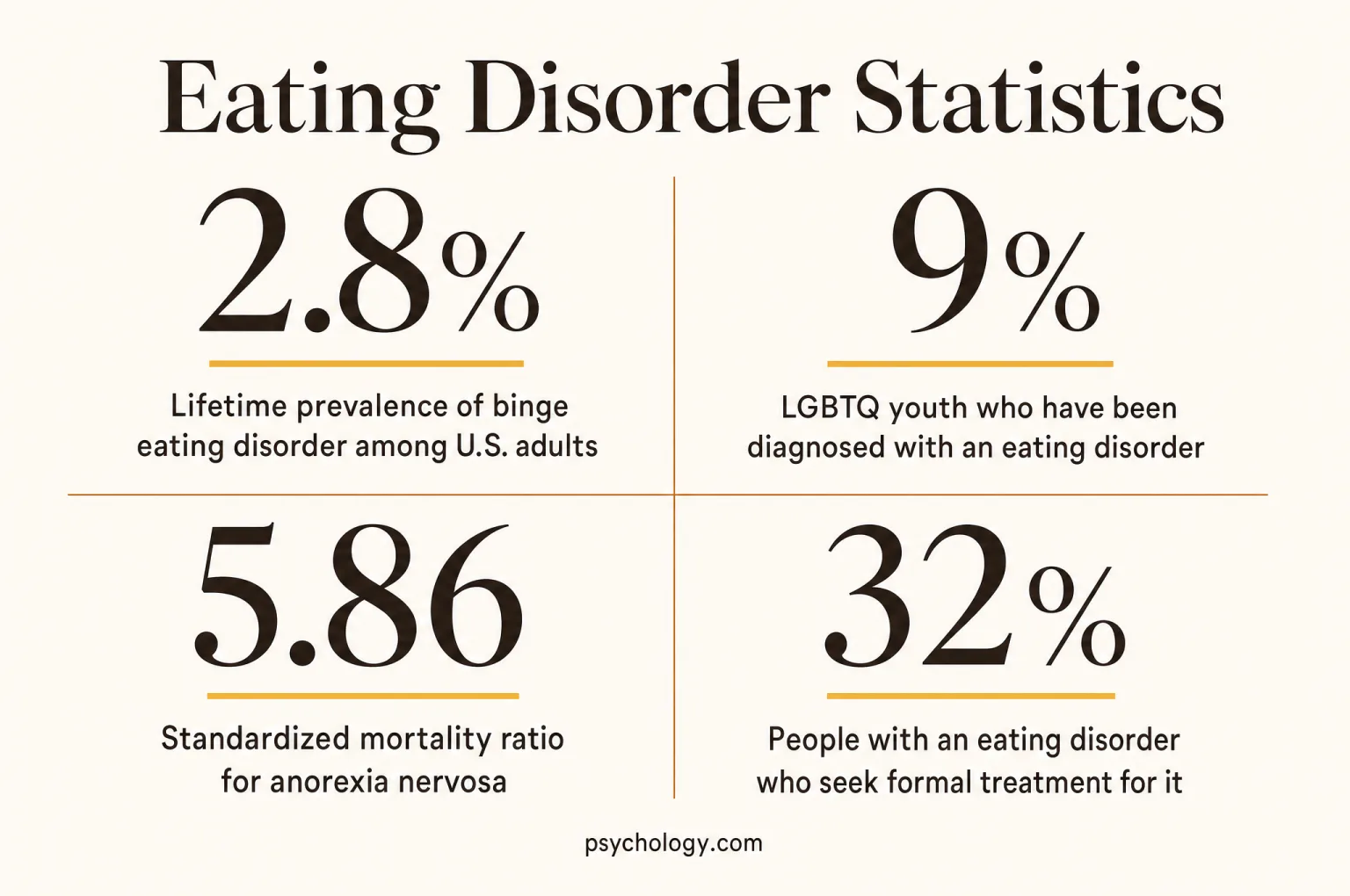
- Arcelus and colleagues reported an anorexia standardized mortality ratio of 5.86 in their 2011 meta-analysis, meaning close to six times the expected death rate for age and sex (Source). Arcelus et al., Archives of General Psychiatry, 2011
- STRIPED and Deloitte estimated $64.7 billion in U.S. financial costs and $326.5 billion in lost wellbeing from eating disorders for 2018-19 in their 2020 report (Source). STRIPED and Deloitte Access Economics, 2020
- CDC reported in 2022 that the share of emergency visits involving eating disorders among girls aged 12 to 17 roughly doubled in 2020 and 2021 compared with 2019 (Source). CDC MMWR, 2022
- FAIR Health reported in 2023 that eating disorder claim lines as a share of all private medical claim lines rose 65% between 2018 and 2022, while the ARFID share rose 305% (Source). FAIR Health, 2023
- Ali and colleagues reported in their 2025 meta-analysis that 32% of people with an eating disorder sought formal treatment specifically for it from a health professional (Source). Ali et al., International Journal of Eating Disorders, 2025
- Solmi and colleagues reported in their 2022 meta-analysis that 48.1% of feeding and eating disorders began before age 18 and 82.4% before age 25 (Source). Solmi et al., Molecular Psychiatry, 2022
- A study published in the Journal of Athletic Training in 2023 found that 25.3% of NCAA Division I and II student-athletes surveyed before the 2020 pandemic screened at risk for an eating disorder, including 17.3% of men (Source). Journal of Athletic Training, 2023
How common eating disorders are
The best U.S. estimate comes from the 2020 STRIPED and Deloitte Access Economics report, which modeled every major diagnosis by age and sex. It puts lifetime prevalence near one in ten, with millions of people ill in any given year and most cases falling outside the classic anorexia picture.
Americans alive in 2018-19 projected to have an eating disorder during their lifetime
The STRIPED and Deloitte report estimated that 28.8 million Americans alive in 2018-19 will have an eating disorder at some point in their lives, past, present or future. Of those, 21.0 million had already had one by 2018-19 (14.4 million women and 6.6 million men) and 7.8 million were expected to develop one later. Lifetime prevalence to date was 8.60% among females and 4.07% among males. The single most common diagnosis in this model is OSFED, the category for clinically serious presentations that do not meet every criterion.
- 1.66%One-year prevalence of any eating disorder in the U.S.
5.48 million people were ill in 2018-19: 2.62% of females and 0.67% of males.
- 1.18%One-year prevalence of OSFED among females
OSFED was the most common eating disorder for both sexes (0.27% of males), ahead of binge eating disorder, anorexia and bulimia.
- 8.4%Lifetime prevalence among women across 94 international studies
The weighted mean for men was 2.2%. Point prevalence in the Americas (4.6%) was higher than in Europe (2.2%) or Asia (3.5%), per a 2019 review.
Galmiche et al., American Journal of Clinical Nutrition, 2019
- 2.7%Lifetime prevalence among U.S. adolescents aged 13 to 18
3.8% of girls and 1.5% of boys in the 2001 to 2004 National Comorbidity Survey Adolescent Supplement, the last national diagnostic survey of teens.
- 15.3%Women who had met criteria for an eating disorder by mid-life
In a UK cohort surveyed in 2009 to 2012 and published in 2017, 5,658 women around age 48 completed the first assessment; 3.6% had a disorder in the past year. Eating disorders do not end with adolescence.
- 5.75MProjected U.S. cases in 2029-30
Demographic growth alone lifts the one-year count from 5.48 million, before any change in underlying rates.
Wondering where you stand? The free eating disorder test on Psychology.com is a five-minute screening tool; it does not diagnose anything.
Anorexia, bulimia, binge eating and ARFID
Each diagnosis has its own prevalence, age of onset and course. Binge eating disorder had the highest lifetime prevalence of the three diagnoses measured in two U.S. adult surveys. The ranking of anorexia and bulimia differed between surveys. ARFID is a separate diagnosis, and screening, clinical diagnoses and insurance claims measure different aspects of its frequency.
Lifetime prevalence of binge eating disorder among U.S. adults
In the National Comorbidity Survey Replication (2001 to 2003), binge eating disorder was the most common eating disorder with a lifetime prevalence of 2.8%, compared with 1.0% for bulimia and 0.6% for anorexia. The later NESARC-III survey (2012 to 2013), which applied DSM-5 criteria to a larger sample, found different lifetime rates: 0.85% for binge eating disorder, 0.80% for anorexia and 0.28% for bulimia. Both surveys put binge eating disorder first and found higher rates among women. Anorexia ranked below bulimia in the NCS-R and above it in NESARC-III.
- 1.2%U.S. adults with binge eating disorder in the past year
Twice as common in women (1.6%) as in men (0.8%). 62.6% reported impairment and 18.5% severe impairment, per NCS-R data from 2001 to 2003.
- 0.3%U.S. adults with bulimia in the past year
Five times more common in women (0.5%) than men (0.1%). 78.0% of people with bulimia reported impairment and 43.9% severe impairment.
- 0.9%Lifetime anorexia among women, 0.3% among men
The NCS-R (2007 analysis) put lifetime bulimia at 1.5% of women and 0.5% of men, and binge eating disorder at 3.5% of women and 2.0% of men.
- 0.3% to 15.5%ARFID prevalence in non-clinical samples
In specialist eating disorder services the range is 5% to 22.5%, and one surveillance study found 2.02 new clinical cases per 100,000 per year, per a 2023 review of 30 studies.
Sanchez-Cerezo et al., European Eating Disorders Review, 2023
- 16.27%People with ARFID who also have an autism diagnosis
A 2025 meta-analysis of 21 studies also found ARFID in 11.41% of autistic people, and the authors suggested considering screening for both in clinical settings.
Sader et al., International Journal of Eating Disorders, 2025
- 6.5 yearsMedian persistence of bulimia; 4.3 years for binge eating disorder
Across 14 countries in the World Mental Health Surveys, fewer than half of lifetime bulimia or binge eating cases ever received treatment (published 2013).
| Diagnosis | Median onset age | Onset before 18 | Onset before 25 | Source |
|---|---|---|---|---|
| Anorexia nervosa | 17 | 55.2% | 78.7% | Solmi et al., 2022 |
| Bulimia nervosa | 18 | 45.3% | 82.9% | Solmi et al., 2022 |
| Binge eating disorder | 20 | 34.5% | 73.5% | Solmi et al., 2022 |
| All feeding and eating disorders | 18 (peak 15.5) | 48.1% | 82.4% | Solmi et al., 2022 |
What ARFID looks like in the clinic
Avoidant/restrictive food intake disorder was added to the DSM in 2013 and is not driven by body image. In a UK and Ireland surveillance study of 319 children and adolescents reported by pediatricians and psychiatrists in 2021-22 and published in 2024, 45.5% were girls and the mean age was 11.2 years, a younger and more male profile than anorexia or bulimia. The most common presentation combined sensory sensitivity with a lack of interest in food (38.2%), followed by a pure sensory subtype (29.5%), lack of interest (25.1%) and fear of aversive consequences such as choking (7.2%). Psychiatric comorbidity is the rule: 45% of one ARFID cohort met criteria for a current comorbid diagnosis and 53% for a lifetime one. Sources: eClinicalMedicine, 2024; Kambanis et al., 2020. Psychology.
com also offers a free binge eating disorder test for people who recognize the pattern above.
Psychology.com also offers separate anorexia, bulimia and ARFID screenings. These questionnaires organize concerns for a conversation with a professional; their results cannot establish a diagnosis or describe the prevalence of a condition in the population.
Who is affected
Women and girls carry the highest rates, but eating disorders cross every sex, age, weight, race and sexual orientation. The groups least likely to fit the stereotype are also the ones least likely to be diagnosed, which is why the prevalence numbers and the diagnosis numbers diverge.
LGBTQ youth who have been diagnosed with an eating disorder
In the Trevor Project's 2021 national survey of 34,759 LGBTQ young people aged 13 to 24, 9% said they had been diagnosed with an eating disorder and a further 29% suspected they had one but had never been diagnosed. Diagnosis rates ranged from 12% among Native and Indigenous youth to 4% among Black youth, even though the share who suspected a disorder was similar across groups. LGBTQ youth with a diagnosis had nearly four times the odds (aOR 3.94) of a past-year suicide attempt compared with peers who had never had or suspected one; support resources are listed in the questions section below.
- 10.5%Transgender men reporting a lifetime eating disorder diagnosis
8.1% of transgender women reported the same. Sexual minority adults also show higher lifetime rates of anorexia (1.7%), bulimia (1.3%) and binge eating disorder (2.2%) than cisgender heterosexual adults.
- 87%LGBTQ youth dissatisfied with their body
Rates were 90% among transgender and nonbinary youth versus 80% among cisgender youth in a 2021 survey of 33,993 young people; body dissatisfaction was associated with higher odds of a past-year suicide attempt (aOR 1.96). The survey does not establish causation.
- Half as likelyBIPOC people diagnosed, despite similar prevalence
Black, Indigenous and other people of color are affected at similar rates to white peers but are about half as likely to receive a diagnosis, and less likely to be asked about symptoms by doctors.
- Under 6%People with an eating disorder who are medically underweight
Most people with eating disorders are at a normal or higher weight. Higher-weight patients have 2.45 times the odds of disordered eating yet are diagnosed half as often.
- 41%Women over 50 with current or past core eating disorder symptoms
71.2% of women 50 and over say they are trying to lose weight. Among older adults generally, prevalence is 2% to 7% for women and under 1% for men.
- 1 in 3Women veterans with symptoms consistent with a DSM-5 eating disorder
About one in five men veterans reported the same in a 2021 study, and among active service members the incidence of eating disorders rose 79% between 2017 and 2021.
- 31.1%Children aged 6 to 11 with caregiver-reported disordered eating behaviors in 2022
A CDC publication in 2026 analyzed the National Survey of Children's Health and found this share had at least one reported behavior in the past year. This broad behavioral measure does not establish an eating disorder diagnosis.
- 30.4%Adolescents aged 12 to 17 with caregiver-reported disordered eating behaviors in 2022
The same nationally representative survey measured caregiver observations, which differ from the diagnostic interviews behind the older NIMH prevalence estimate. The two percentages cannot be used to calculate a trend in diagnosed eating disorders.
Comorbidity is the norm
Eating disorders rarely travel alone. FAIR Health found that 72% of privately insured patients with an eating disorder in the 2018 to 2022 study period had at least one co-occurring mental health diagnosis, most often generalized anxiety disorder (41%) and major depressive disorder (39%). ANAD reports that more than 70% of people with eating disorders have another condition, that 10% to 35% have OCD unrelated to their eating disorder, and that 6% to 17% have ADHD. One in five people with an eating disorder will develop a substance use disorder in their lifetime. Sources: FAIR Health, 2023; ANAD; NEDA, citing Bahji et al. 2019.com for anyone working through the body dissatisfaction that so often sits underneath.
A free body image worksheet is available on Psychology.
Impact: health, mortality and cost
Eating disorders are among the deadliest psychiatric conditions and among the most expensive. The mortality figures below are drawn from meta-analyses and national cohorts; the cost figures come from the 2020 STRIPED and Deloitte U.S. economic model, which also counts unpaid caregiving and lost wellbeing.
Standardized mortality ratio for anorexia nervosa
The 2011 meta-analysis of 36 studies covering 17,272 patients and 755 deaths found that people with anorexia died at 5.86 times the expected rate, versus 1.93 for bulimia and 1.92 for EDNOS. The weighted mortality rate for anorexia was 5.1 deaths per 1,000 person-years, and one in five of those deaths was a suicide. Later work confirms the scale: a 2016 German clinical cohort found an SMR of 5.35 for anorexia, and a 2021 review of the evidence still describes the increase in mortality risk as five times or more. If you or someone you love is struggling, help is available; the questions section below lists crisis resources.
Arcelus et al., Archives of General Psychiatry, 2011 · Fichter and Quadflieg, 2016 · van Eeden et al., 2021
- 10,200U.S. deaths associated with eating disorders in 2018-19
About 3,400 of them, one third, were linked to OSFED, the category that gets the least attention. The report's range runs from 5,500 to 22,000.
- 2.47xAdjusted hazard of in-hospital death among women hospitalized with anorexia
The Quebec cohort included 1,298,890 women, including 5,169 hospitalized with anorexia between 1989 and 2016, with follow-up through March 31, 2018. Relative to a comparison group admitted for delivery or pregnancy termination, the adjusted hazard ratio was 2.47 overall, 9.01 at five years and 2.90 at 20 years after the index hospitalization.
- 24.9%U.S. adults with lifetime anorexia who have attempted suicide
Versus 5.0% of adults without an eating disorder. The figure was 31.4% for bulimia, 22.9% for binge eating disorder and 44.1% for the binge-purge subtype of anorexia (NESARC-III, 2012 to 2013).
- $64.7BAnnual financial cost of eating disorders in the U.S.
$11,808 per person affected in 2018-19. Productivity losses made up 75.2% ($48.6 billion), informal caregiving 10.4% ($6.7 billion), efficiency losses 7.4% and the health system just 7.0% ($4.6 billion).
- $326.5BAdditional annual loss of wellbeing
Equivalent to 1.3 million disability-adjusted life years. Individuals and families bore 36.3% of the financial cost, government 27.5% and employers 25.2%.
- 48%Higher yearly healthcare costs for people with an eating disorder
Mental health comorbidity is also associated with 48% lower yearly earnings, and more than 3.3 million healthy life years are lost worldwide each year.
| Cost component | Amount | Share | Source |
|---|---|---|---|
| Productivity losses | $48.6 billion | 75.2% | Deloitte, 2020 |
| Informal caregiving | $6.7 billion | 10.4% | Deloitte, 2020 |
| Efficiency losses | $4.8 billion | 7.4% | Deloitte, 2020 |
| Health system costs | $4.6 billion | 7.0% | Deloitte, 2020 |
| Wellbeing loss (not included above) | $326.5 billion | 1.3 million DALYs | Deloitte, 2020 |
Why anorexia is so dangerous, and why it is not only anorexia
Anorexia deaths are mostly from natural causes tied to the illness itself; the Quebec cohort found elevated risk from suicide, pulmonary disease, endocrine disease and organ failure, and the German cohort found that anorexia patients died earlier than those with bulimia, binge eating disorder or EDNOS. But the other diagnoses are not benign. Bulimia roughly doubles mortality (SMR 1.93), binge eating disorder raised it by half in the German cohort (SMR 1.50), and the standardized mortality ratio for EDNOS (1.92) sits at the same level as bulimia. Recovery is possible even after decades, which is covered in the treatment section. Sources: Auger et al., 2021; Fichter and Quadflieg, 2016; Arcelus et al., 2011.
Treatment and the care gap
Many people with an eating disorder go without treatment specifically for it, and those who do typically wait years. The gap has barely moved in fifteen years of research. When care does arrive, the evidence is more hopeful than most people assume, especially for adolescents treated early.
People with an eating disorder who seek formal treatment for it
A 2025 meta-analysis of 21 studies and 37,423 participants found that 32% of people with an eating disorder sought treatment from a health professional specifically for it, and 30% sought help from any source including helplines and support groups. The authors concluded there had been little to no improvement since the previous review in 2011, which put treatment seeking at 23.2%. Psychology.
Ali et al., International Journal of Eating Disorders, 2025 · Hart et al., Clinical Psychology Review, 2011
- 33.8%U.S. adults with anorexia who sought treatment for their eating disorder
43.2% for bulimia and 43.6% for binge eating disorder, per NCS-R data from 2001 to 2003. Most who did get care were treated for something else.
- 67.4 monthsAverage untreated duration among people seeking first treatment for binge eating disorder
In a review published in 2021, anorexia averaged 29.9 months untreated and bulimia 53.0 months across 14 studies from seven countries. These estimates describe help-seeking populations at first treatment. Retrospective evidence suggested that shorter delays might be associated with a greater likelihood of remission.
- 27.4%Mid-life women with an eating disorder who had ever sought help
In the UK cohort surveyed in 2009 to 2012 and published in 2017, the most common contact was a general practitioner (8.2%); only 1.2% had seen a psychiatrist for their eating disorder.
- 20%Adolescents with eating disorders who seek treatment
Among college students who screen positive, 20% or fewer report receiving treatment, and only 22% of colleges offer year-round screening.
- 62.8%Women with anorexia who had recovered 22 years later
In a cohort initiated in 1987 with its last follow-up in 2013, 31.4% had recovered at nine years, so about half of those still ill at nine years went on to recover. For bulimia, 68.2% had recovered at both points.
- 49%Adolescents in full remission a year after family-based treatment
Versus 23% after individual adolescent-focused therapy in a 121-person randomized trial of 12- to 18-year-olds with anorexia (2010).
| Level of care | Typical cost | Note | Source |
|---|---|---|---|
| Outpatient therapy session | $150 | Per session average | Project HEAL |
| Intensive outpatient program | $1,500 per week | Several hours a day, several days a week | Project HEAL |
| Residential or inpatient care | $2,000 per day | Average; plans often cap days or exclude levels of care | Project HEAL |
| Average treatment episode | $80,000 | Across levels of care | Project HEAL |
| Full continuum over two years | $250,000 | Inpatient through outpatient relapse prevention | Project HEAL |
The insurance picture
FAIR Health's analysis of private claims found that telehealth use for eating disorder treatment rose by more than 10,000% between 2018 and 2022 and became the most common place of service, while services by psychiatric nurses rose 108%. Even so, the health system accounts for only 7.0% of the total economic cost of eating disorders, which says as much about how little care is delivered as about how cheap it is. ANAD reports that patients who meet full criteria for anorexia were 14 times more likely to receive recommended treatment than those with atypical anorexia, and that only 40% of adolescents with malnutrition from an eating disorder received the recommended care. Sources: FAIR Health, 2023; STRIPED and Deloitte, 2020; ANAD.
Alongside the levels of care described above, many people find a structured self-compassion exercise helpful for working through the shame and self-criticism that often accompany an eating disorder. It is not a substitute for professional treatment.
com keeps a plain-language guide to the options at /tests/eating-disorder.
People exploring care can use the directory to find a licensed therapist and ask about experience with eating disorders, insurance participation and coordination with other care providers. Population averages for treatment use describe access across groups and cannot determine which level of care an individual needs.
Trends 2019 to 2026
The pandemic years brought substantial increases in eating disorder presentations in U.S. surveillance and hospital studies, especially among girls and young women. Volumes fell back from the 2021 peak but stayed well above 2019, and the underlying long-run increase, visible in college screening and in incidence among young girls, predates COVID-19.
Relative share of emergency visits involving eating disorders among girls aged 12 to 17, 2020 to early 2022 versus 2019
CDC surveillance found that the proportion of emergency department visits for eating disorders among adolescent girls was 1.95 times the 2019 level in 2020, 2.29 times in 2021 and 1.99 times in January 2022. A follow-up report found that eating disorders accounted for a 55% larger share of all adolescent emergency visits in fall 2022 than in fall 2019 (visit ratio 1.55). This measure covered both sexes combined; the share was elevated separately among girls and boys.
- 11.9/monthGrowth in eating disorder admissions at 38 children's hospitals in the first pandemic year
Before the pandemic, admissions were rising by 1.70 per month. Emergency visits went from +1.50 to +12.9 per month, then fell by 6.3 per month in the second year.
- +7.2%/monthRise in adolescent inpatient admissions across 15 U.S. sites, April 2020 to April 2021
Aggregate monthly admissions had already grown from 81 in January 2018 to 109 in February 2020; after the peak, admissions fell 3.6% per month through December 2021.
- 125 vs 56Admissions in the first pandemic year versus the prior three-year average at one Michigan hospital
More than double. A southeastern U.S. pediatric system saw monthly admissions rise from 8.6 to 15.8 and average stays lengthen from 7.8 to 12.1 days.
Otto et al., Pediatrics, 2021 · Journal of Eating Disorders, 2023
- +101.4%Anorexia patient volumes among 0- to 17-year-olds, Q2 2022 versus Q1 2018
All other eating disorders rose 85.3% in the same group; adult volumes rose 48.1% and 45.6%. Females made up 74.0% of pediatric patients.
- 65%Rise in eating disorder claim lines as a share of all private claims, 2018 to 2022
ARFID rose 305%, binge eating disorder 81%, anorexia 73% and bulimia 3%. The South rose most (84%), the Northeast least (51%), and the largest age group shifted from 19 to 24 to 14 to 18.
- 15% to 28%College students screening at risk for an eating disorder, 2013 to 2020-21
Across 267,599 Healthy Minds Study respondents, risk rose 13 percentage points, three of them during the pandemic. In 2020-21, 28.2% of 96,645 students screened positive.
Daly and Costigan, Psychiatry Research, 2022 · Journal of American College Health, 2025
| Indicator | Change | Period | Source |
|---|---|---|---|
| Global point prevalence of eating disorders (94 studies) | 3.5% to 7.8% | 2000-2006 to 2013-2018 | Galmiche et al., 2019 |
| Anorexia incidence in girls aged 10 to 14 (Dutch primary care) | 9 to 39 per 100,000 | Four decades to 2020s | Hoek, 2025 |
| Bulimia incidence, total population (Dutch primary care) | 9 to 3 per 100,000 | 1980s to 2010s | Hoek, 2025 |
| Global age-standardized DALY rate | 37.33 to 43.36 per 100,000 | 1990 to 2021 | GBD 2021 analysis, 2025 |
| Global age-standardized incidence | 106.78 to 124.4 per 100,000 | 1990 to 2021 | GBD 2021 analysis, 2025 |
| Pediatric eating disorder incidence (Kaiser Permanente) | 177 to 205 per 100,000 per year | 2015 to 2019 | Hartman-Munick et al., 2022 |
The global count is bigger than the official one
The Global Burden of Disease study counted 13.6 million people with anorexia or bulimia worldwide in 2019. A 2021 Lancet Psychiatry extension estimated a further 41.9 million cases of binge eating disorder (17.3 million) and OSFED (24.6 million) that the official count left out, which together add 3.7 million disability-adjusted life years and bring the global total to 6.6 million DALYs. The GBD 2021 update projects continued growth in burden to 2035, with the heaviest load among females aged 15 to 24. Sources: Santomauro et al., Lancet Psychiatry, 2021; GBD 2021 analysis, 2025.
Eating disorders in boys, men and athletes
Men make up a quarter or more of cases in some samples and a tenth of insurance claims, a gap that reflects who gets recognized rather than who gets ill. Athletes of both sexes carry higher risk than non-athletes, with the highest rates in sports that reward leanness, weight classes or aesthetics.
U.S. males who have had an eating disorder at some point in their lives
The STRIPED and Deloitte model put lifetime prevalence among males at 4.07%, or 6.6 million people, with 1.09 million ill in 2018-19 alone. A 2007 study cited in the male eating disorders literature reported that 25% of anorexia and bulimia cases were male, and the NCS-R found lifetime binge eating disorder in 2.0% of men. Yet FAIR Health found that males accounted for less than 11% of private eating disorder claim lines in every year from 2018 to 2022, and ANAD reports women are up to five times more likely to be diagnosed and 1.5 times more likely to be treated. Men tend to present later and sicker.
STRIPED and Deloitte, 2020 · Strother et al., 2012 · FAIR Health, 2023
- 25.2%Adolescent boys reporting any muscle-enhancing behavior
Versus 3.8% of girls among 18,924 U.S. adolescents; 29.2% of boys were trying to gain weight, and 2.7% of young men aged 18 to 26 reported anabolic steroid use. Muscularity-driven disordered eating is the male pattern standard screens miss.
Nagata et al., International Journal of Adolescent Medicine and Health, 2020
- 13.5%Elite athletes with a clinical or subclinical eating disorder, versus 4.6% of controls
Among the entire population of Norwegian elite athletes (n = 1,620) in 2004. Male rates were highest in antigravitation sports (22%); female rates peaked in aesthetic sports (42%).
Sundgot-Borgen and Torstveit, Clinical Journal of Sport Medicine, 2004
- 0 to 19%Prevalence range for eating disorders among male athletes
The range for female athletes is 6% to 45%, per a 2013 review of the athlete literature.
Bratland-Sanda and Sundgot-Borgen, European Journal of Sport Science, 2013
- 25.3%NCAA Division I and II student-athletes at risk for an eating disorder
28.9% of women and 17.3% of men across 2,054 athletes at 40 institutions, using data collected before the 2020 pandemic and published in 2023. 10.0% of women and 6.5% of men reported binge eating; 3.7% overall reported vomiting.
- 38.18%Collegiate athletes across 19 sports at risk for an eating disorder in a 2025 study
46.53% of women and 22.37% of men; 47.17% were also at risk of low energy availability, and 22.73% were at risk for both.
- 13.66%Male NCAA distance runners screening positive for eating disorder risk
The rate among female distance runners was 45.95%, in a sample of 638 athletes competing at 800 meters or longer.
Why men are undercounted
Diagnostic criteria, screening questionnaires and treatment programs were built around female patients, so male presentations centered on muscularity, compulsive exercise and binge eating are routinely read as fitness or as a substance problem. Strother and colleagues note that around 57% of men with binge eating disorder also struggle with substance use and are often diagnosed only with the substance disorder. ANAD reports that men with eating disorders tend not to recognize their symptoms as problematic and present to healthcare with more severe illness. The male share of cases in NIMH data ranges from a quarter of anorexia cases (0.3% vs 0.9% lifetime) to a third of binge eating disorder cases (0.8% vs 1.6% in the past year). Sources: Strother et al., Eating Disorders, 2012; ANAD; NIMH.
Common questions
How common are eating disorders in the United States?
The 2020 STRIPED and Deloitte Access Economics report projected that 28.8 million Americans alive in 2018-19 would have an eating disorder at some point in their lives, including past and future cases. Its separate estimates of lifetime experience to date were 8.60% among females and 4.07% among males. For 2018-19 alone, it estimated 5.48 million cases, or 1.66% of the population. OSFED was the most common category in that model. The NCS-R adult survey (2001 to 2003) found lifetime rates of 2.8% for binge eating disorder, 1.0% for bulimia and 0.6% for anorexia. Sources: STRIPED report; NIMH.
Which eating disorder is the most common?
In the U.S. cost model, other specified feeding or eating disorder (OSFED) is the most common, with a one-year prevalence of 1.18% among females and 0.27% among males, and it accounts for roughly 40% to 44% of all cases. Among named diagnoses, binge eating disorder leads: 2.8% lifetime prevalence in the NCS-R (2001 to 2003), and 0.85% under DSM-5 criteria in NESARC-III (2012 to 2013), ahead of anorexia (0.80%) and bulimia (0.28%). ARFID is harder to count, with estimates from 0.3% to 15.5% in non-clinical samples, but it is the diagnosis with the largest relative increase in its share of all medical claim lines in the FAIR Health analysis, up 305% from 2018 to 2022. Sources: STRIPED report; NIMH; NESARC-III; ARFID review; FAIR Health.
What is the mortality rate for eating disorders?
A 2011 meta-analysis found a standardized mortality ratio of 5.86 for anorexia, meaning close to six times the expected death rate, and 5.1 deaths per 1,000 person-years. These group estimates cannot predict an individual outcome. Bulimia and EDNOS had ratios of 1.93 and 1.92. STRIPED and Deloitte estimated 10,200 U.S. deaths associated with eating disorders in 2018-19. Recovery is possible, including after years of illness. If you are thinking about harming yourself, call or text 988 in the U.S., any time. Sources: Mortality meta-analysis; STRIPED report; Recovery study.
Did eating disorders increase during the pandemic?
Yes. CDC surveillance found that the share of emergency visits involving eating disorders among girls aged 12 to 17 roughly doubled in 2020 and 2021 compared with 2019 (visit ratios 1.95 and 2.29). Among adolescents of both sexes combined, the share was 55% above baseline in fall 2022. These ratios measure proportions of visits. In a separate study, admissions at 38 children's hospitals grew by 11.9 per month in the first pandemic year versus 1.70 per month before it. FAIR Health found a 65% increase in eating disorder claim lines as a share of all private medical claim lines between 2018 and 2022. Sources: CDC 2022; CDC 2023; Hospital study; FAIR Health.
How many people with eating disorders get treatment?
About a third. A 2025 meta-analysis of 21 studies found that 32% of people with an eating disorder sought formal treatment for it, with the authors concluding there had been little improvement since the 2011 review, which estimated 23.2%. In NCS-R data collected in 2001 to 2003, 33.8% of adults with anorexia and 43.6% with binge eating disorder sought treatment specifically for it. In a review published in 2021, the average untreated duration among people seeking first treatment ran from about two and a half years for anorexia to more than five years for binge eating disorder. Studies also document recovery: 62.8% of women with anorexia had recovered at a 22-year follow-up last conducted in 2013, and 49% of adolescents were in full remission a year after family-based treatment in a trial published in 2010. Sources: 2025 treatment review; 2011 treatment review; NIMH; Untreated-duration review; Recovery study; Family-based treatment trial.
Do men and boys get eating disorders?
Yes. The STRIPED and Deloitte model estimates that 4.07% of U.S. males, 6.6 million people, had experienced an eating disorder by 2018-19, and 1.09 million were ill in 2018-19. Some clinical samples report that 25% of anorexia and bulimia cases are male, and binge eating disorder affects 2.0% of men over a lifetime in NCS-R data collected in 2001 to 2003. In FAIR Health data from 2018 to 2022, men accounted for under 11% of eating disorder claim lines; claim shares do not directly measure diagnosis probability. Male presentations often centre on muscularity rather than thinness; a study published in 2020 reported muscle-enhancing behaviors among 25.2% of adolescent boys. Athletes of both sexes are at higher risk, and a sample collected before the 2020 pandemic found 17.3% of male and 28.9% of female NCAA Division I and II athletes screening at risk. Sources: STRIPED report; Men and eating disorders; NCS-R; FAIR Health; Muscle-enhancing behaviors; Athlete study.
How much do eating disorders cost the United States each year?
The 2020 STRIPED and Deloitte Access Economics report estimated the direct financial cost of eating disorders in the United States at $64.7 billion for 2018-19, or $11,808 per person affected. Productivity losses made up 75.2% of that total, informal caregiving 10.4% and the health system just 7.0%. The same model estimated a further $326.5 billion in lost wellbeing, equivalent to 1.3 million disability-adjusted life years. These are modeled economic estimates, not measured government spending. Source: STRIPED and Deloitte, 2020.
How we compiled this
Statistics were drawn from federal datasets (NIMH's National Comorbidity Survey tables, CDC MMWR surveillance), the STRIPED and Deloitte Access Economics economic model, peer-reviewed meta-analyses and cohort studies, and the statistics pages of NEDA and ANAD where they cite a primary study. Figures retain their source links; the September 16, 2026 update checked NIMH, Deloitte, FAIR Health and CDC publisher material and added the CDC analysis of the 2022 National Survey of Children's Health. Where the underlying survey is older than 2023 the data year is stated in the text. Mortality and self-harm figures follow safe-messaging guidance. Cost figures are estimates by the issuing organization. Behavioral surveillance, claims, screening results and diagnostic prevalence use different denominators and are labeled separately. Last full review: September 16, 2026.
Journalists and researchers may reuse any statistic with attribution to the original source and a link to Psychology.com.
Cite this source
Fontane Pennock, S. (2026, September 13). Eating Disorder Statistics 2026. Psychology.com. https://psychology.com/eating-disorder-statistics/
References
- Deloitte Access Economics. (2020). The social and economic cost of eating disorders in the United States of America: A report for STRIPED and the Academy for Eating Disorders. hsph.harvard.edu (PDF) · deloitte.com
- National Institute of Mental Health. (n.d.). Eating disorders: Statistics (NCS-R 2001 to 2003; NCS-A 2001 to 2004). nimh.nih.gov
- National Eating Disorders Association. (2025). Eating disorder statistics. nationaleatingdisorders.org · ANAD. (2025). Eating disorder statistics. anad.org
- Arcelus, J., Mitchell, A. J., Wales, J., & Nielsen, S. (2011). Mortality rates in patients with anorexia nervosa and other eating disorders: A meta-analysis of 36 studies. Archives of General Psychiatry, 68(7), 724-731. jamanetwork.com
- Fichter, M. M., & Quadflieg, N. (2016). Mortality in eating disorders: Results of a large prospective clinical longitudinal study. International Journal of Eating Disorders, 49(4), 391-401. pubmed.ncbi.nlm.nih.gov · Auger, N., et al. (2021). Anorexia nervosa and the long-term risk of mortality in women. World Psychiatry, 20(3), 448-449. pmc.ncbi.nlm.nih.gov
- CDC. (2022). Pediatric emergency department visits associated with mental health conditions before and during the COVID-19 pandemic, January 2019 to January 2022. MMWR, 71(8). cdc.gov · CDC. (2023). Emergency department visits involving mental health conditions among adolescents, January 2019 to February 2023. MMWR, 72(19). cdc.gov
- Milliren, C. E., Richmond, T. K., & Hudgins, J. D. (2023). Emergency department visits and hospitalizations for eating disorders during the COVID-19 pandemic. Pediatrics, 151(1). pubmed.ncbi.nlm.nih.gov · Hartman-Munick, S. M., et al. (2022). Association of the COVID-19 pandemic with adolescent and young adult eating disorder care volume. JAMA Pediatrics, 176(12), 1225-1232. pubmed.ncbi.nlm.nih.gov
- Otto, A. K., et al. (2021). Medical admissions among adolescents with eating disorders during the COVID-19 pandemic. Pediatrics, 148(4). pubmed.ncbi.nlm.nih.gov · Journal of Eating Disorders. (2023). Hospitalization patterns for adolescents with eating disorders during COVID-19. pmc.ncbi.nlm.nih.gov · Hartman-Munick, S. M., et al. (2022). Incidence and medical hospitalization rates of patients with pediatric eating disorders. The Permanente Journal, 26(4). pubmed.ncbi.nlm.nih.gov
- Trilliant Health. (2023). Eating disorders among child and adolescent patients incrementally spiked following the pandemic's onset. trillianthealth.com
- FAIR Health. (2023). From 2018 to 2022, eating disorder claim lines increased 65 percent nationally as a percentage of all medical claim lines. fairhealth.org
- Galmiche, M., Déchelotte, P., Lambert, G., & Tavolacci, M. P. (2019). Prevalence of eating disorders over the 2000-2018 period: A systematic literature review. American Journal of Clinical Nutrition, 109(5), 1402-1413. pubmed.ncbi.nlm.nih.gov
- Udo, T., & Grilo, C. M. (2018). Prevalence and correlates of DSM-5-defined eating disorders in a nationally representative sample of U.S. adults. Biological Psychiatry, 84(5), 345-354. pubmed.ncbi.nlm.nih.gov · Udo, T., Bitley, S., & Grilo, C. M. (2019). Suicide attempts in US adults with lifetime DSM-5 eating disorders. BMC Medicine, 17, 120. pmc.ncbi.nlm.nih.gov
- Hudson, J. I., Hiripi, E., Pope, H. G., & Kessler, R. C. (2007). The prevalence and correlates of eating disorders in the National Comorbidity Survey Replication. Biological Psychiatry, 61(3), 348-358. pubmed.ncbi.nlm.nih.gov · Swanson, S. A., et al. (2011). Prevalence and correlates of eating disorders in adolescents (NCS-A). Archives of General Psychiatry, 68(7), 714-723. pubmed.ncbi.nlm.nih.gov
- Kessler, R. C., et al. (2013). The prevalence and correlates of binge eating disorder in the WHO World Mental Health Surveys. Biological Psychiatry, 73(9), 904-914. pubmed.ncbi.nlm.nih.gov
- Micali, N., et al. (2017). Lifetime and 12-month prevalence of eating disorders amongst women in mid-life. BMC Medicine, 15, 12. pmc.ncbi.nlm.nih.gov
- Solmi, M., et al. (2022). Age at onset of mental disorders worldwide: Large-scale meta-analysis of 192 epidemiological studies. Molecular Psychiatry, 27, 281-295. pmc.ncbi.nlm.nih.gov
- van Eeden, A. E., van Hoeken, D., & Hoek, H. W. (2021). Incidence, prevalence and mortality of anorexia nervosa and bulimia nervosa. Current Opinion in Psychiatry, 34(6). pmc.ncbi.nlm.nih.gov · van Hoeken, D., & Hoek, H. W. (2020). Review of the burden of eating disorders. Current Opinion in Psychiatry, 33(6), 521-527. pubmed.ncbi.nlm.nih.gov · Hoek, H. W. (2025). The incidence and prevalence of eating disorders between 1975 and 2024: Commentary. International Journal of Eating Disorders. pmc.ncbi.nlm.nih.gov
- Santomauro, D. F., et al. (2021). The hidden burden of eating disorders: An extension of estimates from the Global Burden of Disease Study 2019. Lancet Psychiatry, 8(4), 320-328. pubmed.ncbi.nlm.nih.gov · GBD 2021 analysis. (2025). Global, regional, and national burdens of eating disorders from 1990 to 2021 and projection to 2035. pmc.ncbi.nlm.nih.gov
- The Trevor Project. (2022, 2023). Research briefs: Eating disorders among LGBTQ youth; LGBTQ youth and body dissatisfaction. thetrevorproject.org (2022) · thetrevorproject.org (2023)
- Nagata, J. M., Ganson, K. T., & Austin, S. B. (2020). Emerging trends in eating disorders among sexual and gender minorities. Current Opinion in Psychiatry, 33(6), 562-567. pubmed.ncbi.nlm.nih.gov
- Hart, L. M., et al. (2011). Unmet need for treatment in the eating disorders: A systematic review. Clinical Psychology Review, 31(5), 727-735. pubmed.ncbi.nlm.nih.gov · Ali, K., et al. (2025). The unmet treatment need for eating disorders: What has changed in more than 10 years? International Journal of Eating Disorders, 58(1), 46-65. pubmed.ncbi.nlm.nih.gov
- Austin, A., et al. (2021). Duration of untreated eating disorder and relationship to outcomes: A systematic review. European Eating Disorders Review, 29(3), 329-345. pubmed.ncbi.nlm.nih.gov
- Eddy, K. T., et al. (2017). Recovery from anorexia nervosa and bulimia nervosa at 22-year follow-up. Journal of Clinical Psychiatry, 78(2), 184-189. psychiatrist.com · Lock, J., et al. (2010). Randomized clinical trial comparing family-based treatment with adolescent-focused individual therapy for adolescents with anorexia nervosa. Archives of General Psychiatry, 67(10), 1025-1032. pmc.ncbi.nlm.nih.gov
- Project HEAL. (2025). Cost of treatment. theprojectheal.org
- Sanchez-Cerezo, J., et al. (2023). What do we know about the epidemiology of ARFID in children and adolescents? A systematic review. European Eating Disorders Review, 31(2), 226-246. pubmed.ncbi.nlm.nih.gov
- Sader, M., et al. (2025). The co-occurrence of autism and ARFID: A prevalence-based meta-analysis. International Journal of Eating Disorders, 58(3), 473-488. pubmed.ncbi.nlm.nih.gov · Kambanis, P. E., et al. (2020). Psychiatric comorbidities in children and adolescents with ARFID. pubmed.ncbi.nlm.nih.gov · eClinicalMedicine. (2024). Subtypes of ARFID in children and adolescents: A latent class analysis. pmc.ncbi.nlm.nih.gov
- Daly, M., & Costigan, E. (2022). Trends in eating disorder risk among U.S. college students, 2013-2021. Psychiatry Research, 317, 114882. pubmed.ncbi.nlm.nih.gov · Journal of American College Health. (2025). Loneliness is associated with eating disorders among a national sample of U.S. college students during the COVID-19 pandemic (Healthy Minds Study 2020-21). pmc.ncbi.nlm.nih.gov
- Sundgot-Borgen, J., & Torstveit, M. K. (2004). Prevalence of eating disorders in elite athletes is higher than in the general population. Clinical Journal of Sport Medicine, 14(1), 25-32. pubmed.ncbi.nlm.nih.gov · Bratland-Sanda, S., & Sundgot-Borgen, J. (2013). Eating disorders in athletes. European Journal of Sport Science, 13(5), 499-508. pubmed.ncbi.nlm.nih.gov
- Journal of Athletic Training. (2023). Eating disorder risk and pathogenic behaviors among collegiate student-athletes. pmc.ncbi.nlm.nih.gov · Journal of Eating Disorders. (2025). Eating disorder risk and low energy availability risk in collegiate athletes. pmc.ncbi.nlm.nih.gov · Journal of Sports Medicine. (2019). Eating disorder risk among NCAA Division I cross country and track student-athletes. pmc.ncbi.nlm.nih.gov
- Nagata, J. M., et al. (2020). Prevalence and correlates of muscle-enhancing behaviors among adolescents and young adults in the United States. International Journal of Adolescent Medicine and Health, 34(2), 119-129. pubmed.ncbi.nlm.nih.gov · Strother, E., et al. (2012). Eating disorders in men: Underdiagnosed, undertreated, and misunderstood. Eating Disorders, 20(5), 346-355. pmc.ncbi.nlm.nih.gov
- CDC. (2026). Prevalence and correlates of caregiver-reported disordered eating behaviors and concerns among US children and adolescents aged 6 to 17 years, 2022. Preventing Chronic Disease, 23:250353. CDC, Preventing Chronic Disease, 2026
More statistics and related pages
Talk it through with a licensed therapist
If any of this is close to home, a licensed therapist who treats eating disorders can help you work out what applies to you. Browse license-verified therapists on the internet's original directory.
This page is educational information, not a diagnosis or a substitute for professional care. If you are in crisis, call or text 988 (U.S. Suicide & Crisis Lifeline), any time.