
 By
By Reviewed by
NIMH reports U.S. prevalence estimates of 0.25% to 0.64% for schizophrenia and related psychotic disorders, drawing on studies published in 2005, 2006 and 2013. WHO’s September 11, 2026 fact sheet estimates 27 million people with schizophrenia worldwide. These estimates describe different diagnostic groups and populations. Kadakia and colleagues estimated the U.S. excess economic burden at $343.2 billion for 2019, including health care, caregiving and lost productivity. That historical annual estimate does not measure current spending. Sources were checked again on September 16, 2026, with study periods retained.
Last full review: September 16, 2026 · sourced from NIMH, WHO, the Global Burden of Disease study, federal datasets and peer-reviewed meta-analyses.
Ten numbers that define schizophrenia in 2026
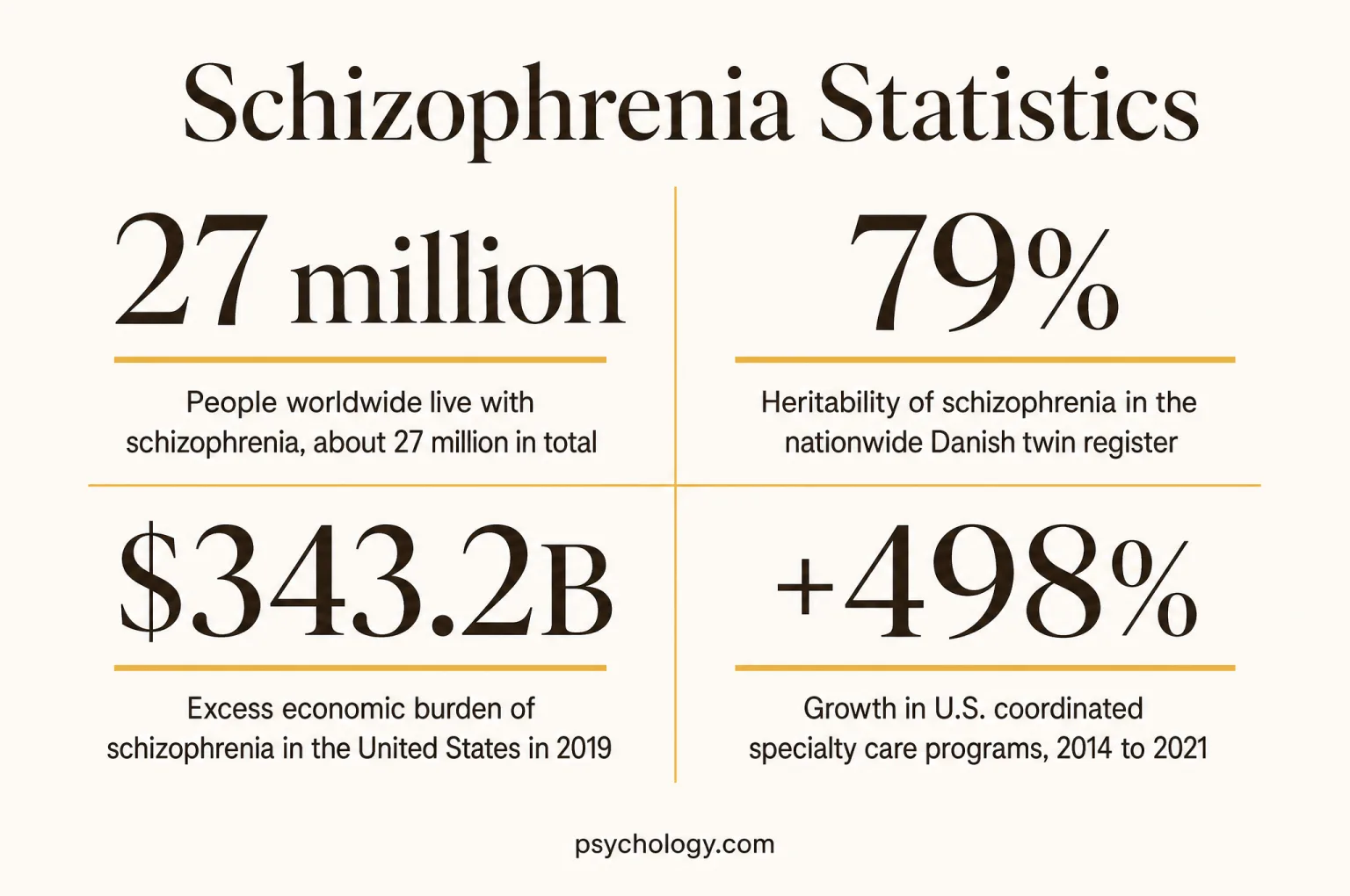
- WHO’s September 11, 2026 fact sheet estimates that 27 million people worldwide live with schizophrenia; among adults aged 20 and over, it reports about 1 in 206. WHO, 2026
- NIMH’s summary of studies published in 2005, 2006 and 2013 reports U.S. prevalence estimates of 0.25% to 0.64% for schizophrenia and related psychotic disorders across studies using different methods and populations. NIMH
- Solmi and colleagues’ 2023 Global Burden of Disease analysis counted 23.6 million prevalent cases in 2019, up more than 65% since 1990 in raw numbers while age-standardized rates stayed flat. Solmi et al., Molecular Psychiatry, 2023
- 20.5 years was the peak onset age for schizophrenia-spectrum disorders and primary psychotic states in Solmi and colleagues’ 2022 meta-analysis; 47.8% began before 25 and 3% before 14. Solmi et al., Molecular Psychiatry, 2022
- Hilker and colleagues’ 2018 Danish twin-register study estimated schizophrenia heritability at 79%, with concordance of 33% in identical twins and 7% in fraternal twins. Hilker et al., Biological Psychiatry, 2018
- Hjorthøj and colleagues’ 2017 meta-analysis estimated 14.5 years of potential life lost in schizophrenia, with pooled life expectancy of 59.9 years for men and 67.6 for women. Hjorthøj et al., Lancet Psychiatry, 2017
- Correll and colleagues’ 2022 meta-analysis found all-cause mortality 2.94 times the general population’s across 57 studies, and suicide mortality 9.76 times across 28 studies. Correll et al., World Psychiatry, 2022
- Kadakia and colleagues’ 2022 study estimated the U.S. excess economic burden at $343.2 billion in 2019, about double the inflation-adjusted 2013 estimate; methods also changed between estimates. Kadakia et al., Journal of Clinical Psychiatry, 2022
- More than two in three people with psychosis worldwide, according to WHO’s September 11, 2026 fact sheet, receive no specialist mental health care; only 29% do. WHO, 2026
- Ayano and colleagues’ 2019 review estimated schizophrenia prevalence at 10.29% across 24 studies of people experiencing homelessness, and any psychotic disorder at 21.21% across 18 studies. Ayano et al., BMC Psychiatry, 2019
How common schizophrenia is
Schizophrenia prevalence depends on the population and definition being measured. NIMH’s U.S. range covers schizophrenia and related psychotic disorders, while MDPS measures the broader schizophrenia spectrum and distinguishes lifetime from past-year prevalence. WHO’s current fact sheet estimates 27 million people worldwide. These sources answer related but different questions.
People worldwide live with schizophrenia, about 27 million in total
WHO’s fact sheet, updated September 11, 2026, estimates that 27 million people worldwide live with schizophrenia. It reports adult prevalence of 1 in 206 (0.49%) among people aged 20 and over. These are population estimates, and the adult figure uses a different age denominator from the global count. Onset is most often in late adolescence or the twenties. WHO separately reports that approximately 50% of people in mental hospitals have a schizophrenia diagnosis. This hospital statistic describes who occupies those beds and says nothing about how many people with schizophrenia are ever hospitalized.
- 0.25% to 0.64%U.S. prevalence of schizophrenia and related psychotic disorders
NIMH summarizes household surveys, diagnostic interviews and medical records, including studies published in 2005 and 2006. Excluding hospitalized, homeless or incarcerated people can affect estimates; the range does not measure the size of that exclusion bias.
- 0.33% to 0.75%International prevalence among non-institutionalized people
NIMH summarizes international studies published in 2005 and 2018. These estimates concern schizophrenia among non-institutionalized people; diagnostic definitions and sampling methods differ from the U.S. studies, so the ranges are not directly interchangeable.
- 3.7 millionU.S. adults aged 18 to 65 with a lifetime history of a schizophrenia-spectrum disorder
The 2023 MDPS report, based on interviews conducted from October 2020 to October 2022, estimates 3.7 million (1.8%) with a lifetime history. Its past-year estimate is 2.5 million (1.2%). The spectrum includes schizophrenia, schizoaffective disorder and schizophreniform disorder.
- 3.9 millionAmericans with schizophrenia in the 2019 economic burden model
The 2022 model applied a lifetime prevalence assumption of 1.19% to the 2019 U.S. population, giving 3,906,050 people. This is a modeled count used for costing, rather than a survey count of people currently experiencing symptoms.
- 23.6 millionPrevalent cases worldwide in 2019, Global Burden of Disease study
The GBD 2019 analysis estimated 23.6 million prevalent cases and an age-standardized prevalence of 287.4 per 100,000. These modeled estimates have uncertainty intervals and should be compared within the same GBD round.
GBD 2019 Mental Disorders Collaborators, Lancet Psychiatry, 2022
- 80.54 per 100,000Median annual incidence of first-episode psychosis among privately insured Americans aged 15 to 40
The 2026 study identified 86,695 first-episode diagnoses in commercial claims from 2013 to 2021. Comparing estimated incidence with national program enrollment suggested that more than 90% do not access coordinated specialty care; it did not follow everyone over a lifetime.
- 15 to 100 per 100,000People who develop psychosis each year, in NIMH’s research summary
NIMH’s 2023 Understanding Psychosis publication reports this annual incidence range without assigning it a single data year. Psychosis can occur in several psychiatric and medical conditions, so this range cannot be interpreted as the number of new schizophrenia diagnoses. Incidence measures new occurrences; prevalence measures people living with a condition.
Interpreting global counts across study rounds
An analysis of GBD 2021 estimates 23.18 million prevalent cases and 1.223 million incident cases in 2021, with the prevalent count up about 70.1% since 1990 and relatively stable global age-standardized estimates (Frontiers in Psychiatry, 2025). Stable age-standardized estimates do not show that risk was unchanged in every country or age group. GBD 2021 is also not the latest round cited by WHO’s 2026 fact sheet. The Lancet Commission announcement describes about 23 million people with schizophrenia and related psychotic disorders and reports schizophrenia accounting for 1.5% to 3% of health expenditure in developed countries (Fondation FondaMental, May 24, 2026). These are attributed summaries from separate sources and do not add up to a single harmonized global estimate.
Who schizophrenia affects
Global estimates show a modest male predominance in schizophrenia, while age of onset tends to be earlier in men. Family studies, diagnosis-disparity research and studies of people experiencing homelessness address different aspects of who is affected. Custody-related distress figures below provide context for care needs; they do not measure schizophrenia prevalence.
Heritability of schizophrenia in the nationwide Danish twin register
The 2018 study analyzed 31,524 Danish twin pairs born between 1951 and 2000 and followed through June 1, 2011. Estimated schizophrenia concordance was 33% for identical twins and 7% for fraternal twins; heritability was 79% for schizophrenia and 73% for the broader spectrum. Heritability describes variation in susceptibility within a population under a statistical model. It is not the percentage of an individual’s illness caused by genes, and the concordance estimate is not a guarantee about either twin’s future.
- 1.1 to 1Male-to-female ratio of prevalence worldwide
The 2023 GBD analysis reports a male-to-female burden ratio of 1.1 across 1990 to 2019. Raw prevalence was higher in women after age 65; the authors discuss earlier male onset and longer female life expectancy as possible explanations.
- Late teens to early 30sTypical onset window, with men first
NIMH places male onset in late adolescence to the early twenties and female onset in the early twenties to early thirties. Its topic page states that diagnosis usually occurs between 16 and 30; onset and diagnosis are distinct events.
- 2.42xOdds that a Black American is diagnosed with schizophrenia compared with a White American
The 2018 meta-analysis combined 55 U.S. studies. The structured-interview subgroup had an odds ratio of 1.77, but its difference from unstructured assessments was not statistically significant; these data do not isolate clinician judgment as the cause.
- 3 to 6xHigher likelihood that autistic youth develop schizophrenia than neurotypical peers
A 2022 conceptual review reports this association for autistic youth and discusses overlapping clinical and genetic features. Read it as a relative association. It gives no absolute probability that an autistic person will develop schizophrenia.
- 10.29%Pooled schizophrenia prevalence in studies of people experiencing homelessness
The 2019 review included 31 studies and 51,925 participants overall, but the schizophrenia estimate uses 24 studies. Eighteen studies yielded 21.21% for any psychotic disorder. Schizophrenia estimates ranged from 8.83% in developed-country studies to 22.15% in developing-country studies, with substantial heterogeneity.
- 14% and 26%Prisoners and jail inmates with serious psychological distress in the past 30 days, versus 5% of the general population
BJS’s 2011 to 2012 National Inmate Survey measured distress during the previous 30 days and compared it with a standardized general-population estimate. These are broad distress measures; they do not count schizophrenia diagnoses or estimate schizophrenia prevalence in custody.
| Exposure or scenario | Result | Source |
|---|---|---|
| Daily cannabis use versus never use, adjusted odds ratio | 3.2x | Di Forti et al., 2019 |
| Daily high-potency use versus never use, adjusted odds ratio | 4.8x | Di Forti et al., 2019 |
| Estimated preventable fraction across all sites if high-potency cannabis were unavailable, assuming causality | 12.2% | Di Forti et al., 2019 |
| Same modeled fraction for London, assuming causality | 30.3% | Di Forti et al., 2019 |
| Same modeled fraction for Amsterdam, assuming causality | 50.3% | Di Forti et al., 2019 |
Worried about early signs in yourself or someone close? Psychology.com's free psychosis risk screening and paranoia test are short, private, and built to support a conversation with a professional; they cannot establish a diagnosis.
Onset, symptoms and course
Onset and diagnosis often occur in young adulthood, but the timing varies. Studies of first-episode psychosis show substantial delays before treatment, and research uses several definitions of recovery. The figures below retain those distinctions so that an age distribution, a treatment delay and a recovery proportion are not mistaken for an individual prognosis.
Peak onset age for schizophrenia-spectrum disorders and primary psychotic states
The 2022 meta-analysis covered 192 studies and 708,561 people across many mental disorders. Its schizophrenia-spectrum and primary-psychosis group included 36 studies, with median onset at 25 and an interquartile range of 20 to 34. Within that broader group, 3% of onsets occurred before 14, 12.3% before 18 and 47.8% before 25. The peak age was 20.5 years. These are population summaries rather than diagnostic age cutoffs, and the full review’s sample size should not be mistaken for a schizophrenia-only sample.
- 16 to 30Age range in which most people are first diagnosed
NIMH states that schizophrenia is usually diagnosed between ages 16 and 30, after the first episode of psychosis. Changes in thinking, mood and social functioning can precede that episode; these changes are not specific enough to establish a diagnosis.
- 75% to 80%Schizophrenia cases with onset before age 40, in a 2019 review
The clinical review defines early onset as before 40, late onset as 40 to 60 and very late onset as after 60. It estimates 20% to 25% begin in the latter two groups; women are more represented in later-onset groups.
Tampi et al., Therapeutic Advances in Psychopharmacology, 2019
- 14 weeksMedian duration of untreated psychosis worldwide, with a mean of 42.6 weeks
The 2024 meta-analysis included 369 studies of first-episode psychosis. The pooled median used 206 studies and 37,215 people; the mean of 42.6 weeks used 283 studies and 41,320 people. These summarize different sets of studies.
- 74 weeksMedian duration of untreated psychosis among 404 Americans in the NIMH RAISE trial
The U.S. RAISE trial enrolled 404 people aged 15 to 40 with first-episode schizophrenia or related disorders. Its 2016 report found a 74-week median delay. This selected trial sample should not be treated as a nationally representative U.S. estimate.
- 13.5%Median share of people who meet strict recovery criteria
The 2013 review included 50 studies of schizophrenia and related psychoses, searched through October 2011. Recovery required improvement in clinical and social domains, sustained for at least two years in at least one domain. It did not establish the current recovery rate.
- At least 1 in 3People with schizophrenia who will be able to fully recover, per WHO
WHO’s September 11, 2026 fact sheet says at least one in three people will be able to fully recover and at least a third experience complete remission of symptoms. These statements use different concepts from the strict historical review above; their difference is not a measured change over time.
Untreated psychosis and later outcomes
In the 2016 RAISE report, coordinated care improved quality-of-life scores over two years, with an effect size of 0.31 overall. The effect sizes were 0.54 for untreated psychosis lasting 74 weeks or less and 0.07 for longer durations (Kane et al., 2016). Those subgroup differences do not make 74 weeks a biological deadline for benefit. A review published online on December 26, 2024 describes estimates of impaired illness awareness ranging from 50% to 98%, with important differences in definitions and measures (Rose and Harvey, CNS Spectrums). That wide range should not be read as a precise current prevalence or as the sole explanation for delayed care.
Changes in mood and sleep can be described alongside the timing of experiences when preparing for a professional assessment. Psychology.com’s daily diary card and sleep diary provide spaces to record those observations. Neither worksheet establishes a schizophrenia diagnosis or estimates a person’s future risk; the population figures above serve a different purpose from an individual assessment.
Impact: health, mortality and cost
Schizophrenia’s economic burden extends to families, employers and health systems. A U.S. model published in 2022 estimated that indirect costs accounted for nearly three quarters of the 2019 total. Comparisons with the earlier 2013 estimate reflect both changing costs and changes in how researchers counted and valued the burden.
Excess economic burden of schizophrenia in the United States in 2019
The 2022 study estimated $251.9 billion in indirect costs (73.4% of the total), including caregiving ($112.3 billion), premature mortality ($77.9 billion) and unemployment ($54.2 billion). Direct health care was $62.3 billion (18.2%), and direct non-health care was $35.0 billion (10.2%) before subtracting $6.0 billion in cost offsets (1.7%). The annual excess cost was $87,856 per modeled person with schizophrenia. The estimate roughly doubled from 2013 after inflation adjustment, but the methods and prevalence assumptions also changed, so this is not a like-for-like measurement of spending growth.
- 3% to 4%Swedish adults with schizophrenia classified as employed as their main activity, 2006 to 2013
The register study covered ages 18 to 64. Disability pension was the main activity for 86% in 2006 and 83% in 2013. The employment measure is a main-activity classification rather than a count of anyone doing paid work; the study does not establish a U.S. employment rate.
- 26.8%Lifetime prevalence of suicide attempts among people with schizophrenia
The review published online in 2019 included 35 studies and 16,747 people overall; 28 studies contributed to lifetime prevalence. The 45.9% since-onset and 3.0% one-year estimates each came from only two studies. Because the samples and recall periods differ, the three figures cannot be compared directly as risks.
- 10.1% vs 6.6%Recorded violent victimisation in schizophrenia-spectrum patients versus community controls, Victoria, Australia
The 2013 study linked records for 4,168 patients and 4,641 community controls, using diagnosis cohorts from 1975 to 2005. Recorded sexual victimisation was 1.7% versus 0.3% (reported odds ratio 2.77). These record-based proportions are not annual victimisation rates.
- 41.8%Caregivers reporting moderate to severe burden in a 2012 Iranian convenience sample
Among 225 family caregivers recruited in Hamadan from July to September 2012, 41.8% reported moderate to severe burden, 27.1% severe burden and 43.1% feelings of burnout. This single-hospital sample does not estimate national caregiver prevalence.
- 12 per 100,000State psychiatric hospital beds in the United States, against a recommended 50
TAC reports 12 state-hospital beds per 100,000 people in 2023 and cites an expert planning benchmark of 50. Beds occupied by civil patients per capita fell 17% from 2016 to 2023; the median jail wait was two months across 26 reporting states.
| Component | 2019 cost | Share of total |
|---|---|---|
| Indirect costs, all | $251.9B | 73.4% |
| Unpaid caregiving | $112.3B | part of the 73.4% |
| Premature mortality | $77.9B | part of the 73.4% |
| Unemployment | $54.2B | part of the 73.4% |
| Direct health care | $62.3B | 18.2% |
| Direct non-health care before offsets | $35.0B | 10.2% |
| Cost offsets subtracted | -$6.0B | -1.7% |
Disability at global scale
Schizophrenia accounted for 12.2% of mental-disorder DALYs in GBD 2019 and ranked 20th among all causes of years lived with disability. The disability weight for acute psychosis was the highest health-state weight in that study (GBD 2019 Mental Disorders Collaborators, 2022). Solmi and colleagues report 15.1 million schizophrenia DALYs for 2019 (Solmi et al., 2023). NIMH’s separate statistics summary describes schizophrenia among the top 15 causes of disability (NIMH). Those rankings come from different source summaries and should not be treated as a measured change in rank. DALYs combine disability and premature mortality, although the GBD method does not capture the full excess mortality associated with schizophrenia.
Treatment and the care gap
Maintenance antipsychotic trials show lower relapse rates than placebo, and a 2017 review found clozapine response in about four in ten participants with treatment-resistant schizophrenia. Access remains uneven: WHO reports low specialist-care coverage for psychosis worldwide, while U.S. data show declining clozapine prescribing per Medicare Part D enrollee between 2015 and 2020.
People with psychosis worldwide who do not receive specialist mental health care
WHO’s September 11, 2026 fact sheet reports that only 29% of people with psychosis receive specialist mental health care. This concerns psychosis as a group, rather than schizophrenia alone. A separate U.S. measure from the 2022 NSDUH found that 66.7% of adults with serious mental illness received mental health treatment, representing 10.2 million of an estimated 15.4 million adults. That broader category includes multiple diagnoses, and its treatment measure includes inpatient, outpatient and prescription care. These percentages describe different populations and services, so they cannot be used as a direct international comparison.
- 27% vs 64%One-year relapse on antipsychotic medication versus placebo
The 2012 review included 65 randomized maintenance-treatment trials with 6,493 patients stabilized before continuation or withdrawal. One-year relapse was 27% versus 64% (risk ratio 0.40; number needed to treat 3); readmission was 10% versus 26%.
- 40.1%People with treatment-resistant schizophrenia who respond to clozapine
The 2017 meta-analysis estimated a 40.1% response rate, with a 22-point mean PANSS symptom-score reduction across the analyzed treatment data as a whole, responders and non-responders alike. Its background estimates 25% to 33% have treatment resistance and suggests 12% to 20% may also not respond adequately to clozapine.
- 0.43All-cause mortality risk ratio associated with clozapine use versus no antipsychotic
The 2022 observational meta-analysis reported risk ratios of 0.71 for any antipsychotic, 0.39 for second-generation long-acting injectables and 0.43 for clozapine versus non-use. Associations can be affected by differences between treated and untreated groups; this is not a randomized drug ranking.
- -18.0%Change in population-adjusted clozapine prescriptions among Medicare Part D enrollees, 2015 to 2020
Prescriptions fell from 32.2 to 26.4 per thousand enrollees, with nine-fold variation between states; only Massachusetts and South Dakota consistently prescribed well above average.
- 353Coordinated specialty care programs for first-episode psychosis in the United States in 2021
EPINET reported 353 programs in 2021, compared with 59 in 2014, a 498% increase. At the time, 48 states, the District of Columbia and Puerto Rico had programs. The federal block-grant set-aside rose from 5% to 10% during this period.
- More than 90%Estimated share of Americans with first-episode psychosis not accessing coordinated specialty care
The 2026 authors compared incidence from privately insured people aged 15 to 40 in 2013 to 2021 with national CSC enrollment. The greater-than-90% estimate is inferred by combining datasets; nobody directly observed every American with a first episode.
Psychology.com keeps a plain-language schizophrenia resource page for people newly diagnosed and their families. The directory can help people find a licensed therapist for a conversation about support and local services. Access to a therapist and access to a coordinated specialty care program are different service measures; neither should be inferred from a general mental health treatment percentage.
Trends 2019 to 2026
Recent developments include Cobenfy’s approval in 2024, removal of the clozapine REMS program in 2025 and a Lancet Commission announced in 2026. Historical program counts document the expansion of early psychosis care from 2014 to 2021. Global prevalence estimates also vary between successive modeling rounds, so apparent changes need careful interpretation.
Growth in U.S. coordinated specialty care programs, 2014 to 2021
EPINET counted 59 U.S. coordinated specialty care programs in 2014, 145 in 2015, 170 in 2016, 214 in 2017, 240 in 2018 and 353 in 2021. That is a 498% increase from the 2014 baseline. The report gives federal set-aside funding of $45.7 million in 2015 and $82.5 million in 2021. Responding states reported 6,360 clients served in 2021, an incomplete national count. Separately, a 2026 claims analysis estimated median annual first-episode psychosis incidence at 80.54 per 100,000 privately insured people aged 15 to 40 and inferred a CSC access gap exceeding 90%.
EPINET State Snapshot 2021 to 2022 (NASMHPD and Westat) · Psychiatric Services, 2026
- 23.6M to 23.18MGlobal prevalent cases, GBD 2019 estimate versus GBD 2021 estimate
The 2019 and 2021 GBD rounds use different model versions, so these totals alone do not establish a two-year decline. Within their respective rounds, global counts rose about 65% to 70% from 1990 while age-standardized estimates remained relatively stable; this does not mean every population’s risk was unchanged.
- September 26, 2024FDA approval of xanomeline and trospium (Cobenfy), the first new class of schizophrenia medicine in several decades
It targets muscarinic rather than dopamine receptors and cut PANSS scores by 9.6 and 8.4 points more than placebo in two five-week trials. The manufacturer cites 2.8 million Americans with schizophrenia and says up to 60% get inadequate improvement or intolerable side effects on existing drugs.
Bristol Myers Squibb approval announcement, September 26, 2024, PDF
- June 13, 2025FDA removed the clozapine REMS program
FDA removed the restricted-distribution and reporting program effective June 13, 2025, concluding that labeling and routine safety surveillance could manage the risk. The agency still advises prescribers to monitor absolute neutrophil counts according to the prescribing information.
- 88.0 to 23.8 weeksMean untreated psychosis duration in European studies published in 1991 to 2000 versus 2021 to 2022
The 2024 meta-analysis groups studies by publication period. The pooled means were 88.0 and 23.8 weeks, but the earlier estimate had a wide 95% confidence interval of 18.5 to 157.6 weeks. The comparison sets different study samples side by side and does not track one population over time.
- -17%Change in state-hospital beds occupied by civil patients per capita, 2016 to 2023
TAC reports a 17% decline in civil occupancy per 100,000 population. Its separate total of 12 state-hospital beds per 100,000 in 2023 includes civil and forensic use; the 50 per 100,000 figure is an expert planning benchmark and was never measured as the need for schizophrenia alone.
- May 24, 2026Announcement of the Lancet Commission on schizophrenia and psychotic disorders
Co-chaired by Marion Leboyer and Michael Berk and launched on World Schizophrenia Awareness Day, the Commission is due to report within three years.
| Year | Development | Source |
|---|---|---|
| 2019 | GBD counts 23.6 million prevalent cases, 1.3 million new cases and 15.1 million DALYs worldwide | Solmi et al., 2023 |
| 2019 | Estimated U.S. excess economic burden is $343.2 billion; the earlier 2013 model estimated $155.7 billion using different methods | Kadakia et al., 2022 |
| 2021 | 353 coordinated specialty care programs operate across 48 states, DC and Puerto Rico | EPINET, 2022 |
| 2022 | 15.4 million U.S. adults (6.0%) have a serious mental illness; 66.7% receive treatment | NIMH |
| 2024 | FDA approves Cobenfy, the first schizophrenia antipsychotic targeting cholinergic rather than dopamine receptors | Bristol Myers Squibb |
| 2025 | FDA ends the clozapine REMS, effective June 13, 2025 | FDA |
| 2026 | Lancet Commission announced; WHO fact sheet updated to 27 million people worldwide | Fondation FondaMental · WHO |
Limits of the historical comparisons
The recovery review published in 2013 found no improvement across the historical studies it included; its search ended in October 2011 (Jääskeläinen et al., 2013). The 2018 diagnosis-disparity review found a persistent Black/White difference across three decades of included U.S. research (Olbert et al., 2018). Neither establishes that the same pattern continued unchanged through 2026. Medicare clozapine prescribing fell between 2015 and 2020 (PLOS One, 2025), before the 2025 REMS removal. Assessing that policy’s effect requires later utilization data and an analysis that accounts for other changes in prescribing.
Life expectancy and physical health
Physical illnesses contribute substantially to early mortality among people with schizophrenia. The studies below measure different outcomes: years of potential life lost, mortality risk ratios, metabolic conditions and recorded deaths in a hospital cohort. Keeping these measures distinct matters, because a population average is not a forecast for a particular person.
Years of potential life lost, weighted average across 11 studies on five continents
Hjorthøj and colleagues’ 2017 meta-analysis included 11 studies reported in 13 publications, covering five continents and up to 247,603 people. It estimated 14.5 years of potential life lost overall, 15.9 for men and 13.6 for women. Pooled life expectancy was 64.7 years overall, 59.9 for men and 67.6 for women. NIMH separately reports 28.5 years of potential life lost in a U.S. study published in 2015, while WHO’s September 11, 2026 fact sheet says nine years earlier. These summaries use different populations and measures; their differences do not establish a trend or predict an individual’s lifespan.
Hjorthøj et al., Lancet Psychiatry, 2017 · NIMH, citing 2015 research · WHO, September 11, 2026
- 2.52xAll-cause mortality relative to people without schizophrenia
The 2022 review included 135 studies and 4,536,447 people with schizophrenia overall. The 2.52 risk ratio came from 79 studies using mixed control groups, including people with other illnesses. The separate comparison with the general population was 2.94 across 57 studies.
- 9.76xSuicide mortality relative to the general population
The 2022 meta-analysis pooled 28 studies for this comparison. Separately, Palmer and colleagues’ 2005 model estimated lifetime suicide mortality at 4.9%, with 5.6% in cohorts followed from illness onset or first admission. These are historical group estimates and predict nothing about any one individual.
Correll et al., 2022 · Palmer et al., Archives of General Psychiatry, 2005 · NIMH
- 33.4%Prevalence of metabolic syndrome in people with schizophrenia
The 2015 review estimated schizophrenia-specific metabolic syndrome prevalence at 33.4% across 93 studies and 29,596 people. Its broader severe-mental-illness analyses found 47.2% among clozapine users and, in matched-control studies, 29.2% versus 18.1% in controls (risk ratio 1.58).
- 2.15xOdds of type 2 diabetes with a history of schizophrenia
The 2024 review pooled 32 observational studies published from 2004 to 2023, including 2,007,168 people with schizophrenia and 35,883,980 without. Sex-specific odds ratios versus the respective non-schizophrenia comparison groups were 2.12 for women and 1.68 for men.
- 7.2x and 3.3xOdds of current smoking in men and women with schizophrenia versus general-population comparators
The 2005 review reports an odds ratio of 7.2 across 32 male studies in 18 nations and 3.3 across 25 female studies in 15 nations. The odds ratios come from historical studies and do not measure smoking prevalence or current risk multipliers.
- 58.97 yearsMean age at death among 123 deaths in a Romanian schizophrenia cohort
The 2025 study followed 635 hospitalized patients for ten years and observed 21.3 deaths per 1,000 person-years. The authors compared mean age at death with national life expectancy to describe a roughly 17-year gap; that subtraction is not a life-table estimate for the cohort.
Care and the mortality gap
In the 2022 meta-analysis, antipsychotic use was associated with lower all-cause mortality than non-use (risk ratio 0.71), with stronger associations for some long-acting injectables and clozapine (Correll et al., 2022). These observational results do not determine how many years of the gap treatment can prevent. WHO identifies cardiovascular, metabolic and infectious conditions as contributors to early death (WHO, 2026). NIMH reports that one third of U.S. adults with serious mental illness received no mental health treatment in 2022 (NIMH), but that broad treatment measure does not measure access to physical-health care.
Common questions
How common is schizophrenia?
WHO estimates about 27 million people worldwide; among adults aged 20 and over it is 1 in 206. NIMH puts U.S. prevalence of schizophrenia and related psychotic disorders between 0.25% and 0.64%, and the 2023 MDPS report estimates that 3.7 million American adults aged 18 to 65 have a lifetime history of a schizophrenia-spectrum disorder. The Global Burden of Disease study counted 23.6 million prevalent cases worldwide in 2019 and about 1.3 million new cases a year.
At what age does schizophrenia usually start?
Solmi and colleagues’ 2022 meta-analysis reports peak onset at 20.5 years, median onset at 25, and the middle half between 20 and 34 for schizophrenia-spectrum disorders and primary psychotic states. It estimates 3% before 14 and 12.3% before 18. NIMH describes earlier onset in men and diagnosis usually between 16 and 30. A 2019 review places 75% to 80% of schizophrenia onsets before 40. A separate 2024 review reports mean untreated first-episode psychosis lasting 42.6 weeks; onset and diagnosis measure different events.
Is schizophrenia genetic?
A Danish twin study published in 2018 estimated heritability at 79%, with schizophrenia concordance of 33% for identical twins and 7% for fraternal twins. Heritability describes how much susceptibility varies across a population; it says nothing about an individual’s probability of developing schizophrenia. The study followed twins through June 1, 2011, so the remaining co-twins cannot be described as people who will never develop it. The results support contributions from genetic and environmental factors, while leaving substantial uncertainty about any one person’s future.
Do people recover from schizophrenia?
WHO states that at least one in three people with schizophrenia will be able to fully recover. A historical 2013 review found a median recovery proportion of 13.5% across 50 studies, requiring clinical and social improvement, with at least one domain sustained for two years. These different definitions and study populations should not be treated as interchangeable forecasts. A 2012 review of maintenance-treatment trials reported one-year relapse of 27% with antipsychotics versus 64% with placebo, while the RAISE trial found benefits from coordinated care. Individual outcomes vary.
Why do people with schizophrenia die earlier?
Physical illnesses contribute substantially to premature mortality. A 2022 meta-analysis found all-cause mortality 2.94 times that of the general population. A separate 2017 review estimated 14.5 years of potential life lost, with pooled life expectancy of 59.9 years for men and 67.6 for women. These historical averages do not determine an individual’s lifespan. Cardiovascular, metabolic and infectious conditions are important concerns, and observational studies associate antipsychotic treatment with lower mortality. The size of the gap varies across populations and methods.
What is the suicide risk in schizophrenia?
Historical studies show elevated risk, but group statistics cannot predict an individual’s future. Palmer and colleagues’ 2005 model estimated lifetime suicide mortality at 4.9%; a 2019 review estimated lifetime suicide-attempt prevalence at 26.8% across 28 studies. These are distinct outcomes, and most people with schizophrenia do not die by suicide. Support and care are available. If you or someone you know is thinking about suicide, call or text 988 in the United States to reach the Suicide and Crisis Lifeline at any hour.
Does psychosis always mean schizophrenia?
Psychosis can occur with several conditions and does not by itself establish schizophrenia. NIMH’s Understanding Psychosis publication describes psychosis in bipolar disorder, severe depression and some neurological illnesses, as well as in association with sleep deprivation, medications or substance use. Some people experience psychosis without later receiving a schizophrenia diagnosis. This distinction explains why statistics for psychosis, schizophrenia-spectrum disorders and schizophrenia cannot be substituted for one another. An individual diagnosis requires a qualified professional assessment.
How we compiled this
This page combines historical and recent estimates from WHO, NIMH, GBD analyses, federal reports and peer-reviewed research. The September 13, 2026 verification checked all ten findings, all seven figure blocks, every data row, and the supporting charts and notes against freshly fetched source text. Blocked publisher pages were replaced with accessible copies of the same research or NCBI abstracts. Study populations, reference periods and outcome definitions are stated where they affect interpretation. Odds ratios are distinguished from risks, and observational associations from causal effects. Different studies and modeling rounds are not treated as directly comparable. WHO’s internally inconsistent all-age reciprocal and percentage were omitted; its population count is retained as an attributed estimate. These statistics are educational and do not predict individual outcomes. On September 16, 2026, WHO and NIMH were fetched again and the existing research citations were checked for access and numerical support. NIMH’s mental-illness page contains conflicting narrative and chart values for serious mental illness; this page attributes its historical treatment figures to the narrative and does not combine them with the chart. A newer NSDUH release was located, but its publisher text could not be retrieved, so no newer estimate was substituted. New psychosis incidence figures come from a separate NIMH publication and retain its broader diagnostic scope. Last full review: September 16, 2026.
Journalists and researchers may reuse any statistic with attribution to the original source and a link to Psychology.com.
Cite this source
Fontane Pennock, S. (2026, September 13). Schizophrenia Statistics 2026. Psychology.com. https://psychology.com/schizophrenia-statistics/
References
- World Health Organization. (September 11, 2026). Schizophrenia: fact sheet. who.int
- National Institute of Mental Health. (n.d.). Schizophrenia: statistics. nimh.nih.gov
- National Institute of Mental Health. (n.d.). Mental illness: statistics (2022 National Survey on Drug Use and Health). nimh.nih.gov
- Ringeisen, H., et al. (2023). Mental and Substance Use Disorders Prevalence Study: Findings Report. RTI International. Full report PDF
- Treatment Advocacy Center. (2023). Bed shortages. tac.org
- GBD 2019 Mental Disorders Collaborators. (2022). Global, regional, and national burden of 12 mental disorders in 204 countries and territories, 1990 to 2019. The Lancet Psychiatry, 9(2), 137-150. pmc.ncbi.nlm.nih.gov
- Solmi, M., et al. (2023). Incidence, prevalence, and global burden of schizophrenia: data, with critical appraisal, from the Global Burden of Disease (GBD) 2019. Molecular Psychiatry. nature.com
- Solmi, M., Radua, J., Olivola, M., et al. (2022). Age at onset of mental disorders worldwide: large-scale meta-analysis of 192 epidemiological studies. Molecular Psychiatry, 27, 281-295. pmc.ncbi.nlm.nih.gov
- Hjorthøj, C., Stürup, A. E., McGrath, J. J., & Nordentoft, M. (2017). Years of potential life lost and life expectancy in schizophrenia: a systematic review and meta-analysis. The Lancet Psychiatry, 4(4), 295-301. research.regionh.dk
- Correll, C. U., et al. (2022). Mortality in people with schizophrenia: a systematic review and meta-analysis of relative risk and aggravating or attenuating factors. World Psychiatry, 21(2), 248-271. pmc.ncbi.nlm.nih.gov
- Palmer, B. A., Pankratz, V. S., & Bostwick, J. M. (2005). The lifetime risk of suicide in schizophrenia: a reexamination. Archives of General Psychiatry, 62(3), 247-253. NCBI abstract
- Lu, L., et al. (2019). Prevalence of suicide attempts in individuals with schizophrenia: a meta-analysis of observational studies. Epidemiology and Psychiatric Sciences, 29, e39. pmc.ncbi.nlm.nih.gov
- Kadakia, A., et al. (2022). The economic burden of schizophrenia in the United States. Journal of Clinical Psychiatry, 83(6). psychiatrist.com
- Hilker, R., et al. (2018). Heritability of schizophrenia and schizophrenia spectrum based on the nationwide Danish twin register. Biological Psychiatry, 83(6), 492-498. NCBI abstract
- Di Forti, M., et al. (2019). The contribution of cannabis use to variation in the incidence of psychotic disorder across Europe (EU-GEI): a multicentre case-control study. The Lancet Psychiatry, 6(5), 427-436. NCBI abstract
- Olbert, C. M., Nagendra, A., & Buck, B. (2018). Meta-analysis of Black vs. White racial disparity in schizophrenia diagnosis in the United States. Journal of Abnormal Psychology, 127(1), 104-115. NCBI abstract
- Hunt, G. E., Large, M. M., Cleary, M., Lai, H. M. X., & Saunders, J. B. (2018). Prevalence of comorbid substance use in schizophrenia spectrum disorders in community and clinical settings, 1990 to 2017. Drug and Alcohol Dependence, 191, 234-258. NCBI abstract
- Ayano, G., Tesfaw, G., & Shumet, S. (2019). The prevalence of schizophrenia and other psychotic disorders among homeless people: a systematic review and meta-analysis. BMC Psychiatry, 19, 370. pmc.ncbi.nlm.nih.gov
- Bronson, J., & Berzofsky, M. (2017). Indicators of mental health problems reported by prisoners and jail inmates, 2011-12. Bureau of Justice Statistics. bjs.ojp.gov
- Salazar de Pablo, G., et al. (2024). What is the duration of untreated psychosis worldwide? A meta-analysis of pooled mean and median time and regional trends and other correlates across 369 studies. Psychological Medicine. cambridge.org
- Kane, J. M., et al. (2016). Comprehensive versus usual community care for first-episode psychosis: 2-year outcomes from the NIMH RAISE Early Treatment Program. American Journal of Psychiatry, 173(4), 362-372. pmc.ncbi.nlm.nih.gov
- Jääskeläinen, E., et al. (2013). A systematic review and meta-analysis of recovery in schizophrenia. Schizophrenia Bulletin, 39(6), 1296-1306. PMC full text
- Leucht, S., et al. (2012). Antipsychotic drugs versus placebo for relapse prevention in schizophrenia: a systematic review and meta-analysis. The Lancet, 379(9831), 2063-2071. NCBI abstract
- Haddad, P. M., Brain, C., & Scott, J. (2014). Nonadherence with antipsychotic medication in schizophrenia: challenges and management strategies. Patient Related Outcome Measures, 5, 43-62. pmc.ncbi.nlm.nih.gov
- Siskind, D., Siskind, V., & Kisely, S. (2017). Clozapine response rates among people with treatment-resistant schizophrenia: data from a systematic review and meta-analysis. Canadian Journal of Psychiatry, 62(11), 772-777. NCBI abstract
- U.S. Food and Drug Administration. (2025). FDA removes Risk Evaluation and Mitigation Strategy (REMS) program for the antipsychotic drug clozapine. fda.gov
- Bristol Myers Squibb. (September 26, 2024). U.S. Food and Drug Administration approves Bristol Myers Squibb's COBENFY (xanomeline and trospium chloride). bms.com PDF
- Kazandjian, M., et al. (2022). State Snapshot 2021-2022: Early psychosis programming across the United States. EPINET, NASMHPD and Westat. nationalepinet.org
- Breitborde, N. J. K., et al. (2026). Incidence of first-episode psychosis among privately insured individuals. NCBI abstract
- Vancampfort, D., et al. (2015). Risk of metabolic syndrome and its components in people with schizophrenia and related psychotic disorders, bipolar disorder and major depressive disorder: a systematic review and meta-analysis. World Psychiatry, 14(3), 339-347. pmc.ncbi.nlm.nih.gov
- National Institute of Mental Health. (2023). Understanding Psychosis. NIH Publication No. 23-MH-8110. Annual incidence and the distinction between psychosis and schizophrenia. nimh.nih.gov
More statistics and related pages
Talk it through with a licensed therapist
If psychosis, paranoia or a schizophrenia diagnosis is part of your life or someone else's, a licensed therapist can help you sort out what applies to you and what to do next. Browse license-verified therapists on the internet's original directory.
This page is educational information, not a diagnosis or a substitute for professional care. If you are in crisis, call or text 988 (U.S. Suicide & Crisis Lifeline), any time.