 Reviewed by
In short
Psychotherapy and counseling help people work through distress, mental health symptoms, and life difficulties with a trained professional. Approaches include cognitive behavioral, psychodynamic, humanistic, and interpersonal therapy. Expect an initial assessment, shared goals, and conversations or exercises tailored to your needs, with the format and pace agreed on together.
Key facts
- Psychotherapy, or talk therapy, is a collaborative treatment with a trained mental health professional. It can take place individually or in a group. NIMH: Psychotherapies.
- There are several evidence-based approaches, including CBT, psychodynamic therapy, and humanistic therapy. The approach should match the problem being treated and the clinician's training. NIMH: Choosing an approach.
- Therapy is effective for many conditions, including anxiety and depression, and can support personal growth. It may be used alongside medication depending on the condition and your needs. NIMH: Treatment options.
- The relationship with your therapist supports effective treatment: comfort, trust, and collaboration matter when discussing personal difficulties. NIMH: What to look for in a therapist.
What is psychotherapy?
Psychotherapy is a collaborative treatment in which you work with a trained professional to understand and change thoughts, feelings, and behaviors that are causing distress. People also call it talk therapy or counseling. Your goals might include sleeping more consistently, managing worry, or handling conflict with less distress. It is delivered by licensed clinicians such as psychologists, licensed counselors, clinical social workers, marriage and family therapists, and psychiatrists.
The American Psychological Association describes psychotherapy as a way to help people of all ages live happier, healthier, and more productive lives by addressing emotional difficulties and mental health conditions. It is not just for crisis. People use therapy to recover from a specific problem, to cope with a hard period, to understand long-standing patterns, or simply to grow.
A common question is the difference between psychotherapy and counseling. The terms overlap heavily and are often used interchangeably. Counseling sometimes refers to shorter, focused work on a particular issue, while psychotherapy can imply deeper or longer-term work, but in practice the line is blurry and the right fit depends on your goals, not the label.
The main types of therapy
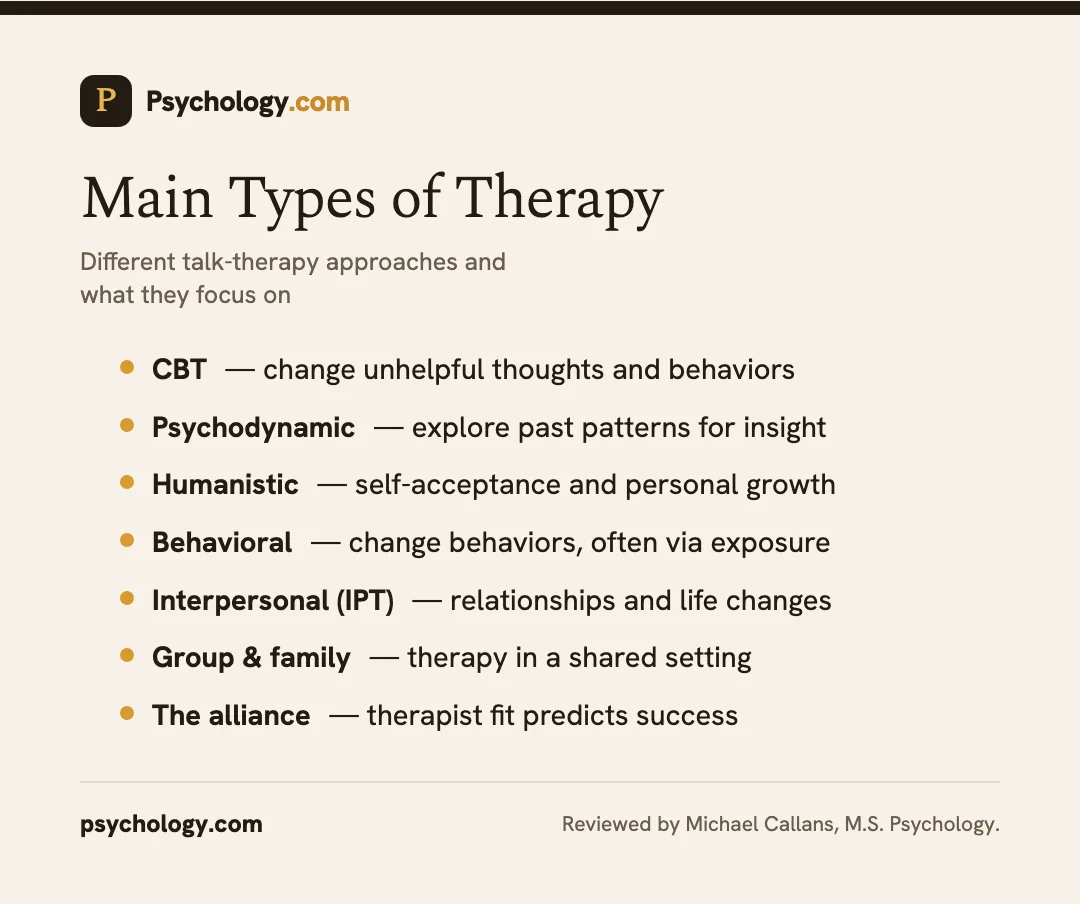
There is no single kind of therapy. Different approaches suit different problems and people, and many therapists blend them. The major families include:
- Cognitive behavioral therapy (CBT). A structured, present-focused approach that helps you identify and change unhelpful thoughts and behaviors. It has strong evidence for anxiety, depression, OCD, and more.
- Psychodynamic therapy. Explores how past experiences and unconscious patterns shape current feelings and relationships, building insight over time.
- Humanistic therapy. Centers on self-acceptance, personal growth, and your own capacity to change, with approaches such as person-centered therapy.
- Behavioral therapy. Focuses on changing specific behaviors through methods like exposure, often used for phobias and anxiety.
- Interpersonal therapy (IPT). Targets relationship difficulties and life changes that affect mood, with good evidence for depression.
- Group and family therapy. Therapy in a shared setting, useful for connection, support, and relationship dynamics. See group therapy.
Several specialized approaches build on these foundations, including EMDR for trauma and acceptance and commitment therapy. The best approach depends on your situation, and a skilled therapist will recommend and adapt as you go.
What therapy treats
Psychotherapy helps with a wide range of mental health conditions and life difficulties. According to the National Institute of Mental Health, it is used to treat conditions including depression, anxiety, PTSD, bipolar disorder, eating disorders, and substance use problems, often alongside medication.
Therapy is not only for diagnosed conditions. People also use it to work through grief, relationship struggles, stress, low self-worth, major transitions, and a general sense of being stuck. The common thread is that talking things through with a trained, objective professional helps you understand what is happening and build healthier ways of responding.
What to expect
Therapy usually starts with an assessment, where the therapist asks about your history, your current concerns, and what you hope to achieve. Together you set goals and agree on a direction. Sessions commonly last about 30 to 50 minutes and may happen weekly, in person or by video, according to the American Psychiatric Association. Your clinician will confirm the schedule for your care.
In sessions you talk openly, and the therapist listens, asks questions, offers perspective, and may teach specific skills. Everything you share is confidential, within the legal limits a therapist will explain at the start, such as situations involving risk of harm. Progress is rarely a straight line, and it is normal for some sessions to feel harder than others. Most importantly, the bond between you and your therapist, sometimes called the therapeutic alliance, is an important part of effective care, so it is worth finding someone you trust.
How to start
Starting therapy is simpler than it can feel. A few steps help:
- Clarify what you want help with. You do not need a perfect description, just a sense of what is bothering you or what you want to change.
- Find a licensed professional. Use a trusted directory, ask your primary care doctor, or check your insurance network. Confirm the therapist is licensed in your state.
- Consider fit and logistics. Think about specialty, approach, cost, format, and availability. Many therapists offer a brief consultation first.
- Give it a few sessions. It can take a session or two to settle in. If it does not feel right after a fair try, it is okay to switch therapists.
If you are in crisis or thinking about harming yourself, do not wait for an appointment. Call or text 988 (Suicide and Crisis Lifeline, US) for free, confidential help any time.
Frequently asked questions
What is the difference between psychotherapy and counseling?
The terms overlap and are often used interchangeably. Counseling sometimes refers to shorter, focused work on a specific issue, while psychotherapy can mean deeper or longer-term work. Both are forms of talk therapy delivered by trained professionals, and the right fit depends on your needs. Ask about the clinician's license, experience with your concern, and proposed approach rather than relying on the service label.
How do I know which type of therapy is right for me?
You do not need to choose alone. A good therapist assesses your situation and recommends an approach, and many combine methods. CBT has strong evidence for anxiety and depression, while other approaches suit relationship patterns, trauma, or personal growth. Ask why the therapist recommends a method, what sessions involve, and how you will judge progress together. Feeling comfortable raising questions is also important.
Does therapy actually work?
Yes. Research shows that psychotherapy can improve symptoms and functioning for many mental health conditions. Some treatment plans use therapy alone, while others combine it with medication. Skills learned during therapy can continue helping afterward. Results depend on your concerns, the approach, and how treatment develops. Agree on concrete goals with your therapist and discuss changes if you are struggling to improve.
How do I find counseling near me?
To find counseling near you, search a therapist directory, your health plan's provider list, or local community mental health clinics. Check the clinician's license and experience with your concern, then confirm availability and fees directly. Ask whether they offer an initial consultation and whether it costs anything. If local options are limited, ask about video appointments with a clinician authorized to practice where you will attend.
Related
- Anxiety
- Depression
- Group Therapy
- Adlerian Therapy
- Jungian Therapy
Therapists who specialize in general counseling
Connect with a licensed therapist on Psychology.com who works with general counseling.
- A FAMILY MATTER
- Advance Thru Psychotherapy and Family Development
- Amanda P Bailey
- Amy Keller
- Anne Ciota
- Arlyn P. Stern LCSW
Browse all therapists →
Finding the right help
When you are ready to take the next step, these guides walk you through finding and starting with the right therapist.
- Getting started with therapy
- How to find the right therapist
- Find a therapist who takes insurance
- Free & low-cost therapy
References
- American Psychological Association (APA): Understanding psychotherapy and how it works
- American Psychiatric Association (APA): What is psychotherapy?
- National Institute of Mental Health (NIMH): Psychotherapies
- Mayo Clinic: Psychotherapy
- NHS: Types of talking therapies
Preparing for your first counseling appointment
Write down what prompted you to seek help, how it affects your daily life, and what you would like to change. Bring questions about confidentiality, fees, and how progress will be reviewed. You can tell the therapist if a topic feels difficult to discuss and ask to approach it gradually.
The Do I Need Therapy? self-reflection test can help you organize concerns; it does not diagnose a condition or determine eligibility for care. Use the feelings wheel to find words for experiences you want to describe. Explore the therapies and approaches hub to compare formats before your consultation.