 Reviewed by
In short
Dual diagnosis means having a mental health condition and a substance use disorder at the same time. These conditions can worsen each other. Integrated treatment addresses both through a coordinated plan that may include therapy, medication, and recovery support, giving people a stronger foundation for lasting recovery.
Key facts
- Dual diagnosis means a person has both a mental health condition and a substance use disorder at the same time. A comprehensive assessment helps distinguish overlapping symptoms. NIMH: co-occurring disorders.
- Co-occurring disorders are common, and either condition can develop first. Shared risks include genetics, stress, and trauma. NIMH: co-occurring disorders.
- Treating one condition while ignoring the other often leads to relapse. Coordinating care reduces the chance that symptoms or medication needs will be overlooked. NIMH: co-occurring disorders.
- Integrated treatment, which addresses both conditions together, works best. Care can combine behavioral therapies, medication, and case management, tailored to the conditions involved. NIMH: co-occurring disorders.
What is dual diagnosis?
Dual diagnosis, also called co-occurring disorders, describes having a mental health condition and a substance use disorder at the same time. The mental health side might be depression, anxiety, bipolar disorder, PTSD, or another condition. The substance use side involves alcohol, prescription medication, or other drugs used in a way that causes harm or loss of control. An assessment should consider when symptoms began, changes in substance use, current medications, and daily functioning. NIMH: co-occurring disorders.
The two conditions are tangled together. Each one can trigger, mask, or worsen the other, which is why a dual diagnosis is best understood as a single, connected picture rather than two separate problems. It is also far from rare. The Substance Abuse and Mental Health Services Administration (SAMHSA) reports that millions of adults in the United States experience co-occurring mental health and substance use disorders, and that many people with a substance use disorder also have a mental illness. Recognizing both is the first step toward effective care.
One reason dual diagnosis can go unrecognized for so long is that the symptoms overlap and obscure each other. Heavy drinking can look like depression, a panic disorder can look like a reaction to stimulants, and the substance use can hide the mental health condition or be blamed for everything. A careful assessment that considers both at once is what untangles the picture.
Why mental health and substance use co-occur
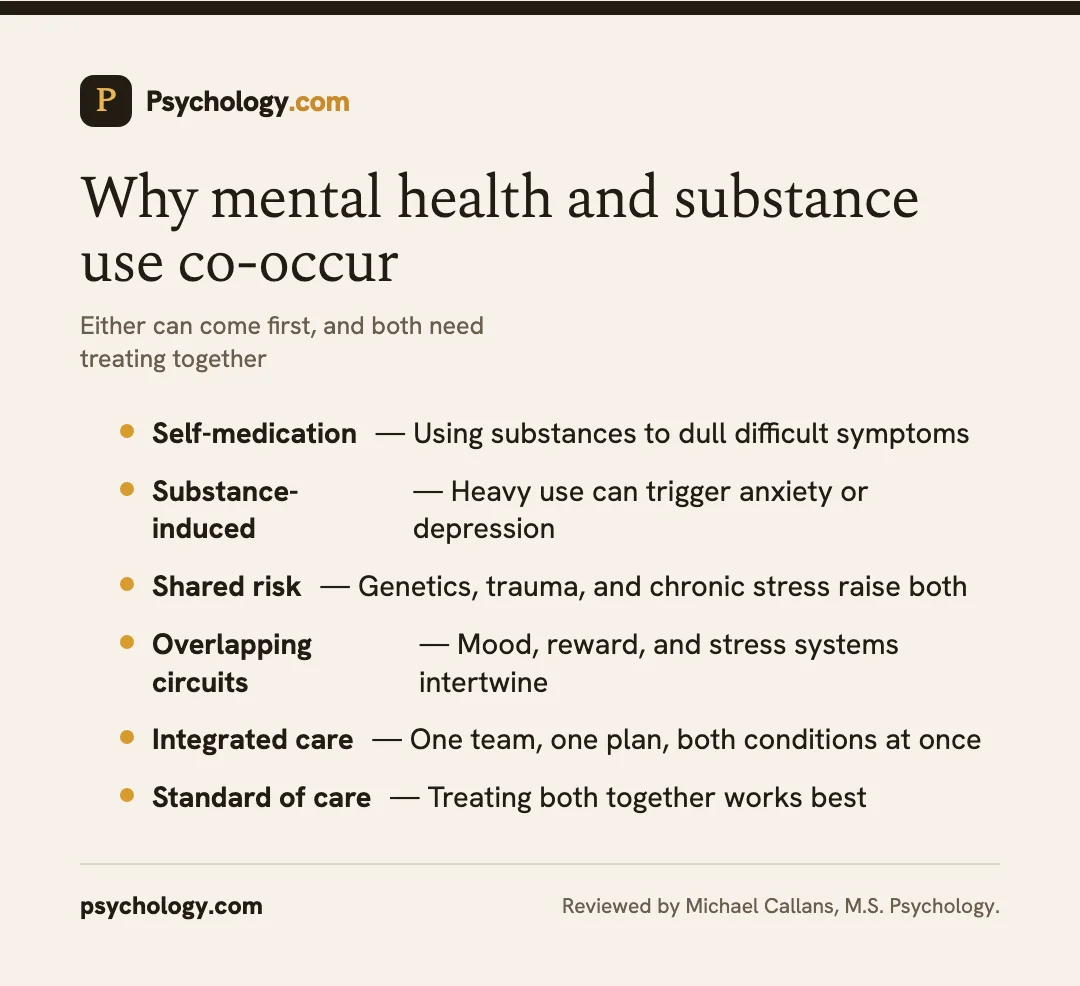
There is no single reason the two appear together, and the relationship runs in more than one direction. The National Institute on Drug Abuse (NIDA) describes three broad explanations for this overlap, none of which excludes the others. Several pathways are common:
- Self-medication: people may use alcohol or drugs to dull difficult symptoms such as low mood, panic, or intrusive memories. Relief is temporary and the underlying condition usually gets worse.
- Substance-induced changes: heavy or long-term substance use can change brain chemistry and trigger or deepen anxiety, depression, or psychosis.
- Shared risk factors: genetics, early trauma, chronic stress, and environment raise the risk of both conditions, which helps explain why they so often appear in the same person.
- Overlapping brain systems: the brain circuits involved in mood, reward, and stress are involved in both mental illness and addiction, so a change in one system can affect the other.
Because the two feed each other, it is often impossible and unnecessary to say which one is the "real" problem. Both are real, and both need attention.
Common combinations
Almost any mental health condition can pair with substance use, but some combinations are seen often. Recognizing a familiar pattern can make it easier to ask for the right help:
- Depression with alcohol use, where drinking briefly lifts mood but deepens it over time
- Anxiety disorders with alcohol or sedative use, used to quiet worry or panic
- PTSD with alcohol or drug use, often to dull intrusive memories or hyperarousal
- Bipolar disorder with stimulant or alcohol use, sometimes tracking mood swings
- Schizophrenia with nicotine, cannabis, or other substance use. See schizophrenia.
These pairings are examples, not rules. The specific combination matters less than the principle that both halves of the picture need to be assessed and treated.
Why integrated treatment matters
“If you have a dual diagnosis, it is usually better to treat both conditions at the same time rather than separately.”
For many years, mental health and addiction were treated in separate systems, and people were sometimes told to get sober before mental health care, or the reverse. That approach often failed because the untreated condition kept pulling the person back. It also created practical barriers, with people bounced between programs that did not communicate.
Integrated treatment addresses both conditions at the same time, with one coordinated team and a single plan. It recognizes that the two problems feed each other and that progress in one area supports progress in the other. The Substance Abuse and Mental Health Services Administration (SAMHSA) identifies integrated treatment, care that treats mental and substance use disorders together rather than separately, as the most effective approach for co-occurring disorders. This model is now considered the standard of care.
| Approach | How it works | Main drawback or strength |
|---|---|---|
| Sequential treatment | One condition treated first, the other afterward | The untreated condition often pulls progress backward |
| Parallel treatment | Both conditions treated at once by separate teams | Care can fragment when providers do not communicate |
| Integrated treatment | One coordinated team, one plan, both conditions together | Considered the standard of care for co-occurring disorders |
More than 1 in 5U.S. adults live with a mental illness, 59.3 million people in 2022NIMH
178,000estimated U.S. deaths per year from excessive drinking during 2020 to 2021; this is an alcohol-harm estimate, not a count of dual diagnosis deathsCDC
21.0 millionU.S. adults had a major depressive episode in 2021; depression is among the most common conditions in dual diagnosisNIMH
How dual diagnosis is treated
Good treatment starts with a thorough assessment that looks at both conditions together, along with physical health, history, and the person's own goals. From there, an integrated plan typically combines the elements below, adjusted over time as needs change.
Therapy
Approaches such as cognitive behavioral therapy, motivational interviewing, and trauma-focused therapy help people understand the link between their symptoms and substance use, build coping skills, and reduce relapse risk. Therapy also addresses the underlying mental health condition directly, which is essential, since treating the substance use alone tends to leave the original driver in place.
Medication
Medication may treat the mental health condition, support recovery from substance use, or both. For some substance use disorders, medication-assisted treatment is an evidence-based option that the Substance Abuse and Mental Health Services Administration (SAMHSA) recognizes as part of comprehensive care. All medication should be managed by a prescriber who knows the full picture, since some substances interact with psychiatric medicines.
Coordinated and ongoing support
Recovery is supported by case management, peer and group support, family involvement, and care that continues over time. Setbacks are common and are treated as part of the process, not as failure. The aim is steady progress and a life worth staying well for, not perfection.
Levels of care can be matched to need and can change over time. Some people do well with outpatient therapy and regular check-ins, while others benefit from more intensive support such as a structured day program or residential treatment, especially early on or after a setback. There is no single right path. What the evidence consistently points to is that treating both conditions together, with continuity of care rather than a one-off intervention, gives people the strongest foundation for lasting recovery.
Does this sound familiar? Answer honestly and kindly; this is a private moment of taking stock, not a judgment.
Free, confidential, self-paced, with an instant plain-language result and a PDF you can bring to a professional. A screening is not a diagnosis.
Free tools and worksheets
Practical, printable exercises from our free library that people managing dual diagnosis often find useful. No signup needed.
When to seek help
Reach out to a doctor or mental health professional if substance use is affecting your mood, relationships, work, or health, or if a known mental health condition is getting harder to manage. It is also worth seeking help if you have noticed that you rely on alcohol or drugs to cope with difficult feelings, or if loved ones have raised concerns. You do not need to have hit a crisis point to deserve care. If you are unsure where to start, SAMHSA's National Helpline (1-800-662-HELP) offers free, confidential, 24/7 referral and information services. Seek help immediately if you have thoughts of harming yourself. Treating both conditions together makes recovery far more likely.
Frequently asked questions
Which comes first, the mental illness or the substance use?
Either can come first. Sometimes a mental health condition leads to substance use, and sometimes substance use triggers or unmasks a mental health condition. What matters most is treating both. A clinician reviews the timing of symptoms and substance use because overlapping symptoms can complicate assessment.
Can you treat addiction without treating the mental health condition?
It is much harder. When the underlying mental health condition is left untreated, the risk of relapse rises. Integrated treatment that addresses both gives the best results. Treatment can begin while the full picture is being assessed. Ask how the addiction provider will coordinate with your mental health clinician.
Is dual diagnosis common?
Yes. Co-occurring mental health and substance use disorders are common, and effective integrated treatment is widely available. Access varies by location and insurance. Ask a provider whether they assess both conditions and offer coordinated care or referrals for the services you need.
Is dual diagnosis the same as co-occurring disorders?
Yes. Dual diagnosis and co-occurring disorders describe the same situation: having a mental health condition and a substance use disorder at the same time. You may also see the older term comorbidity, which simply means two conditions occurring together. Whichever term your provider uses, the treatment principle is identical: assess and address both conditions together rather than one at a time.
What does integrated treatment for dual diagnosis involve?
Integrated treatment means one coordinated team treats the mental health condition and the substance use disorder together under a single plan. It typically combines therapy such as CBT or motivational interviewing, medication for one or both conditions, and ongoing supports like case management, peer groups, and family involvement. This model is considered the standard of care for co-occurring disorders.
Which mental health conditions most often occur with substance use?
Depression, anxiety disorders, PTSD, bipolar disorder, and schizophrenia are among the conditions most often seen alongside substance use. Common pairings include depression with alcohol, anxiety with alcohol or sedatives, and PTSD with substances used to dull intrusive memories. The specific combination matters less than the principle that both halves of the picture need assessment and treatment at the same time.
Related conditions
- Depression
- PTSD
- Anxiety
- Addiction Statistics 2026
Therapists who specialize in dual diagnosis
Connect with a licensed therapist on Psychology.com who works with dual diagnosis.
- Advance Thru Psychotherapy and Family Development
- Candice Edelbaum
- Caren Nowak
- Dr. Camille Caiozzo
- Dr. David A Kahn
Finding the right help
When you are ready to take the next step, these guides walk you through finding and starting with the right therapist.
- Getting started with therapy
- How to find the right therapist
- Find a therapist who takes insurance
- Free & low-cost therapy
References
- Substance Abuse and Mental Health Services Administration (SAMHSA). Co-Occurring Disorders and Other Health Conditions.
- SAMHSA. National Helpline (1-800-662-HELP).
- National Institute on Drug Abuse (NIDA). Why is there comorbidity between substance use disorders and mental illnesses?
- National Institute of Mental Health (NIMH). Substance Use and Co-Occurring Mental Disorders.
- Mayo Clinic. Drug addiction (substance use disorder): Symptoms and causes.
- MedlinePlus: Dualdiagnosis
Preparing for a dual diagnosis appointment
Bring a list of prescribed medicines, alcohol and other substances used, and any previous treatment. Describe what happens to mood, sleep, anxiety, and functioning when use changes. Ask who will coordinate the plan, how medication interactions will be reviewed, and whom to contact if symptoms worsen between visits.
Explore our mental health conditions hub and guides to gambling addiction and depression and persistent sadness. An alcohol use screening can help organize concerns for a clinician; it cannot establish a dual diagnosis. The relapse prevention worksheet provides space for triggers, coping steps, and support contacts.
