Sleep Apnea Risk Test: A Self-Report Screener, Not a Home Sleep Study
This is a self-report risk screener with no sensor in it. Eighteen questions score your nighttime breathing signs, your daytime consequences and your standing risk factors, and you get a risk band plus an optional PDF to take to an appointment. It is not a home sleep apnea test: no questionnaire can count your breathing events or measure your oxygen, and only a sleep study can establish sleep apnea.
 Reviewed byMichael Callans, MSW
Sleep Apnea Risk Test (Self-Report Screener) is a free, confidential 18-question self-assessment, original self-report risk screener, not the STOP-Bang. It takes about 5 minutes, runs entirely in your browser, and gives you a plain-language score across 4 interpretation bands plus an optional in-depth report. It is an educational screening, not a diagnosis.
Three things a clinician weighs before ordering a sleep study
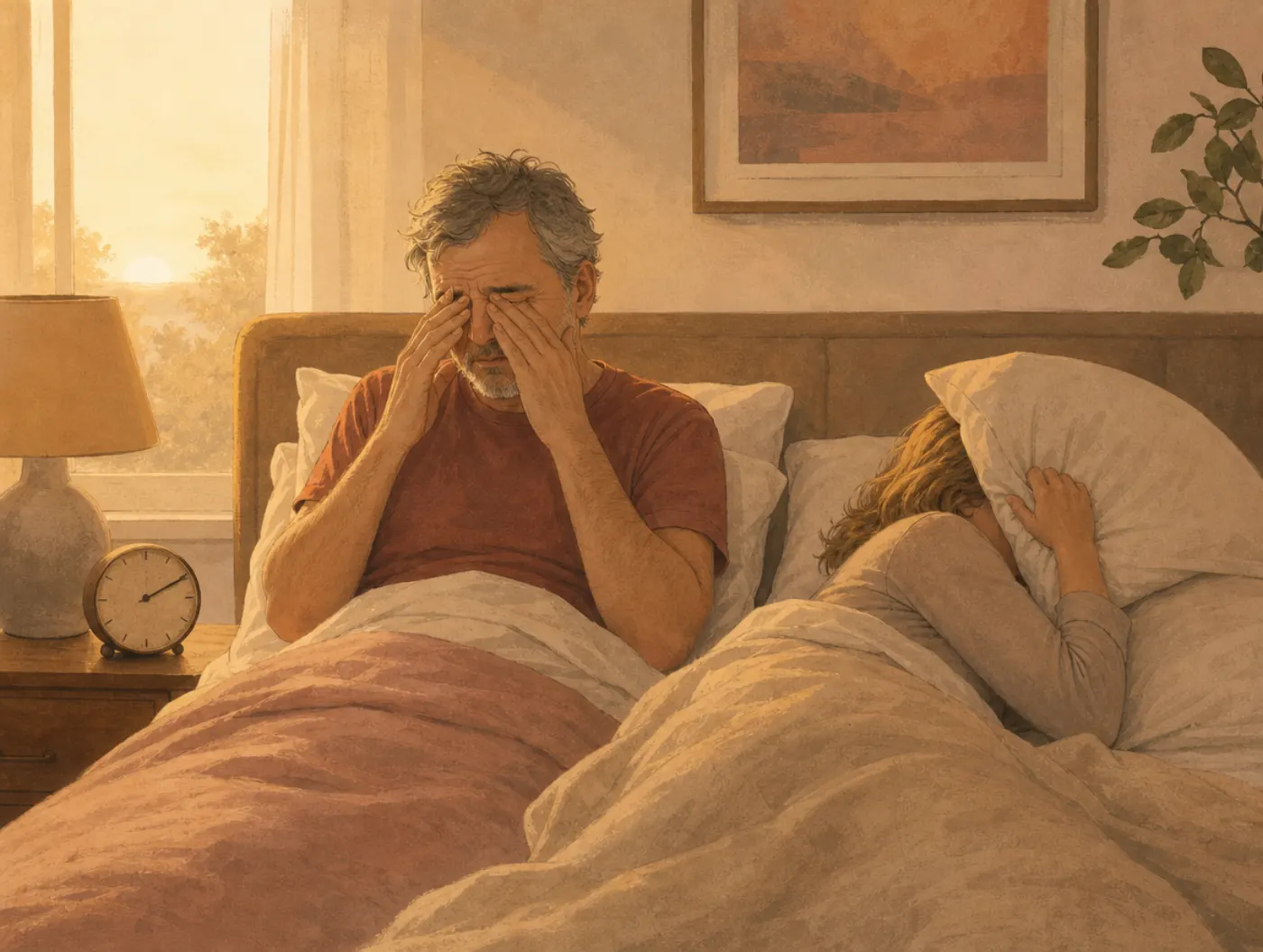
Sleep apnea is a breathing problem, and you cannot see your own breathing while you are asleep. What you can report is what other people have noticed, what the nights leave behind in your mornings, and the standing physical factors that raise the odds. This screener scores those three together and gives you a risk band to bring to an appointment. It contains no sensor, measures nothing, and cannot establish whether you have sleep apnea; only a sleep study can do that.
Nighttime breathing signs
Loud snoring, pauses someone else has noticed, waking with a gasp or a choking feeling, a very dry mouth or sore throat on waking, night sweats, and waking repeatedly without knowing why. These are the signs a clinician asks about first, and the ones a bed partner can often answer better than you can.
Daytime consequences
Sleepiness that does not match the hours you spent in bed, nodding off in a chair in the evening, morning headache, concentration and memory lapses, irritability that tracks your nights, and fighting sleep at the wheel. Fragmented breathing shows up in the day more reliably than it shows up in your memory of the night.
Standing risk factors
Age band, collar or neck size, weight change since your mid-twenties, blood pressure and whether it is controlled, alcohol close to bedtime, and a blocked nose or mouth breathing at night. Each is graded rather than answered yes or no, so a borderline factor counts as borderline instead of disappearing.
| Feature | Typical free quiz | Psychology.com |
|---|---|---|
| Says plainly it is a questionnaire, not a device | Often blurred with at-home tests | Stated in the first screen and the heading |
| Risk factors graded, not yes or no | Yes or no | Four graded levels per factor |
| Separates night signs, day effects and risk factors | One undifferentiated score | Three areas with their own bars |
| Explains the sleep study a result should lead to | Rarely | Home test and in-lab study both explained |
| Clinician-reviewed interpretation | Rarely | Yes, clinician reviewed |
| Optional in-depth personalized report | No | Yes, written to your exact scores |
| Answers stay on your device | Often collected | Scored in your browser; only summary scores if you request a PDF or report |
Therapists Who Work With Sleep and insomnia
If your result points to something you want help with, these licensed therapists work with it. Every member is matched to the federal NPI Registry; board checks are dated on the profile.
-
View profile
License verified, checked Oct 13, 2026
New York, New York Telehealth and in person $200 to $350 per session, sliding scale
-
View profile
Christie LeonardLCSW, LICSW
License verified, checked Sep 29, 2026
“Attachment & Nervous System Therapy for Individuals and Couples”
Tampa, Florida Telehealth and in person $115 to $150 per session, sliding scale
-
View profile
Dr. Greggy LubinAPRN
License verified, checked Oct 6, 2026
“Personalized telehealth psychiatric care for adults with ADHD, anxiety, depression, burnout, PTSD, insomnia, and complex medication needs.”
Virginia Telehealth $295 to $995 per session
How scoring works
Answers are scored 0–54 in total. Your result falls into one of 4 bands:
| Score | Band | What it suggests |
|---|---|---|
| 0–10 | Low risk signs | You reported few of the signs and risk factors that make a clinician think about sleep apnea. That is reassuring on a questionnaire, and it is not a clean bill of health, because no questionnaire can see your breathing. |
| 11–21 | Some risk signs | Some of the pattern is here, without the full picture. Worth watching, worth mentioning at your next appointment, and worth looking at which of the three bars carried your score. |
| 22–34 | Moderate risk signs | Enough of the pattern is here that a clinician would want to measure your breathing rather than keep guessing. The next step is an appointment and a request for a sleep study. |
| 35–54 | High risk signs | Your answers show a strong pattern across all three areas. This deserves a clinician's attention soon rather than at some point, and the request to make is for a sleep study. |
How the sleep apnea risk score works
Eighteen statements are graded from 0 to 3. The twelve statements about your nights and your days run from never or rarely up to almost always. The six risk factors carry their own answer choices, so your age, collar size, weight change, blood pressure, evening alcohol and nasal breathing each land on one of four graded levels rather than a yes or a no. That matters because risk factors are rarely all-or-nothing: being eleven pounds heavier than you were at twenty-five is not the same as being sixty pounds heavier, and a questionnaire that asks only yes or no throws that difference away.
Each of the three areas can reach 18 points and the total runs from 0 to 54. The four bands are low risk signs at 0 to 10, some risk signs at 11 to 21, moderate risk signs at 22 to 34, and high risk signs at 35 to 54. Those cutoffs are educational divisions of our own scale, not clinical cutoffs: no published validation study stands behind them, and they should not be compared with the score ranges of a validated screener. The three bars matter as much as the number, because a high total built entirely out of risk factors with no breathing signs and no daytime effect means something different from a moderate total built out of witnessed pauses and sleepiness at the wheel.
The grouping into nighttime signs, daytime consequences and standing risk factors is our own educational structure. It follows the shape of a clinical sleep history rather than a validated factor analysis, and the three bars should be read as a map of where your score came from, not as subscales with known reliability.
What this test cannot do, and what a sleep study does
This page has no sensor in it. It cannot count how many times your breathing stops or narrows per hour, it cannot measure the oxygen in your blood, and it cannot see your heart rate, your airflow, your chest movement or your sleep stages. Those measurements are the whole basis of a sleep apnea finding, and a questionnaire has access to none of them. The American Academy of Sleep Medicine puts it plainly in its 2017 diagnostic guideline: clinical tools, questionnaires and prediction algorithms should not be used to establish obstructive sleep apnea in adults in the absence of polysomnography or home sleep apnea testing. This screener agrees with that completely, and nothing on this page is a diagnosis.
What does the measuring is a sleep study, and there are two kinds. A home sleep apnea test is a small kit you wear for one to three nights, ordered by a clinician and read by one: usually a finger or wrist sensor plus a nasal cannula and a chest band, recording airflow, effort, oxygen saturation and pulse. In-lab polysomnography is a night in a sleep laboratory with a fuller set of sensors, including brain activity, eye movement and leg movement, which is what makes it the standard test and the right one when the picture is complicated by heart or lung disease, neuromuscular conditions, suspected other sleep disorders, or a home test that came back negative while the suspicion stayed.
The validated questionnaire a clinician is most likely to hand you is STOP-Bang (Chung and colleagues, 2008), developed at the University Health Network in Toronto. It is eight items and it is well studied as a pre-test screen, particularly before surgery. It is not reproduced on this page: the questionnaire is owned by its developers and the University Health Network, and commercial use requires a license from them, so we wrote our own items instead and named theirs. The same goes for the Epworth Sleepiness Scale (Johns, 1991), which measures daytime sleepiness and is proprietary, and for the Berlin Questionnaire (Netzer and colleagues, 1999). All three are named here and none of them is reproduced here.
One limit worth naming. The neck size bands on this page use a single set of thresholds, and the validated screeners use different ones for men and women (17 inches or 43 cm for men, 16 inches or 41 cm for women), as well as counting male sex as a risk factor in its own right. We left sex out of the scoring, which means this screener reads a woman's risk lower than a clinician would. Sleep apnea is already missed more often in women, so if you are a woman with daytime sleepiness and witnessed pauses, treat a middling total here as worth an appointment anyway.
Sleep apnea, insomnia and plain tiredness are not the same thing
Three very different problems arrive at the same complaint, which is that you are tired. In sleep apnea the sleep time is often normal and the sleep quality is wrecked, because the airway keeps narrowing and each event pulls you briefly toward waking without you remembering it. In insomnia the problem is getting to sleep or staying asleep, and the night is spent awake and aware of it. In a circadian mismatch there is nothing wrong with your sleep at all except when it happens: a late body clock pushed against an early alarm produces exactly the same fog.
They can also coexist, and the combination of insomnia and sleep apnea is common enough to have its own name in the literature. The practical point is that the three have different treatments, so guessing is expensive. If your nights are spent lying awake, our insomnia test Insomnia Test (ISI) fits the pattern better than this one. If the timing is the issue, our chronotype test Chronotype Quiz looks at your body clock. If your sleep looks fine on paper and the tiredness is still there, our fatigue test Fatigue Test and brain fog test Brain Fog Test cover the ground where sleep is not the whole answer, and our sleep quality test Sleep Quality Test is the broader place to start.
One more overlap is worth naming because it is so often missed in both directions: untreated sleep apnea produces low mood, irritability and poor concentration that look exactly like depression, and depression produces tiredness that looks exactly like sleep apnea. If the low mood is the loudest part, our depression test Depression Test is worth taking alongside this one, and tell whichever clinician you see about both sets of answers rather than choosing between them.
What to do with your result
If your band is moderate or high, the next step is an appointment, and the thing that makes that appointment productive is specifics. Write down what a bed partner or housemate has actually said, in their words. Note whether you have ever woken gasping, and roughly how often. Keep two weeks of rough sleep and wake times with how you felt in the afternoon. Bring your blood pressure readings if you have them, and your weight now against your weight in your mid-twenties. A result from this page plus that record is the kind of thing that gets a sleep study ordered; a result from this page on its own is a conversation starter.
If you have ever fought to stay awake at the wheel, treat that as the urgent item regardless of your total. Say it out loud to a clinician and stop driving while drowsy in the meantime, because that single symptom carries more immediate risk than the rest of the questionnaire put together.
If your band is low and you are still exhausted, the honest reading is that this screener found little pointing at breathing and the cause is probably somewhere else. That is useful information, not a dead end. Sleep length, insomnia, body clock, iron, thyroid, medication and mood all belong on the list, and a basic set of bloodwork plus two weeks of a sleep diary will narrow it faster than another questionnaire will.
Methodology & sources
This is an original educational screener written for Psychology.com. The eighteen statements are our own writing, informed by the clinical sleep history that precedes a sleep study and by the risk factors established in the obstructive sleep apnea literature: loud snoring, witnessed apneas, gasping arousals, excessive daytime sleepiness, age, neck circumference, weight gain, hypertension, evening alcohol and nasal obstruction. No validated instrument is reproduced. STOP-Bang (Chung et al., 2008), the Epworth Sleepiness Scale (Johns, 1991) and the Berlin Questionnaire (Netzer et al., 1999) are named here because a reader deserves to know which questionnaires are the validated ones, and none of their item wording is reproduced here; STOP-Bang in particular is licensed through the University Health Network and commercial use requires their permission.
Items are graded 0 to 3, with the six risk factors carrying their own graded answer choices, for a total from 0 to 54 across three areas of 18 points each. The four bands are educational divisions of that range rather than clinical cutoffs, and they have not been validated against polysomnography or against any published screener. This page is a screening for education and self-reflection, it is not a diagnosis, and it cannot measure breathing events or oxygen because it contains no sensor. The 2017 American Academy of Sleep Medicine guideline is explicit that questionnaires and prediction algorithms are not a substitute for polysomnography or a home sleep apnea test, and the result here should be read as a reason to ask for one of those, not as a result in its own right.
References
- Chung F, Yegneswaran B, Liao P, et al. STOP questionnaire: a tool to screen patients for obstructive sleep apnea. Anesthesiology. 2008;108(5):812-821. doi.org/10.1097/ALN.0b013e31816d83e4
- Kapur VK, Auckley DH, Chowdhuri S, et al. Clinical practice guideline for diagnostic testing for adult obstructive sleep apnea: an American Academy of Sleep Medicine clinical practice guideline. J Clin Sleep Med. 2017;13(3):479-504. doi.org/10.5664/jcsm.6506
- Johns MW. A new method for measuring daytime sleepiness: the Epworth Sleepiness Scale. Sleep. 1991;14(6):540-545. doi.org/10.1093/sleep/14.6.540
- Netzer NC, Stoohs RA, Netzer CM, Clark K, Strohl KP. Using the Berlin Questionnaire to identify patients at risk for the sleep apnea syndrome. Ann Intern Med. 1999;131(7):485-491. doi.org/10.7326/0003-4819-131-7-199910050-00002
- Benjafield AV, Ayas NT, Eastwood PR, et al. Estimation of the global prevalence and burden of obstructive sleep apnoea: a literature-based analysis. Lancet Respir Med. 2019;7(8):687-698. doi.org/10.1016/S2213-2600(19)30198-5
Cite this source
Psychology.com. (2026, October 21). Sleep Apnea Risk Test (Self-Report Screener). Psychology.com. https://psychology.com/tests/sleep-apnea
Sleep Apnea Risk Test (Self-Report Screener) FAQ
Is this a home sleep apnea test?
No. This is a questionnaire with no sensor in it. A home sleep apnea test is a physical kit, ordered by a clinician and read by one, that records your airflow, breathing effort, oxygen saturation and pulse over one to three nights. It is often covered by insurance when a clinician has documented a reason to order it. Self-pay prices in the US vary widely by device and by whether a physician reads the recording: consumer guides put a home test somewhere in the region of $150 to $1,000, and an in-lab study at around $3,000 on average, with a range running from roughly $1,000 to several times that. Treat those as rough figures, not quotes, and ask for your own out-of-pocket number before you book. What a questionnaire like this one is good for is the appointment that gets the kit ordered: a written risk band, three area scores and your own notes are concrete things to hand over, and they are a great deal more persuasive than saying you are tired.
Can this test tell me whether I have sleep apnea?
No, and nothing that runs in a browser can. Establishing sleep apnea means counting how often your breathing stops or narrows per hour of sleep and watching what happens to your oxygen, which requires a recording device. Only a sleep study can do that: either a home sleep apnea test or in-lab polysomnography, both ordered and interpreted by a clinician. The 2017 American Academy of Sleep Medicine guideline says directly that questionnaires and prediction algorithms are not a substitute for those tests. Read your result here as a reason to ask, not as an answer.
Why do you not use the STOP-Bang questionnaire?
Because we are not licensed to. STOP-Bang (Chung and colleagues, 2008) is the validated eight-item screener a clinician is most likely to use, and it is owned by its developers and the University Health Network in Toronto; commercial use requires a license from them. Rather than quietly rewording their items, we wrote our own and named theirs so you know which questionnaire is the validated one. The same applies to the Epworth Sleepiness Scale and the Berlin Questionnaire, both named on this page and neither reproduced. If you want a STOP-Bang score, ask your clinician to run it.
Does this screener score men and women the same way?
It does, and that is a limit rather than a design choice we would defend. The neck size question here uses one set of bands for everyone. The validated screeners use different thresholds by sex, 17 inches or 43 cm for men and 16 inches or 41 cm for women, and they also count male sex as a risk point in its own right. We left sex out of the scoring entirely, which means this page reads a woman's risk lower than a clinician would read the same body. Obstructive sleep apnea is already missed more often in women than in men. So if you are a woman with daytime sleepiness, unrefreshing sleep or a witnessed pause, treat a middling total here as worth an appointment rather than as reassurance, and say the symptoms out loud at it.
I live alone, so I do not know whether I snore or stop breathing. Does that ruin my result?
It lowers it, and that is a real limitation worth saying out loud. The witnessed signs are the strongest items on any sleep apnea questionnaire, and people who sleep alone systematically under-report them. Two things help. First, your daytime score and your risk factors still count, and a high score on those two areas with nothing in the night column is a meaningful pattern to take to an appointment. Second, a phone left recording audio overnight, or any basic sleep app, will tell you within a few nights whether there is loud snoring and whether it has pauses in it. Bring whatever you find.
What happens at a sleep medicine appointment?
A clinician takes a sleep history, which is mostly the questions on this page asked out loud, plus your weight, blood pressure, neck and airway, your medications and anything a bed partner has noticed. If the picture fits, they order a sleep study. An uncomplicated adult with a strong story often gets a home test; a complicated one, or a negative home test with the suspicion still standing, gets in-lab polysomnography. If the study is positive, treatment usually starts with a conversation about airway pressure therapy, and may include an oral appliance, positional therapy, weight and alcohol changes, or surgery in particular cases. None of that needs to be decided before the first visit.
Is the test really confidential?
Yes. It runs entirely in your browser. Your individual answers are scored in your browser and are never sent to us or linked to you. They stay in this tab so you can return to your result, and closing or clearing the tab clears them. If you ask us to email the PDF, we receive your summary scores with your email address, never your individual answers. No account is needed.