Mindfulness Activities for Kids: Short, Playful Exercises by Age
Mindfulness activities for kids work best when they are short, concrete and feel like a game. Five exercises you can lead at home or in a classroom, with age bands, realistic timings, and a straight account of what the research does and does not show.
 Reviewed byMichael Callans, MSW
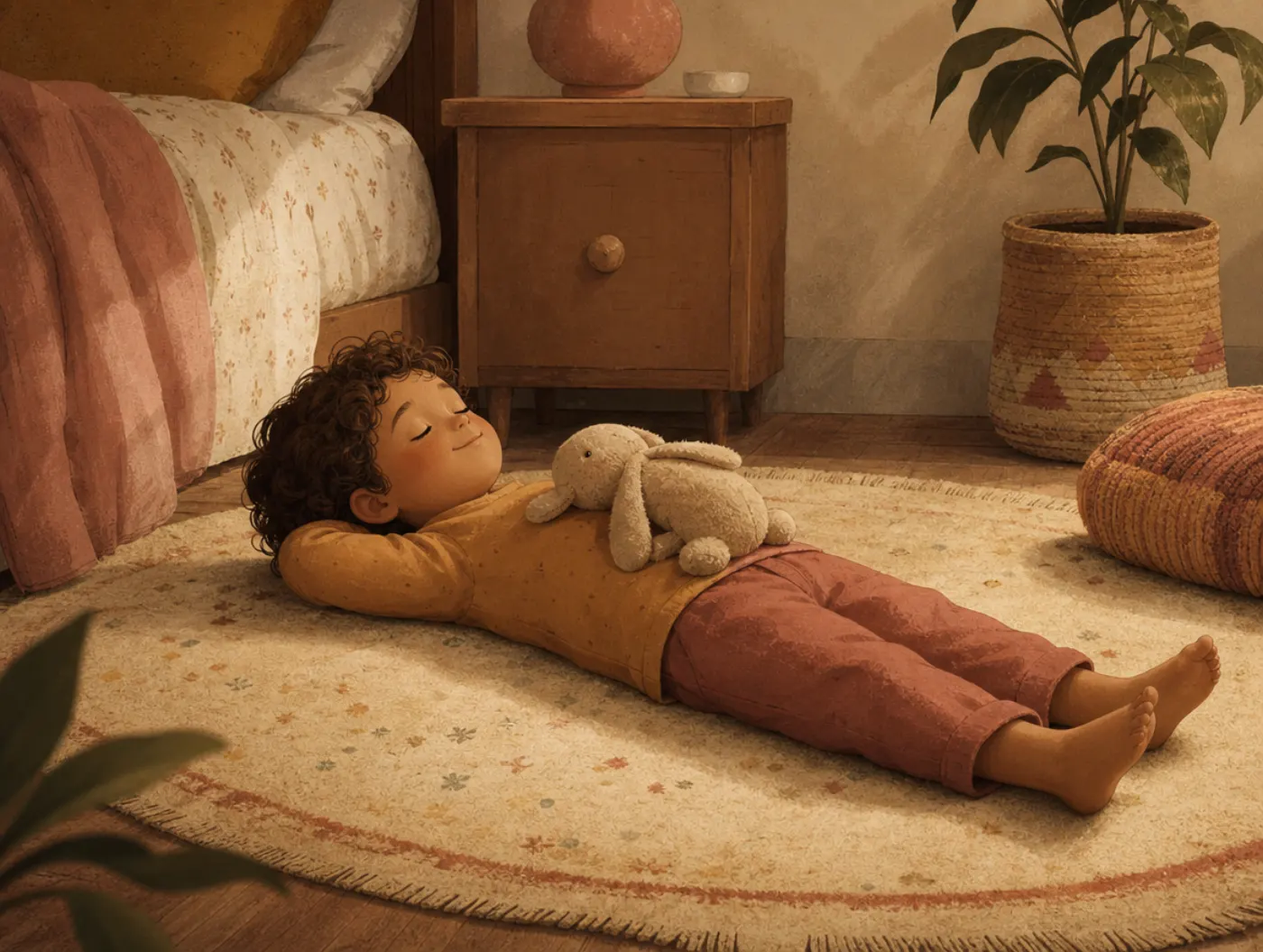
Teddy on the tummy (breathing buddy), ages 3 and up
- Your child lies on their back and places a small soft toy on their belly. You lie beside them with your own toy or your hand on your belly.
- Ask them to breathe in slowly through the nose and watch the toy rise, then breathe out slowly and watch it sink.
- Count five breaths together out loud, or say 'up' and 'down' as the toy moves.
- If the toy falls off, that is part of the game: put it back and carry on.
- One to three minutes. Stop while it is still fun.
Five-senses safari, ages 5 and up
- Go on a hunt together: find five things you can see, and say them out loud.
- Then four things you can hear, near and far. Pause and listen before answering.
- Three things you can feel: the floor, a sleeve, the air on your face.
- Two things you can smell, or two smells you like.
- One thing you can taste, or one thing you are looking forward to.
- Two to five minutes. Works well on a walk or at a window.
One raisin, ages 6 and up
- Give your child one raisin (or a grape, an apple slice, a single cracker) and ask them to pretend they have never seen one before.
- Look at it together: the folds, the colors, how the light catches it.
- Feel it between the fingers. Hold it to the ear and squeeze gently: does it make a sound?
- Smell it. Then place it on the tongue without chewing and notice what happens in the mouth.
- Chew once, very slowly. Notice the taste change. Then swallow and notice the raisin is gone.
- Three to five minutes. Expect giggles; they are allowed.
Bell listening, ages 5 and up
- Use a bell, a singing bowl, a glass tapped with a spoon, or a phone chime.
- Ask your child to close their eyes, or look at the floor, and raise a hand when the sound has completely disappeared.
- Ring it once. Wait in silence until the hand goes up.
- Ask: what else could you hear while you waited?
- One to two minutes. Repeat two or three times if they ask.
Robot to ragdoll, ages 3 and up
- Stand up together. On 'robot', your child goes stiff all over: arms straight, legs straight, jaw tight, for about five seconds.
- On 'ragdoll', everything goes floppy: arms dangle, knees soften, head droops.
- Do it three times, then lie down and travel through the body together: 'Are your toes robot or ragdoll? Your knees? Your tummy? Your shoulders? Your face?'
- Let them answer out loud. Then one slow breath, and finish.
- Two to five minutes. Never squeeze to the point of pain, and skip any body part that hurts.
Age bands and timings
Ages 3 to 5
One to three minutes. Fully physical and visible: teddy breathing, robot to ragdoll, blowing out an imaginary candle. You do every step too.
Ages 6 to 9
Three to six minutes. Five-senses safari, one raisin, bell listening. They can take turns leading a step.
Ages 10 to 12
Five to ten minutes. A short lying-down body scan, bell listening with longer silences, and leading an activity for a younger child.
What the research does and does not show
- Small average benefits for attention, executive function and anxiety symptoms in meta-analyses, smaller when compared with an active alternative.
- The largest trial (MYRIAD, 2022, over 8,000 pupils) found no mental-health benefit from universal school mindfulness training after a year.
- Short home or classroom activities can help a particular child settle in the moment; they are not a treatment and not a prevention program.
- Children who are pushed into it, or whose difficulty is something else (an unsafe home, bullying, a learning need), are unlikely to benefit.
When to use these, and when not to
Use them at a calm, fixed time: after school, before homework, before a bedtime story. Do them with your child, keep them short, and end before interest runs out. Do not introduce a new one during a meltdown; a flooded child is unlikely to take it in, and the exercise can become linked with being in trouble. A familiar, liked activity can be offered gently and dropped if refused. Never present mindfulness as a consequence for being too wild. If your child's worry, anger or sadness is intense or lasting, a pediatrician or child therapist is the next step.
Therapists Who Work With Parenting
A worksheet is a start. These licensed therapists work with the same problem; every member is matched to the federal NPI Registry and board checks are dated on the profile.
-
View profile
Natasha SeiterLMFT, PhD
License verified, checked Oct 16, 2026
“I help couples stuck in cycles of misunderstanding to find their way back to one another.”
Fort Collins, Colorado Telehealth and in person $150 per session
-
View profile
Rachel AstarteLMFT, MA, MFA
License verified, checked Oct 19, 2026
“If traditional talk therapy hasn’t worked for you, you’re my people.”
Nyack, New York Telehealth and in person $175 to $300 per session, sliding scale
-
View profile
Shaudi AdelLCSW, MSW
License verified, checked Oct 13, 2026
“Check out my profile for a free consultation!”
New York, New York Telehealth $80 per session, sliding scale



About this tool
Mindfulness activities for kids are short exercises that help a child notice what is happening right now, in the body, in the senses or in the breath, without needing to change it. For an adult, mindfulness is usually taught as sitting practice. For a child, that is the wrong format. Children learn through play, movement and concrete objects, so the activities that work are games with a focus built in: a soft toy that rides on the belly as it rises and falls, a hunt for five sounds, a single raisin eaten as slowly as possible. The adult's job is to lead by doing it alongside, keep it short, and treat wandering attention as the normal material of the exercise rather than a failure.
The rule of thumb that children's mindfulness teachers use is one minute per year of age, so a four-year-old gets a four-minute ceiling and an eight-year-old an eight-minute one. It is a heuristic, not a research finding, and most sessions should be shorter than the ceiling: a good one-minute activity done daily teaches more than a struggling ten-minute one done once. Age also changes what is possible. Three- to five-year-olds need something physical and visible: the teddy breathing, the robot-to-ragdoll game, blowing out an imaginary candle. Six- to nine-year-olds can manage the five-senses game, the raisin, and listening for a bell to fade. Ten- to twelve-year-olds can do a short body scan and can begin to lead an activity for a younger sibling, which is often where the learning sticks.
The exercises here come from a recognizable lineage. The raisin exercise is the opening practice of Jon Kabat-Zinn's mindfulness-based stress reduction program, written for adults in 1979 and borrowed by every children's curriculum since. The breathing buddy, a soft toy on the belly, and the five-senses game appear in Susan Kaiser Greenland's work on mindfulness for children. Eline Snel's Sitting Still Like a Frog gave a generation of Dutch and then international parents a set of short scripts. The robot-to-ragdoll game is a child-sized version of a body scan crossed with progressive muscle relaxation: stiff like a robot, then floppy like a ragdoll, noticing the difference. None of this is proprietary; the ideas are old and the formats are simple.
The evidence deserves a careful summary, because the enthusiasm has run ahead of it. Meta-analyses of mindfulness programs for children and adolescents, such as the 2019 review by Darren Dunning, Willem Kuyken and colleagues, find small average benefits for attention, executive function, and symptoms of anxiety and depression, and the benefits shrink when programs are compared with an active alternative rather than with nothing. Then came MYRIAD, the largest trial yet: more than 8,000 pupils aged 11 to 14 in 85 British secondary schools, randomized to a well-designed school mindfulness curriculum or to usual lessons. Published in 2022, it found no improvement in mental health or wellbeing after a year compared with usual provision, most pupils did little of the home practice, and the authors concluded that universal school-based mindfulness training, delivered that way, should not be assumed to help. That is a sobering result, and it is worth holding alongside the warmer small studies.
What follows from this for a parent or teacher is not that the activities are useless, but that expectations should be modest and specific. A two-minute breathing game before homework may help a particular child settle. It will not, on the current evidence, prevent depression, raise grades across a class, or substitute for treatment when a child is struggling. The children most likely to enjoy and use these activities are those who are introduced to them playfully, by an adult who does them too, and who are never made to sit still as a punishment under the name of mindfulness. The children least likely to benefit are those pushed into it, or those whose difficulty is something else: an unsafe home, an unmet learning need, bullying, or anxiety severe enough to need a clinician.
A few practical points make the difference between a game and a chore. Do it with your child, not to them; children copy what adults do far more than what adults say. Keep your own voice slow and a little quieter than usual. Name what you notice out loud ('my mind went to dinner, I'm bringing it back to the teddy'), so the child learns that wandering is expected and returning is the skill. End before interest runs out. Make it a routine with a fixed slot, after school or before a bedtime story, rather than an emergency measure. And do not try to teach a new exercise in the middle of a meltdown; most children cannot take in something new while flooded, and the exercise can become linked with being in trouble. An already familiar activity that the child likes can be offered gently in a hard moment, and dropped without comment if it is refused.
The common mistakes are predictable. Running too long. Correcting the child's technique instead of noticing with them. Expecting calm as the outcome, when the actual outcome is noticing; a child can do the exercise well and still be bouncy afterward. Using screens or apps as the whole practice, which removes the shared attention that does most of the work. Presenting mindfulness as something the child must do because they are too wild, which turns a skill into a verdict. And giving up after a week because nothing visible changed. The benefits that do exist are slow and small, and they show up as a child who, months later, can say 'I need a minute' and take one.
If your child's worry, anger or sadness is intense, lasts weeks, keeps them from school or friends, or you are using these activities mainly to manage something that frightens you, a pediatrician or a child therapist is the right next step, and a few calming games are not a substitute. Psychology.com's therapist directory lets you search for child and family therapists at no cost. The Emotional Regulation Activities for Kids and Calm-Down Corner Cards cover the companion skills: naming feelings, and having a place to settle.
References
- Kuyken W, Ball S, Crane C, et al. Effectiveness and cost-effectiveness of universal school-based mindfulness training compared with normal school provision in reducing risk of mental health problems and promoting well-being in adolescence: the MYRIAD cluster randomised controlled trial. Evid Based Ment Health. 2022;25(3):99-109.
- Dunning DL, Griffiths K, Kuyken W, et al. Research review: the effects of mindfulness-based interventions on cognition and mental health in children and adolescents: a meta-analysis of randomized controlled trials. J Child Psychol Psychiatry. 2019;60(3):244-258.
- Kabat-Zinn J. Full Catastrophe Living: Using the Wisdom of Your Body and Mind to Face Stress, Pain, and Illness. Delacorte Press; 1990.
- Greenland SK. The Mindful Child: How to Help Your Kid Manage Stress and Become Happier, Kinder, and More Compassionate. Free Press; 2010.
- Snel E. Sitting Still Like a Frog: Mindfulness Exercises for Kids (and Their Parents). Shambhala; 2013.
Cite this source
Psychology.com. (2026, October 19). Mindfulness Activities for Kids. Psychology.com. https://psychology.com/tools/mindfulness-activities-for-kids
Mindfulness Activities for Kids FAQ
What is the best mindfulness activity for a 4 year old?
Something physical, visible and under four minutes. Teddy on the tummy is the usual first choice: your child lies down with a soft toy on their belly and watches it rise and fall for five slow breaths, with you doing the same beside them. Robot to ragdoll, going stiff and then floppy, works for children who cannot lie still. Blowing out an imaginary candle teaches a slow exhale. At this age you do every step too, and you stop while it is still fun.
How long should mindfulness activities for kids be?
Shorter than you think. Children's mindfulness teachers use one minute per year of age as a ceiling: three minutes for a three-year-old, eight for an eight-year-old. It is a rule of thumb rather than a research finding, and most sessions should stop well before it, ideally while the child is still engaged. One or two minutes done most days builds more than a long session done occasionally. If a child asks for more, do one more round rather than stretching the exercise.
Does mindfulness actually help children?
Modestly, in some ways, and less than the hype suggests. Meta-analyses find small benefits for attention, executive function and anxiety symptoms, shrinking when compared with an active alternative. The largest trial, MYRIAD in 2022, tested a school mindfulness curriculum with over 8,000 pupils and found no mental-health benefit after a year. Short activities can help a particular child settle and give them a skill to reach for; they are not a treatment for anxiety or depression and should not be sold to a child, or to yourself, as one.
Can I use mindfulness activities during a tantrum?
Not as a new lesson. A child in a meltdown is unlikely to take in a skill they are still learning, and insisting that they breathe or notice their senses in that moment can escalate things and link the exercise with being in trouble. During a tantrum, stay close, stay calm, keep everyone safe, and say little. If an activity is already familiar and the child likes it, you can offer it gently, once, and let it go if they refuse. Afterward, once the wave has passed, you can reconnect and later return to the activities at a calm time. Regular calm practice is what makes a skill more likely to be available when a feeling is big.
What is the one-minute-per-year rule?
A rule of thumb used by people who teach mindfulness to children: a session's ceiling in minutes roughly matches the child's age in years. A five-year-old can manage up to about five minutes; a ten-year-old up to about ten. It has no formal research behind it, but it matches what teachers see about attention span and it stops adults from running activities far too long. Treat it as a maximum, not a goal, and end earlier if attention has already moved on.
Are mindfulness activities for kids the same as meditation?
They share the core idea of paying attention on purpose to what is happening now, but the format is different. Meditation, as adults practice it, usually means sitting still and quiet for a stretch of time, which most children cannot do and should not be made to do. Mindfulness activities for kids build the same noticing skill into games, movement, food and sounds, in bursts of one to ten minutes. Some older children grow into brief seated practice, but it is never the starting point.