Feldenkrais Method: Learning to Move With Attention
The Feldenkrais Method is a movement education practice built by Moshe Feldenkrais, an engineer and judo teacher, on the idea that the nervous system learns better movement from slow curious attention rather than from effort or correction. This guide covers the two formats, who uses it, what the research honestly supports, and a short lying lesson you can print.
 Reviewed byMichael Callans, MSW
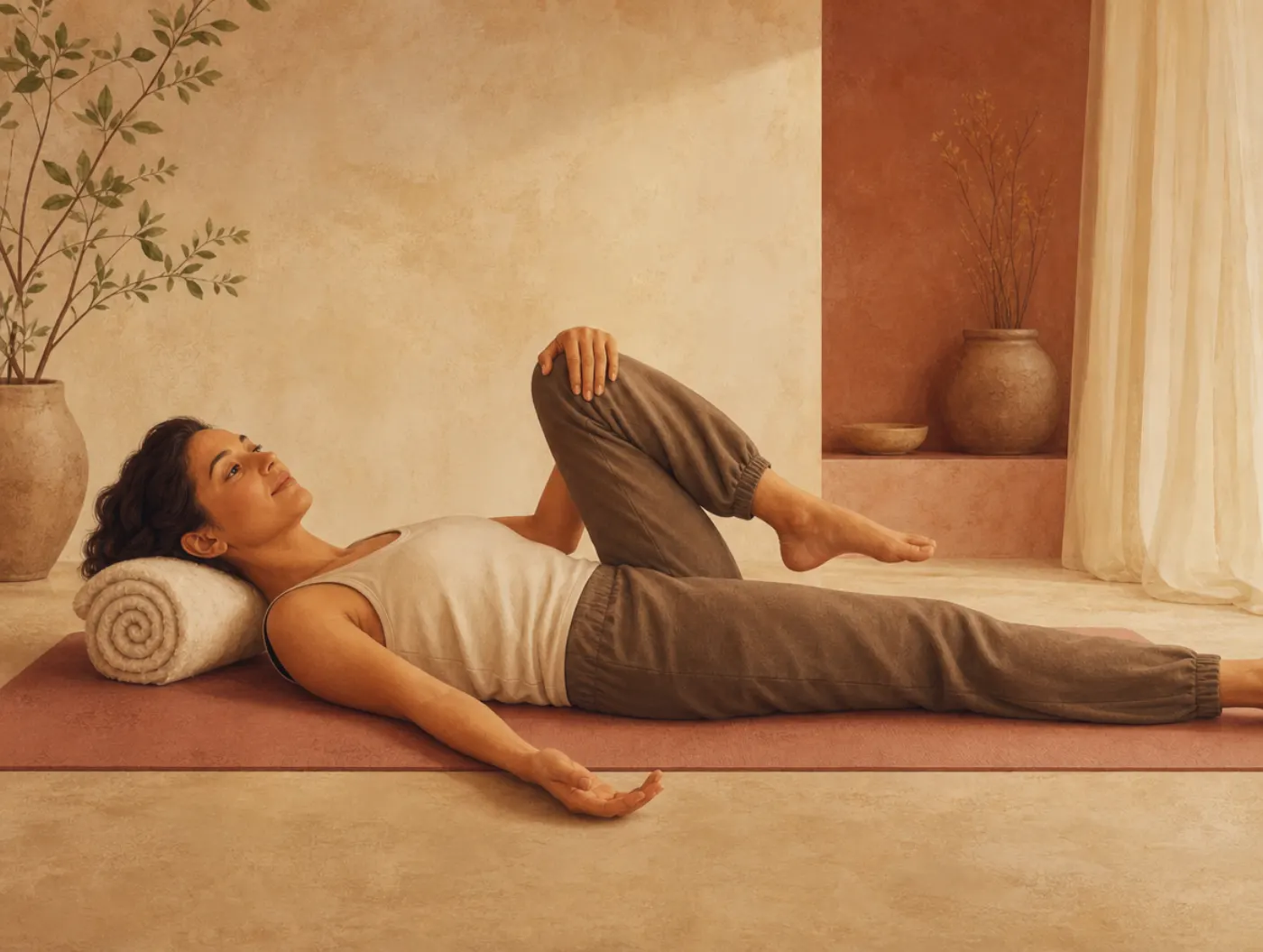
A short lying lesson (about 12 minutes)
- Lie on your back on a firm surface, a rug or a mat rather than a bed. Bend the knees so the feet stand on the floor about hip width apart, and let the arms rest out to the sides. Spend a full minute doing nothing but noticing where your back touches the floor and where it does not.
- Slowly tilt the pelvis so the lower back comes a little closer to the floor, then let it return. Keep the movement small, slow and so easy that it costs almost nothing. About ten times, pausing whenever your attention wanders.
- Rest with the legs long for thirty seconds. The rests are part of the lesson, not a break from it, and skipping them changes what the lesson does.
- Bend the knees again and repeat the same small tilt, this time noticing what else joins in: the ribs, the breath, the head, the pressure under each foot. Ten more, still small. If anything strains, make the range smaller instead of pushing through it.
- Rest. Then press a little more through the right foot only, about eight small tilts, and rest again. Repeat on the left. Then lie still and notice whether the two sides felt the same.
- Finish with the legs long for a minute, roll onto one side and come up slowly. Walk a few steps and notice how you stand, turn and breathe. The noticing is the result: nothing has to feel better for the lesson to have done its work.
The rules that make a lesson work
- Do less than you can. If a movement takes effort, make it smaller. Effort recruits the habit you are trying to notice.
- Go slowly enough to feel detail. Speed hides exactly the information the lesson is made of.
- Never stretch into pain and never hold a position to improve it. This is not stretching, strengthening or conditioning.
- Rest often, with the legs long. The pauses are where the sorting happens, and they are not optional.
- Compare instead of correcting. The question is what is different between one side and the other, or before and after, not what is wrong.
- Expect nothing visible. A lesson can succeed and leave you with no achievement except an easier turn of the head.
Feldenkrais glossary
The two formats, and what neither one is
Awareness Through Movement
A class of up to twenty or thirty people, 40 to 60 minutes, guided entirely by voice. You lie on a mat in ordinary clothes and follow small slow movements with long rests. No demonstration, no mirrors, no counting. Cheap, widely available, and the usual way in.
Functional Integration
One to one, clothed, lying or sitting on a low padded table. The practitioner moves or supports you with light contact and very little talking. Chosen when a specific limitation needs individual attention, or when following verbal instruction is difficult.
What neither one is
Not physiotherapy, not massage, not chiropractic, not psychotherapy, not exercise. Nothing is adjusted, released or manipulated, no strength or flexibility goal is set, and no condition is diagnosed or treated. If pain is new, severe or spreading, get it assessed first.
What a class is actually like
Walk in and you will find people lying on mats in ordinary clothes, looking like nothing much is going on. The teacher talks continuously but quietly, giving one small instruction and then a question: slide the right foot along the floor, and notice what happens in your left shoulder. There is usually no demonstration, which is deliberate, because copying a shape puts you back in your habit instead of in your own sensing. Movements are repeated many times at a size that feels almost pointless, broken by rests with the legs long. Nobody is corrected, nobody is adjusted, and the teacher rarely touches anyone during a group class. Most lessons run 40 to 60 minutes and end with standing and walking and noticing. People commonly report feeling taller or looser, and some people feel nothing the first few times, which is ordinary rather than a sign it will not work for them.
What the evidence shows, and does not
Two systematic reviews frame it. Hillier and Worley, 2015, found 20 randomized trials with very mixed populations and outcomes, pooled seven of them on balance in older adults with results favoring the method on a timed walking and turning test and on reach, saw single-study effects on perceived effort, comfort, body image perception and dexterity, and rated the overall risk of bias high. Berland and colleagues, 2022, looked at it as a physiotherapy tool across 16 trials, again found the clearest pooled signal on timed walking and turning in older adults, rated five trials good, ten fair and one poor, noted that no trial blinded participants or therapists, and concluded the risk of bias remains high. Their summary is the one to take away: effects comparable to other physiotherapy techniques in people with spine pain. What that means in practice is that the method is a reasonable option, that it is not proven superior to anything, and that there is no Cochrane-level body of evidence behind it. Claims of healing, realignment or cure are not supported by this literature.
Check with a clinician before trying the lesson if
- Your pain is new, severe, or spreading, or comes with numbness, weakness, or changes in bladder or bowel control. That needs assessment, not a movement lesson.
- Recent surgery, a fracture or a joint replacement means a specific protocol is already in place and takes priority.
- You get dizzy or faint when lying down or standing up, or a clinician has told you to avoid lying flat.
- You are pregnant, where lying flat on the back for long periods is often advised against in later stages.
- Advanced osteoporosis or an unstable spine is on your record, in which case even small loaded movements get planned with a clinician.
Related tools & tests
Carrying the day in your neck and shoulders?
Therapists who work with stress and chronic tension can help with what the body is holding and why. Free to search our directory.
Therapists Who Work With Stress
A worksheet is a start. These licensed therapists work with the same problem; every member is matched to the federal NPI Registry and board checks are dated on the profile.
-
View profile
Brittany WebbLPC, LCPC
License verified, checked Nov 4, 2026
“Your trusted OCD and trauma therapist”
Philadelphia, Pennsylvania Telehealth $50 to $165 per session
-
View profile
Carol WilliamsLCSW
License verified, checked Oct 9, 2026
“Beyond Survival, Toward Living.”
Miramar, Florida Telehealth $125 to $200 per session
-
View profile
Caycee Terrell-ViningLPC, MEd
License verified, checked Nov 4, 2026
“Reclaim your life with the strength you already carry.”
Covington, Louisiana Telehealth $150 per session, sliding scale



About this tool
The Feldenkrais Method is a form of movement education rather than a treatment. It was built over several decades by Moshe Feldenkrais (1904 to 1984), who trained as an engineer, earned a doctorate in science in Paris, worked as a research assistant to the physicist Frederic Joliot-Curie, and was among the first Europeans to hold a black belt in judo. A knee injury that medicine of the day proposed to operate on sent him into years of self-experiment instead, and what he arrived at was not a set of exercises but a way of paying attention while moving. He was not a physician or a physical therapist, and the method does not claim to be medicine.
The central idea is that most of how you move is learned, held as habit, and therefore available to be learned differently. Habit is efficient but it is also invisible: you cannot easily change a pattern you cannot feel. So the method works by lowering effort until sensation becomes fine enough to notice distinctions, which is where the word awareness in its name comes from. The aim is not a correct posture or a stronger muscle. It is a larger set of options, so that turning, reaching, standing and breathing can happen in more than one way and the body can pick a cheaper one.
Read the diagram as text
The same movement is drawn twice, a head and shoulders seen from above with the range of a turn as a quiet arc over it. In both scenes a faint mark runs from the head out to the top of the arc: the same rest position, and both movements set off from it the same way. On the left the movement travels all the way to the far end of the range, where a heavy bar lies across the pointer as a hard stop, and short effort strokes bristle all round the head and shoulders. On the right the same movement covers a fifth of the range, in brand, with fine ticks along that short stretch and the brand pointer standing in it; no stop bar, no effort strokes, and the rest of the range left open as a quiet guide. The brand marks the short attended stretch where a difference can be felt. On the phone canvas the two scenes stack.
The same movement, two ways of making it
Conceptual contrast, not ratings
The same person, the same movement and the same range in both, set off from the same rest position; what changes is how far the movement travels and the effort and attention brought to it.
Pressed to the end of the range, with effort: The habit is repeated as it already runs, and the sensation is too coarse for anything new to be noticed in it.
Made small and slow, with attention on what is felt: Distinctions become fine enough to notice, which is what the awareness in the name refers to, and the aim is more options rather than a correct posture or a stronger muscle.
There are two formats. Awareness Through Movement is a group class, guided entirely by voice, usually done lying on the floor, in which a teacher talks you through small slow movements and asks questions about what you notice. There is often no demonstration on purpose, so you are not copying a shape. Functional Integration is the one-to-one version: you stay clothed, lying or sitting on a low padded table, and the practitioner uses gentle hands-on contact to move or support you and to offer the nervous system the same kind of information without words. Most practitioners teach both.
A class looks like very little is happening. People lie on mats, the instructions are quiet and repetitive, nobody sweats, and there are long rests with the legs long. The rests are part of the method rather than recovery breaks. Lessons typically run 40 to 60 minutes and often end with a suggestion to stand and walk and notice whether anything is different. What people most often report afterward is not strength or flexibility but ease: a head that turns further without being told to, a lower back that stops announcing itself, a sense of being a little taller that lasts an hour or a day.
The method is used in a few distinct places. Chronic back, neck and shoulder pain is the most common reason people try it. Balance and confident walking in older adults is the second, and it is also used in multiple sclerosis and Parkinson's disease as a way of working with function rather than with the disease. It has a long history among musicians, dancers, actors and athletes who want to remove unnecessary effort from a trained skill. It sits in our stress section because slow attention with the effort taken out tends to settle arousal, which is a side effect its practitioners notice rather than a claim the method was built to make.
On evidence, the honest position is promising and thin. The 2015 systematic review by Susan Hillier and Anthea Worley gathered 20 randomized trials, found the populations and outcomes highly varied, and pooled seven studies on balance in older adults, where results favored the method on a timed walking and turning test and on reach. Single studies reported effects on perceived effort, comfort, body image perception and dexterity. The authors rated risk of bias high, which tempers all of it, and concluded that the effects looked generic rather than disease-specific, consistent with the method's own claim that it works by learning.
A 2022 systematic review and meta-analysis by Ruth Berland and colleagues looked at the method specifically as a physiotherapy tool and included 16 randomized trials. The clearest pooled result was again on timed walking and turning in older adults; most other pooled comparisons were too small or too varied to show anything. On a standard rating scale the reviewers judged five trials good, ten fair and one poor, noted that participants and therapists were not blinded in any of them, and wrote that the risk of bias remains high. Their conclusion was measured: effects comparable to other physiotherapy techniques in people with spine pain, not better than them.
Two things the method is not. It is not physiotherapy: the training is not a health professional qualification, practitioners do not diagnose, and nothing here replaces an assessment for pain that is new, severe, spreading, or accompanied by numbness, weakness or loss of bladder control. It is also not psychotherapy, despite the attention to inner sensation, and it should not be offered as treatment for a mental health condition. If what you want is a settling practice with a clearer evidence base behind it, Progressive Muscle Relaxation and Body Scan Meditation are better studied starting points.
Practitioners in North America hold the Guild Certified Feldenkrais Practitioner credential, which requires graduating from an accredited program: about 800 hours of training across roughly 160 training days spread over at least three years, followed by annual practice and continuing learning requirements. Guilds in other countries run comparable programs, and the method's names are trademarked, so the terms on a practitioner's page are a reasonable signal that the training was the real one. Ask how long someone has taught, whether they work mainly in groups or one to one, and whether they have experience with your particular complaint. The lesson below is our own writing in the style of the method, not a transcript of a Feldenkrais lesson.
References
- Feldenkrais M. Awareness Through Movement: Health Exercises for Personal Growth. New York: Harper & Row; 1972.
- Feldenkrais M. The Elusive Obvious. Cupertino, CA: Meta Publications; 1981.
- Hillier S, Worley A. The effectiveness of the Feldenkrais Method: a systematic review of the evidence. Evid Based Complement Alternat Med. 2015;2015:752160. doi:10.1155/2015/752160
- Berland R, Marques-Sule E, Marin-Mateo JL, Moreno-Segura N, Lopez-Ridaura A, Sentandreu-Mano T. Effects of the Feldenkrais Method as a physiotherapy tool: a systematic review and meta-analysis of randomized controlled trials. Int J Environ Res Public Health. 2022;19(21):13734. doi:10.3390/ijerph192113734
- Feldenkrais Guild of North America. Guild Certified Feldenkrais Practitioner certification policy. 2025. https://cdn.ymaws.com/www.feldenkraisguild.com/resource/resmgr/pdf/policies/gcfp-certification-20250127.pdf
Cite this source
Psychology.com. (2026, November 6). Feldenkrais Method. Psychology.com. https://psychology.com/tools/feldenkrais-method
Feldenkrais Method FAQ
What is the Feldenkrais Method?
The Feldenkrais Method is a movement education practice developed by Moshe Feldenkrais, an engineer and judo teacher who rebuilt his own injured knee through years of self-experiment. Its premise is that most of how you move is learned habit, that habit is invisible until effort is reduced enough to feel it, and that the nervous system will choose an easier option once it notices one exists. In practice that means very small, very slow movements with long rests, done either in a voice-guided group class or one to one with light hands-on contact. It is education, not treatment, and it does not diagnose anything.
Does the Feldenkrais Method actually work?
The evidence is promising and limited. A 2015 systematic review of 20 randomized trials found results favoring it for balance in older adults when seven studies were pooled, plus single-study effects on perceived effort, comfort and dexterity, and rated the overall risk of bias high. A 2022 review and meta-analysis of 16 trials found the same clearest signal on timed walking and turning in older adults, rated most trials fair, and concluded that effects were comparable to other physiotherapy techniques in people with spine pain. So it is a reasonable option. It is not proven better than anything else, and claims of healing or realignment are not supported.
What happens in a Feldenkrais class?
You lie on a mat in ordinary clothes while a teacher guides small slow movements by voice, usually with no demonstration to copy, and asks what you notice as you go. Movements are repeated many times at a size that can feel almost pointless, broken by rests with the legs long, which are considered part of the lesson rather than breaks. Nobody is corrected and the teacher rarely touches anyone in a group. Classes run 40 to 60 minutes and often end with standing and walking to compare. Feeling nothing the first few times is common and is not a sign it will not suit you.
Is Feldenkrais the same as physical therapy or yoga?
No to both. Physical therapy assesses and treats a problem with goals for strength, range and function, delivered by a licensed clinician. The Feldenkrais Method sets no goal of that kind, and its practitioners are not health professionals by virtue of their training. Yoga works toward named postures and usually involves holding, stretching and effort; Feldenkrais work deliberately removes effort and never holds a shape to improve it. The closest relative is probably the Alexander Technique, which shares the learning frame. If an injury is undiagnosed or the pain is new, start with a clinician, not with any of these.
Can Feldenkrais help back pain?
It is one of the most common reasons people try the Feldenkrais Method, and the 2022 review concluded that its effects in spine pain look comparable to other physiotherapy techniques rather than better. That is a real but modest claim, drawn from a small number of trials with a high risk of bias. The practical reading: if back pain is persistent, has been assessed, and nothing has clearly helped, this is a reasonable thing to try alongside whatever your clinician advises. If pain is new, severe, spreading, or comes with numbness, weakness or changes in bladder or bowel control, get it assessed first.
How do I find a certified Feldenkrais practitioner?
Look for the Guild Certified Feldenkrais Practitioner credential in North America, or the equivalent national guild listing elsewhere. Certification requires graduating from an accredited program of about 800 hours across roughly 160 training days over at least three years, plus annual practice and continuing learning. The method's names are trademarked, so their correct use on a practitioner's page is a fair signal. Useful questions to ask: how long have you taught, do you work mainly in groups or one to one, and have you worked with my particular complaint. Group classes are usually the cheaper and easier way to find out whether it suits you.
Can I do Feldenkrais at home?
Yes, within limits. Awareness Through Movement lessons were designed to be delivered by voice, which is why recorded lessons and the printable on this page work reasonably well at home. The rules matter more than the particular movement: do less than you can, go slow enough to feel detail, never stretch into pain, rest with the legs long between sequences, and compare rather than correct. What home practice cannot do is notice what you are not noticing, which is most of what a teacher adds. A few live classes first, then home practice, is the usual advice from practitioners.