Chronically Online Test: See How Much the Feed Shapes Your Attention and Offline Life
This chronically online test asks how often the feed is running your attention, your opinions, and your evenings, from reading the comments first to feeling behind after a day offline. Get an instant score, a three-part breakdown, and a 48-hour reset plan.
 Reviewed byMichael Callans, MSW
Chronically Online Test is a free, confidential 20-question self-assessment, original educational screener informed by problematic internet use research. It takes about 5 minutes, runs entirely in your browser, and gives you a plain-language score across 4 interpretation bands plus an optional in-depth report. It is an educational screening, not a diagnosis.
Three ways the internet gets into your head, measured separately
Being chronically online is not about hours. Plenty of people work online all day and stay grounded, and plenty of people spend less time but come away with their opinions, their vocabulary, and their sense of what is real reshaped by the feed. This screener looks at the three places that shows up: your attention, your worldview, and the life you have when the screen is off. The questions are light in tone and honest in substance.
Attention and compulsion
The pull of the feed: checking before you are out of bed, scrolling past the point of interest, refreshing for reactions, losing time. These are the behaviors problematic internet use research measures, in everyday language.
Worldview and discourse
The part most quizzes miss: reading comments before forming an opinion, discourse language leaking into real life, arguing with strangers, knowing the lore of dramas between people you have never met, real events feeling less real until you see the reaction.
Offline life
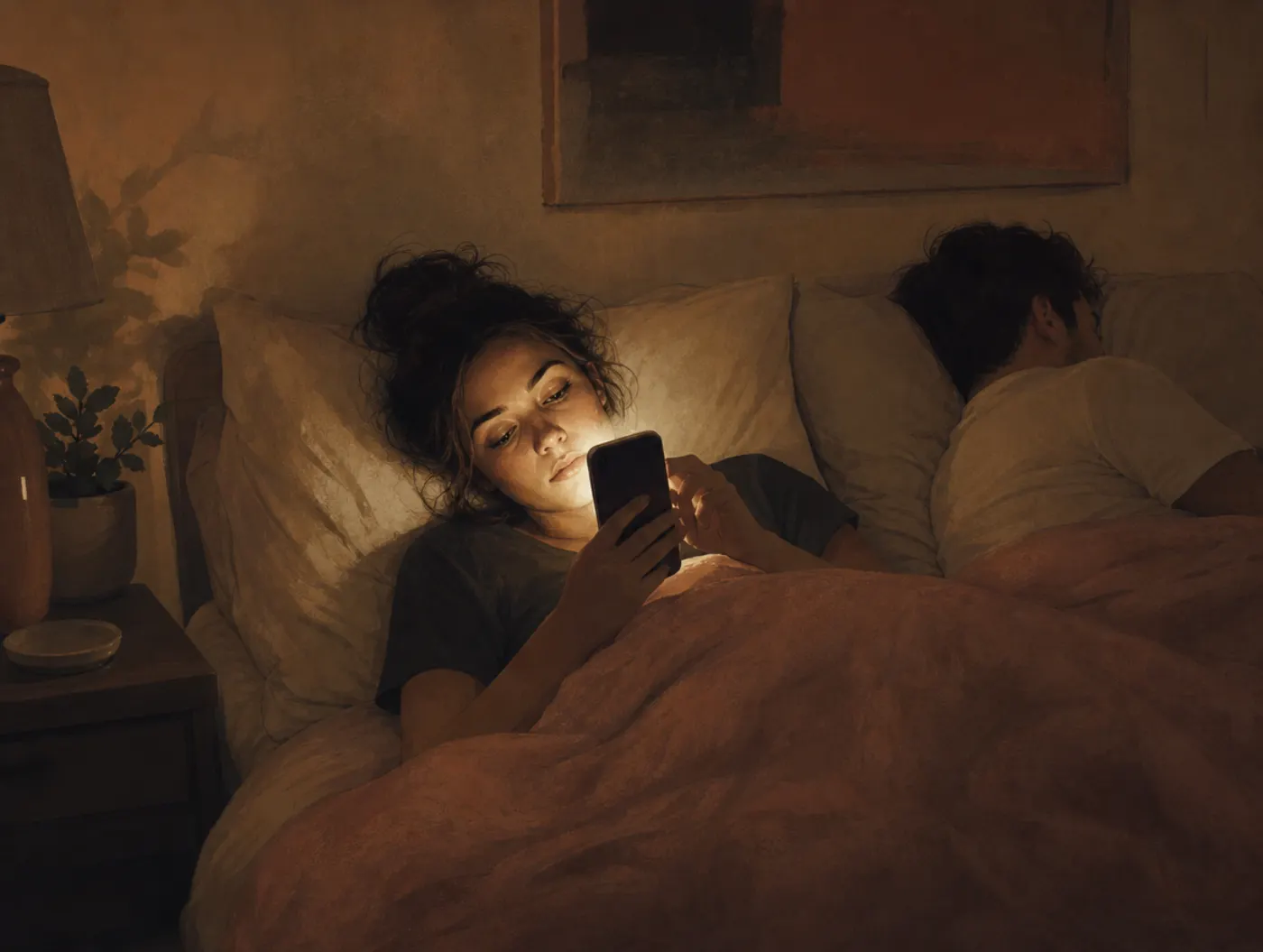
What is left when the screen is off: feeling behind after a day away, fewer hobbies than a few years ago, shortened plans, loneliness despite constant contact, and people telling you about your phone.
| Feature | Typical free quiz | Psychology.com |
|---|---|---|
| Measures worldview effects, not just screen time | Rarely | Yes, a dedicated discourse section |
| Grounded in problematic internet use research | Rarely | Yes, cited and explained |
| Honest about where the joke ends | Either all joke or all alarm | Light tone, real line to the addiction tests |
| Gives a concrete reset, not a lecture | Rarely | Yes, a 48-hour plan |
| Clinician-reviewed interpretation | Rarely | Yes, clinician reviewed |
| Optional in-depth personalized report | No | Yes, written to your exact scores |
| Answers stay on your device | Often collected | Scored in your browser; only summary scores if you request a PDF or report |
Therapists Who Work With Addiction
If your result points to something you want help with, these licensed therapists work with it. Every member is matched to the federal NPI Registry; board checks are dated on the profile.
-
View profile
Danielle JonesLPC, NCC
License verified, checked Oct 20, 2026
“Queer Black neurodivergent therapist specializing in trauma, anxiety, depression, and relationships.”
Denver, Colorado Telehealth $170 to $250 per session
-
View profile
Dr. Ehsan Adib ShabahangLMHC, LPC, NCC
License verified, checked Oct 22, 2026
“Be your best and never give up.”
Cambridge, Massachusetts Telehealth and in person $300 to $350 per session, sliding scale
-
View profile
Dr. Katherine SchoechLPC, PhD, MA
License verified, checked Oct 16, 2026
Denver, Colorado Telehealth $100 per session



How scoring works
Answers are scored 0–80 in total. Your result falls into one of 4 bands:
| Score | Band | What it suggests |
|---|---|---|
| 0–20 | Online, in proportion | The feed is in proportion for you: you use the internet, obviously, but it does not seem to be running your attention or your opinions. |
| 21–40 | Leaning online | The feed has a real foothold in your attention or your worldview, and it is worth noticing before it grows. |
| 41–60 | Chronically online | The feed is shaping a lot of your attention, your opinions, and your offline time, and you are probably aware of it. |
| 61–80 | Deep in the feed | The feed is running most of your attention and a lot of your inner life, and the offline side is likely paying for it. |
How the chronically online score is calculated
The test has 20 statements about things that happen when the internet becomes the main place you live. You rate each from 0 (never) to 4 (very often), for a total from 0 to 80. Higher means more of your attention, your opinions, and your offline time are being shaped by the feed. The four result bands are quarters of that range and are educational guides, not clinical cut-offs. Chronically online is an internet phrase, not a diagnosis, and this page does not screen for a disorder; it helps you see a pattern and decide what to do with it.
The breakdown splits the same answers three ways. Attention and compulsion covers seven items on the pull of the feed: checking before you get up, scrolling after the interest is gone, reopening apps without meaning to, restlessness when you cannot check, refreshing for reactions, losing time, and scrolling in bed. Worldview and discourse covers seven items on how the internet shapes what you think and say: reading comments first, discourse words in real speech, arguing with strangers, judging a person from one post, events feeling unreal until you see the reaction, following dramas between strangers, and narrating your life as content. Offline life covers six items on what is left: feeling behind after a day away, awkwardness in person, shortened plans, fewer hobbies, loneliness despite constant contact, and people commenting on your phone use. This grouping is ours, built for reflection, not a validated subscale structure. If the pull you feel reaches past the feed, the addictive personality test scores the five traits research links to compulsive habits and what protects against each.
What chronically online actually means
The phrase started as an insult and became a self-description. It points at something specific: not how much time you spend online, but how much the internet's logic has become your default way of seeing things. The chronically online person reads a news story and thinks about the discourse before the event. They know the three-year backstory of a feud between two accounts they do not follow. They describe an awkward colleague as a red flag and a pleasant afternoon as a core memory, and they hear themselves do it. They have opinions on things that only exist as online arguments, held with the heat of things that matter. And when they are away from the feed for a day, they feel a low, specific anxiety that the world has moved on without them, which is the feeling the Offline life section is trying to measure.
Research on problematic internet use describes the compulsive side of this picture. Kimberly Young's early work in the late 1990s proposed internet addiction as a behavioral pattern with features borrowed from other compulsions: preoccupation, tolerance, failed attempts to cut down, and use to escape low mood. Scott Caplan's generalized problematic internet use model added a key piece: for many people, online interaction feels safer and easier than face-to-face contact, which drives a preference for online social life, which in turn makes the offline version feel harder, which drives more online time. That loop is why the Offline life items matter even when your attention score is moderate. Being chronically online is partly a compulsion story and partly a story about where you feel most at home. The worldview effects are less studied but widely recognized: a feed optimized for engagement rewards outrage, certainty, and in-group signaling, and spending years inside it changes how you read ordinary human behavior.
The costs, and a 48-hour reset
The costs are mostly quiet. Time, obviously: the hours that would have gone to a hobby, a walk, a friend, or sleep. Attention, which fragments when it is trained to expect a new input every few seconds; our Attention Span Test looks at that directly. Mood: a three-week experiment by Hunt and colleagues at the University of Pennsylvania found that students randomly assigned to limit social media to about 30 minutes a day reported less loneliness and lower depressive symptoms than those who used it as usual. Allcott and colleagues' larger study of deactivating Facebook for a month found small improvements in well-being and a drop in political polarization, along with more time with friends and family. And a cost that is harder to name: a sense of the world as a hostile place full of people waiting to be wrong, which is not what most of your neighbors are like.
A reset is not a detox and does not need to be dramatic. Try 48 hours, ideally a weekend. Before you start, delete the two apps you reach for most (you can reinstall them on Monday; the point is to break the automatic reach, not to make a vow). Move your phone charger out of the bedroom and buy or borrow an alarm clock. Tell one person what you are doing, so the first morning of nothing to check has somewhere to go. Plan one offline thing for each half-day, however small: a walk without headphones, cooking something that takes an hour, a board game, a shop you walk into instead of order from. Keep a note of what you wanted to check and why, because the list is usually short and oddly revealing. On the Sunday evening, notice two things: how the day felt at about 4pm, when the itch is usually strongest, and whether anything on the feed that you missed turned out to matter. Most people find the answer is nothing, and that finding does more than any argument about screen time.
After the reset, keep the two changes that cost you least and gave you most, usually the phone out of the bedroom and a fixed time of day for the feeds. If being alone with your thoughts turned out to be the hard part, that is worth knowing too. Our Loneliness Test and Social Anxiety Test can tell you whether online life has been covering for something that deserves its own attention.
When it is actually addiction
Most people who score high on this page are not addicted to anything. They have a habit shaped by products designed to be habit-forming, and the habit responds to friction, environment, and a bit of honesty. The line into something more serious is drawn by loss of control and harm: you have tried repeatedly to cut down and cannot; the use continues despite real damage to sleep, work, relationships, or money; you feel irritable, anxious, or low when you cannot get online; and you are using the internet mainly to escape feelings rather than to do or enjoy anything. If those sentences describe you, take our Internet Addiction Test, which is built on the established screening model, and if the pull is specifically your phone or specifically games, our Phone Addiction Test and Video Game Addiction Test (IGDS9-SF) test are more targeted.
Gaming disorder is recognized in the World Health Organization's ICD-11; broader internet or social media addiction is still debated among researchers, which is one reason this page uses an everyday phrase instead of a clinical one. The debate does not make the harm less real for the people experiencing it. If you recognize the loss-of-control pattern, a therapist who works with behavioral addictions can help, and cognitive behavioral approaches have reasonable evidence for problematic internet use. If the online life is covering for low mood, anxiety, or loneliness, treating that tends to loosen the habit more than any app blocker will.
Methodology & sources
This is an original educational screener, not a validated clinical instrument, and it is labeled as such. Its 20 statements were written for this page and are informed by two strands of research on problematic internet use: the compulsive-use features described in Kimberly Young's early work on internet addiction (preoccupation, loss of control, use to escape mood, and continued use despite harm), and Scott Caplan's generalized problematic internet use model, which links a preference for online social interaction, mood regulation through internet use, and deficient self-regulation to negative outcomes offline. The worldview and discourse items extend beyond that research into the everyday effects people describe when they call themselves chronically online; they are editorial, not drawn from a validated scale. The experimental evidence on reducing social media use (Hunt et al., 2018; Allcott et al., 2020) informs the reset section.
The three-part breakdown (Attention and compulsion, Worldview and discourse, Offline life) is our own grouping built for reflection, not a psychometric factor structure, and the four result bands are quarters of the 0 to 80 range rather than published cut-offs. Chronically online is a cultural phrase, not a condition; this page does not screen for internet addiction, gaming disorder, or any other diagnosis. Where the pattern described here shades into loss of control and harm, the page points to the Internet Addiction, Phone Addiction, and Video Game Addiction tests, which are built on established screening models, and to professional support.
References
- Young KS. Internet addiction: The emergence of a new clinical disorder. CyberPsychology & Behavior. 1998;1(3):237-244. doi.org/10.1089/cpb.1998.1.237
- Caplan SE. Theory and measurement of generalized problematic Internet use: A two-step approach. Computers in Human Behavior. 2010;26(5):1089-1097. doi.org/10.1016/j.chb.2010.03.012
- Hunt MG, Marx R, Lipson C, Young J. No more FOMO: Limiting social media decreases loneliness and depression. Journal of Social and Clinical Psychology. 2018;37(10):751-768. doi.org/10.1521/jscp.2018.37.10.751
- Allcott H, Braghieri L, Eichmeyer S, Gentzkow M. The welfare effects of social media. American Economic Review. 2020;110(3):629-676. doi.org/10.1257/aer.20190658
- Kuss DJ, Griffiths MD, Karila L, Billieux J. Internet addiction: A systematic review of epidemiological research for the last decade. Current Pharmaceutical Design. 2014;20(25):4026-4052. doi.org/10.2174/13816128113199990617
Cite this source
Psychology.com. (2026, October 5). Chronically Online Test. Psychology.com. https://psychology.com/tests/chronically-online
Chronically Online Test FAQ
What does chronically online mean?
It is an internet phrase for someone whose attention, opinions, and sense of what is normal have been shaped more by online life than by the people and places around them. It is not about hours; it is about the feed becoming your default lens. Typical signs are reading comments before forming your own view, discourse language in everyday speech, strong opinions on arguments that only exist online, and a low anxiety after a day away. It is not a diagnosis.
Is being chronically online the same as internet addiction?
No. Most people who score high here have a strong habit, not an addiction. Addiction involves loss of control and harm: repeated failed attempts to cut down, continued use despite real damage to sleep, work, or relationships, and distress when you cannot get online. If that describes you, our internet addiction test is built on the established screening model and is the right next step.
I work online all day. Will that inflate my score?
Not much, because the items ask about compulsion and worldview rather than hours. Answering emails for eight hours does not make you refresh a post for reactions or judge a stranger from one comment. If you work online and your score is still high, that is useful information: the habit has moved beyond the job. Look at the Offline life section in particular, since that is where the cost of a fully online day usually shows.
Is the test really confidential?
Yes. It runs entirely in your browser. Your individual answers are scored in your browser and are never sent to us or linked to you. They stay in this tab so you can return to your result, and closing or clearing the tab clears them. If you ask us to email the PDF, we receive your summary scores with your email address, never your individual answers. No account is needed.
Does cutting down actually help?
The experimental evidence says yes, modestly. In a three-week study, students who limited social media to about 30 minutes a day reported less loneliness and lower depressive symptoms than a control group, and a month-long Facebook deactivation study found small gains in well-being and more time with friends and family. The effects are not dramatic, but they are real, and most people notice them within days. If loneliness is part of why you are online, our loneliness test can help you see that clearly.
What if being online is where I feel most like myself?
That is common and worth taking seriously rather than shaming. For many people, online spaces offer community, identity, and ease that in-person life has not. The question is whether the online version is adding to your life or replacing parts of it you would rather have back. If face-to-face contact feels harder than it used to, our social anxiety test is a good place to look, and the reset plan on this page is designed to be gentle rather than punishing.