In short
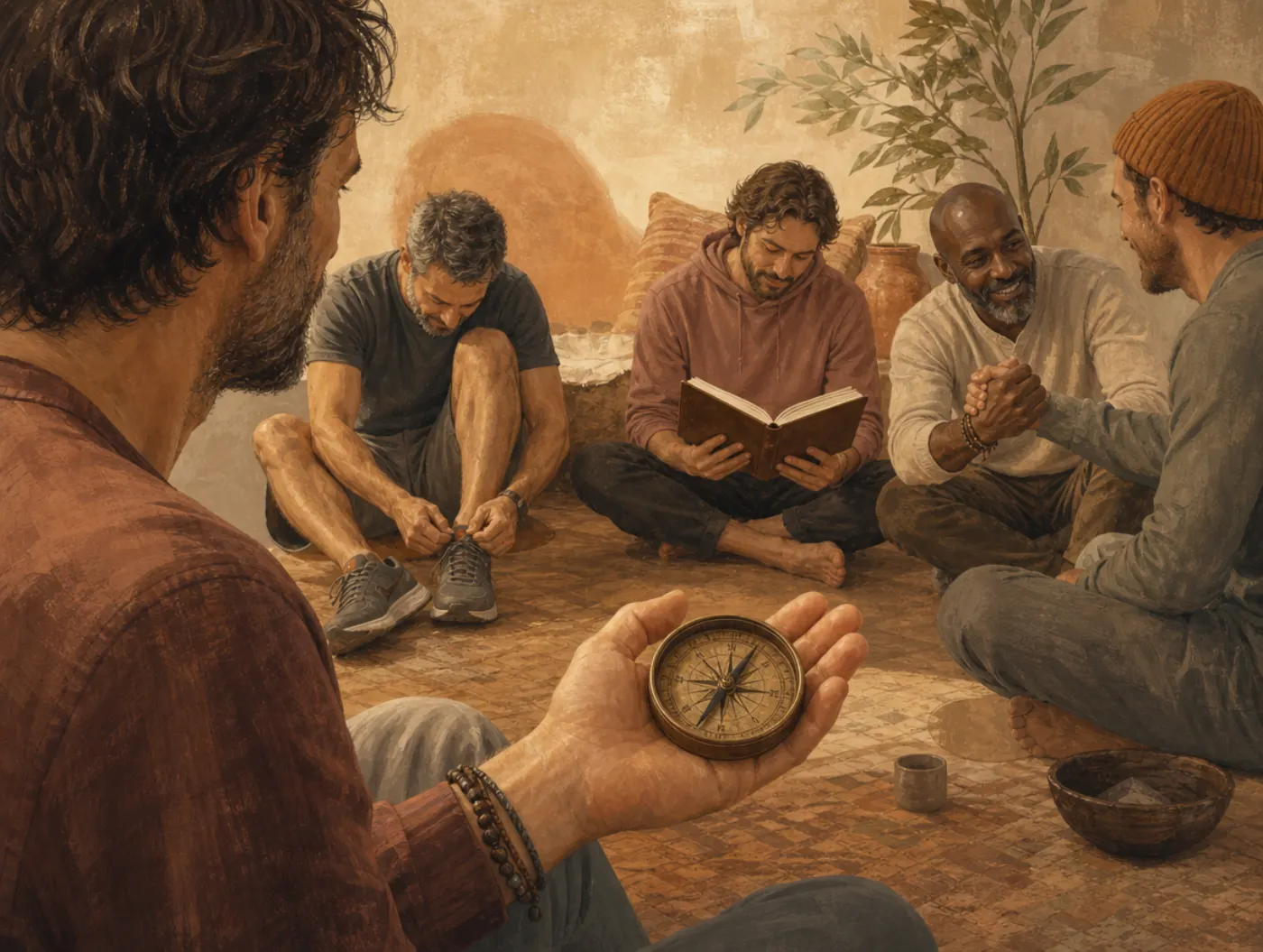
King, Warrior, Magician, Lover is a model of mature masculine psychology from Robert Moore and Douglas Gillette's 1990 book of the same name. The four archetypes describe patterns of adult functioning: King (responsibility and fair order), Warrior (disciplined, purposeful effort), Magician (understanding used responsibly), and Lover (attention and connection to life). Psychology.com's Male Archetype Test measures all four together and reports your leading pattern; it is an original questionnaire and, like the book itself, not a validated psychological instrument.
- Model
- Four archetypes: King, Warrior, Magician, Lover
- Source
- Robert Moore and Douglas Gillette, 1990
- Core idea
- Mature adulthood as responsibility, discipline, insight, and connection
- Framework type
- Narrative model, not a measured trait
- Also called
- KWML
- Test
- Male Archetype Test
What King, Warrior, Magician, Lover is, and where it comes from
King, Warrior, Magician, Lover: Rediscovering the Archetypes of the Mature Masculine is a 1990 book by Jungian analysts Robert Moore and Douglas Gillette. Drawing on mythology, folklore, and clinical work, they proposed four archetypal patterns available to men at their most mature and functional: the King, the Warrior, the Magician, and the Lover.
The book grew out of the same period as the broader mythopoetic men's movement associated with the poet Robert Bly, which used myth and ritual to give men language for emotional experience that mainstream culture often left unaddressed. Moore and Gillette's specific contribution was a structured model: four mature archetypes, each with two opposite immature or shadow forms.
Their central argument was that mature masculinity is not about dominance or suppressing feeling, but about responsibility, discipline, understanding, and genuine connection, and that failures of masculinity usually come from an imbalance in one of these four patterns rather than too much or too little masculinity as a whole.
These patterns are not limited to men. While Moore and Gillette wrote specifically about masculine psychology, Psychology.com frames King, Warrior, Magician, and Lover as patterns any adult can recognize in themselves, alongside the goddess archetypes on our separate Female Archetype Test, which explores a different, related tradition.
The book became one of the most widely read texts to come out of the mythopoetic men's movement of the late 1980s and early 1990s, a period that also produced Robert Bly's bestseller Iron John and inspired ongoing men's work organizations, including the ManKind Project, which grew out of the same circle of ideas and still runs experiential group work today. The four names get reordered in searches, from Warrior Magician Lover King to Warrior King Magician Lover, but the model is the same.
How the four archetypes are defined
Moore and Gillette structure each archetype the same way: a mature, functional form, plus two immature shadow poles that sit at opposite extremes, one from taking too much of the pattern and one from taking too little.
King's shadow poles are the Tyrant, who controls to protect status, and the Weakling, who avoids responsibility that is genuinely his. Warrior's are the Sadist, who turns force outward past any real purpose, and the Masochist, who accepts needless suffering. Magician's are the Detached Manipulator, who withholds knowledge for advantage, and the Denying Innocent, who avoids owning what he knows. Lover's are the Addicted Lover, who chases intensity without limits, and the Impotent Lover, who feels cut off from vitality.
On Psychology.com's Male Archetype Test, each archetype is measured with six original questions about everyday adult situations, rated on a simple scale. Each archetype's answers become a percentage of its own maximum, and your highest percentage becomes your leading pattern, though the test reports all four scores together so you can see your whole profile, not just one label.
Moore and Gillette were explicit that the four archetypes work best together rather than in isolation. A King pattern without Warrior's discipline can set a fair direction and never follow through on it. A Warrior pattern without King's sense of purpose can work hard at the wrong thing. Magician without Lover can understand people without caring about them, and Lover without Magician can feel deeply without understanding what the feeling is telling you. This is one reason the test reports a full profile instead of collapsing you into a single label.
King Warrior Magician Lover: why the King is not simply the boss
King and Warrior can both look decisive, but their responsibilities differ within this story-based model. King asks what deserves support, what direction is fair, and how the whole situation can remain workable. Warrior asks what action or boundary will serve that direction. Taking charge is not enough to distinguish them; the purpose and manner of the decision matter.
Moore and Gillette’s follow-up book The King Within describes the King through a combination of authority and care, as the author’s book overview explains. That is a statement of their model, not proof that leadership has four measurable ingredients. In an ordinary team decision, a King-style interpretation might focus on allocating responsibility fairly, while a Warrior-style interpretation focuses on carrying out the agreed task and stopping work that falls outside its limits.
The four archetypes
The King describes taking responsibility that creates order and room for other people, from making a fair call under pressure to making sure someone else gets credit for a shared success. It is not about outranking people; its shadow poles are the Tyrant, who controls to protect status, and the Weakling, who avoids a decision that is genuinely his.
The Warrior describes disciplined, purposeful effort with real limits: following through once motivation fades, and stating a boundary plainly instead of letting it build into resentment. Its shadow poles are the Sadist, who turns discipline into harshness, and the Masochist, who endures needless suffering and calls it commitment.
The Magician describes careful inquiry and responsible use of what you understand, from diagnosing the real cause of a stuck problem to explaining something clearly so someone else can use it. Its shadow poles are the Detached Manipulator, who withholds knowledge for advantage, and the Denying Innocent, who avoids owning what he knows.
The Lover describes full attention to ordinary life: noticing beauty in a familiar moment, saying specifically what you appreciate about someone, feeling genuinely restored by something you enjoy. Its shadow poles are the Addicted Lover, who chases ever-greater intensity, and the Impotent Lover, who feels cut off from vitality altogether.
King Warrior Magician Lover: balancing insight with participation
Magician and Lover describe different ways of engaging with experience in this framework. Magician seeks understanding, perspective, and the ability to make knowledge useful. Lover emphasizes participation, appreciation, and feeling connected to life. The contrast becomes clearer when expertise creates distance: understanding every feature of a piece of music is not the same experience as letting yourself enjoy it.
For a practical reflection, consider planning a gathering. A Magician description might fit the person who understands why the arrangements work; a Lover description might fit attention to the atmosphere and shared enjoyment. Both can belong to the same adult. A low Lover score does not establish an inability to care, just as a high Magician score does not establish wisdom. Ask which mode the situation needed and which one your actions actually expressed.
How to find your leading archetype
Psychology.com's Male Archetype Test asks 24 original questions, six per archetype, about ordinary adult situations rather than abstract preferences. It reports King, Warrior, Magician, and Lover as percentages together, so you can see your whole profile rather than a single type.
The result screen explains your leading pattern in plain language and names both shadow poles for each archetype without shaming language. An optional in-depth report is available afterward for anyone who wants a longer written breakdown.
It is worth taking the test more than once over time rather than treating a single result as fixed. Because the questions ask about current habits and choices, a profile taken during a demanding stretch of work can look different from one taken during a calmer season, and that shift is itself useful information.
What the research says
King, Warrior, Magician, Lover is a narrative framework built from Jungian psychology, mythology, and clinical observation, not a measured personality trait with population norms. It has not been validated the way trait instruments like the Big Five have, and Psychology.com's Male Archetype Test is an original, unvalidated questionnaire inspired by the model.
Sociologist Michael Schwalbe's study of the mythopoetic men's movement this book helped shape found real value in giving men vocabulary for responsibility, discipline, insight, and connection, alongside a fair criticism that mythic archetypes can romanticize a pattern instead of examining it critically.
The American Psychological Association's guidelines for practice with boys and men caution against treating any single template, mythic or otherwise, as the definition of healthy masculinity. King, Warrior, Magician, Lover is best used as a reflective tool and a shared vocabulary, not a scientific description of personality.
Common misconceptions
A common misconception is that this model is about dominance or being in charge. Moore and Gillette are explicit that the mature forms of all four archetypes serve other people and oneself without controlling or diminishing anyone; the shadow poles, not the mature archetype, describe the harmful versions.
Another misconception is that these patterns only apply to men. While the book is written about masculine psychology and uses that language throughout, the underlying patterns, responsibility, discipline, insight, and connection, describe ways of functioning that adults of any gender recognize in themselves.
A third misconception is confusing this King, Warrior, Magician, Lover model with Psychology.com's separate twelve-archetype personality model, which also includes archetypes named Magician and Lover but describes an entirely different framework. The two share some names from mythology and folklore but are not the same model; each has its own page here.
A fourth misconception is using a leading archetype as an excuse for how you treat people, saying a harsh comment is just my Warrior or a controlling decision is just my King. Moore and Gillette's own model labels exactly that behavior a shadow pole, not the mature archetype, so this kind of excuse actually contradicts the book it is borrowing language from. Start with the King archetype, the pattern of responsibility that creates order and room for others. The warrior archetype page covers disciplined effort, its two shadow poles, and what helps a mature Warrior pattern.
What is King, Warrior, Magician, Lover: Rediscovering the Archetypes of the Mature Masculine about?
King, Warrior, Magician, Lover: Rediscovering the Archetypes of the Mature Masculine is the full title of the 1990 book by Jungian analysts Robert Moore and Douglas Gillette that this model comes from. Drawing on mythology, folklore, and clinical work, it proposes four archetypal patterns available to men at their most mature: the King, the Warrior, the Magician, and the Lover, each with two opposite immature shadow forms. Its central argument is that mature masculinity is about responsibility, discipline, understanding, and connection rather than dominance, and that failures usually come from an imbalance in one pattern. The book grew out of the mythopoetic men's movement associated with Robert Bly, and it remains one of that movement's most widely read texts.
The 4 types
The King Archetype (King, Warrior, Magician, Lover) →
Steady responsibility and fair decisions that create room for others to thrive.
The Warrior Archetype (King, Warrior, Magician, Lover) →
Focused effort, clear limits, and follow-through in service of what matters.
The Magician Archetype (King, Warrior, Magician, Lover) →
Careful inquiry and understanding used responsibly, not mysticism or superior intellect.
The Lover Archetype (King, Warrior, Magician, Lover) →
Full attention to life, appreciation, and connection, never romance or sex.
Key takeaways
- King, Warrior, Magician, Lover is a 1990 model of mature masculine psychology from Jungian analysts Robert Moore and Douglas Gillette.
- The four archetypes are King (responsibility and fair order), Warrior (disciplined effort), Magician (responsible understanding), and Lover (attention and connection).
- Each archetype has two shadow poles, one from taking too much of the pattern and one from taking too little, described in plain, non-shaming language.
- The patterns are available to any adult, not limited to men, though Moore and Gillette wrote specifically about masculine psychology.
- Psychology.com's separate twelve-archetype model also includes archetypes named Magician and Lover; the two frameworks are distinct.
- The Male Archetype Test is an original, unvalidated questionnaire offered for self-reflection, not a scientifically validated personality instrument.
See your King, Warrior, Magician, and Lover scores
Take the free Male Archetype Test to see all four patterns together, with a plain-language read on your leading one.
Cite this source
Fontane Pennock, S. (2026, October 18). King, Warrior, Magician, Lover. Psychology.com. https://psychology.com/types/king-warrior-magician-lover
Frequently asked questions
What is King, Warrior, Magician, Lover?
It is a 1990 model of mature masculine psychology from Jungian analysts Robert Moore and Douglas Gillette, describing four archetypal patterns: King, Warrior, Magician, and Lover. Each has a mature form and two immature shadow poles. Psychology.com's Male Archetype Test measures all four together.
Is King, Warrior, Magician, Lover a scientifically validated model?
No. It is a narrative framework built from Jungian psychology and mythology, not a measured personality trait. It has no population norms or peer-reviewed validity data, and Psychology.com's Male Archetype Test is an original, unvalidated questionnaire inspired by it.
Can women use this framework?
Moore and Gillette wrote specifically about masculine psychology, but the underlying patterns, responsibility, discipline, insight, and connection, are ones adults of any gender recognize in themselves. Psychology.com's separate Female Archetype Test explores a related tradition through Jean Shinoda Bolen's seven goddess archetypes.
What are the shadow sides in this model?
Each archetype has two: King's are the Tyrant and the Weakling, Warrior's are the Sadist and the Masochist, Magician's are the Detached Manipulator and the Denying Innocent, and Lover's are the Addicted Lover and the Impotent Lover. All are metaphors for imbalance, not clinical labels.
Are the Magician and Lover archetypes here the same as the ones in the 12 Jungian archetypes?
No. Psychology.com's separate twelve-archetype model also includes archetypes named Magician and Lover, but it is a different framework with a different history. Both Magician pages and both Lover pages are linked from this index for comparison.
How do I find my leading archetype?
Take Psychology.com's free Male Archetype Test, 24 original questions about everyday situations. It reports King, Warrior, Magician, and Lover as percentages together, with an explanation of your leading pattern and an optional in-depth report afterward.
Does King Warrior Magician Lover mean choosing one archetype?
No, King Warrior Magician Lover is a framework for considering how four patterns work together. A leading score highlights the description most strongly endorsed, not the only role available to you. It can be more useful to ask what a situation calls for, such as direction, a boundary, understanding, or participation, than to defend the top label.
Is King Magician Warrior Lover a different system?
King Magician Warrior Lover usually refers to the same four-pattern framework with the middle names reordered. The original book title is King, Warrior, Magician, Lover. The order is not a ranking of personal worth or a sequence you must complete. Check that the descriptions refer to Moore and Gillette’s model, since other archetype frameworks reuse some of the names.
Is there a King Warrior Magician Lover test?
Yes. The King Warrior Magician Lover test on Psychology.com is the free Male Archetype Test: 24 original questions, six per archetype, about ordinary adult situations rather than abstract preferences. It reports King, Warrior, Magician, and Lover as percentages together, names your leading pattern, and explains both shadow poles for each archetype without shaming language, with an optional in-depth report afterward. Like the book itself, it is not a validated psychological instrument, so read the result as a reflective tool.
Related types


References
- Moore, R., & Gillette, D. (1990). King, Warrior, Magician, Lover: Rediscovering the Archetypes of the Mature Masculine. HarperSanFrancisco. https://books.google.com/books?id=TU4gAQAAIAAJ
- Jung, C.G. The Archetypes and the Collective Unconscious. Collected Works of C.G. Jung, Volume 9, Part 1. 2nd ed. Princeton University Press; 1969. press.princeton.edu
- Schwalbe, M. Unlocking the Iron Cage: The Men's Movement, Gender Politics, and American Culture. Oxford University Press; 1996. archive.org
- American Psychological Association. APA Guidelines for Psychological Practice with Boys and Men. 2018. apa.org
- Moore R, Gillette D. The King Within: Accessing the King in the Male Psyche. Avon Books; 1992. Author overview: https://robertmoore-phd.com/index.cfm?fuseaction=page.display&page_id=77