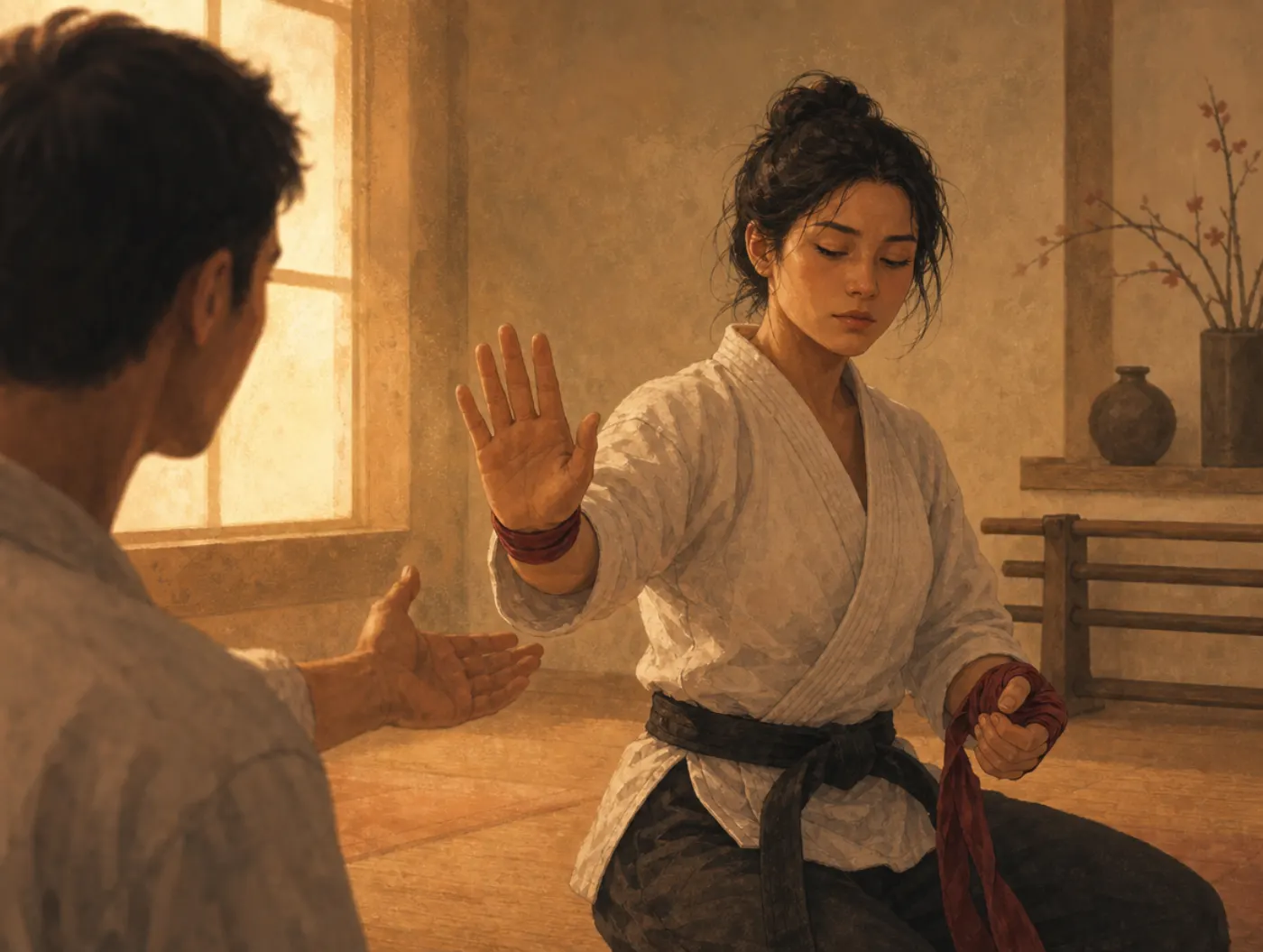
In short
Warrior is one of four adult patterns measured by Psychology.com's Male Archetype Test, based on Robert Moore and Douglas Gillette's 1990 book King, Warrior, Magician, Lover. A strong Warrior score describes disciplined effort with real limits: practicing a skill after the excitement fades, stating a boundary plainly, or finishing something because it matters, not because it feels good in the moment. It is a pattern anyone can recognize, not a rating of toughness, and the test also reports your King, Magician, and Lover scores.
- Source model
- King, Warrior, Magician, Lover (Moore and Gillette, 1990)
- Core drive
- Disciplined effort that serves a purpose beyond comfort
- Biggest strength
- Following through when motivation fades
- Watch for
- Turning discipline into harshness, toward yourself or others
- Shadow poles
- Sadist and Masochist
- Test
- Male Archetype Test
The Warrior archetype at a glance
A strong Warrior score usually shows up as follow-through rather than intensity. It might be someone who keeps training after the novelty wears off, who says no to a request that would compromise something they have committed to, or who stays in an uncomfortable conversation because avoiding it would cost more later. The through-line is purposeful effort that continues after motivation runs out.
Warrior is one of four archetypes in Robert Moore and Douglas Gillette's King, Warrior, Magician, Lover: Rediscovering the Archetypes of the Mature Masculine (1990), alongside King, Magician, and Lover, each with its own page here. In their model, the mature Warrior serves a cause larger than personal comfort, with real ethical limits on how that effort is used.
On Psychology.com's Male Archetype Test, Warrior is measured through everyday scenarios: whether you follow through once enthusiasm fades, whether you can state a limit without either backing down or escalating, whether you can tolerate short-term discomfort for a longer-term outcome. A high score means this feels familiar, not that you are combative or physically tough. Everyday warrior archetype examples: keeping up training after the novelty fades, or stating a limit plainly without backing down or escalating.
Core traits of the Warrior pattern
The organizing trait is disciplined action in service of a purpose. People with a strong Warrior pattern tend to treat a commitment as binding even once the initial motivation is gone, training or working steadily rather than only when they feel inspired.
A second trait is clarity about limits. A mature Warrior pattern can name a boundary directly, a deadline, a workload, a line that should not be crossed, without softening it into a vague hint or turning it into a fight.
A third trait is a kind of ethical restraint: the effort is aimed at something specific and stops there. Moore and Gillette are careful to separate the mature Warrior from aggression, describing genuine Warrior energy as skill in service of a cause, with real limits on the harm it is willing to cause.
The Warrior archetype: what is the effort serving?
The author-site account of Moore and Gillette's The Warrior Within connects Warrior determination with perseverance, fidelity, and commitments to workplaces, communities, and families. That type-specific source locates the metaphor in sustained service, not simply in winning confrontations. It is an account of the authors' theory, not a scientific finding about a Warrior personality.
One practical way to use the distinction is to finish this sentence before a demanding commitment: "I am doing this so that..." A clear answer, such as keeping an agreed service running while a colleague is away, gives effort a purpose and an endpoint. If the only answer is proving that you can endure more than anyone else, the Warrior metaphor may be obscuring the question of whether the effort still helps.
Strengths
The clearest strength is reliability under difficulty. A strong Warrior pattern keeps showing up on the days that are inconvenient, which is often the actual difference between a habit that sticks and one that does not.
Warrior-leaning people tend to be direct, saying what they mean about a limit or a disagreement instead of letting it build up silently, which often makes them easier, not harder, to work with over time. If the direction and fairness of a decision matter more to you than carrying it out, read about the King archetype, Warrior's closest neighbor in this model.
They also tend to perform well under real pressure, since the pattern is built around tolerating discomfort in service of an outcome, rather than needing conditions to be comfortable before acting.
A mature Warrior pattern protects other people well, holding a boundary on someone else's behalf, defending a teammate, or absorbing a hard conversation so someone more vulnerable does not have to.
They also tend to recover their footing quickly after a setback. Because effort, not mood, is the thing they trust, a bad week does not usually derail a Warrior-leaning person's larger commitments the way it might for someone relying on motivation alone.
Challenges and blind spots
The clearest risk is letting discipline turn into harshness. Moore and Gillette name this shadow pole the Sadist: force turned outward, using pressure or intensity on other people well past the point that serves anyone. In ordinary life this looks like pushing a team past a reasonable limit because giving less than everything feels like failure.
The opposite shadow, the Masochist, is quieter and often praised rather than questioned: enduring unnecessary suffering and calling it commitment. This shows up as staying in a punishing job, relationship, or training schedule long after it stopped serving any real purpose, because stopping would feel like weakness.
A strong Warrior pattern can also struggle to rest without guilt, treating downtime as something to earn rather than something a sustainable effort actually requires. Left unchecked, this produces bursts of intensity followed by burnout rather than steady output.
Because the pattern values toughness, it can be genuinely hard for a Warrior-leaning person to ask for help, since asking can feel like conceding that the effort was not enough on its own.
There is also a subtler risk of confusing motion with progress, staying busy on a difficult task rather than stepping back to ask whether it is still the right task. Discipline aimed at the wrong target is still discipline, but it stops being useful.
The Warrior pattern in relationships
In close relationships, a strong Warrior pattern often shows up as loyalty in the specific sense of showing up consistently, not the sentimental sense: remembering commitments, defending a partner or friend when it costs something, doing the unglamorous parts of caretaking without being asked twice.
The risk is applying the same discipline to feelings that works for tasks. A partner who wants to be heard, not fixed or pushed through, can experience a Warrior-leaning person's directness as pressure, especially when a difficult conversation gets treated like an obstacle to overcome rather than a feeling to sit with.
The healthiest expression pairs Warrior's follow-through with the attention a strong Lover pattern brings. Discipline that includes real presence, not just competence, tends to land as care rather than as one more task completed.
The Warrior pattern at work
At work, a strong Warrior pattern often looks like the person who finishes what they start, holds a deadline others have quietly abandoned, or takes on the unglamorous task that keeps a project from stalling. This kind of reliability tends to earn trust even without much visibility.
It fits naturally into roles with a clear goal and a real cost to quitting early: training, sales, operations, anything with a long runway between effort and payoff. It grates in environments with constantly shifting priorities, since the pattern's strength is sustained focus, and constant redirection can feel like betrayal of an earlier commitment.
The Sadist shadow at work usually shows up as an unreasonable standard applied to a team, treating anything less than maximum effort as unacceptable. The Masochist shadow shows up as chronic overwork treated as a badge of honor. Both benefit from an outside check on whether the standard being enforced is actually necessary.
A healthy Warrior pattern at work also knows when a fight is over. Continuing to argue for a decision that has already been made, or reworking something that has already shipped, spends discipline on a battle that no longer needs winning.
Growth: what helps a mature Warrior pattern
Practice naming a limit out loud before you are angry about it, at the point where it is still just information rather than a confrontation.
Schedule rest the same way you would schedule a workout: as a planned commitment, not a reward you have to earn by first proving you deserve it.
Notice one place where you are enduring something out of pride rather than genuine necessity, and ask what would actually change if you stopped.
Ask for help with something specific this week, before you are at the point of needing it, so it does not feel like an admission of failure.
If King is close behind in your profile, let it help you question whether an effort actually serves the goal, not just your own sense of toughness. If Magician is strong, use its habit of stepping back to check whether the fight you are in is the right one.
Warrior archetype discipline includes a stopping rule
A Warrior archetype reflection needs a rule for stopping as well as starting. Without one, every completed task can become evidence that another task should be taken on. Before a difficult week, define the essential commitment, what adequate completion looks like, and when to review whether the work still serves its original purpose.
For example, an adult preparing for a professional assessment might commit to a planned practice session, record the next weak point, then stop at the agreed time. Extending every session until exhaustion would not automatically show greater dedication. Within this pattern, restraint preserves the capacity to return to the work. King helps question the direction; Warrior practice includes carrying out the stopping decision even when pushing harder would feel more impressive.
The Warrior archetype compared with its neighbors
Within this model, Warrior's closest neighbor is King: King sets the direction and the standard of fairness, described on its own page, while Warrior supplies the disciplined effort that carries a decision out once it has been made.
Warrior is also worth distinguishing from the Hero, one of twelve archetypes in Psychology.com's separate Jungian archetype model. Both describe courage and action, but they come from different frameworks with different histories.
What the research says
King, Warrior, Magician, Lover is a narrative framework built from Jungian psychology and mythology, not a measured personality trait. Moore and Gillette's model has not been validated the way trait instruments like the Big Five have, and Psychology.com's Male Archetype Test is an original, unvalidated questionnaire inspired by it, with no population norms or clinical cutoffs.
Sociologist Michael Schwalbe's research on the mythopoetic men's movement that formed around this model found genuine value in giving men vocabulary for effort and restraint, alongside a real risk: mythic language about warriors can slide into glorifying toughness instead of examining when toughness stops helping.
The American Psychological Association's guidelines for practice with boys and men caution against treating any single template, including a warrior ideal, as the definition of healthy masculinity, which is worth holding alongside a high Warrior score on this test.
How to find out if Warrior is your leading pattern
Psychology.com's Male Archetype Test asks 24 original questions about everyday situations, six per archetype, and reports a percentage for King, Warrior, Magician, and Lover together, so you see your whole profile rather than one label. The result screen explains what a leading Warrior score tends to mean and names both shadow poles plainly.
An optional in-depth report is available afterward for anyone who wants a longer written breakdown of their specific mix. The result describes patterns in how you answered today, not a fixed measure of toughness or worth. For how the Warrior fits beside the other three patterns, read the King Warrior Magician Lover overview. A closely related pattern from Psychology.com's separate twelve-archetype family is described on the hero personality page.
Is there a warrior personality type?
A warrior personality type is not a measured trait; in this model, Warrior is one of four narrative patterns from Robert Moore and Douglas Gillette's 1990 book King, Warrior, Magician, Lover, and Psychology.com's Male Archetype Test is an original, unvalidated questionnaire inspired by it. The warrior personality traits people recognize are disciplined action in service of a purpose, treating a commitment as binding once the initial motivation is gone; clarity about limits, naming a boundary directly without turning it into a fight; and ethical restraint, effort aimed at something specific that stops there. A high score means this feels familiar, not that you are combative or physically tough, and adults of any gender recognize the pattern.
| Feature | Warrior (King, Warrior, Magician, Lover) | Hero (12 Jungian archetypes) |
|---|---|---|
| Source model | Moore and Gillette's four-archetype masculine model (1990) | Psychology.com's twelve-archetype personality model |
| What it measures | Disciplined, purposeful effort with real limits | Courage and achievement through overcoming a challenge |
| Core focus | Following through once motivation fades | Proving competence by rising to a specific test |
| Shadow poles | Sadist and Masochist | Not part of this framework's language |
| Test it comes from | Male Archetype Test | Archetype Test |
| Where to read more | This page | The Hero archetype page |
Key takeaways
- The Warrior pattern from Psychology.com's Male Archetype Test describes disciplined, purposeful effort with real limits, not aggression or toughness for its own sake.
- It comes from Moore and Gillette's 1990 book King, Warrior, Magician, Lover, a narrative framework rather than a validated personality measure.
- Its two shadow poles are the Sadist, who turns force outward past any real purpose, and the Masochist, who endures needless suffering and calls it commitment.
- Warrior is easy to confuse with the Hero archetype from Psychology.com's separate twelve-archetype model; they come from different frameworks.
- Growth for a strong Warrior pattern usually means scheduling rest deliberately and naming limits before resentment builds.
- The pattern is available to anyone, regardless of gender; the test also reports your King, Magician, and Lover scores alongside it.
Curious about your leading archetype?
Take the free Male Archetype Test to see your King, Warrior, Magician, and Lover scores together, with a plain-language read on your leading pattern.
Cite this source
Fontane Pennock, S. (2026, October 18). The Warrior Archetype (King, Warrior, Magician, Lover). Psychology.com. https://psychology.com/types/warrior
Frequently asked questions
Does a strong Warrior score mean I'm aggressive?
No. The mature Warrior pattern in Moore and Gillette's model is disciplined effort with real ethical limits, not aggression. Force used past any real purpose is closer to what the model calls the Sadist, one of Warrior's two shadow poles, not the mature pattern itself.
What is the difference between Warrior and Hero?
Warrior comes from Moore and Gillette's 1990 book King, Warrior, Magician, Lover, one of four adult patterns. Hero is one of twelve archetypes in a separate model available on Psychology.com's Archetype Test. Both involve courage, but Warrior is about sustained discipline while Hero is about rising to a specific challenge.
Can Warrior describe someone who isn't a man?
Yes. Moore and Gillette wrote about masculine psychology specifically, but the underlying pattern, disciplined effort with clear limits, is one adults of any gender recognize in themselves. Psychology.com treats these as patterns available to anyone.
Is the Male Archetype Test scientifically validated?
Warrior is offered for self-reflection, not diagnosis. The test is an original questionnaire inspired by Moore and Gillette's narrative model, without scientific validation, population norms, or peer-reviewed validity data to support its results.
What are the Warrior archetype's shadow sides?
Moore and Gillette describe two: the Sadist, who turns force on other people past any useful purpose, and the Masochist, who accepts needless suffering and treats it as virtue. Both are metaphors for imbalance, not clinical labels.
How does Warrior differ from King in this model?
King, covered on its own page, sets the direction and fairness of a decision. Warrior supplies the disciplined effort that carries a decision out once it is made. Many people carry both patterns close together in their profile.
Can the warrior archetype include walking away from an argument?
The Warrior archetype can include walking away when continuing an argument no longer serves a useful purpose. In this framework, a clear limit matters more than winning every exchange. State what you will do, such as returning to the discussion at an agreed time, and follow through without treating the pause as a punishment.
Does the warrior archetype require constant productivity?
The Warrior archetype does not require constant productivity; it describes effort directed toward a purpose with real limits. A commitment can include rest, help from someone else, and a point at which the work is complete. The useful question is whether discipline sustains what matters, rather than merely increasing the amount of discomfort endured.
Is the warrior archetype Jung's own idea?
Not directly. King, Warrior, Magician, Lover is a narrative framework that Robert Moore and Douglas Gillette built from Jungian psychology and mythology in 1990, so the warrior archetype Jung is associated with reaches this page through their four-pattern model rather than a category Jung defined himself. The model has not been validated the way trait instruments like the Big Five have, and the American Psychological Association's guidelines caution against treating any single template, including a warrior ideal, as the definition of healthy masculinity.
Is there a warrior test?
The warrior test on Psychology.com is the free Male Archetype Test, which measures Warrior through everyday scenarios: whether you follow through once enthusiasm fades, whether you can state a limit without backing down or escalating, and whether you can tolerate short-term discomfort for a longer-term outcome. It reports your King, Magician, and Lover scores alongside Warrior. The result describes patterns in how you answered today, not a fixed measure of toughness or worth, and it is offered for self-reflection, not diagnosis.
Related types


References
- Moore, R., & Gillette, D. (1990). King, Warrior, Magician, Lover: Rediscovering the Archetypes of the Mature Masculine. HarperSanFrancisco. https://books.google.com/books?id=TU4gAQAAIAAJ
- Jung, C.G. The Archetypes and the Collective Unconscious. Collected Works of C.G. Jung, Volume 9, Part 1. 2nd ed. Princeton University Press; 1969. press.princeton.edu
- Schwalbe, M. Unlocking the Iron Cage: The Men's Movement, Gender Politics, and American Culture. Oxford University Press; 1996. archive.org
- American Psychological Association. APA Guidelines for Psychological Practice with Boys and Men. 2018. apa.org
- Moore R, Gillette D. The Warrior Within: Accessing the Knight in the Male Psyche. William Morrow; 1992. Author-site overview: https://robertmoore-phd.com/index.cfm?fuseaction=page.display&page_id=78