In short
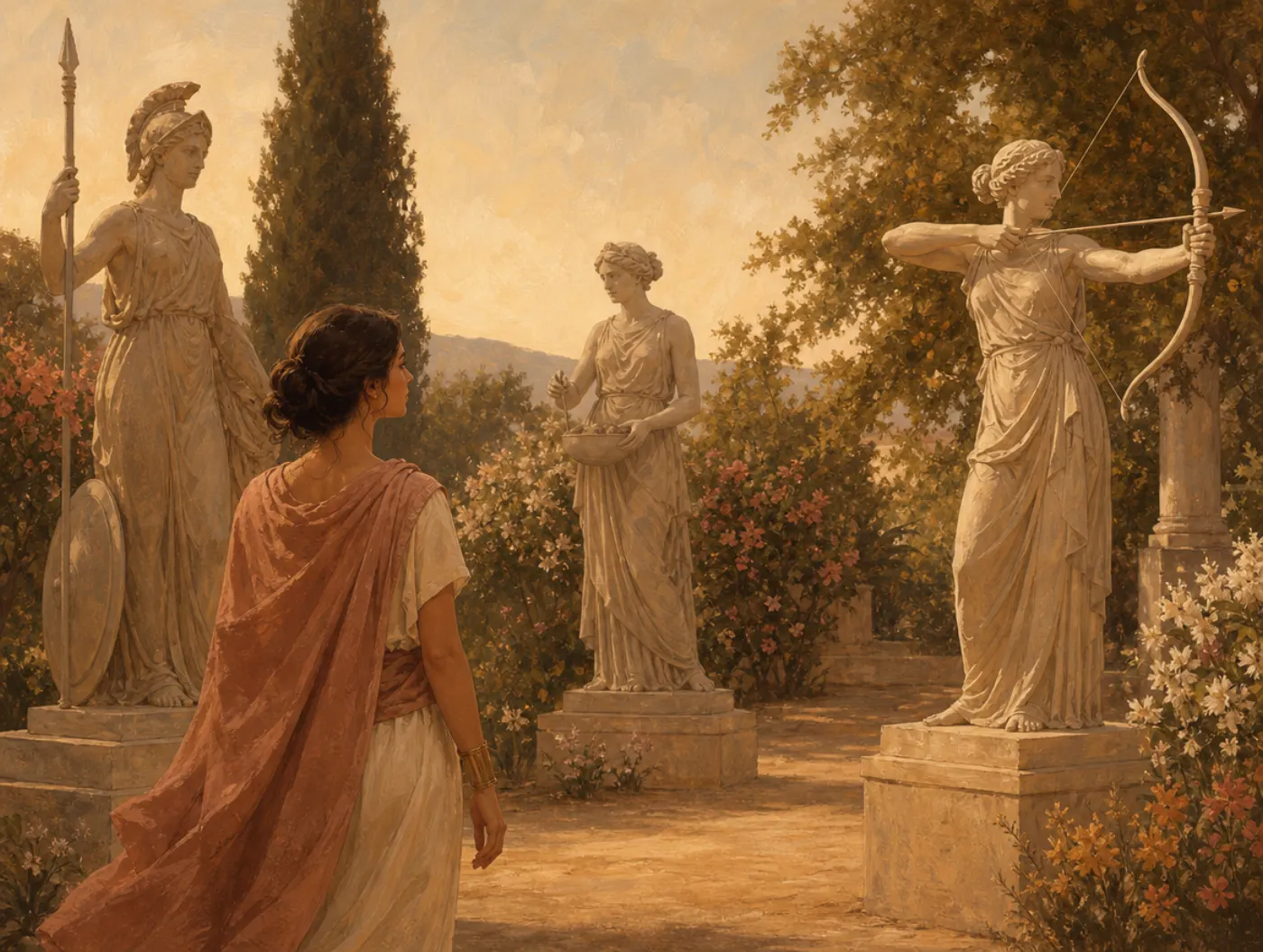
The goddess archetypes are seven inner patterns named after Greek goddesses, first laid out by the Jungian analyst Jean Shinoda Bolen in her 1984 book Goddesses in Everywoman. Artemis, Athena, and Hestia describe forms of self-directed independence; Hera, Demeter, and Persephone describe forms of relationship and change; Aphrodite describes creative, absorbed attention. Psychology.com's free Female Archetype Test estimates which patterns currently stand out for you. The model is a narrative lens for reflection, not a validated personality instrument, and it is available to any adult, not a rule about what women are like.
- Source
- Jean Shinoda Bolen, Goddesses in Everywoman, 1984
- Number of patterns
- Seven: Artemis, Athena, Hestia, Hera, Demeter, Persephone, Aphrodite
- Three groupings
- Independent, relational, and creative-alchemical
- Who it's for
- Any adult; not a claim about gender
- Evidence status
- Narrative reflection framework, not a validated instrument
- Test
- Female Archetype Test
Where the goddess archetypes come from
In 1984, the psychiatrist and Jungian analyst Jean Shinoda Bolen published Goddesses in Everywoman, a book that used seven figures from Greek mythology as a way to talk about recurring inner patterns: what a person tends to want, how they tend to handle closeness and independence, and where their sense of meaning tends to come from. Bolen was drawing on the work of Carl Jung, who argued decades earlier that certain images and story patterns, which he called archetypes, show up again and again across cultures because they capture something durable about how people experience being human.
Bolen's contribution was to take that broader idea and give it a specific, memorable vocabulary using goddess names most people already half-know from myth: Artemis the hunter, Athena the strategist, Hestia the keeper of the hearth, Hera the wife of Zeus, Demeter the grieving mother, Persephone the abducted maiden who becomes a queen, and Aphrodite the goddess of love and beauty. Each name is a shorthand for a pattern, not a literal claim that anyone is reenacting a myth.
Psychology.com's Female Archetype Test is an original questionnaire informed by Bolen's framework. It is not a reproduction of any instrument from her book, since Bolen's work was a set of essays and case reflections rather than a scored test. Our questions and result copy are our own, written to explore the same seven themes in plain, modern language. Searches for women archetypes or the 7 goddesses usually land on this same list: Artemis, Athena, Hestia, Hera, Demeter, Persephone, and Aphrodite.
Three groups: independent, relational, and creative
Bolen organized her seven goddesses into three loose groups, and understanding the groups makes the individual patterns easier to place. The first group, sometimes called the independent or self-directed goddesses, includes Artemis, Athena, and Hestia. Each of these patterns centers on a sense of purpose or focus that does not depend on another person's approval: Artemis pursues a chosen goal, Athena solves a practical problem, and Hestia tends an inner center of stillness.
The second group centers on relationship and connection to others, and includes Hera, Demeter, and Persephone. Hera's pattern is drawn toward committed partnership, Demeter's toward caring for someone's growth, and Persephone's toward staying open as a situation or a self-understanding changes, sometimes through circumstances she did not choose. Bolen described these three as more exposed to disappointment and grief precisely because their sense of meaning depends more on another person.
Aphrodite stands on her own as a creative or, in Bolen's word, alchemical pattern. She is not primarily about independence or about a bond with one other person, but about the intensity of engagement itself: with beauty, with an idea, with a shared moment. In our reflection, this is about attention and creative appreciation, not about sexual behavior.
Goddess archetypes: what an Athena complex question is really asking
If the phrase Athena complex brought you here, begin with the narrower Athena archetype: a story about practical strategy, competence, and navigating a system. Calling that pattern a complex does not turn it into a scored category on this page. The useful question is which decisions the Athena story illuminates, and where it leaves something out.
Athena and Artemis can both sound independent, but their narrative priorities differ. An Athena interpretation might focus on understanding an organization’s rules well enough to achieve a goal. An Artemis interpretation might focus on protecting a chosen mission even when those rules get in the way. Neither interpretation means someone lacks warmth or must put achievement before relationships. Compare the purpose behind a choice rather than attaching a goddess name to ambition alone.
The seven patterns
Artemis represents a focused, self-directed independence. Someone whose profile leans toward Artemis tends to protect a chosen goal fiercely, value the freedom to pursue an interest without needing everyone around them to share it, and feel most alive when working toward something that matters to them personally, often alongside companions who share the same pursuit rather than a single central partner.
Athena represents strategic, practical competence. Someone whose profile leans toward Athena tends to want to understand a problem clearly, break it into manageable steps, and improve through experience. This pattern favors reasoned judgment and often forms strong working alliances with people it respects, sometimes at the expense of pausing to notice its own feelings along the way.
Hestia represents quiet inner focus. Someone whose profile leans toward Hestia tends to find meaning in a simple routine or a calm, private space, without needing an audience or an impressive outcome to justify it. This pattern is comfortable being alone and can be mistaken for aloofness when it is really a preference for depth over display.
Hera represents committed partnership. Someone whose profile leans toward Hera tends to want a dependable, mutually chosen bond and to invest real effort in building something enduring with another person. This pattern takes agreements seriously and can feel a strong sense of betrayal when a commitment's actual terms are broken.
Demeter represents nurturing care. Someone whose profile leans toward Demeter tends to notice practical needs readily and find meaning in helping another person feel supported or grow more capable, whether through parenting, mentoring, friendship, or community life. The pattern's generosity can be sustaining for others and, without limits, exhausting for the person carrying it.
Persephone represents receptivity and adaptation through change. Someone whose profile leans toward Persephone tends to let a new situation or a new understanding of themselves take shape gradually rather than forcing quick certainty, which can be genuinely useful in a real transition and can also tip into letting someone else effectively make the decision by default.
Aphrodite represents creative, absorbed attention. Someone whose profile leans toward Aphrodite tends to notice the emotional or aesthetic quality of an experience, throw themselves fully into something they find beautiful or alive, and bring that vitality into a room. The pattern's challenge is sustaining a commitment once the initial spark of novelty has faded.
Patterns for any adult, not a rule about gender
It is worth saying plainly: these seven patterns describe ways of moving through a life, not a claim about what women are like or a checklist for femininity. Bolen herself later wrote a companion volume, Gods in Everyman, applying a parallel set of Greek figures to men, and Psychology.com's own Male Archetype Test explores a separate set of patterns, King, Warrior, Magician, and Lover, drawn from a different tradition. Neither model claims that a given pattern belongs to one gender.
Any adult can recognize themselves in more than one goddess pattern, and most people do, since real lives call on focused independence in one season, committed partnership in another, and quiet inner tending in a third. The point of naming a leading pattern is not to sort people into fixed types, but to give language to a tendency that might otherwise stay unexamined, so it becomes easier to notice, question, and choose rather than simply live out by default.
The mythology itself is used here as a narrative reference, a set of well-known images that make an abstract pattern easier to hold in mind, not as a religious claim or a rule about how anyone should behave. Disagreeing with part of a description, or noticing that a pattern fits in some situations and not others, is a normal and useful part of using this framework rather than a sign that it has failed.
Goddess archetypes across adulthood: why seven is not a lifetime limit
The seven goddess archetypes belong to a particular selection of mythic figures, not an exhaustive count of possible adult lives. Bolen later extended her writing to Goddesses in Older Women, exploring archetypal themes after fifty. The book’s scope shows that her myth-based approach continued beyond the seven-pattern framework; it does not provide evidence for a required psychological change at a birthday.
For reflection, an adult who has spent years organizing around others’ needs might now find Hestia’s inward focus more meaningful, while still valuing Demeter’s care. Another might recognize Athena’s strategic interest after taking on new responsibilities. Those are possible ways of reading a life transition, not age rules. A goddess description can become more useful as circumstances change without implying that one permanent inner identity has been replaced by another.
How to find yours
Psychology.com's free Female Archetype Test asks 28 original statements and scores your agreement across the seven patterns, then highlights whichever pattern stands out most clearly in your answers. The result screen explains what a leading Artemis, Athena, Hestia, Hera, Demeter, Persephone, or Aphrodite pattern tends to look like, along with a possible shadow side and one concrete next step, and an optional in-depth report is available for anyone who wants to go further into their full profile rather than just the top result.
Because the seven totals do not add up to a fixed hundred percent and ties are possible, a result close between two patterns is common and worth reading both descriptions rather than forcing a single label. The most useful way to use a result is to ask which parts genuinely fit your own recent choices and which do not, rather than treating the label as a final verdict.
What the research says
Bolen's goddess model is a narrative framework built for reflection, not a psychometric instrument with published reliability or validity data. It sits within a broader tradition of Jungian archetypal theory, which proposes that certain image-patterns recur across cultures and carry psychological weight. That broader theory has drawn serious scholarly attention and serious scholarly criticism: a 2012 review by the psychologist Christian Roesler in the Journal of Analytical Psychology examined the archetype concept against contemporary genetics and neuroscience and concluded there is still no firm scientific basis for the idea that specific symbolic patterns are inherited in a way every person has equal access to.
That does not make the goddess patterns useless for reflection. Bolen's model, like other narrative frameworks used in counseling and coaching, can help a person name a tendency, consider its costs and benefits, and think about what they would like to do differently, and the vocabulary has remained in wide use for exactly that reason since 1984. This is a framework for reflection rather than diagnosis, and it cannot measure a trait with scientific precision or tell you with certainty which pattern you carry, since the underlying constructs have not been validated the way an established psychological measure has.
Read a goddess result the way you would read a thoughtful essay about a tendency you already half-recognized in yourself: useful for the questions it raises, not authoritative because a test produced it.
Common misconceptions
A common misconception is that the goddess archetypes are an ancient system used the same way for thousands of years. In fact, the specific application of these seven names as a modern psychological reflection tool dates to Bolen's 1984 book; the myths themselves are far older, but the framework organizing them into seven complementary patterns is a twentieth-century synthesis.
A second misconception is that the model claims women naturally fit one of these patterns while men do not. Bolen explicitly extended a parallel approach to men in a later book, and our own Male Archetype Test explores a different but related set of masculine patterns. The goddess names are a vocabulary choice drawn from myth, not a claim that these patterns are exclusive to any gender.
A third misconception treats Persephone and Demeter's myths, which involve abduction and grief, as endorsing anything about those events. The reflection uses the emotional core of the story, receptivity to unwanted change and the depth of maternal loss, as a lens, not as a template for how relationships or family life should work.
A fourth misconception is that a low score on a pattern means that trait is absent or undesirable. Every pattern described here has real strengths and a real shadow side, and most people carry a mix of several patterns depending on the area of life and the season they are in. The pattern most often misread as being about looks is the Aphrodite personality archetype, which is about creative, absorbed attention. Among the seven, the persephone personality is the one organized around staying open while a situation or a sense of self changes. Among the three relational patterns, the hera personality is the one built around chosen, lasting partnership. For the self-directed pattern built around protecting a chosen goal, see the Artemis personality page.
Are the goddess archetypes the same as Greek archetypes?
Greek archetypes is a broad label, and this page covers one specific modern selection: the seven Greek goddess figures Jean Shinoda Bolen chose in 1984 for Goddesses in Everywoman. Bolen built on Carl Jung's older idea that certain story patterns recur across cultures, then gave it a vocabulary from myth most people already half-know. She later wrote a companion book, Gods in Everyman, applying a parallel set of Greek god figures to men, and Psychology.com's separate Male Archetype Test uses King, Warrior, Magician, and Lover, drawn from a different tradition. So the goddess archetypes are Greek in their imagery, but the seven-pattern framework itself is a twentieth-century synthesis for reflection, not an ancient system or a validated instrument.
The 7 types
The Artemis Archetype →
Independence, chosen goals, and fairness, protected fiercely on your own terms.
The Athena Archetype →
Strategy, competence, and clear thinking, aimed at the practical problem in front of you.
The Hestia Archetype →
Quiet attention and inner steadiness, meaningful without needing an audience.
The Hera Archetype →
Chosen commitment and dependable partnership, built to last.
The Demeter Archetype →
Practical care and steady support, helping others grow without needing thanks.
The Persephone Archetype →
Openness and adaptation through change, including change you didn't choose.
The Aphrodite Archetype →
Creative appreciation and full presence, engaged with beauty and experience.
Key takeaways
- The seven goddess archetypes come from Jean Shinoda Bolen's 1984 book Goddesses in Everywoman, building on Carl Jung's broader theory of recurring inner patterns.
- Artemis, Athena, and Hestia describe forms of self-directed independence; Hera, Demeter, and Persephone describe forms of relationship and change; Aphrodite describes creative, absorbed attention.
- The patterns are available to any adult and are not a claim about what women are naturally like.
- The model is a narrative framework for reflection, not a validated psychological instrument, and it carries no clinical weight.
- Psychology.com's free Female Archetype Test estimates which pattern currently stands out most in your answers, with an optional in-depth report for the full profile.
Curious which pattern stands out for you?
Take the free Female Archetype Test for an original, plain-language reflection across all seven patterns.
Cite this source
Fontane Pennock, S. (2026, October 18). The Seven Goddess Archetypes. Psychology.com. https://psychology.com/types/goddess-archetypes
Frequently asked questions
What are the 7 goddess archetypes?
Artemis, Athena, Hestia, Hera, Demeter, Persephone, and Aphrodite, as described by Jean Shinoda Bolen in her 1984 book Goddesses in Everywoman. Each represents a different inner pattern, from focused independence to committed partnership to creative, absorbed attention.
Who created the goddess archetype system?
The psychiatrist and Jungian analyst Jean Shinoda Bolen introduced this specific set of seven patterns in Goddesses in Everywoman, published in 1984, drawing on Carl Jung's earlier, broader theory of recurring archetypal images.
Is the goddess archetype test scientifically validated?
No. It is a narrative framework for self-reflection, not a psychometric instrument with published reliability or validity data. It can be a useful mirror for thinking about your own patterns; it is not a diagnosis or a scientific measurement.
Can men use the goddess archetypes too?
The patterns are described as available to any adult regardless of gender. Bolen also wrote a companion book applying a parallel approach to men, and Psychology.com's separate Male Archetype Test explores a different set of masculine patterns, King, Warrior, Magician, and Lover.
Can I have more than one goddess archetype?
Yes. Most people recognize more than one pattern in themselves, and it is common for a test result to show two patterns close together rather than one clear leader. Different areas of life or different seasons can bring out different patterns.
Is Aphrodite about sex?
No. In this framework, Aphrodite represents creative appreciation, absorbed attention, and the ability to engage fully with something beautiful or alive. It is not a statement about sexual behavior, appearance, or relationship status.
How is this different from the Archetype Test?
Psychology.com's general Archetype Test uses a separate set of twelve narrative figures common in storytelling, such as the Hero and the Caregiver. The Female Archetype Test uses Bolen's seven goddess-specific patterns instead. Both are reflection tools, not competing claims about which is correct.
What does Athena complex mean in psychology?
In this context, Athena complex is an informal interpretation of an Athena-related pattern, not a category measured by the seven-archetype framework. The Athena description emphasizes strategy and practical competence. A useful follow-up is whether attention to effectiveness sometimes crowds out another priority, such as asking for help, without assuming that ambition itself reveals an underlying problem.
Why are there 7 archetypes in the goddess framework?
There are seven because this framework follows the selection of Greek goddess figures in Bolen’s Goddesses in Everywoman. Seven is a feature of that book’s organization, not a scientific limit on personality or mythology. Other archetype frameworks use different figures and counts, so interpret a result within its own narrative system rather than combining the labels into one universal test.
How do I find out which of the seven goddesses I am?
To see which of the seven goddesses stands out for you, take Psychology.com's free Female Archetype Test: 28 original statements scored across all seven patterns, with the leading pattern highlighted on your result screen. Because the seven totals do not add up to a fixed hundred percent, a close result between two patterns is common, so read both descriptions. It is a reflection tool, not a validated instrument or a diagnosis, and it is written for adults.
Related types


References
- Bolen JS. Goddesses in Everywoman: A New Psychology of Women. Harper & Row; 1984. Author overview: https://www.jeanbolen.com/books
- Jung CG. The Archetypes and the Collective Unconscious. 2nd ed. Collected Works of C. G. Jung, Vol 9, Part 1. Hull RFC, trans. Princeton University Press; 1969. press.princeton.edu
- Roesler C. Are archetypes transmitted more by culture than biology? Questions arising from conceptualizations of the archetype. Journal of Analytical Psychology. 2012;57(2):223-246. doi.org
- Bolen JS. Goddesses in Older Women: Archetypes in Women Over Fifty. HarperCollins; 2009 digital edition (originally published 2001). https://books.google.com/books?id=yeQuwnqQfsIC