Emotion Faces for Kids: The Six Basic Expressions and How to Teach with Them
Emotion faces are the six basic expressions used to build a young child's feeling vocabulary. This guide gives the six, what each looks like in plain words, and how to use them with a child as a prompt rather than a test. The printable is a word-and-description reference, not illustrated cards.
 Reviewed byMichael Callans, MSW
The six faces and what to point to
How to introduce the cards you have made or bought
- Start with happy, sad and angry. These are the three most preschoolers already half-know. Add scared, surprised and disgusted over the following weeks.
- Name your own feeling with a card first. "I am feeling a bit like this one today, because the car would not start." Children copy what adults model.
- Ask what the child sees, not what they feel. "What do you notice about this face?" is a question anyone can answer; "What are you feeling?" is not.
- Connect the face to a moment, not a rule. "That looks like how you were when the tower fell over." The feeling word attaches to the memory.
- Keep sessions short and stop while it is still fun. Two minutes at dinner beats a twenty-minute lesson.
Games that keep it light
- Match the face to the story: pause a picture book and ask which card fits the character right now.
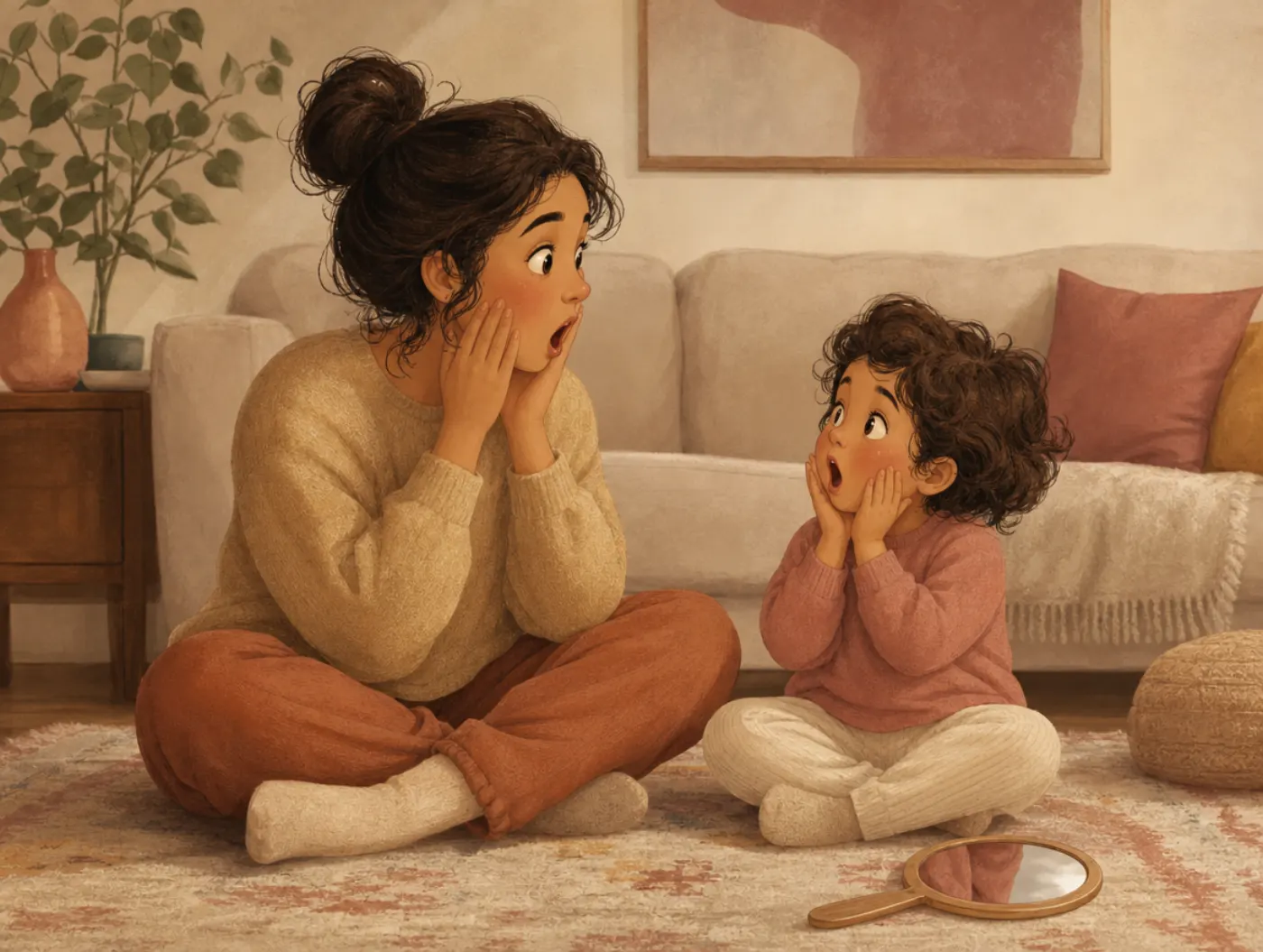
- Mirror faces: make each face together in a mirror and notice what the eyebrows and mouth do.
- Big and small: sort the cards into feelings that feel big in the body and feelings that feel small, then swap and discuss.
- Feelings weather report: at breakfast, each person picks the card closest to their morning and says one word about why.
- Face to fix: pick a card and together think of one thing that helps when a person feels like that.
A face is a clue, not a verdict
What the card shows
A scowl: eyebrows down, mouth tight.
What the child might actually feel
Angry. Or concentrating hard. Or about to cry. Or squinting at the sun.
What to ask instead of guessing
"Your face looks like this card. Is that what is happening inside, or something else?"
Words first, faces second
Children learn feeling words in a rough order: good versus bad, then happy, sad and angry, then fear, surprise and disgust, which stay muddled for years. A three year old who calls every unhappy face sad is on schedule. Teach to that order, and treat the face on the card as one clue to a feeling alongside the body, the situation and what just happened.
Therapists Who Work With Parenting
A worksheet is a start. These licensed therapists work with the same problem; every member is matched to the federal NPI Registry and board checks are dated on the profile.
-
View profile
Gail PoustLMFT, MSc
License verified, checked Oct 6, 2026
“Therapy for the hardest chapters of reproductive life: fertility, loss, postpartum, PMDD, perimenopause, and OCD. Online for adults anywhere in California.”
Berkeley, California Telehealth $180 per session
-
View profile
Grayson WallenLPCC/LPC
License verified, checked Sep 29, 2026
“Gottman Couples Therapist Male CA and AZ”
Encinitas, California Telehealth and in person $250 to $500 per session, sliding scale
-
View profile
Hayley WoodLPC, MS
License verified, checked Oct 17, 2026
“Therapy for women who are tired of holding everything together.”
Tulsa, Oklahoma Telehealth $200 to $250 per session



About this tool
Emotion faces for kids are picture cards that show a simple face for each of a handful of basic emotions, used to help young children learn to name feelings. A typical set covers happy, sad, angry, scared, surprised and disgusted, drawn clearly enough that a three year old can tell them apart. Parents, preschool and primary teachers, speech and language therapists and child therapists use them as a shared vocabulary: a way to talk about feelings with a child who does not yet have the words, and a way to make an abstract thing visible. This page is written for the adult who will use them. The printable here is a plain-words reference to the six expressions for the adult; picture cards, if you want them, are something you draw together, photograph or buy.
The six faces come from the work of the psychologist Paul Ekman, who in the late 1960s and 1970s showed photographs of posed expressions to people in several cultures, including a preliterate group in Papua New Guinea, and found that happiness, sadness, anger, fear, surprise and disgust were matched to the intended expression at rates well above chance. From this he argued for a small set of basic emotions with universal facial signals. That claim shaped almost every feelings chart and emotion card set in print, which is why the same six faces appear on classroom walls across the world.
Here is the caution that most card sets leave out. Facial expressions do not map onto feelings as cleanly as the cards imply. In 2019 the psychologist Lisa Feldman Barrett and colleagues reviewed the evidence in a long report for Psychological Science in the Public Interest and concluded that people scowl when angry only some of the time, scowl for other reasons the rest of the time, and that the same is true of every so-called signature expression. Faces vary with culture, context and the individual. A child can be furious with a flat face and delighted with a frown of concentration. The cards show what a feeling is often drawn as, not what it must look like. If you use them as a test, asking a child to read faces and marking the answers, you are testing a rule that is not reliable, and you risk teaching a child to distrust their own feelings when their face disagrees.
So use the cards as a vocabulary prompt, not a test. The question is not "what is this face feeling?" but "what do you see, and when have you felt something like that?" That shift does three things. It separates the drawing from the child's own experience, which is the thing you actually want to talk about. It lets a child be right whatever they say, which keeps them talking. And it models the real skill, which is noticing what is happening inside and finding a word for it, with the face as one clue among several: the body, the situation, what just happened.
Children learn emotion words gradually and in a fairly predictable order. Sherri Widen and James Russell showed that preschoolers begin with a split between feeling good and feeling bad, then add happy, sad and angry as distinct categories, with fear, surprise and disgust arriving later and often confused with one another for years. So a three year old who calls every unpleasant face "sad" is not wrong; they are on schedule. Start with the three the child already partly has, add the others as they come up in real life, and expect disgust and surprise to be the last to settle.
The cards work best woven into ordinary moments rather than set up as a lesson. Name your own feeling with a card at dinner. Pull out the matching face when a character in a story has an obvious reaction. Ask the child to find the card for how a sibling seems to feel after a fall. Play simple games: match the face to a situation, make the face in a mirror, sort the cards into "feels big" and "feels small," or build a short story that moves a character from one face to another. Keep sessions to a few minutes and stop while it is still fun. A calm-down corner with the cards on the wall gives a child a way to point when words are out of reach.
Evidence for emotion vocabulary teaching is reasonable at the program level. Susanne Denham's research on emotional competence in preschoolers, and the social and emotional learning programs built on it, link a larger feeling vocabulary to better self-regulation and peer relationships. There is no trial of face cards on their own, and there does not need to be: they are one prop in a larger practice of talking about feelings. The cards suit toddlers through early primary age, children with language delays, and children who find direct questions about feelings too exposing. The cards should never be used to drill facial recognition as if it were a skill a child is failing, and that matters most for autistic children, who are often tested on exactly this; the caution that faces are unreliable signals of feeling applies to every child. Whether pictures, context or words help a particular child most is individual, not something a diagnosis predicts.
Common mistakes: using the cards only when a child is upset, so they become a signal of trouble; correcting a child's reading of a face; asking a child who is mid-meltdown to pick a card; and expecting the cards to do the regulating. If a child by five or six still has very few feeling words, seems not to notice or respond to others' emotions, or has intense, long outbursts most days, talk with a pediatrician or a child therapist. Psychology.com's directory lets you search for one by specialty at no cost. The Emotion Faces Chart and Emotion Cards on this site are the general versions, the Feelings Chart gives a larger vocabulary for older children, and Emotional Regulation Activities for Kids covers what to do once the feeling has a name.
References
- Ekman P, Friesen WV. Constants across cultures in the face and emotion. Journal of Personality and Social Psychology. 1971;17(2):124-129.
- Barrett LF, Adolphs R, Marsella S, Martinez AM, Pollak SD. Emotional expressions reconsidered: challenges to inferring emotion from human facial movements. Psychological Science in the Public Interest. 2019;20(1):1-68.
- Widen SC, Russell JA. Children acquire emotion categories gradually. Cognitive Development. 2008;23(2):291-312.
- Denham SA. Emotional Development in Young Children. Guilford Press; 1998.
- Barrett LF. How Emotions Are Made: The Secret Life of the Brain. Houghton Mifflin Harcourt; 2017.
Cite this source
Psychology.com. (2026, October 19). Emotion Faces for Kids. Psychology.com. https://psychology.com/tools/emotion-faces-for-kids
Emotion Faces for Kids FAQ
What are emotion faces for kids?
They are picture cards showing a simple face for each of a few basic emotions, usually happy, sad, angry, scared, surprised and disgusted, that parents, teachers and therapists use to help young children learn feeling words. The child sees the face, the adult names the feeling and links it to a real moment, and over time the child builds a vocabulary for what is happening inside them. They are best used as a prompt for conversation woven into daily life, not as a lesson or a quiz.
What are the six basic emotions on emotion face cards?
Happiness, sadness, anger, fear, surprise and disgust. The set comes from Paul Ekman's cross-cultural studies in the late 1960s and 1970s, which found these expressions were recognized above chance in several cultures. Most children's charts use them with child-friendly labels such as happy, sad, mad, scared, surprised and yucky. Later research, notably Lisa Feldman Barrett's 2019 review, shows these faces are typical ways a feeling is drawn, not reliable signs of what any given person is feeling, which is why the cards work as vocabulary and not as a test.
At what age can a child learn emotion faces?
Toddlers from about two can point to happy and sad faces, and most three year olds can separate happy, sad and angry. Fear, surprise and disgust come later and are often mixed up until five or six, so a young child who calls every unpleasant face sad is developing normally. Start with the three they partly have, add the rest as real situations arise, and judge progress by the words the child starts using about their own feelings, not by how many cards they can label.
Are emotion faces accurate? Do faces really show feelings?
Less reliably than the cards suggest. Paul Ekman's research found the six expressions were recognized across cultures, but a 2019 review led by Lisa Feldman Barrett concluded that people produce the classic expression for a feeling only some of the time, and produce the same expression for other reasons the rest of the time. Faces depend on context, culture and the person. So treat a card as what a feeling is often drawn like, not as proof of what a child feels, and always ask rather than tell.
How do I use emotion face cards with my child?
Keep them where feelings happen and bring one out in ordinary moments: name your own feeling at dinner, match a card to a character in a story, or ask which card fits a sibling after a fall. Ask what the child sees rather than what they feel, and connect the face to a specific memory. Play short games such as mirror faces or sorting big and small feelings, and stop while it is still fun. Avoid using the cards only when the child is upset, and never correct their reading of a face.
Are emotion faces useful for autistic children?
They can help with feeling words, and whether a particular child likes clear pictures, prefers context and stories, or wants words alone is individual rather than something autism predicts. The caution bears repeating here: do not use the cards to drill facial recognition as if it were a skill the child is failing; the research showing that faces are unreliable signals of feeling applies to every child, autistic or not. Use the cards to build vocabulary around the child's own experience, follow their lead on what interests them, and ask a speech and language therapist or child therapist for approaches tailored to the child.