Feelings Chart: Simple Descriptions of Common Feelings for All Ages
A feelings chart lists common emotions with plain descriptions to help kids and adults name what they feel. Use this free printable PDF for check-ins at home or in class.
 Reviewed byMichael Callans, MSW
Common feelings, in plain words
How to use the chart
- Look at the chart and find the feeling that fits best right now.
- Read the short description to check it really matches.
- Say it out loud or point to it: 'I feel ___.'
- Ask the next question: what made me feel this way?
- Then decide what might help, like a break, a hug, a drink of water, or talking to someone.
Ways to use a feelings chart
- Daily check-ins at home or at the start of a school day.
- Helping a child name a big feeling before it turns into a meltdown.
- A calm-down corner where a child can point instead of explain.
- A quick adult pause to name a mood before reacting to it.
- A shared family or classroom language for talking about feelings.
Print it and keep it visible
A feelings chart only works if it is easy to reach. Print it and put it somewhere feelings tend to show up: a kitchen wall, a classroom, a bedroom door, a desk. The more ordinary it is to glance at and name a feeling, the more natural emotional check-ins become for the whole family or group. The same sheet works as a simple feelings chart for adults, or a feeling chart for a child who is just learning the words. For a chart about how people prefer to give and receive affection rather than what they feel, see the affection style chart.
Related tools & tests
Want help with big feelings at home?
A therapist can help you or your child understand and manage emotions. Free to search our directory.
About this tool
A feelings chart is a printable reference that helps children and adults name emotions when finding words feels difficult. This chart pairs common feeling words with brief descriptions so you can point, read, or talk about what fits before deciding what kind of support you need. A feelings chart is the simplest version of an emotion reference: a short list of common feelings, each with a plain description, so anyone can point to what they are experiencing. It is a staple in classrooms, family homes, and therapy rooms because it removes the hardest first step, which is finding the words at all.
For children, a chart builds emotional literacy: the basic ability to recognize and name feelings. That skill is the foundation of self-regulation, because a child who can say 'I feel frustrated' is far better placed to ask for help than one who can only act it out. For adults, the same chart works as a quick check-in, a way to pause and name a mood before reacting to it.
The descriptions below are kept short and concrete on purpose. They are meant to confirm a feeling, not to define it perfectly. Use the chart as a starting point: once you or a child can name the basic feeling, you can get more specific, talk about what caused it, and decide what might help.
Naming feelings is part of emotional intelligence research and approaches such as RULER, developed by Marc Brackett and colleagues at the Yale Center for Emotional Intelligence. RULER includes recognizing, understanding, labeling, expressing, and regulating emotions. The chart can support practice with feeling words, although it is not the full RULER program. Work by developmental psychologist Susan Denham links emotional competence in early childhood with school readiness and relationships with peers and teachers. Naming is a starting point that can lead to understanding the cause and choosing a response.
One common mistake is stopping at the first word that seems close enough. Angry and frustrated can look alike on a chart but often call for different responses, and a feeling can also be layered, for example scared underneath angry. Encourage a second pass: after naming the first feeling, ask if there is another one sitting underneath it.
If big feelings are frequent, intense, or hard to bring back down even with naming and support, that is worth raising with a pediatrician, school counselor, or therapist. A feelings chart is a starting point for building the vocabulary, not a substitute for support when emotions are affecting sleep, school, friendships, or family life. Psychology.com's therapist directory can help you find a provider who works with children or families.
The technique of putting emotions into words is also called affect labeling. In a laboratory brain-imaging study, Matthew Lieberman and colleagues found that labeling emotional images was associated with lower amygdala activity than comparison tasks. The amygdala is involved in processing emotionally significant information. This finding offers a possible explanation for why naming emotions may help, but it does not show that this printable chart treats anxiety or reliably stops distress.
A chosen word is a description of the moment, not a diagnosis or a fixed personality trait. Try adding the situation and a request: I feel frustrated because the task is confusing, and I would like help starting. Mixed feelings also fit. Someone can feel proud of a change and worried about what comes next without needing to select a single correct answer.
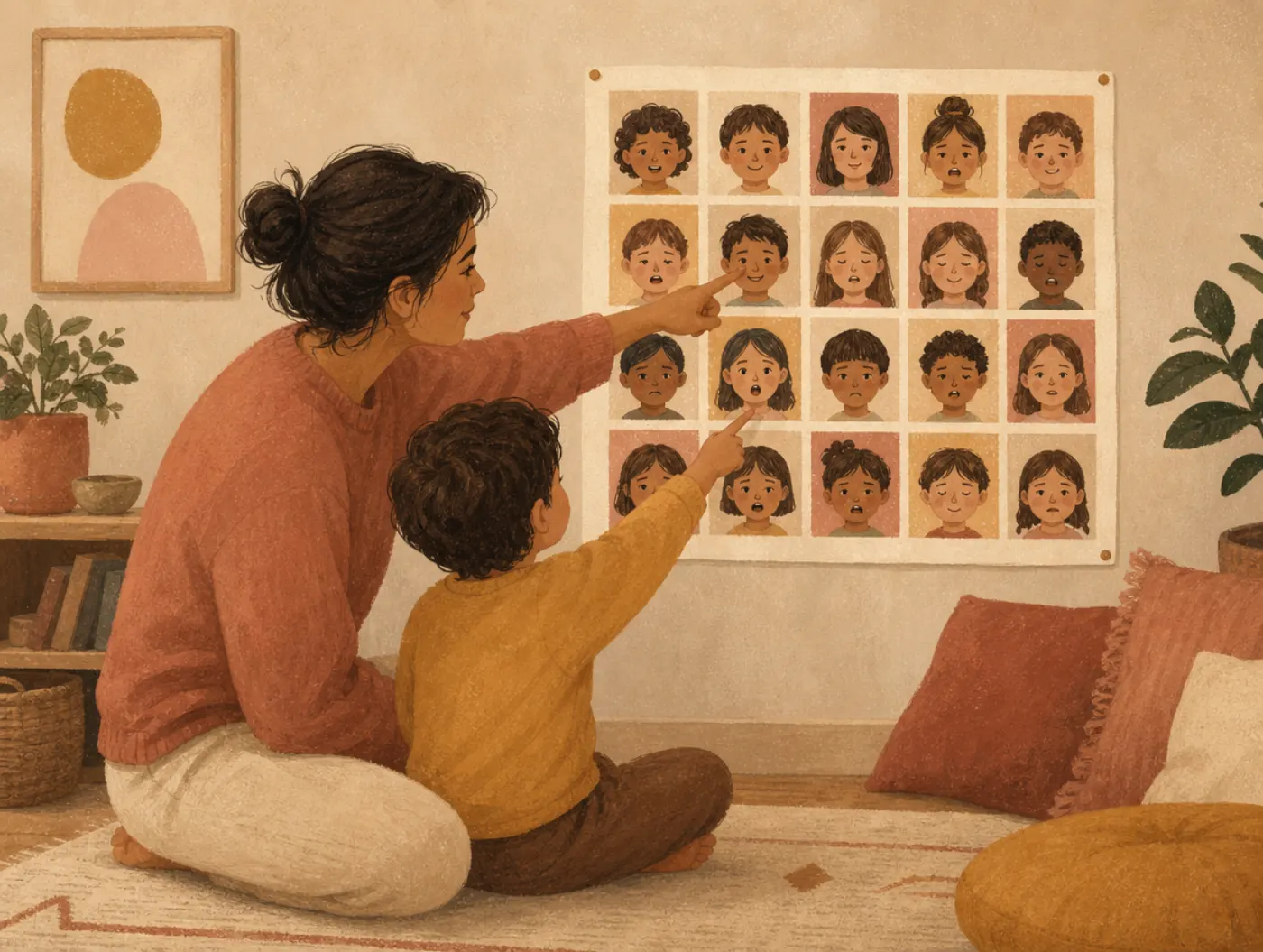
When using the chart with a child, model a check-in with your own words and leave room for the child to disagree with your guess. Pointing is an acceptable response. Avoid turning the chart into a quiz or requiring a public explanation in a classroom. If talking is too difficult in the moment, offer support and return to the chart when the child is willing. Keep the feeling separate from the behavior you need to address. For example, you might say, 'You feel angry that playtime ended. I will help you put the toy down safely.' Accepting the feeling does not require allowing hitting or hurtful words. Avoid using happy or calm as the answer a child must choose to earn praise.
For adults who struggle to find a word, begin with a description such as tense, heavy, restless, or uncertain, then see whether an emotion word fits. Body sensations can prompt reflection, but they do not prove a particular emotion. You can also write your own word beside the chart if the printed options do not describe your experience. If the chart's wording feels unfamiliar, try describing the feeling in the language you use most comfortably, then look for a close match together. Treat the printed descriptions as prompts rather than corrections to someone's own account. A useful check-in might end with a clearer request for company, space, or help, even when the feeling itself has not changed.
The Emotion Faces Chart and Emotion Cards offer other ways to start a conversation. The Feelings Thermometer helps describe intensity, while the Feelings Wheel expands the vocabulary available to you. The Alexithymia Test is a self-assessment for adults reflecting on difficulty identifying and describing feelings; it cannot diagnose a condition. The tools library offers related exercises for continued practice.
References
- Brackett MA, et al. Emotional intelligence and emotion regulation: implications for child and adult development. In: Handbook of Emotion Regulation. Guilford Press; 2014.
- Denham SA. Social-emotional competence as support for school readiness. Early Educ Dev. 2006;17(1):57-89.
- Yale Center for Emotional Intelligence. RULER. https://medicine.yale.edu/childstudy/services/community-and-schools-programs/center-for-emotional-intelligence/ruler/
- Lieberman MD, Eisenberger NI, Crockett MJ, Tom SM, Pfeifer JH, Way BM. Putting feelings into words: Affect labeling disrupts amygdala activity in response to affective stimuli. Psychological Science. https://pubmed.ncbi.nlm.nih.gov/17576282/
Cite this source
Psychology.com. (2026, October 18). Feelings Chart. Psychology.com. https://psychology.com/tools/feelings-chart
Feelings Chart FAQ
What is a feelings chart?
A simple reference that lists common emotions with short, plain descriptions, so a child or adult can quickly point to and name what they are feeling. It gives you a starting vocabulary for a check-in. After choosing a word, consider what happened and what kind of support would feel useful.
Is this chart for kids or adults?
Both. The descriptions are written plainly enough for children but the chart works just as well as a quick emotional check-in for adults. Adults can use it privately before a conversation or after a stressful event. With children, offer help reading the words and accept pointing, uncertainty, or a word they suggest themselves.
How does a feelings chart help children?
It builds emotional literacy, the ability to recognize and name feelings. A child who can name a feeling is far better able to ask for help than one who can only act it out. Practice can include hearing an adult name a feeling and being invited to choose a word. Naming does not guarantee a child can immediately calm down; support may still be needed.
How is this different from a feelings wheel?
A chart is simpler: a short list of common feelings with descriptions. A feelings wheel offers a larger, more nuanced vocabulary organized in rings. Start with the chart, then graduate to the wheel. You can keep using either reference according to what feels helpful. The chart is not a test you must pass before using a broader vocabulary.
Where should I put the chart?
Somewhere visible and easy to reach: a fridge, a classroom wall, a bedroom door, a calm-down corner, or a desk. Easy access is what makes check-ins a habit. Offer a private way to use it as well, especially in shared spaces. A person can point or reflect silently without having to explain their feelings to everyone nearby.
Is the feelings chart free to download and print?
Yes. The feelings chart and its PDF are free to download and print for home, classroom, or clinical use. Nothing you enter is saved or uploaded, since the chart is a printable reference rather than a form.
Is there a free feelings chart PDF I can print?
Yes. The free feelings chart PDF on this page is a feelings chart printable for home, classroom, or clinical use, with 16 common feelings and a plain description next to each one. Nothing you enter is saved or uploaded, since the chart is a printable reference rather than a form. Put it somewhere easy to reach, like a fridge or a classroom wall, so a check-in takes seconds rather than a search.
Can I use this as a feelings check in chart?
Yes. A feelings check in chart is simply a feelings list used at a set moment, like the start of a school day or a quiet minute before a hard conversation. Point to the feeling that fits, read the short description to confirm it, then ask what caused it and what might help. Adults can use it privately as an emotional check in chart for adults, and children can point rather than explain.