In short
The first practical intelligence scale was published by Alfred Binet and Theodore Simon in Paris, in volume 11 of L'Annee Psychologique, dated 1904 and published in 1905, to identify schoolchildren who needed extra teaching, and it had no quotient and no ranking. William Stern proposed dividing mental age by actual age, Lewis Terman multiplied that by 100 and published the Stanford revision in 1916, Robert Yerkes turned testing into a mass group procedure for the United States Army during the First World War, and David Wechsler replaced the age quotient in 1939 with the deviation score every modern test still uses. The same instruments were put to uses Binet had argued against. Psychology.com's IQ Test is a free reasoning quiz, not a clinical assessment.
- First working scale
- Alfred Binet and Theodore Simon, Paris, 1905
- Its original purpose
- Finding schoolchildren who needed extra teaching
- Who added the quotient
- William Stern, then Lewis Terman in 1916
- Who made it a mass test
- Robert Yerkes, United States Army, 1917 to 1919
- Who built the modern scale
- David Wechsler, 1939, the deviation score
- Test
- IQ Test: Free Reasoning Quiz
The answer is a chain, not a name
If you want one name, the usual answer is Alfred Binet, and it is the best single answer available. But the thing most people mean by an IQ test, a number on a scale with an average of 100 that places you against other people, was assembled by at least five people across roughly thirty-five years, and several of them would have disliked what the others did with it.
The chain runs: Binet and Simon built a graded scale of tasks in Paris. William Stern suggested turning the result into a ratio. Lewis Terman brought the scale to the United States, multiplied the ratio by a hundred and gave the world the quotient. Robert Yerkes turned individual testing into something you could do to a million men. David Wechsler threw out the ratio and built the scale we actually use.
Knowing the chain matters because the purpose changed at nearly every link. What began as a tool for deciding which children needed more teaching became a device for sorting adults into ranks, and that shift, rather than any single invention, is the real history of the IQ test.
Binet and Simon, 1905
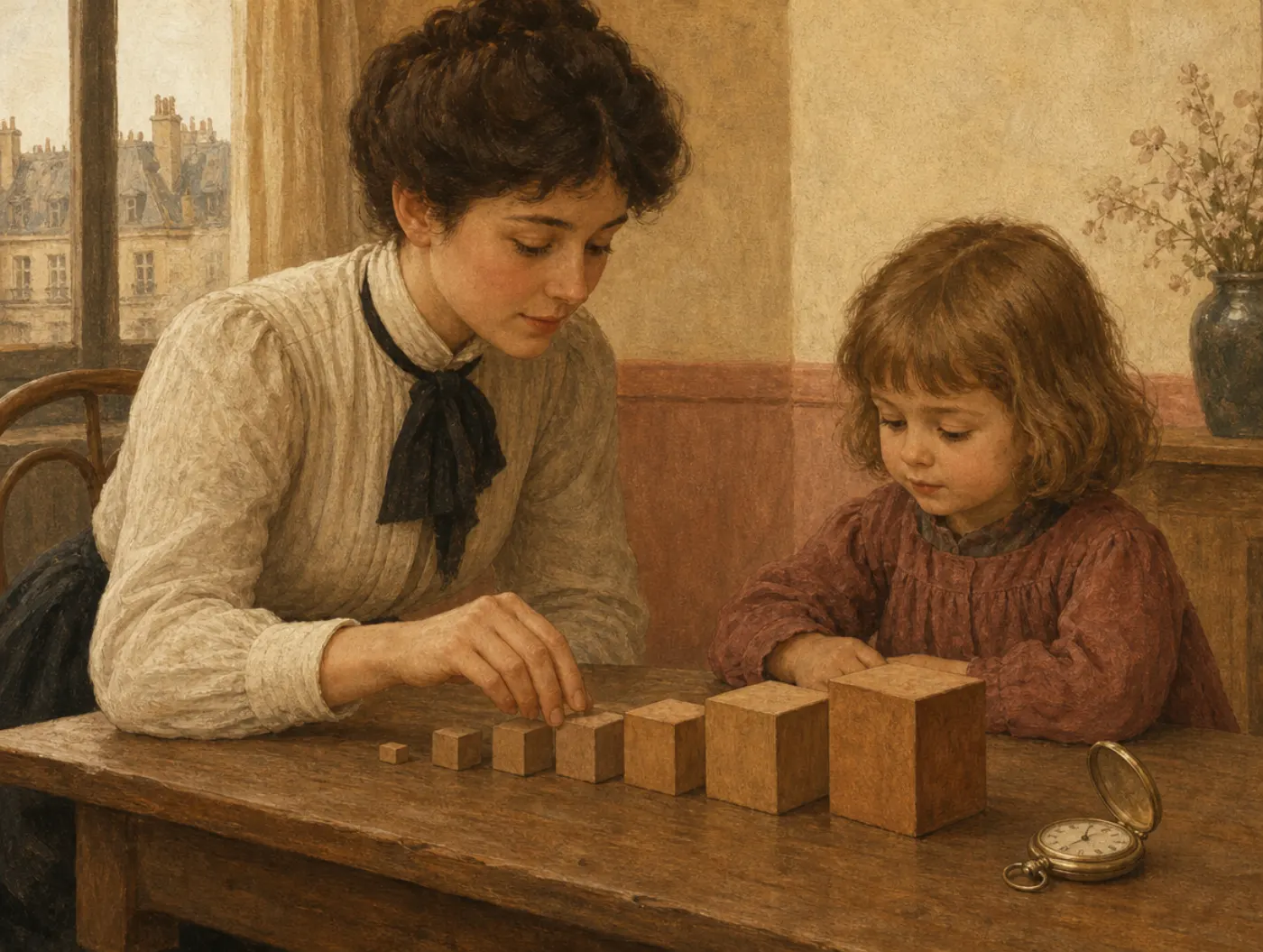
In the early 1900s the French education ministry wanted a way to identify children who were not keeping up in ordinary classrooms so that they could be taught differently. Alfred Binet, who ran the psychology laboratory at the Sorbonne, and Theodore Simon, a young physician, were asked for a practical method. Their answer appeared in L'Annee Psychologique in volume 11, the paper usually dated 1905 and known as the Binet-Simon scale.
The design was plain and effective. They assembled thirty short tasks in order of difficulty, from following a moving object with the eyes to repeating sentences, defining words, and explaining abstract terms, and established the age at which typical children passed each one. A child's performance was then reported as a mental level, meaning the age group whose tasks they could manage. There was no quotient, no scale with a mean of 100, and no comparison between adults.
That design carries its original purpose inside it. The scale was built to find children who needed help, which is a question about teaching, and it was explicitly a practical screening device rather than a theory of the mind. Binet was aware the result could be misread and said so in print.
He did not live to see most of what followed. Binet died in 1911, six years after the first scale and five years before the version that made the quotient famous.
Stern's quotient and Terman's hundred
The German psychologist William Stern proposed the step that produced the familiar number: divide the mental level by the child's actual age. A nine-year-old performing like an eleven-year-old gets a ratio above one. Stern called it a mental quotient, and it solved a real problem, because being two years behind matters more at six than at sixteen.
Lewis Terman, at Stanford, multiplied that ratio by a hundred to get rid of the decimal point, and published his revision and extension of the Binet-Simon scale as The Measurement of Intelligence in 1916. That book is where the intelligence quotient enters the language, where the scale is restandardized on American children, and where it is extended upward so that it can be given to adults.
Terman's revision was a genuine technical advance and it also changed the project. Binet had built an instrument for identifying children who needed more teaching. Terman presented a scale for sorting people by a quantity he regarded as largely inherited and largely fixed, and he argued for its use in classifying pupils and workers. The instrument stayed similar. The claim attached to it did not.
Yerkes and the Army tests
When the United States entered the First World War, Robert Yerkes, then president of the American Psychological Association, persuaded the army to let psychologists test recruits at scale. The committee he led produced two group tests: Alpha, a written test for men who could read English, and Beta, a picture-based test for men who could not. Both could be given to a room full of people at once by an examiner with brief training.
The program ran to well over a million men, and the official report, Psychological Examining in the United States Army, appeared in 1921. Its operational value to the army was modest and widely questioned at the time. Its effect on testing was enormous: it established that mental testing could be done cheaply, in groups, on paper, and it is the direct ancestor of every group-administered aptitude test since.
The administration was also uneven in ways that mattered for what came next. Literacy levels among recruits were lower than the planners expected, queues for the Beta test grew, and men were routed between the two versions inconsistently. Scores produced under those conditions were then treated as a national dataset about ability.
What the Army data was used for
In 1923 Carl Brigham, who had worked on the army testing, published an analysis of that data arguing that the recruits' scores showed differences in innate ability between national and racial groups. The book was used in public and congressional argument during the period that produced the restrictive United States immigration legislation of 1924.
The analysis was wrong, and its author said so. In 1930 Brigham published a paper in Psychological Review retracting it, concluding that comparative studies of national and racial groups could not be made with the tests then available, and that his own earlier comparison was without foundation. The language of a retraction in a journal of that era is unusually direct.
The retraction arrived long after the harm. Legislation does not reverse when a dataset does, and the broader eugenic movement of the 1910s to 1930s used test results to argue for restricting immigration and for sterilization laws in several American states. This is not a footnote to the history of intelligence testing. It is one of the main things the early instruments were actually used for, and any honest page on who created the IQ test has to say so.
Binet's own position
Binet had argued against the view that would later be attached to his scale. In his 1909 book Les idees modernes sur les enfants he rejected the idea that a child's measured level set a ceiling, writing that intellectual development does not follow a regularly rising line and that a pupil who does not understand this year will understand better next year.
His proposed response to a low result was teaching, not classification. He described deliberate training of attention, memory and reasoning as something that could be practiced and improved, and he treated the scale as a way of deciding who needed that training rather than as a measure of fixed worth.
That is the sharpest irony in the story. The man whose name sits on the oldest surviving intelligence test believed the thing the test became famous for asserting was false, and he said so before anyone had turned his scale into a quotient.
Wechsler and the scale we still use
The age-ratio quotient does not work for adults, because mental level stops rising while age does not, and by the 1930s this was an obvious problem. David Wechsler, chief psychologist at Bellevue Hospital in New York, solved it in 1939 with the Wechsler-Bellevue scale and the approach set out in The Measurement of Adult Intelligence.
His move was to abandon age ratios entirely. Instead, raw performance is ranked against a sample of people in the same age band, and that rank is converted onto a scale whose mean is set to 100 and whose standard deviation is set to 15. That is the deviation score, and it is still how every major test reports a result today, which makes Wechsler the author of the number most people picture when they say IQ.
He also built the structure. Wechsler grouped subtests into separate verbal and performance scales and reported them alongside the total, on the argument that a single figure hides too much. Current editions have replaced that split with five domains, but the principle that a battery reports a profile rather than one number is his.
Where the field stands now
The two instruments that descend most directly from this history are still in use: the Stanford-Binet scales, now in their fifth edition, and the Wechsler scales, whose adult version was revised in 2024. Both are individually administered by qualified examiners, both report five domain scores alongside a total, and both are re-normed every decade or two.
The claims attached to them have narrowed considerably. Modern test manuals and professional standards present a score as a sample of performance under standardized conditions, compared with a reference group, carrying a confidence interval, and they state explicitly that the result is not a measure of ability to do a particular job or a credential of any kind.
What has not changed is the pull that a single number exerts. That is worth holding in mind when reading any result, including one of ours: the reason this history includes so much misuse is not that the early testers were uniquely careless, but that a tidy figure about a person is an unusually tempting thing to over-read.
How to find out where you land
Psychology.com's IQ Test is a free reasoning quiz: 30 original text-only questions for adults, untimed, reported as an estimated range with a breakdown across five categories. It is self-administered, unproctored and unnormed, which means it is not an IQ score and not a clinical assessment, and an optional in-depth report is available if you want a longer write-up of the result.
A score comparable to the history on this page comes from an individually administered battery given by a qualified examiner. If you want to understand what such a score would mean before you pursue one, the IQ scale page explains the ranges and the margin of error, and what an IQ test measures walks through the five domains a professional battery samples.
| Feature | Binet and Simon, 1905 | The quotient after 1916 |
|---|---|---|
| Purpose | Find children who needed extra teaching | Rank people on a general quantity |
| What it reported | A mental level, as an age group | A single number with 100 as average |
| Who was tested | Children, one at a time | Children and adults, eventually in groups |
| View of the result | A reason to teach differently | Largely inherited and largely fixed |
| Used for | Placing pupils in suitable instruction | Military classification, immigration argument, school sorting |
| Scale across ages | Not comparable between age groups | Comparable, by dividing by age |
| What survived | Graded tasks and individual administration | The number, after Wechsler rebuilt how it is computed |
Key takeaways
- Alfred Binet and Theodore Simon published the first working scale in volume 11 of L'Annee Psychologique, dated 1904 and published in 1905, built to identify schoolchildren who needed extra teaching rather than to rank anyone.
- The quotient came later: William Stern proposed dividing mental level by age, and Lewis Terman multiplied it by 100 in his 1916 Stanford revision, which also recast the scale as a measure of a largely fixed quantity.
- Robert Yerkes made testing a mass group procedure in the United States Army from 1917, which is the ancestor of every paper aptitude test since.
- Army data was used in 1923 to argue for differences in innate ability between national groups during the immigration debate; the author retracted that analysis in Psychological Review in 1930.
- Binet himself rejected the idea of a fixed ceiling, writing in 1909 that intellectual development does not follow a regularly rising line and that a pupil who does not understand this year will understand better next.
- David Wechsler built the scale still in use, replacing the age ratio in 1939 with a rank against an age-matched sample set to an average of 100.
See how you handle the reasoning itself
Our free IQ Test is the descendant of all of this and none of its authority: 30 untimed text questions, an estimated range, and no claim to be a clinical assessment.
Cite this source
Fontane Pennock, S. (2026, November 8). Who Created the IQ Test. Psychology.com. https://psychology.com/types/who-created-the-iq-test
Frequently asked questions
Who invented the IQ test?
Alfred Binet, with Theodore Simon, created the first practical intelligence scale in Paris, published in volume 11 of L'Annee Psychologique, dated 1904 and published in 1905. It reported a mental level rather than a quotient. The number people mean by IQ was added later by William Stern and Lewis Terman, and the modern version of it was built by David Wechsler in 1939.
Why was the first IQ test created?
To identify schoolchildren who were not keeping up in ordinary classrooms so that they could be taught differently. The French education ministry wanted a practical method, and Binet and Simon built a graded series of short tasks for the purpose. It was a screening device for teaching decisions, not a ranking instrument and not a theory of intelligence.
Who came up with the term IQ?
The ratio came from William Stern, who proposed dividing a child's mental level by their actual age and called it a mental quotient. Lewis Terman multiplied it by a hundred to remove the decimal and published it in The Measurement of Intelligence in 1916, which is where the intelligence quotient enters common use in English.
Did Binet agree with how his test was used?
No, and he said so before the quotient existed. In Les idees modernes sur les enfants in 1909 he rejected the view that a measured level sets a ceiling, arguing that intellectual development does not follow a regularly rising line and that a pupil who does not understand this year will understand better next year. He treated a low result as a reason to teach, not to classify.
Was the IQ test used for eugenics?
Yes. A 1923 analysis of United States Army test data was used in public and congressional argument during the period that produced the 1924 immigration restrictions, and test results were used more broadly to support sterilization laws in several American states. The author of that analysis retracted it in Psychological Review in 1930, concluding that comparisons between national groups could not be made with those tests.
Who created the modern IQ scale with an average of 100?
David Wechsler, in 1939. He discarded the age-ratio quotient, which breaks down in adulthood, and replaced it with a rank against a sample of people in the same age band, converted onto a scale with a mean of 100 and a standard deviation of 15. Every major test still reports results that way.
Is the Stanford-Binet still Binet's test?
Only by descent. The current fifth edition shares the lineage and the name, but the scoring, structure, item content and reference data have been rebuilt repeatedly, and it reports deviation scores across five domains rather than Binet's mental level. Treat the name as a family tree rather than a description of what is in the box.
Related types


References
- Binet A, Simon T. Methodes nouvelles pour le diagnostic du niveau intellectuel des anormaux. L'Annee Psychologique. 1904;11:191-244. (The first Binet-Simon scale, usually dated 1905.) doi.org
- Binet A. Les idees modernes sur les enfants. Ernest Flammarion; 1909. (Full text, including his argument that intellectual development does not follow a regularly rising line.) fr.wikisource.org
- Terman LM. The Measurement of Intelligence. Houghton Mifflin; 1916. (The Stanford revision, and the introduction of the intelligence quotient in English.) openlibrary.org
- Yerkes RM, ed. Psychological Examining in the United States Army. Government Printing Office; 1921. (The official report of the Army Alpha and Beta program.) openlibrary.org
- Brigham CC. Intelligence tests of immigrant groups. Psychological Review. 1930;37(2):158-165. (The author's retraction of his 1923 analysis of the army data.) doi.org
- Boake C. From the Binet-Simon to the Wechsler-Bellevue: Tracing the History of Intelligence Testing. Journal of Clinical and Experimental Neuropsychology. 2002;24(3):383-405. doi.org