In short
Secure attachment in infancy describes a baby who uses a caregiver as a base: exploring when things are calm, seeking comfort when upset, taking that comfort when it arrives, and getting back to playing. It was identified through the Strange Situation procedure developed by Mary Ainsworth, which produced three classifications and later a fourth, and the behavior that distinguishes them is the reunion rather than the separation. Observational research links security most consistently to sensitive, responsive caregiving that repairs after ordinary ruptures, not to perfection. This page is written for adults; the Psychology.com Attachment Style Quiz is about your own relationships, not your child's.
Across our Attachment Style Quiz, here is which of the 4 results people land on.
- What it describes
- A baby using a caregiver as a base to explore from
- Where it comes from
- Ainsworth's Strange Situation observations
- What distinguishes it
- Behavior on reunion, not on separation
- Most consistent predictor
- Sensitive, responsive care that repairs
- Not determined by
- Daycare, working parents, sleep choices, one bad day
- The test here
- Attachment Style Quiz, for adults about themselves
What attachment means in the first years, and what it is for
Attachment in infancy is not a measure of how much a baby loves a parent, and it is not a score for how well the parenting is going. It describes something narrower and more specific: what a baby does with a caregiver when they are frightened, tired or hurt, and whether that caregiver works as a base to go back out from.
The purpose of the system, in John Bowlby's original argument, is protection. An infant who stayed near an adult when alarmed survived, so human babies arrive with the behavior built in: crying, clinging, following, searching. None of it is manipulation or a habit the adult accidentally taught, which is what the childcare advice of the mid twentieth century generally assumed.
The part that gets missed is the exploration half. Mary Ainsworth and Silvia Bell's 1970 paper reported that a mother's presence encouraged exploratory behavior in one-year-olds while her absence depressed exploration and heightened attachment behavior. Security is not a baby who stays close. It is a baby who can leave, because leaving is safe when coming back works.
How the Strange Situation produced four patterns
Ainsworth spent years observing families at home, first in Uganda in the mid 1950s and then in a longitudinal study in Baltimore, before building the procedure she is known for. The Strange Situation is a short sequence of episodes in an unfamiliar room with toys, in which a caregiver leaves and returns and an unfamiliar adult is present for part of it. The point of the design is to raise the stakes gently enough that the attachment system switches on and the pair's usual way of handling it becomes visible.
The classification comes from the reunion. How distressed a baby becomes during the separation reflects temperament as much as anything, which is why it is not the scored part. What the raters attend to is the return: whether the child seeks the caregiver, whether they take the comfort offered, and whether the comfort works well enough that they go back to the toys.
Ainsworth and colleagues described three patterns on that basis, usually labeled secure, avoidant and resistant, the last also called ambivalent. A minority of infants did not fit any of them, and in 1990 Mary Main and Judith Solomon published indices for identifying a fourth, disorganized pattern, so that researchers could code it consistently.
Two things about all of this matter for a parent reading it. These are descriptions of a pair in a research procedure, not properties of a child, and they are assigned by trained raters watching video of a standardized sequence. There is no home version.
The four research patterns, and what they look like outside a lab
The table at the end of this page sets the research description beside the everyday version, which is the more useful one for anyone who is not coding video. Read it as background rather than as something to apply.
The everyday column is deliberately loose, because the honest translation is loose. A child who is clingy on a Tuesday and independent on a Thursday is a normal child, and the patterns describe tendencies across many such days rather than the behavior of an afternoon.
What a secure pattern tends to look like in a baby
In the first year it mostly looks ordinary, which is part of why it is reassuring. A baby settles reasonably well when picked up by a familiar person, not instantly and not always, but the comfort generally does something. They show a clear preference for a few familiar people by the second half of the year. They protest being left, which is a sign the system works rather than a sign of fragility, and the protest ends when the person comes back.
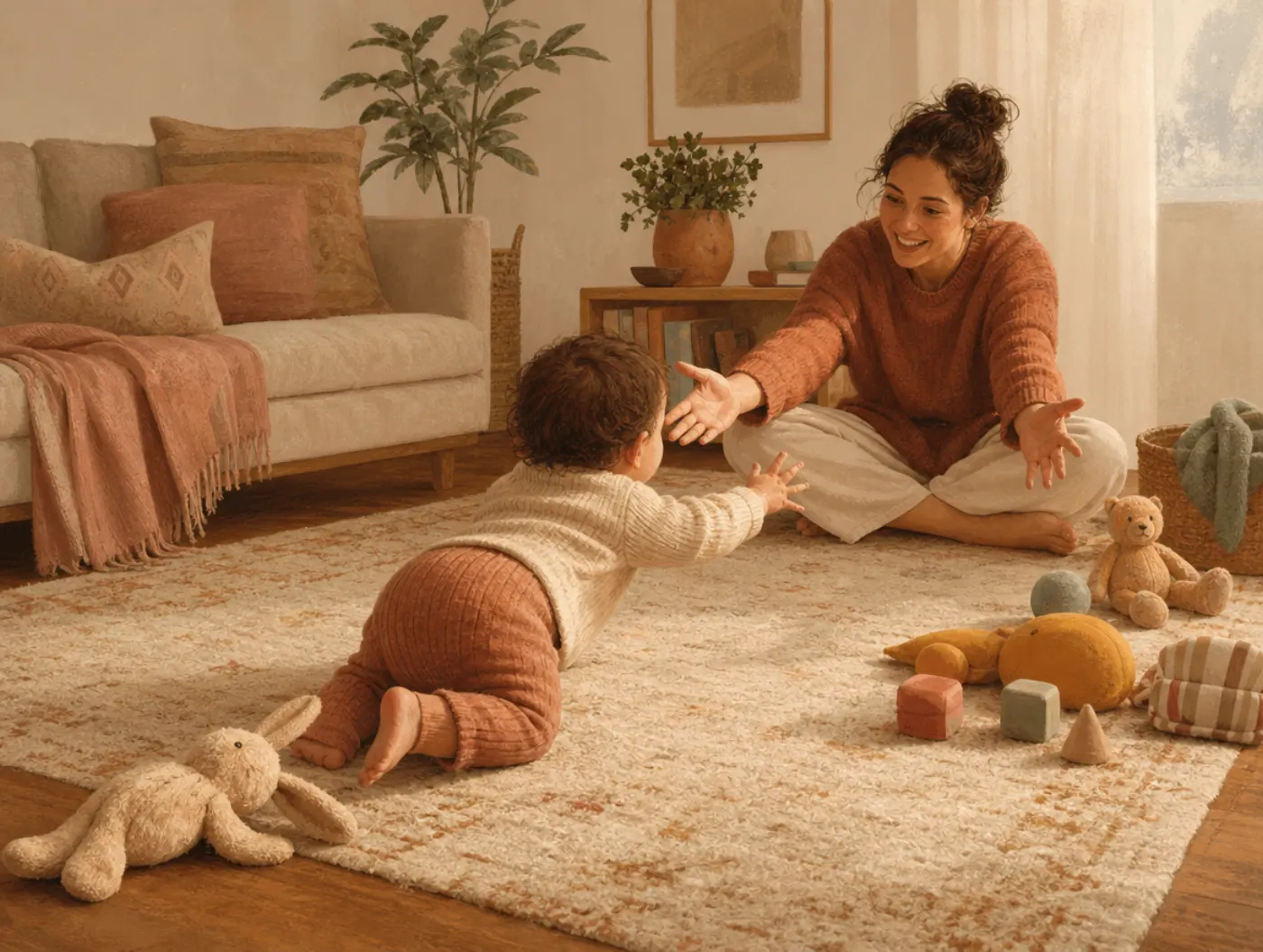
The piece that researchers watch for, and the one parents can recognize without grading anything, is the cycle: distress, contact, settling, back to whatever was interesting. The settling does not need to be fast. What characterizes the pattern is that the contact is used rather than refused or unable to be absorbed.
Separation anxiety around eight to ten months and stranger wariness in the same period are developmental milestones rather than warning signs. A baby who has started objecting to being handed to a stranger has built the discrimination the system needs.
What it looks like in a toddler
By two or three the base-and-explore pattern is visible across a room. A securely leaning toddler at a playground goes further out than they did a year ago, checks back with a look rather than a return trip, and comes all the way in when something goes wrong. The checking in is the behavior, not the staying close.
The other visible feature is bringing things. Toddlers who are using a caregiver as a base share: a leaf, a discovery, a complaint about another child. Sharing is the same system running in a calm state, and a child who brings you things is telling you the base is working.
Big feelings do not count against any of this. Toddlers in every classification have enormous tantrums, refuse to leave the park, and fall apart at bedtime. What differentiates the patterns is not the size of the storm but whether the child comes to you during it and whether being with you helps. And that too varies by day, by illness, by how much sleep everyone had.
What caregiving the research links to security
The most consistent finding is about sensitive responsiveness: noticing a signal, reading it roughly right, and responding in a way that fits, often enough. Marianne De Wolff and Marinus van IJzendoorn pooled 66 studies in 1997 and found observed sensitivity associated with security at about .24 in the core observational subset, a moderate relationship, which led them to call sensitivity an important but not exclusive condition of security.
Two features of that finding are worth noticing. Moderate means other things also matter, including the child's own temperament, the family's circumstances, and the stress load on the caregiver. And often enough means often enough. Nobody reads a baby correctly every time, and the research describes nothing that requires it.
The second thing the evidence supports is repair. Ordinary interaction is full of small misses: a signal missed while answering the door, a response that was wrong, an adult who got short-tempered at the end of a long day. What the research associates with security is not an absence of those moments but the pattern of coming back and putting it right.
There is also encouraging evidence that this responds to teaching rather than being fixed. Across 70 studies, Marian Bakermans-Kranenburg and colleagues found that randomized programs moved insensitive parenting by about 0.33 and infant insecurity by about 0.20, and that the most effective ones used a moderate number of sessions and a clear-cut behavioral focus rather than an open-ended format.
What does not determine it
A great deal of what parents worry about does not carry the weight the internet assigns it. Child care is the clearest case. The NICHD Study of Early Child Care followed 1,153 infants and their mothers across ten sites and reported no significant main effects of child care experience, including quality, amount, age of entry, stability and type, on attachment security. Elevated insecurity appeared only where low maternal sensitivity combined with poor-quality care, more than minimal amounts of care, or multiple arrangements. Day care by itself was not the variable.
Working parents, bottle feeding, a baby who sleeps in a cot rather than a bed, a toddler who had a tough two weeks while you were ill: none of these is the determining factor the anxious version of attachment writing implies. Neither is a single bad day, a lost temper, or a week where you were too flattened to be delightful company.
What does carry weight is the accumulated pattern over many months, and the single best use of a page like this is not to audit yourself against it. It is to notice that the thing being described is repeated ordinary responsiveness, which is both less glamorous and much more achievable than the version where every interaction counts.
Why these classifications travel unevenly across cultures
The Strange Situation was built in the United States with a particular set of assumptions baked into it, including that being briefly left with an unfamiliar adult in an unfamiliar room is a mild, ordinary stressor. Where that assumption does not hold, because infants are rarely separated from a caregiver at all or are routinely cared for by several adults, the same procedure is not putting the same question to the child.
The proportions landing in each classification accordingly differ between samples and between countries, and the review literature treats this carefully. Judi Mesman, Marinus van IJzendoorn and Abraham Sagi-Schwartz, surveying the cross-cultural studies that followed Ainsworth's work in Uganda, describe the overall picture as a balance between universal trends and contextual determinants rather than one attachment pattern per culture. Variation between families within a country is substantial in every sample anyone has collected.
For a parent, the practical reading is modest in two directions. The core idea, that a protective base makes exploration possible, is observed broadly rather than being a local Western finding. And the percentages in any single classification table deserve less weight than they usually get, particularly when they are being used to say something about a culture's childrearing.
Why this page will not help you type your child
This is deliberate. Attachment classifications are assigned by trained raters from video of a standardized procedure, with careful attention to behavior that is easy to misread, and no published checklist converts a parent's observation of their own child into a classification. An attachment pattern is also not a diagnosis, it is not in any diagnostic manual as a condition, and it describes a relationship rather than a trait a child carries.
There is a practical reason to stay out of it as well. A parent watching their own child for signs is no longer doing the thing the research actually links to security, which is responding to the child in front of them. Observation of this kind tends to make interaction stiffer, and the stiffness is the opposite of what helps.
If you have read this far looking for reassurance, the honest version is that there is no test here that would give it to you, and that the behavior associated with security is the ordinary kind: being approachable when they are upset, coming back after the moments that went badly, and letting them go further out than feels comfortable.
If you are worried about your child
Take it to a person rather than to a page. A pediatrician is the right first stop, and they can refer to a clinician who works with young children if there is something to look at. Bring specifics: what you see, when it started, what happens when they are hurt or frightened, what helps and what does not.
A few situations warrant professional input sooner rather than later, and none of them is about an attachment label: a child who seems to have no preference between a familiar adult and a stranger, a child who does not seek comfort when clearly hurt, a marked change after a particular event, or a caregiver who is depressed, frightened or struggling enough that responding feels out of reach. The last one is not a failure and it is one of the more treatable items on the list.
What is not useful is a label applied from a web page. It cannot be accurate, and it tends to settle into a story about the child that outlasts the worry that produced it.
What the test on this page is for
The free Psychology.com Attachment Style Quiz is for adults, about their own close relationships, and it asks how you generally think and feel in them. It is not a child assessment and cannot be used as one. It is a self-report questionnaire for education and reflection, not a clinical or diagnostic instrument, and an optional in-depth report is available afterward for readers who want a longer write-up.
It is still relevant here, for one reason. Research on the transmission of attachment across generations finds modest links between a caregiver's own way of handling closeness and their child's security, and it finds that caregiving sensitivity does not fully account for those links. Your own pattern is the part of this you can actually look at, and attachment theory, the adult attachment styles index and the insecure attachment overview are the places to do it.
| Feature | In the research procedure | The loose everyday version |
|---|---|---|
| Secure | Seeks the caregiver on reunion, takes the comfort, returns to exploring | Comes to you when upset, settles reasonably, goes back out further than last year |
| Avoidant | Minimal approach on reunion, attention stays on the toys | Handles upset alone more than you would expect, rarely asks |
| Resistant or ambivalent | Highly distressed, hard to settle, comfort does not resolve it | Comes to you and stays distressed, slow to get back to play |
| Disorganized | Contradictory behavior: approach with averted gaze, freezing, a dazed look | No consistent strategy visible; coded only by trained raters, never from home observation |
Key takeaways
- Secure attachment in infancy describes using a caregiver as a base: exploring, seeking comfort when upset, taking it, and returning to play.
- The classification comes from the reunion rather than the separation, because how upset a baby gets reflects temperament as much as the relationship.
- The Strange Situation produced three patterns, with disorganized added by Main and Solomon in 1990, and all four are assigned by trained raters from standardized video.
- Sensitive responsiveness is the most consistent predictor, at a moderate strength, and repair after ordinary misses matters more than getting it right every time.
- Child care by itself did not predict insecurity in the NICHD study of 1,153 infants; neither do working parents, feeding choices, sleep arrangements or a bad week.
- No checklist turns a parent's observation into a classification, and a worry about a child belongs with a pediatrician rather than with a label.
Curious about your own pattern?
Take the free Attachment Style Quiz, written for adults about their own close relationships.
Cite this source
Fontane Pennock, S. (2026, November 8). Secure Attachment in Infants: Signs and Patterns. Psychology.com. https://psychology.com/types/secure-attachment-in-infants
Frequently asked questions
What are the signs of secure attachment in a baby?
The pattern rather than any single behavior: a baby who shows a clear preference for familiar people, protests being left, and settles reasonably once a familiar person returns, then goes back to what was interesting. Protest at separation is evidence the system is working. The part that matters is that offered comfort gets used, not that it works instantly.
What does secure attachment look like in a toddler?
Base and explore, visible across a room. A securely leaning toddler goes further from you than they used to, checks back with a glance rather than a return trip, comes all the way in when something goes wrong, and brings you things. Tantrums, refusals and bedtime collapses happen in every pattern and say little on their own.
Can I test my child's attachment style at home?
No. Attachment classifications are assigned by trained raters from video of a standardized procedure, and no published checklist converts a parent's observation into one. Watching your own child for signs also tends to make interaction stiffer, which works against the responsiveness the research actually links to security.
Does daycare cause insecure attachment?
Not on its own. The NICHD Study of Early Child Care followed 1,153 infants across ten sites and found no significant main effects of child care quality, amount, age of entry, stability or type on attachment security. Elevated insecurity showed up only where low maternal sensitivity combined with poor-quality care, high amounts of it, or multiple arrangements.
What kind of parenting builds secure attachment?
Sensitive responsiveness, often enough: noticing a signal, reading it roughly right, and responding in a way that fits. A meta-analysis of 66 studies found a moderate association between observed sensitivity and security, and concluded sensitivity is important but not the only condition. Repair after the ordinary moments that go wrong is part of the pattern rather than an exception to it.
Is separation anxiety a sign of insecure attachment?
No, it is usually a developmental milestone. Protest at separation and wariness of strangers typically appear in the second half of the first year, and they indicate that a baby has built the discrimination the attachment system needs. The informative part is what happens on reunion, not how loudly the leaving was objected to.
Do attachment classifications apply the same way everywhere?
Not identically. The procedure assumes that a brief separation from a caregiver is a mild, familiar stressor, which is not true everywhere, and the proportions falling into each classification differ between samples. Cross-cultural reviews describe the picture as a balance of universal trends and local context. The base-and-explore idea travels better than the percentages do.
Related types


References
- Ainsworth MDS, Bell SM. Attachment, exploration, and separation: illustrated by the behavior of one-year-olds in a strange situation. Child Development. 1970;41(1):49-67. doi.org
- Main M, Solomon J. Procedures for identifying infants as disorganized/disoriented during the Ainsworth Strange Situation. In: Greenberg MT, Cicchetti D, Cummings EM, eds. Attachment in the Preschool Years: Theory, Research, and Intervention. Chicago: University of Chicago Press; 1990:121-160. archive.org
- De Wolff MS, van IJzendoorn MH. Sensitivity and attachment: a meta-analysis on parental antecedents of infant attachment. Child Development. 1997;68(4):571-591. doi.org
- NICHD Early Child Care Research Network. The effects of infant child care on infant-mother attachment security: results of the NICHD Study of Early Child Care. Child Development. 1997;68(5):860-879. doi.org
- Mesman J, van IJzendoorn MH, Sagi-Schwartz A. Cross-cultural patterns of attachment: universal and contextual dimensions. In: Cassidy J, Shaver PR, eds. Handbook of Attachment: Theory, Research, and Clinical Applications. 3rd ed. New York: Guilford Press; 2016. guilford.com
- Bakermans-Kranenburg MJ, van IJzendoorn MH, Juffer F. Less is more: meta-analyses of sensitivity and attachment interventions in early childhood. Psychological Bulletin. 2003;129(2):195-215. doi.org