Music Therapy: What It Is, How It Works, and Activities You Can Try at Home
Music therapy is the clinical use of music by a credentialed therapist to reach non-musical goals such as lower anxiety, better mood or recovered speech. This page explains the profession, the evidence, and offers self-directed activities with a printable card.
 Reviewed byMichael Callans, MSW
The terms, sorted out
Receptive activities (listening)
- Mood-matched playlist: pick three tracks that sound like how you feel now, then two that sit a little calmer, then one you want to arrive at. Play them in order without skipping.
- Lyric listening: play one song you know well and write down the single line that lands hardest today. Note why, in one sentence.
- Body scan with music: lie down, play a slow instrumental piece, and move your attention from feet to head, noticing where the music seems to land in your body.
- Memory track: choose a piece tied to a good time. Listen with eyes closed and let the details of that time come back. Write three of them down afterwards.
- Silence bookends: one minute of silence, one piece of music, one minute of silence. Notice what the quiet sounds like after the music.
Active activities (making)
- Hum your breath: breathe in through the nose, hum the whole way out. Ten breaths. The long exhale is doing the work; the hum makes it easy to lengthen.
- Kitchen drumming: two minutes on a table, a pan or your thighs. Start with your heartbeat, speed it up as far as it wants to go, then bring it down slowly.
- Song swap: take a song you know and rewrite one verse about what is on your mind today. It does not need to rhyme.
- Sing something badly: in the car, in the shower, anywhere nobody is grading. Loud. The point is the breath, the vibration and the permission.
- Move to one track: stand up and let one song move you however it wants to. Nobody is watching. Stop when it ends and notice your pulse and your mood.
A 15-minute mood shift (the iso principle)
- Name the mood you are in now, in one or two words, and rate it 0 to 10.
- Start with music that matches that mood in tempo and feel, not music that contradicts it. Agitated gets something driving; flat gets something slow and sparse.
- Change the next track one small step toward where you want to be: a little slower or a little warmer, not a jump.
- Repeat for three to five tracks, each a step further along.
- Finish with a track that sounds like the state you wanted. Rate the mood again. If nothing moved, that is information, not failure.
When to involve a music therapist
Self-directed activities are for ordinary ups and downs. If you are living with depression, an anxiety disorder, a neurological condition, dementia or a child's developmental difficulty, a credentialed music therapist can design sessions around specific goals and work alongside your doctor or therapist. Ask about the MT-BC credential in the US, or the national register where you live. And if low mood or anxiety has lasted weeks, see a licensed mental health professional first; music can be part of the plan, not the plan.
About this tool
Music therapy is the clinical use of music, by a credentialed music therapist, to reach goals that are not themselves musical: easing anxiety, lifting mood, helping speech return after a stroke, settling agitation in dementia, giving a child with autism a way to communicate. The words matter. Putting on a favorite album to feel better is music listening, and it can be good for you, but it is not music therapy. Music therapy is a health profession with a defined scope, a training route and a credential. In the United States that credential is MT-BC, Music Therapist, Board Certified, awarded by the Certification Board for Music Therapists to people who have completed an approved degree, around 1,200 hours of supervised clinical training and a national exam. The American Music Therapy Association sets the professional standards. In the UK, music therapists are regulated by the Health and Care Professions Council; other countries keep similar registers.
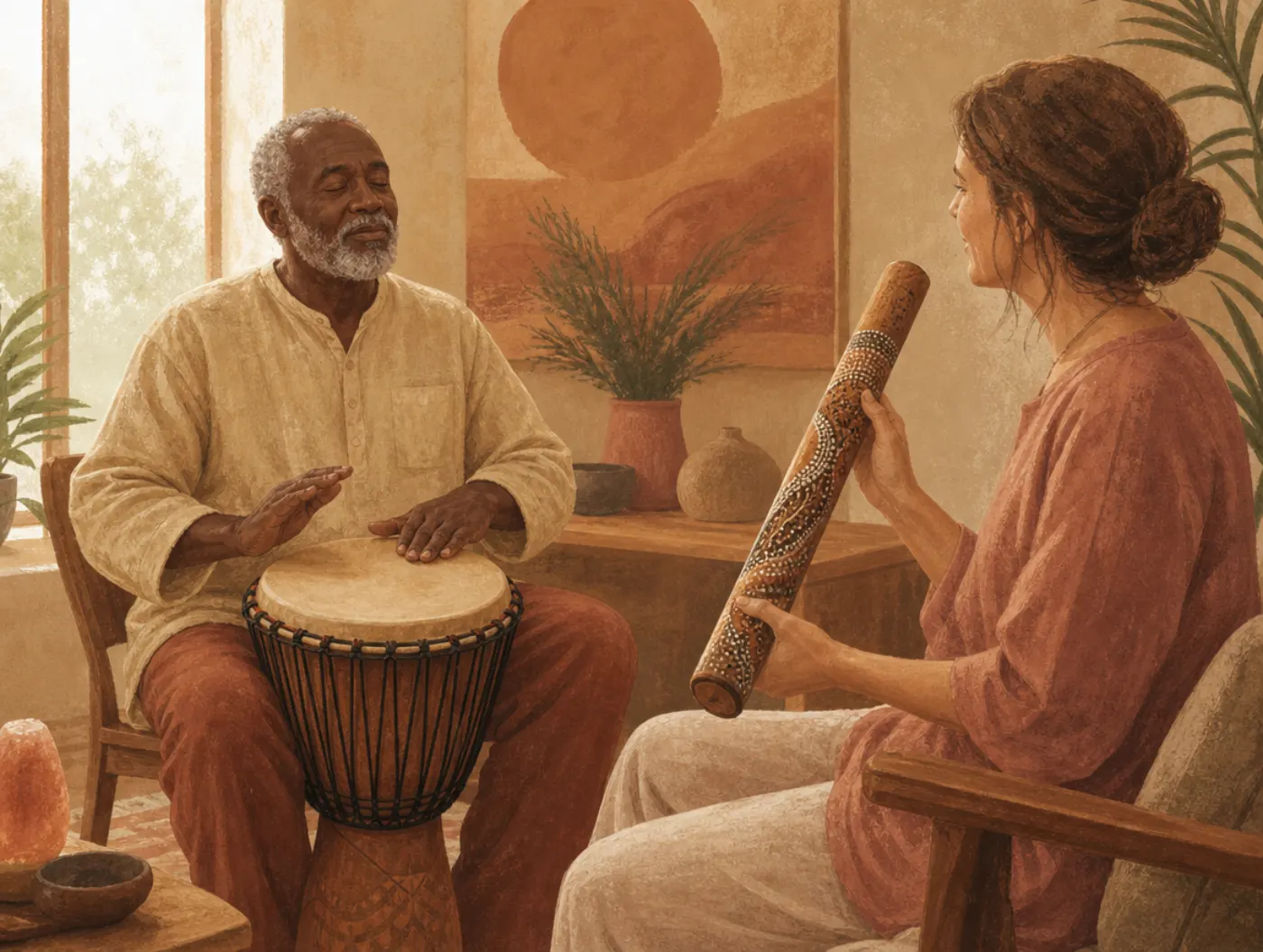
Music therapists usually sort their methods into receptive and active. In receptive methods the person listens: to recorded or live music chosen for a purpose, while the therapist guides attention, relaxation, imagery or a conversation about what came up. Guided Imagery and Music, developed by Helen Bonny in the 1970s, is the best-known structured receptive method. In active methods the person makes music: improvising on simple percussion, singing, writing a song about something that is hard to say, moving to a beat. Clinical improvisation in the Nordoff-Robbins tradition treats the back-and-forth of making sounds together as the relationship itself. No musical skill is needed for any of this. The therapist picks the method for the goal, much as a physiotherapist picks an exercise, and adjusts it from session to session.
The profession grew out of the two world wars, when community musicians played for wounded soldiers in hospitals and staff noticed physical and emotional responses that seemed worth studying properly. Michigan State University opened the first degree program in 1944, professional associations followed in the 1950s, and the field spent the next decades building its theory and research base. Kenneth Bruscia's Defining Music Therapy, now in its third edition, gives the definition most training courses use: a reflexive process in which the therapist helps the client optimise health through music experiences and the relationships that form through them.
The evidence is real but modest and uneven, and this page would rather say that plainly than oversell. A 2017 Cochrane review of music therapy for depression found that, added to usual treatment, it reduced depressive symptoms more than usual treatment alone in the short term, with a similar benefit for anxiety; the authors rated the quality of that evidence as low to moderate and could not say which method worked best or whether the effect lasted. The Cochrane review of music-based interventions for people with dementia, updated in 2025, found they probably improve depressive symptoms and may improve overall behavioral problems at the end of treatment, found no clear benefit for anxiety, emotional well-being or quality of life, agitation, aggression or cognition, and found little evidence that any effect persisted after sessions stopped. Trials are often small, hard to blind, and vary in what they count as music therapy. In short: it helps some people, for some outcomes, usually as an addition to other care, and it is not a cure for anything.
Music therapy is used across the lifespan: in neonatal intensive care, with children who have developmental or communication difficulties, in schools, in adult mental health services, in neurological rehabilitation, in dementia care and in hospices. Melodic intonation therapy, which uses singing to help people with non-fluent aphasia find words again, is one well-known example from stroke rehabilitation. No musical background is needed. It suits less well anyone for whom sound is painful or overwhelming, which happens in some sensory conditions and after some head injuries, and it is not a replacement for medical care, psychotherapy or medication. A good music therapist will say so and will work alongside the rest of the care team.
The activities further down this page are self-directed music activities, not music therapy. They borrow from the receptive and active traditions, they are safe to try at home, and they are the kind of thing a music therapist might suggest between sessions: things a person can do with music, on purpose, for their mood or their nerves. Done with intention they are worthwhile. They are not a treatment, and a playlist should never stand in for care you need.
The common mistakes are worth naming. The first is assuming that relaxing music is universal: tempo and genre preferences are personal, and the piece that settles one person irritates the next. Music therapists use the iso principle, matching the music to the mood you are in first and only then moving it, track by track, toward where you want to be. Starting with something slow and serene when you are agitated often backfires. The second is using music to avoid a feeling rather than to move through it; looping the same sad songs during a low spell can deepen rumination. The third is the belief that a particular genre has special powers. The so-called Mozart effect of the 1990s was a small, short-lived change on one spatial reasoning task, and later studies did not find a general effect on intelligence. Listen to what you like, loudly enough to enjoy and quietly enough to protect your hearing.
If you want music therapy itself, look for the credential. In the US, ask whether the therapist is an MT-BC; the Certification Board for Music Therapists keeps a public register. Referrals often come through hospitals, hospices, special schools and community mental health teams, and some therapists work in private practice. A first session usually involves talking about what you want to change, a little music-making or listening to see what you respond to, and a plan with goals you can both check against. Sessions run from thirty to sixty minutes, individually or in groups.
If the real problem is low mood that has lasted weeks, anxiety that is narrowing your life, or a loved one with dementia whose distress is wearing you down, music can be part of the answer but not the whole of it. A licensed therapist can help with the underlying difficulty and can tell you whether a music therapist should be part of the team. Psychology.com's directory is free to search.
References
- Aalbers S, Fusar-Poli L, Freeman RE, et al. Music therapy for depression. Cochrane Database of Systematic Reviews. 2017;(11):CD004517.
- van der Steen JT, van der Wouden JC, Methley AM, Smaling HJA, Vink AC, Bruinsma MS. Music-based therapeutic interventions for people with dementia. Cochrane Database of Systematic Reviews. 2025;(3):CD003477.
- Goes AO, Nardi AE, Quagliato LA. Outcomes of music therapy on children and adolescents with attention-deficit/hyperactivity disorder: a systematic review and meta-analysis. Trends in Psychiatry and Psychotherapy. 2025;47:e20241020.
- Bruscia KE. Defining Music Therapy. 3rd ed. Barcelona Publishers; 2014.
- American Music Therapy Association. What is music therapy? https://www.musictherapy.org/about/musictherapy/
- Certification Board for Music Therapists. About board certification. https://www.cbmt.org/
Cite this source
Psychology.com. (2026, October 19). Music Therapy Activities. Psychology.com. https://psychology.com/tools/music-therapy-activities
Music Therapy Activities FAQ
What is music therapy?
Music therapy is a health profession in which a credentialed music therapist uses music experiences, listening, singing, playing, improvising or songwriting, inside a therapeutic relationship to work toward goals that are not musical: less anxiety, better mood, recovered speech, calmer behavior, a way to communicate. In the US the credential is MT-BC, Music Therapist, Board Certified. It is practiced in hospitals, hospices, schools, mental health services and private practice, usually alongside other care rather than instead of it.
Is listening to music the same as music therapy?
No. Listening to music you love can be genuinely good for your mood, and the receptive side of music therapy does involve listening, but music therapy means a trained therapist choosing and shaping the music for a specific goal, inside an ongoing relationship, with progress reviewed. A playlist is self-care. Music therapy is treatment delivered by a professional. The activities on this page sit in between: self-directed and intentional, but not therapy.
Does music therapy work for depression and anxiety?
The evidence is encouraging but limited. A 2017 Cochrane review found that music therapy added to usual treatment reduced depressive symptoms and anxiety more than usual treatment alone in the short term. The reviewers rated the evidence as low to moderate quality, could not say which methods work best, and had little data on whether gains lasted. So it is a reasonable addition to treatment for some people, not a substitute for therapy or medication, and not a guarantee.
Can music help with stress?
This is the most common everyday use, and it does not need a therapist. Slow, familiar, predictable music tends to suit winding down, and some music therapists use the iso principle: start near the state you are actually in rather than putting on something serene while you are wound up, then move the tempo down across two or three tracks. That is a clinical approach that may suit some people; it has not been tested as a home technique. The research on music and stress is mostly small studies on listening before or during a stressful event, with modest effects, so treat it as a possible small help rather than a treatment. Stop if a piece pulls you somewhere worse.
Does music therapy help with dementia?
Partly, and less than earlier summaries suggested. The 2025 update of the Cochrane review of music-based interventions for people with dementia found they probably improve depressive symptoms (moderate certainty) and may improve overall behavioral problems (low certainty) at the end of treatment. It found no clear benefit for anxiety, emotional well-being or quality of life, agitation, aggression or cognition, and little evidence that any effect lasted after sessions stopped. Families often report moments of connection that trials do not capture well. Expect comfort and engagement during sessions, not slowed decline.
Do I need to be musical to have music therapy?
No. Music therapists work with people who have never sung in public or held an instrument. Active methods use simple percussion, voice and improvisation where there is no wrong note. Receptive methods only ask you to listen. If you dislike making music, say so; a therapist will choose a receptive approach. Musical skill matters for the therapist, not the client.
How do I find a qualified music therapist?
Look for the credential. In the US that is MT-BC, and the Certification Board for Music Therapists keeps a searchable register; the American Music Therapy Association also lists members. In the UK, check the Health and Care Professions Council register. Hospitals, hospices, special schools and community mental health teams often employ or refer to music therapists, and some work privately. Ask how they would approach your goal and how progress would be reviewed.
Does music therapy help with ADHD?
The evidence is thin. A 2025 systematic review and meta-analysis of music therapy for children and adolescents with ADHD found only a handful of small, very mixed trials, a non-significant trend toward fewer hyperactive and impulsive symptoms, and almost no data on inattention or follow-up, so there is no result to rest on. Explanations for why music should help, such as structure, rhythm or immediate feedback, are not established. What can be said is that some children and adults with ADHD enjoy structured musical activity, preferences vary from person to person, and enjoyment is a reasonable basis for trying an activity. Treat it as a possible adjunct, not as a treatment for ADHD.