Art Therapy Activities: Simple Creative Prompts to Explore Feelings, No Skill Needed
These art therapy activities are free creative prompts for expressing feelings through drawing and collage. Use them for personal reflection; formal art therapy requires a trained professional.
 Reviewed byMichael Callans, MSW
Activities for exploring emotion
- Emotion drawing: pick a feeling you have right now and draw it as color, shape, and line, with no recognizable objects required.
- Draw your feeling as weather: is today a storm, fog, bright sun, or still air? Render it on the page.
- The emotion wheel in color: divide a circle into sections and fill each with a color for a feeling you have felt this week.
- Inside / outside mask: on a paper mask or face outline, draw what you show the world on the outside and what you feel on the inside.
Activities for calm and grounding
- Safe-place image: draw or collage a place, real or imagined, where you feel completely safe. Add the sensory details.
- Mandala drawing: start from a center point and build outward in repeating patterns. The rhythm itself is soothing.
- Zentangle: fill a small square with simple repeated patterns, one stroke at a time, with no plan and no goal.
- Scribble and find: scribble freely for thirty seconds, then turn the page and find an image hidden in the lines.
Activities for self-reflection
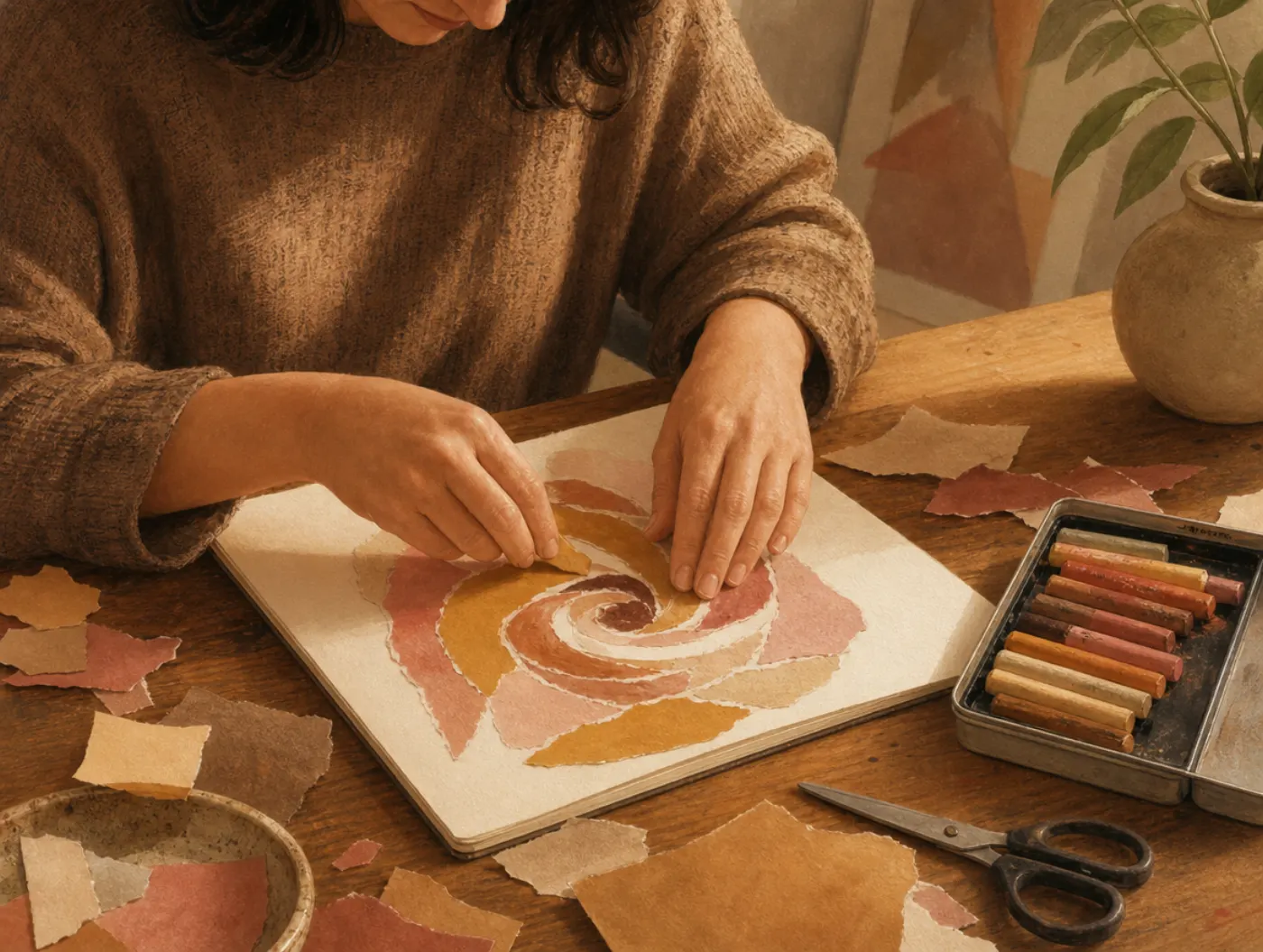
- Collage of you: cut images and words from magazines that represent who you are or who you want to become, and arrange them.
- Bridge drawing: draw a bridge from where you are now to where you want to be, and what lies on each side and underneath.
- Strengths self-portrait: draw or symbolize yourself surrounded by your strengths and the people who support you.
- Gratitude visual: instead of writing your gratitude list, draw or collage three things you are thankful for.
A note on doing this well
Focus on the process over the product, and stay curious about what surfaces rather than judging it. If a prompt stirs up something painful, you do not have to push through. Ground yourself, set it aside, and consider working with a credentialed art therapist or another licensed professional who can support you. The art therapy ideas below are grouped by goal: exploring emotion, calm and grounding, and self-reflection.
Related tools & tests
Curious about working with an art therapist?
A credentialed art therapist can guide expressive work in depth. Free to search our directory.
About this tool
These art therapy activities are self-guided drawing, collage, and image-making prompts for exploring feelings that are hard to put into words. They offer a way to describe your experience visually and reflect on what matters to you, while formal art therapy takes place with a trained professional. You can use colors, shapes, and simple marks without aiming for a polished picture. Choose materials that feel comfortable and let your own meaning guide the reflection.
Formal art therapy is a recognized mental-health profession in which a credentialed art therapist guides the process and helps make sense of what emerges. The prompts below are not therapy and are not a substitute for working with a professional. They are accessible, self-guided creative activities drawn from approaches art therapists use, suitable for reflection, stress relief, and self-expression at home.
A few principles help. Let go of judgment: this is not about making good art. Notice what comes up as you work, including any resistance, calm, or surprise. And give yourself permission to keep, share, or discard whatever you make. If a prompt brings up something heavy or distressing, pause, ground yourself, and consider reaching out to a licensed professional.
A 2016 study led by art therapist Girija Kaimal measured cortisol, a hormone the body releases under stress, before and after 45 minutes of art making and found that levels dropped for most participants, regardless of whether they had any prior art experience. That finding lines up with what art therapists have long observed: the physical act of making something can be calming on its own, separate from whatever the finished piece looks like or means. This was a preliminary study without a control group, so it cannot establish that art making caused the change or that these particular prompts treat anxiety. Cortisol findings also do not tell you how you personally should feel after an activity.
These prompts tend to help most when words feel too limited, for grief, big transitions, or emotions that are hard to name. They work less well as a stand-in for processing significant trauma, which usually goes better with a trauma-informed therapist who can pace the work and help you stay regulated. A common mistake is picking the prompt that feels hardest as a way to push through quickly. Choosing whatever prompt feels most doable today, even a simple one, tends to be more useful than forcing a deep one before you are ready. Sound can do the same work as images for some people; our music therapy activities take the same approach with listening and playing.
After finishing, describe what you notice in everyday language: where you began, what you changed, and what the image means to you. You might give it a title or write a sentence about what you need next. Avoid using colors, symbols, or drawing style to diagnose yourself or another person. A picture can start a conversation without serving as a psychological test.
If you use these prompts with someone else, ask whether they want to talk about their work before offering an interpretation. Let them decide what to share and whether to keep the image private. For your own reflection, an Identifying Emotions Worksheet can help you find words afterward; Grounding Techniques offers an alternative when you want to reconnect with your surroundings.
The Positive Psychology Worksheets collection offers other reflection activities. If distress keeps disrupting sleep, relationships, or daily responsibilities, the Psychology.com therapist directory can help you look for professional support. Ask a prospective art therapist about their art therapy training, credentials, and experience with the concerns you want to address.
References
- Malchiodi CA. Handbook of Art Therapy. 2nd ed. Guilford Press; 2012.
- Kaimal G, Ray K, Muniz J. Reduction of cortisol levels and participants' responses following art making. Art Ther. 2016;33(2):74-80.
- Kaimal, G., Ray, K., & Muniz, J. (2016). Reduction of cortisol levels and participants' responses following art making. Art Therapy, 33(2), 74-80. https://pmc.ncbi.nlm.nih.gov/articles/PMC5004743/
- American Art Therapy Association. About art therapy. https://arttherapy.org/about-art-therapy/
Cite this source
Psychology.com. (2026, October 18). Art Therapy Activities. Psychology.com. https://psychology.com/tools/art-therapy-activities
Art Therapy Activities FAQ
Do I need to be good at art for these to work?
No. Artistic skill is not the point. The benefit comes from the process of making and reflecting, not from producing a polished result. You can begin with scribbles or blocks of color and then ask what they express for you. If judging the picture becomes distracting, try a familiar material and a smaller area of paper.
Is this the same as art therapy?
No. Formal art therapy is delivered by a credentialed art therapist who guides the process. These are self-guided creative prompts inspired by that work, suitable for reflection and stress relief at home. A therapist can adapt creative work to your needs and help you respond to distress that arises during the process.
What if a prompt brings up difficult feelings?
That can happen with expressive work. Pause, use a grounding technique, and set the activity aside. If heavy feelings persist, consider reaching out to a licensed professional. You can look around the room, feel your feet against the floor, and decide whether you want company. You do not need to finish or explain the image.
What supplies do I need?
Whatever you have. Pen and paper is enough. Markers, crayons, paint, or old magazines for collage all work well, but none are required. Choose materials you can handle comfortably and a surface where you can work without worrying about mess. Collage may be an option if drawing feels frustrating; tearing paper can replace cutting when scissors are difficult to use.
What are some good art therapy prompts to start with?
Start simple: draw your current feeling as color, shape, and line; make a safe-place image of somewhere you feel completely calm; or collage words and pictures that represent who you are. Use basic supplies and stop when you have explored enough for now; there is no required time or finished appearance. The full list on this page groups prompts by goal, whether you want to explore emotion, settle your nervous system, or reflect on yourself.
Which art therapy activities work best for adults?
All of the prompts here were written with adults in mind. Mandala and Zentangle drawing suit adults who want calm without much introspection, while the bridge drawing, inside/outside mask, and collage of you go deeper into identity and change. Choose based on what you need that day. Adults working through heavier material may prefer to bring these exercises to a credentialed art therapist.
Can I do these art therapy exercises on my own?
Yes. These art therapy exercises are self-guided and grouped by goal, so you can pick by what you need today: emotion drawing or the inside/outside mask to explore a feeling, mandala or Zentangle drawing to settle, and the bridge drawing or collage of you to reflect on where you are heading. Focus on the process rather than the result, choose the most doable prompt rather than the hardest, and pause if something heavy comes up.
What are therapy drawing prompts?
Therapy drawing prompts are short instructions that give a drawing a purpose other than looking good: draw your feeling as weather, scribble for thirty seconds and find an image in the lines, or draw a bridge from where you are now to where you want to be. Afterward, describe in everyday language where you began, what you changed, and what the image means to you. Avoid reading colors or drawing style as a diagnosis of yourself or anyone else.