Gratitude Activities for Kids: 12 Ideas That Fit the Age
Gratitude activities for kids work best when they match what a child can understand: younger children are mainly learning to notice good things, and the thinking behind the thanks develops gradually. Twelve activities for parents, carers and teachers, with an age guide, a dinner-table script and the one mistake to avoid.
 Reviewed byMichael Callans, MSW
Which activities fit which age
About 3 to 6: noticing
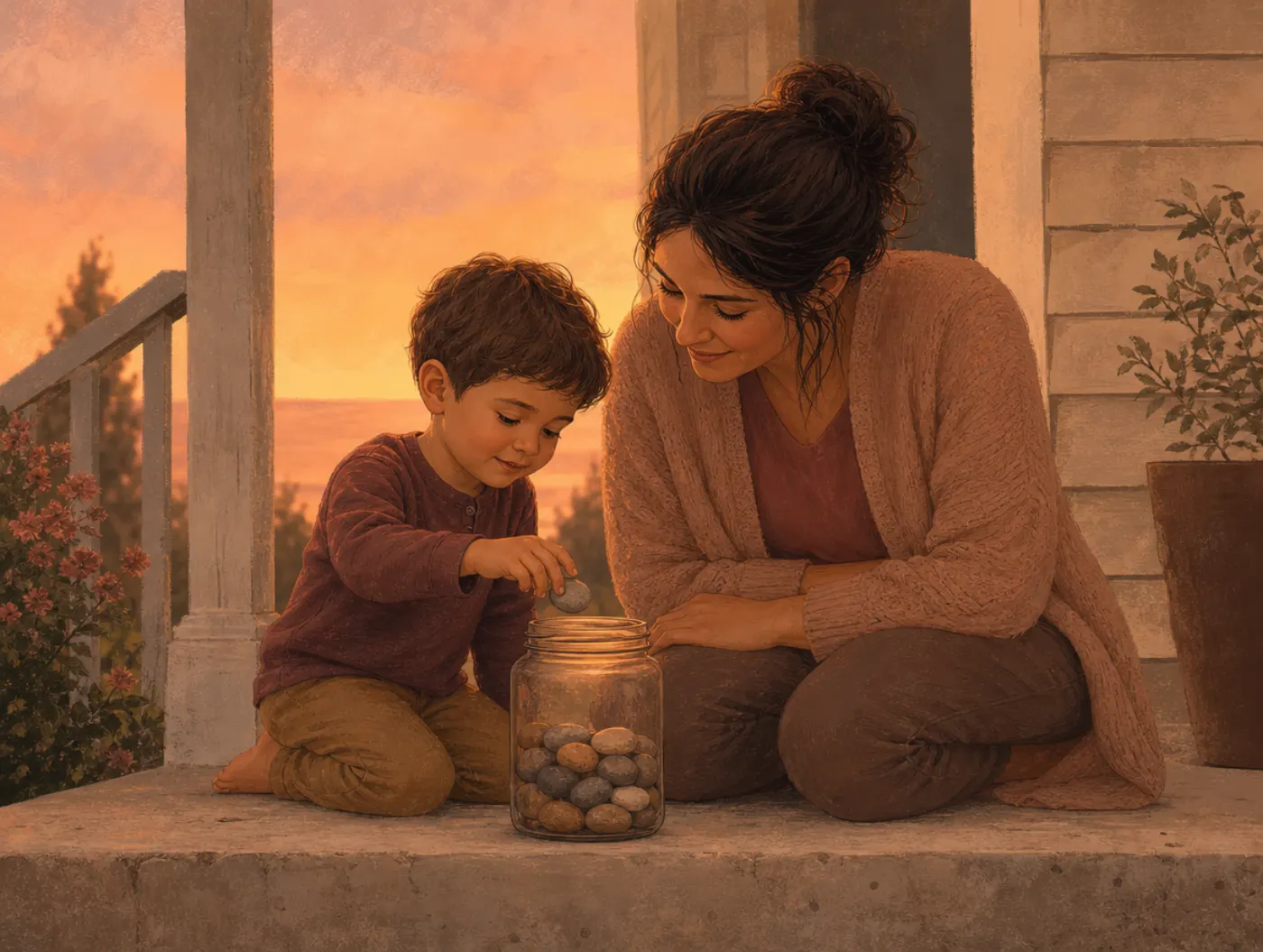
Gratitude jar (child draws or dictates, you write). Gratitude hunt around the house. Three good things at dinner with you going first. Thank-you drawings for a gift. Expect 'the dog' and 'pancakes'; that is a correct answer.
About 7 to 10: the thinking behind thanks
Three good things plus the three questions (who made it happen, what did it cost them, why for you). Specific thank-you letters. The gratitude visit. A gratitude tree or paper chain, one leaf a day.
About 11 and up: private and social
A short gratitude journal a few times a week. Rose, thorn and bud at dinner. Choosing a cause to give time to, then talking about it. Writing a thank-you to a teacher or coach they picked themselves.
Twelve gratitude activities
- Gratitude jar: one good thing per evening on a slip of paper, read out together at the end of the month.
- Three good things at dinner: everyone, adults included, names three good things from the day.
- The three questions: who made that happen, what did it cost them, why do you think they did it for you?
- Gratitude hunt: find five things in the house or garden you are glad exist, and say why.
- Thank-you letters that name what the person did and how it helped.
- The gratitude visit: the child reads the letter to the person, in person or on a call.
- Gratitude tree or paper chain: one leaf or link added per day, displayed where everyone sees it.
- Thank-you drawings for a gift, with the adult writing the child's words underneath.
- Rose, thorn and bud: one good thing, one hard thing, one thing to look forward to.
- A short gratitude journal for older children, two or three entries a few times a week.
- Gratitude walk: on the way to school, each person names something they see that they are glad is there.
- Giving time: an older child chooses a cause or a person to help, and you talk afterwards about what people were grateful for and why.
Dinner-table script for three good things (read by the adult)
- Go first: 'Three good things from my day. One, the sun came out at lunch. Two, a colleague lent me her charger. Three, you two set the table without being asked.'
- Invite, do not instruct: 'What were your three?' If the answer is 'nothing', say 'Fair enough, tough day. Was there one small thing?' and let it go if there was not.
- For children of about seven and up, pick one answer and ask the three questions: 'Who made that happen? What did it cost them, in time or effort? Why do you think they did it for you?'
- If a complaint comes up, hear it fully before you move on: 'That sounds really disappointing.' Do not answer it with gratitude.
- Stop while it is still fun. Three to five minutes, two or three times a week, outlasts a daily ritual.
What not to do
Never use gratitude to shut down a complaint ('you should be grateful'). Do not force thank-yous under threat, compare your child to children who have less, or correct their choice of good thing. Do not run it daily until everyone hates it. And do not expect a gratitude activity to fix a behavior problem or a low mood; it is a gentle habit, not a treatment.
Therapists Who Work With Parenting
A worksheet is a start. These licensed therapists work with the same problem; every member is matched to the federal NPI Registry and board checks are dated on the profile.
-
View profile
Michelle FosterLCSW, MSW
License verified, checked Oct 8, 2026
“Welcome! I'm glad you're taking the first step in your journey.”
Jonesboro, Georgia Telehealth $200 per session, sliding scale
-
View profile
Migdalis NievesLCSW-C, LICSW, LCSW
License verified, checked Sep 30, 2026
Richmond, Virginia Telehealth $150 to $175 per session
-
View profile
License verified, checked Sep 12, 2026
“Direct, out-of-network psychotherapy and couples therapy focused entirely on your breakthroughs, not insurance protocols.”
Danbury, Connecticut Telehealth $300 per session



About this tool
Gratitude activities for kids are simple, repeatable routines that help a child notice good things, work out where they came from, and, as they get older, feel and express thanks for them. The popular ones are a gratitude jar, three good things at the dinner table, thank-you letters and a gratitude hunt. All of them are easy to run. The part that takes some thought is matching the activity to what a child of that age can actually understand, because gratitude in the full sense is a later-developing capacity, and asking too much too early turns it into a performance.
Developmental research shows that understanding of gratitude develops gradually, and that what a child shows depends a lot on how the task is set up. Younger children can say thank you when prompted and can enjoy a gift; the fuller appraisal that gratitude depends on, that someone chose to help them, that it cost that person something, and that it was done for their benefit, becomes more reliable across the primary years. Experiments with preschoolers have found that four to six year olds who are given a gift help and share more with the giver, especially when the giver's intention is made clear, and that five year olds already prefer a recipient who shows gratitude, so the building blocks are present well before a child can explain them. Jeffrey Froh and Giacomo Bono, who have led much of the research on gratitude in young people, built a school curriculum around teaching exactly this appraisal to eight to eleven year olds, and found that children who learned to think this way showed more gratitude and more thankful behavior, with effects still visible months later. The lesson for parents and teachers is that with younger children you are teaching noticing, and with older children you are teaching the thinking behind the thanks.
The evidence for the simple activities is more modest than the enthusiasm around them. Froh's 2008 study of counting blessings in early adolescents found gains in gratitude, optimism and satisfaction with school compared with listing hassles, which is encouraging. A later study found that a gratitude visit, where a young person delivers a thank-you letter in person, helped mainly the children who started with low positive mood; the already cheerful ones showed little change. The pattern across the literature is that gratitude activities are a mild, safe, probably helpful habit, not a transformation, and that the version where an adult talks with the child about who helped and why works better than a list filled in alone. Gratitude seems to be caught through conversation more than taught through worksheets.
For children of about three to six, keep the activities concrete and sensory. A gratitude jar works well: each evening the child draws or dictates one good thing on a slip of paper, you write the words, and the slip goes in the jar to be read out at the end of the month. A gratitude hunt sends them around the house or garden to find things they are glad exist, which is really a noticing exercise with a label on it. Three good things at dinner works at this age if you model it first and accept answers like 'the dog' and 'pancakes'. The aim is the habit of scanning for good, not a correct feeling. Do not ask a four year old to be grateful; ask what was good today.
From about seven to ten, add the thinking. When a child names something good, ask three follow-up questions: who made that happen, what did it cost them, and why do you think they did it for you? That is the appraisal the research says drives gratitude, and asking it at dinner is probably the single most useful thing on this page. This is also the age for thank-you letters that say what the person did and how it helped, rather than a generic thanks, and for the gratitude visit, where the child reads the letter to the person. A gratitude tree or paper chain, with one leaf or link added per day, gives a visible record that this age enjoys.
From about eleven, children can handle gratitude as a private practice and as a social one. A short gratitude journal, two or three entries a few times a week rather than daily, suits this age better than a jar. Rose, thorn and bud at dinner, naming one good thing, one hard thing and one thing to look forward to, gives permission for the hard thing, which matters with teenagers who will otherwise refuse the exercise as fake. Letting an older child choose a cause to give time to, and talking afterwards about what people are grateful for and why, connects gratitude to action. Expect eye-rolling. Keep doing it anyway, briefly.
The one mistake to avoid is using gratitude to dismiss a complaint. 'You should be grateful' in response to a child's disappointment teaches that gratitude is a stick, and children who learn that stop sharing the disappointment rather than start feeling the gratitude. The same goes for forced thank-yous delivered under threat and for comparing a child's situation to children who have less. Gratitude and disappointment can sit together: the party was cancelled and that is rubbish, and grandma still drove over with cake. Name the first before you point to the second. If you only do one thing differently after reading this, do that.
Other common mistakes are smaller. Running an activity every day until it dies of boredom, when two or three times a week lasts longer. Correcting a child's answer ('that is not something to be grateful for') instead of asking a question about it. Doing the activity to the child rather than with them: children copy what adults do far more than what adults assign, so your own three good things at the table matter more than theirs. And expecting the activity to fix a behavior problem. Gratitude activities are a nice habit with mild benefits; they are not a response to entitlement, anxiety or low mood, and a child who seems unable to find anything good for weeks deserves a different conversation.
If a child's inability to name anything good lasts more than a few weeks, comes with withdrawal, irritability, sleep or appetite changes, or with talk of being worthless or not wanting to be here, that is not a gratitude problem. Speak to your child's doctor or a licensed child therapist. The printable lists all twelve activities by age with the follow-up questions and a short script for the dinner table.
References
- Froh JJ, Sefick WJ, Emmons RA. Counting blessings in early adolescents: an experimental study of gratitude and subjective well-being. J Sch Psychol. 2008;46(2):213–233.
- Froh JJ, Kashdan TB, Ozimkowski KM, Miller N. Who benefits the most from a gratitude intervention in children and adolescents? Examining positive affect as a moderator. J Posit Psychol. 2009;4(5):408–422.
- Froh JJ, Bono G, Fan J, et al. Nice thinking! An educational intervention that teaches children to think gratefully. School Psychology Review. 2014;43(2):132-152. doi:10.1080/02796015.2014.12087440
- Tudge JRH, Freitas LBL, eds. Developing Gratitude in Children and Adolescents. Cambridge, UK: Cambridge University Press; 2018.
- Shoshani A, De-Leon Lendner K, Nissensohn A, Lazarovich G, Aharon-Dvir O. Grateful and kind: the prosocial function of gratitude in young children's relationships. Developmental Psychology. 2020;56(6):1135-1148.
- Vaish A, Savell S. Young children value recipients who display gratitude. Developmental Psychology. 2022;58(4):680-692.
Cite this source
Psychology.com. (2026, October 19). Gratitude Activities for Kids. Psychology.com. https://psychology.com/tools/gratitude-activities-for-kids
Gratitude Activities for Kids FAQ
At what age can a child understand gratitude?
Most children say thank you on prompting from about two or three, and the fuller understanding, that someone chose to help, that it cost them something, and that it was done for the child's benefit, develops gradually through the primary years, with experiments finding early forms of it in four to six year olds when the giver's intention is made clear. Research by Jeffrey Froh and Giacomo Bono showed that eight to eleven year olds could be taught this appraisal and that it increased their gratitude. With younger children, gratitude activities are mainly noticing exercises, and that is fine. You are building the habit of scanning for good things; the deeper feeling grows into the habit later.
What is a gratitude jar and how does it work with kids?
A gratitude jar is a container that collects slips of paper, each with one good thing from the day. With a young child, you ask 'what was good today?', write down their words or let them draw it, and drop it in. At the end of the week or month, you read the slips out together. It works because the reading aloud turns a list into a shared story, and because younger children like seeing the jar fill. Keep it to one slip per evening and let anything count. 'The dog' is a legitimate entry.
Do gratitude activities actually work for children?
Modestly, yes. A 2008 study of early adolescents who listed blessings for two weeks found more gratitude, optimism and satisfaction with school than those who listed hassles. A later study of the gratitude visit found it helped mainly children who started out low in positive mood. A school curriculum that taught children how to think about a benefactor's intention, cost and benefit produced larger and longer-lasting gains than simple listing. So gratitude activities are a safe, mildly helpful habit, and the conversation around them matters more than the worksheet. They are not a treatment for anything.
How do I teach gratitude without nagging?
Do it rather than assign it. Children copy what adults model far more than what they are told, so say your own three good things at dinner and write your own thank-you notes where they can see. Invite rather than instruct, accept any answer, and ask curious follow-up questions instead of correcting. Keep sessions short and not daily. And never use gratitude as a response to a complaint. 'You should be grateful' is the fastest way to make a child associate the word with being told off, and it teaches them to hide disappointment, not to feel thankful.
What should I do when my child says there is nothing to be grateful for?
First, take it at face value: a bad day is a bad day, and 'fair enough, tough day' keeps the activity safe. Then ask for one small thing, and let it go if there is none. For older children, rose, thorn and bud is built for this, because it names the hard thing before the good one. If 'nothing' is the answer for weeks, and it comes with withdrawal, irritability, changes in sleep or appetite, or talk of being worthless, that is not about gratitude. Talk to your child's doctor or a licensed child therapist.
Are thank-you letters a good gratitude activity for kids?
Yes, from about seven, when a child can say what the person did and how it helped rather than just 'thanks for the present'. The specificity is the point, because it requires the child to think about the giver's effort and intention. The gratitude visit, where the child reads the letter to the person, has been studied in young people and seems most useful for children who are not naturally upbeat. For younger children, a drawing with their dictated words underneath does the same job at their level. Let them choose who to thank; a chosen letter is worth ten assigned ones.