Gratitude Jar: Collect Small Moments of Good to Reread Whenever You Need a Lift
A gratitude jar collects short notes about moments you appreciate so you can revisit them later. Use this free tool to write specific memories and download printable notes as a PDF.
 Reviewed byMichael Callans, MSW
Related tools & tests
Want help building lasting wellbeing habits?
A therapist can help you make positive practices part of daily life. Free to search our directory.
About this tool
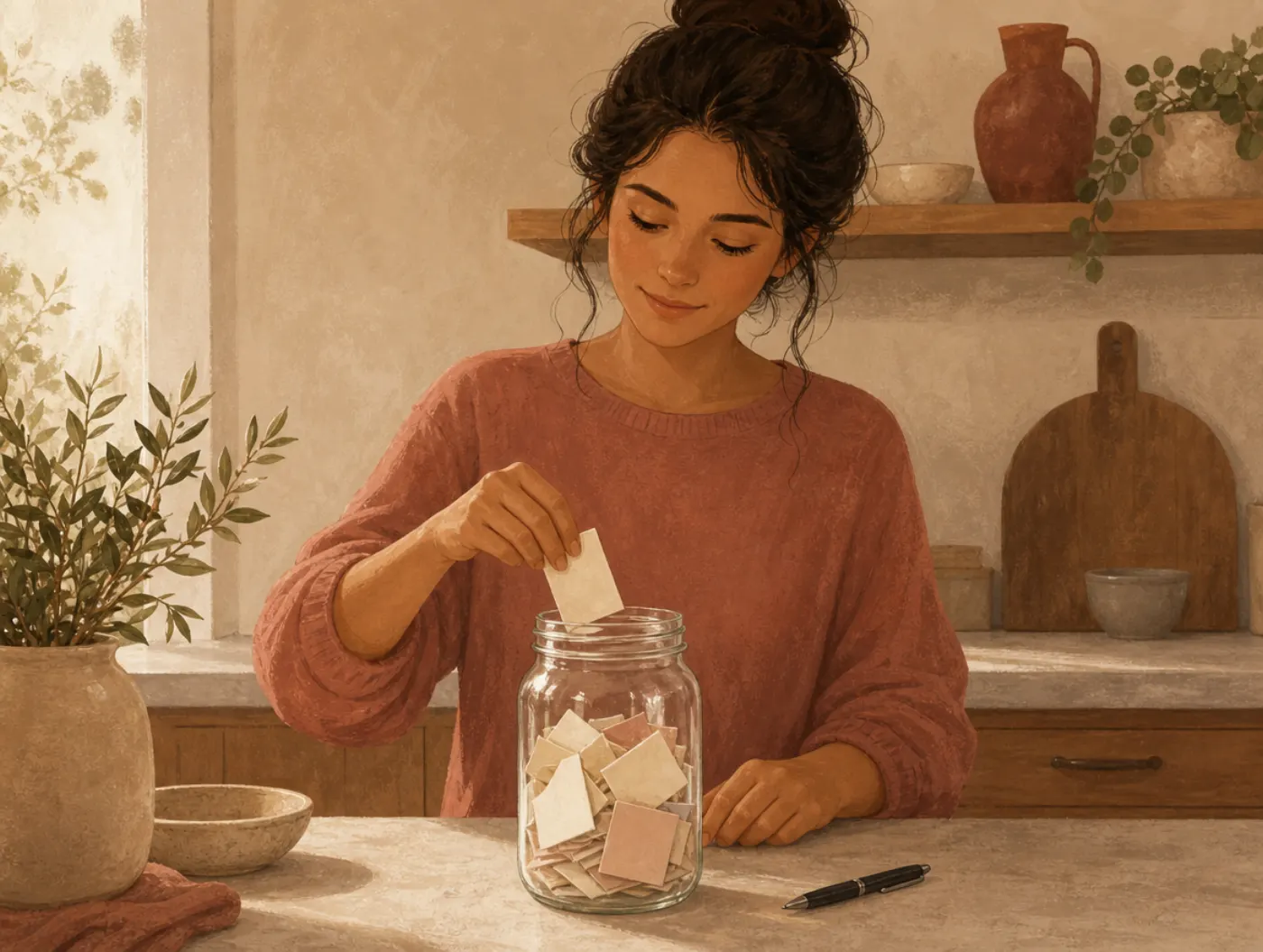
A gratitude jar is a collection of short notes about experiences, people, or everyday moments you appreciate. It helps you save specific memories that might otherwise be forgotten, giving you something concrete to revisit when you want to reflect on what has mattered to you. Keep a jar somewhere visible and add paper slips as moments occur, or use this tool to prepare printable notes. You can reread the collection whenever you choose.
A gratitude jar adapts the practice of writing down things you appreciate into a collection you can revisit. In their experimental research, Robert Emmons and Michael McCullough found that gratitude listing improved some measures of well-being compared with the study comparison conditions, particularly positive affect. Their work supports studying gratitude practices, but it does not establish that a jar itself produces the same benefits or that every person will feel better.
A gratitude jar is especially nice as a shared or family ritual. Households often empty the jar together at the end of a year and read every note aloud. It is also a forgiving practice: there is no streak to maintain and no daily obligation, just an open invitation to notice the good whenever it shows up.
A common mistake is writing something too broad, like my family or everything, which is harder to picture later. A specific moment, such as my sister called just to check in, is easier to remember and more rewarding to reread months on. Another mistake is treating a missed week as failure; the jar has no streak to break, so picking it back up any time works fine.
A gratitude jar is a light, general wellbeing practice, not a treatment for depression or persistent low mood. If sadness, anxiety, or hopelessness stick around despite practices like this one, a licensed therapist can help you look at what is underneath; you can search the Psychology.com therapist directory to find one.
Useful gratitude jar examples include a neighbor bringing back your bin, a quiet place to rest, or a friend remembering something important to you. Add why the moment mattered: it saved effort, helped you feel remembered, or gave you room to breathe. Everyday details are enough. You do not need an impressive event or a cheerful description of the whole day.
When you reread the notes, look for recurring sources of support or enjoyment. You might notice that time outdoors, practical help, or unhurried conversation matters to you and decide to make room for it again. A full jar is not a wellbeing score, and an empty jar does not show that your life lacks value. The collection reflects what you chose and had the opportunity to record.
For a shared jar, agree beforehand which notes may be read aloud and let everyone keep personal notes separate. Invite participation without requiring a positive statement from someone who is upset. A child can draw a memory or ask an adult to write their words. Avoid correcting another person's choice of what deserves gratitude.
Gratitude can sit alongside sadness, anger, or grief. If writing makes you feel pressured to excuse harm or minimize a problem, pause the exercise and attend to what needs care. The Gratitude Journal offers more space for reflection, while the Savoring Worksheet focuses on noticing an enjoyable experience. Both belong to the Positive Psychology Worksheets collection.
If a note reminds you of someone whose help mattered, you can keep the appreciation private or use the Gratitude Letter to put it into words. Sharing is optional. Consider the relationship and your comfort before sending anything, particularly when contact with that person feels complicated.
References
- Emmons RA, McCullough ME. Counting blessings versus burdens: an experimental investigation of gratitude and subjective well-being in daily life. J Pers Soc Psychol. 2003;84(2):377-389.
- Wood AM, Froh JJ, Geraghty AWA. Gratitude and well-being: a review and theoretical integration. Clin Psychol Rev. 2010;30(7):890-905.
- Emmons, R. A., & McCullough, M. E. (2003). Counting blessings versus burdens: An experimental investigation of gratitude and subjective well-being in daily life. Journal of Personality and Social Psychology. https://pubmed.ncbi.nlm.nih.gov/12585811/
Cite this source
Psychology.com. (2026, September 16). Gratitude Jar. Psychology.com. https://psychology.com/tools/gratitude-jar
Gratitude Jar FAQ
What is a gratitude jar?
It is a jar where you drop in short notes about things you are grateful for, whenever they happen. Over time it fills with reminders of the good in your life that you can read back when you need a lift.
How is it different from a gratitude journal?
A journal is usually a daily, structured entry. A gratitude jar is more spontaneous: you add a note any time, with no schedule, and the growing collection gives the habit a physical, visible form. Choose a Gratitude Journal if you want room to describe context and mixed feelings; choose a jar if brief, separate reminders suit you better.
Does gratitude really improve wellbeing?
Gratitude research suggests benefits for some aspects of wellbeing, but results vary. Emmons and McCullough found improvements in several outcomes, with positive affect a particularly consistent finding. Their studies examined gratitude listing, so they cannot establish the effects of this specific jar tool. Use it as an optional reflection practice alongside any support you need.
Is my information saved?
No. Everything stays in your browser. Your notes are never uploaded or stored, and the PDF is generated on your own device.
How many notes should I add to my gratitude jar?
There is no set number. Add one whenever something good happens, whether that is once a day or a few times a week. What matters more than frequency is noticing the moment and writing it down while it is fresh.
Can kids use a gratitude jar?
Yes, it works well as a family or classroom activity. Keep prompts simple, such as one good thing from today, and consider emptying the jar together on a birthday or at the end of the year to read the notes aloud. Let children decide whether to share their own notes, and welcome drawings or dictated words. Participation should remain voluntary, especially when a child is having a difficult day.