
In short
Unit bias is the sense that one unit of something is the right amount to take, so the amount consumed follows the size of the unit rather than hunger or calories. It was demonstrated with candy and pretzels left out in public buildings, and it is the reason that portion size, package size and the size of a serving spoon change how much people eat without changing how much they want.
How unit bias works
A unit answers a question that would otherwise need answering every time: how much is the right amount. One cookie, one bottle, one bag, one plate, one serving. Within a wide range of sizes the unit itself reads as the proper portion, so the decision becomes whether to take one rather than how much to take. That is why the size of a unit can change the amount a person eats while the person's appetite, mood and intentions stay exactly as they were.
Paul Rozin and his colleagues put the heuristic in cultural terms as well. The unit people treat as one serving is partly learned, which is why it travels with a food culture: the typical single-serving yogurt container in French supermarkets held 125 grams against 227 grams in American ones, and the French were not compensating by eating two. A norm of what one portion is, carried in packaging and plate size, does the work that deliberate restraint would otherwise have to do.
The effect is real and partial, and the original paper was careful to say so. If unit size were the only thing driving intake, quadrupling the unit would quadruple the amount taken. It did not. Across the three studies the amount taken rose by factors of 2.27, 1.69 and 1.67 where pure unit control predicted 4, 2 and 4. People do notice size and do adjust; they simply do not adjust all the way, so bigger units still mean more food.
Two limits are worth stating. The 2006 studies measured what people took from a tray or a bowl, not what they swallowed, and they measured it as a daily total in a shared building, so there is no record of individual servings and some of the same residents appeared across days. The broader portion-size literature supplies the controlled evidence: a meta-analytic review found that doubling a portion raised consumption by about 35 percent on average, with the effect flattening as portions grow very large, and a Cochrane review of 86 comparisons from 58 studies with 6,603 participants found a standardized mean difference of 0.38 for larger portion, package or tableware size, 0.46 in adults.
The original study
Andrew Geier, Paul Rozin and Gheorghe Doros published "Unit bias: A new heuristic that helps explain the effect of portion size on food intake" in Psychological Science in 2006. The three studies were run in public buildings in Philadelphia, on people who did not know they were in an experiment, with free food and no limit on how many units anyone could take.
In the first, a mixing bowl of Tootsie Rolls sat in a busy spot on the ground floor of an office building. Every morning it was filled with 240 grams of candy: on alternating days that was either 80 small pieces of 3 grams or 20 large pieces of 12 grams, so the weight on offer was constant and the unit differed fourfold. The pieces left were counted at the end of each day, for ten working days.
The second study is the one the demo reproduces. At an apartment building, management already left large Philadelphia-style soft pretzels in an alcove off the lobby on Mondays, Wednesdays and Fridays. For alternating weeks the researchers either left them whole, at 3 ounces each, or cut them carefully in half, which doubled the number of pieces to 120 and kept the total weight the same. This ran for 12 weeks, giving 18 days of data for each unit size. The third study replaced a tablespoon scoop with a quarter-cup scoop, four times larger, in a one-pound bowl of M&M's on the concierge desk of the same building, under a sign reading Eat Your Fill.
In all three, more food left the bowl when the unit was bigger. Pairing corresponding days, the weight taken was 2.27 times higher for the large Tootsie Rolls, 1.69 times higher for whole rather than halved pretzels, and 1.67 times higher with the large scoop. The pretzel result was the most consistent: all 18 pairs of days favored the whole pretzels. The authors drew the conclusion that gives the paper its title: small portions work not because people eat the same weight in more servings, but because something stops them from going back for a second unit.
Read the diagram and evidence as text
A whole pretzel and a cut half sit inside identical serving rings, each with an acceptance tick. The cut changes the food, not the serving enclosure. The illustrative shapes are separate from the reported ratio: 1.69 times the weight taken on whole-pretzel days, with more taken on all 18 pairs of days. No individual portion or consumption rate is inferred.
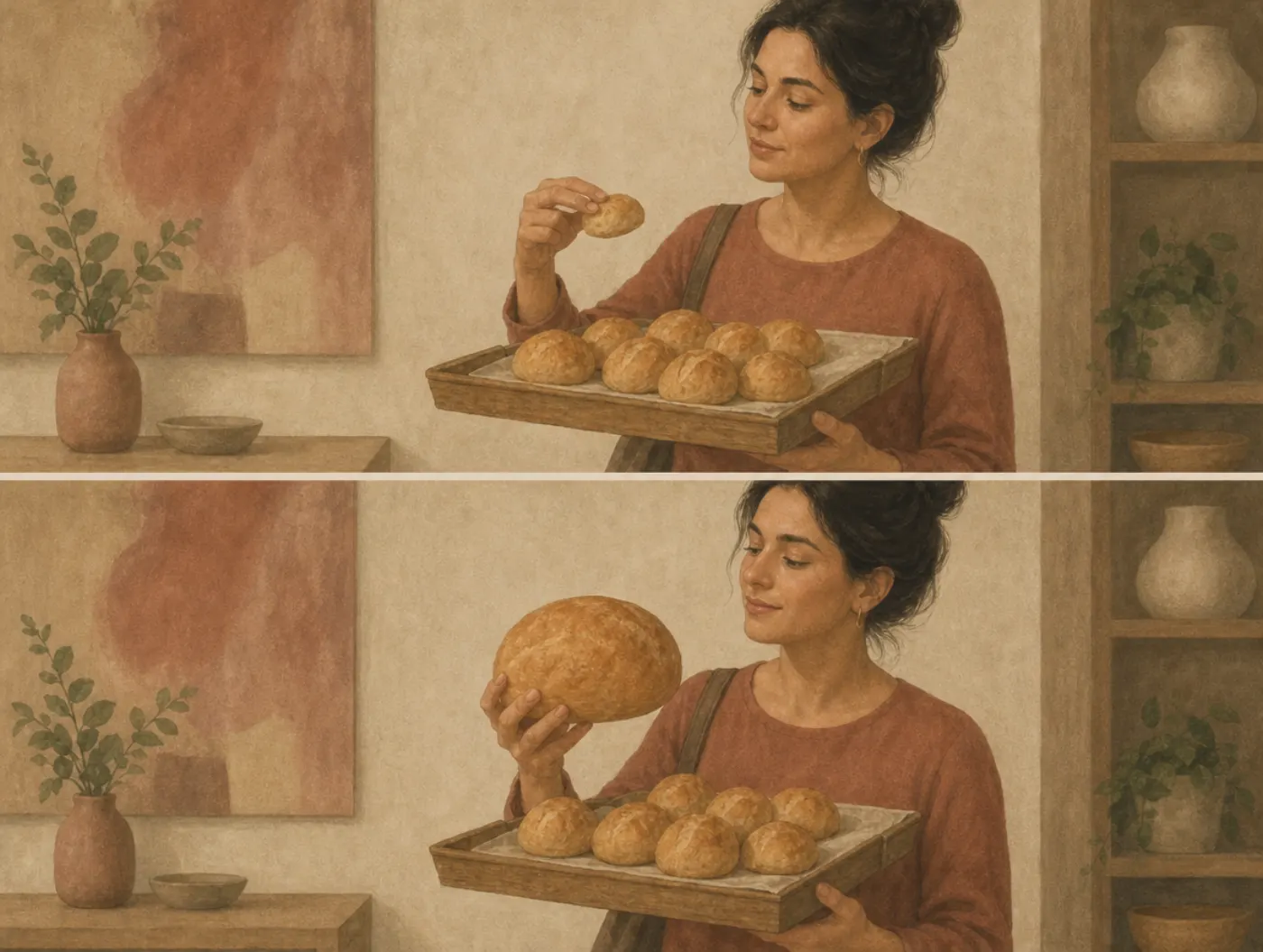
One pretzel is the unit, whatever its size
A ratio from matched days, so no bars; the panels are equal.
Same pretzels, same lobby, same total weight on offer; only the size of one piece changes
Pretzels left whole: 1.69 times the weight taken on the halved days, and more on all 18 pairs of days
Pretzels cut in half: The comparison weight: a half pretzel read as one unit, and residents took less
| Condition | Value and unit | Evidence quote |
|---|---|---|
| Whole pretzels, weight taken | 1.69 times the weight taken on halved-pretzel days | residents took 1.69 times as much pretzel by weight in the weeks when the pretzels were left whole rather than cut in half |
| Matched pairs of days on which whole pretzels drew more weight | 18 pairs of days | the whole pretzels drew more weight on all 18 pairs of days |
Everyday examples
The rows below are illustrations, not findings from the studies cited on this page.
| Situation | What the bias does | What helps |
|---|---|---|
| A bag of chips eaten in front of a screen | The bag is the unit, so a large bag is finished as readily as a small one | Pour a portion into a bowl and put the bag away before starting |
| A restaurant plate twice the size of a home plate | The plate defines one meal, and finishing it reads as eating normally | Decide on arrival to take half home, and ask for the container with the food |
| Wine poured by eye into a large glass | The glass sets the serving, and a drink is counted as one regardless of volume | Measure once to see what a standard serving looks like in your own glass |
| A coffee shop where the smallest size is 16 ounces | The smallest available unit becomes the default order | Order the size you want in ounces rather than by the names on the board |
| A family-size package on offer at the supermarket | The better unit price buys a bigger unit, which gets eaten as one unit | Split the package into single portions when you unpack it |
How to counter it
Unit bias is hard to argue with and easy to work around, because the unit is a physical thing you can change.
- Set the unit before you start eating. Serve a portion onto a plate or into a bowl and put the container out of reach; the served amount becomes the unit.
- Buy the smaller package when the food is one you tend to finish. The unit price is worse and the amount eaten is usually lower.
- Divide on the way in. Repackaging a large bag into single portions at home does the work the manufacturer did not.
- Change the vessel rather than the resolve. Smaller plates, bowls, glasses and serving spoons set smaller units without requiring a decision at the moment of eating.
- Cut things in half. The pretzel study is the clearest demonstration that a unit cut in two is still one unit to the person taking it.
- Read servings per container, not calories per serving. A package that holds two and a half servings is still one unit on the sofa.
This is a page about judgment, not about diet or health. What the research supports is that unit size changes the amount selected and eaten, not that any particular eating pattern follows from that.
What it is not
Unit bias is about the size of one serving of a thing. Its neighbors deal with other ways that quantity and form change a decision.
- It is not the denomination effect, in which the same sum of money is spent more readily as several small bills than as one large one. That one works in the opposite direction: breaking money into smaller units makes it easier to use, while breaking food into smaller units makes it easier to stop.
- It is not the restraint bias, the overestimation of your own ability to resist an impulse. Restraint bias is a belief about willpower; unit bias is about what the environment presents as one portion.
- It is not the less-is-better effect, where a smaller option is preferred when the two are judged separately rather than side by side. That is about how options are valued, not about how much of one is taken.
- It is not simple appetite. The 2006 studies varied nothing but the size of a unit, with the same food, the same place and the same price of zero.
Tests and tools that use this
Related biases
Unit Bias FAQ
What is unit bias?
It is the tendency to treat one unit of something as the appropriate amount, so that the size of the unit determines how much is consumed. Offered a bowl of whole pretzels or the same weight of pretzels cut in half, people take about the same number of pieces either way, which means they take roughly twice as much food when the pieces are twice as large.
What did the demo on this page measure?
How many pieces you said you would take from a free tray, with the unit size assigned at random. Half of visitors see 60 whole pretzels and half see 120 halves, and the tray holds the same total weight in both. Once each version has 50 or more responses the page shows the two distributions side by side, which is where the effect appears, if it appears at all.
How strong is the unit bias effect?
In the original field studies the amount taken rose by factors of 2.27, 1.69 and 1.67 when units or serving spoons were enlarged, where complete control by unit size would have predicted 4, 2 and 4. So unit size matters a great deal and is not the only thing that matters. A later meta-analytic review found that doubling a portion raises consumption by about 35 percent on average.
Did the original study measure how much people actually ate?
No, and the authors said so. They measured what disappeared from the bowl or tray each day, which is selection rather than consumption, and they recorded daily totals in a shared building rather than individual servings. They argued that nearly all of the food taken was eaten on the spot or while walking away. Controlled studies of actual intake, pooled in a Cochrane review, point the same way.
Why do smaller portions reduce how much people eat if the food is unlimited?
Because taking a second unit is a separate decision, and most people do not make it. If people simply ate until satisfied, a smaller unit would just mean two units; in the field studies it meant less food. That is the argument the paper makes for unit bias as a heuristic: one unit reads as the proper amount, which puts a brake on the second.
How do I use unit bias instead of fighting it?
Change the unit rather than your intentions. Serve a portion and put the container away, buy smaller packages of foods you tend to finish, split large packages into single portions when you unpack them, and use smaller plates, glasses and serving spoons. Each of those decides the amount once, in advance, rather than leaving it to be decided while you are eating.

References
- Geier, A. B., Rozin, P., & Doros, G. (2006). Unit bias: A new heuristic that helps explain the effect of portion size on food intake. Psychological Science, 17(6), 521-525. doi.org
- Rozin, P., Kabnick, K., Pete, E., Fischler, C., & Shields, C. (2003). The ecology of eating: Smaller portion sizes in France than in the United States help explain the French paradox. Psychological Science, 14(5), 450-454. doi.org
- Zlatevska, N., Dubelaar, C., & Holden, S. S. (2014). Sizing up the effect of portion size on consumption: A meta-analytic review. Journal of Marketing, 78(3), 140-154. doi.org
- Hollands, G. J., Shemilt, I., Marteau, T. M., Jebb, S. A., Lewis, H. B., Wei, Y., Higgins, J. P. T., & Ogilvie, D. (2015). Portion, package or tableware size for changing selection and consumption of food, alcohol and tobacco. Cochrane Database of Systematic Reviews, 9, CD011045. doi.org
Cite this source
Psychology.com. (2026, October 23). Unit Bias. Psychology.com. https://psychology.com/biases/unit-bias