
In short
The denomination effect is the tendency to spend less readily when a sum of money is held as a single large bill than when the same sum is held as several smaller bills or coins. It shows up when a 20 stays folded in a wallet while four 5s disappear, in the choice not to break a 100 dollar bill for a coffee, and in the way a cash gift in one bill lasts longer than the same gift in change.
How the denomination effect works
A 5 dollar bill and five singles buy exactly the same things, and people treat them differently anyway. Raghubir and Srivastava's explanation is that a large bill is psychologically less fungible than its equivalent in small change: it reads as one whole thing rather than as five spendable units, and breaking it feels like a decision in a way that handing over a single does not. Small bills go one at a time, almost without noticing; the large bill has to be opened, and the opening is where the hesitation lives.
That hesitation does work for people, and the 2009 paper argues that this is the point. Keeping money in a large denomination is a self-control device. Someone who wants to hold on to 100 dollars has a better chance of doing so with one bill than with five 20s, because every purchase would have to start by breaking the whole. In Study 2 of the paper, when participants read a scenario in which they were behind on a monthly savings goal, most chose to be paid a 100 dollar fee as a single bill; when the goal had already been met, most preferred five 20s, which are easier to spend.
The effect has a second half that cuts the other way. Once the decision to spend has been made, people who break a large bill tend to spend more than people spending small bills, a pattern the authors link to a what-the-hell response: the precommitment has already failed, so the rest of the money is less closely watched. In two of the three field studies the average amount spent by those who did buy was higher in the large denomination condition.
Mishra, Mishra and Nayakankuppam had reported a related finding in 2006, which they called a bias for the whole: people said they would spend less when imagining a sum as one 100 dollar bill than as five 20s. Raghubir and Srivastava moved from stated intentions to actual purchases, showed that the amount spent after the decision runs the other way, and put self-control at the center of the account.
The original study
Priya Raghubir and Joydeep Srivastava published "The denomination effect" in the Journal of Consumer Research in December 2009. The paper reports three field studies of real spending, numbered 1a, 1b and 1c, and two scenario studies of the choice between denominations, Studies 2 and 3. The demo on this page reproduces Study 1b, the gas station.
In Study 1a, 89 undergraduate business students at two US universities were thanked for taking part in an experimental session with a dollar, either as a single bill or as four quarters, and told they could keep it or buy candy with it. About 63 percent of the students who held quarters bought candy, 27 of 43; among those who held a bill, 26 percent did, 12 of 46. In Study 1b, 75 adult drivers at a gas station in Omaha answered three questions about gas usage and were paid 5 dollars in one of three forms: five 1 dollar bills, five 1 dollar coins, or one 5 dollar bill. Comparing the two paper conditions, 24 percent of those given five singles made a purchase that was not gas, against 16 percent of those given the single 5 dollar bill. The coin group spent least, 12 percent, which the authors put down to dollar coins being kept as souvenirs. With about 25 people per condition the gas station gap is a handful of shoppers, and the paper rests on the three field studies together.
Read the diagram and evidence as text
A loose bundle of bill silhouettes is contrasted with a single ringed $5 bill. A loose bill moves toward spending as an illustrative mechanism; that motion is not a measured count or amount spent. On identical 0% to 100% rails, 24% of people given singles bought something versus 16% given the whole bill.
Paid 5 dollars at the gas station: did they buy anything?
Share of drivers who bought something; 75 drivers in all
Same 5 dollars, same store, same short survey
Five 1 dollar bills: 24% bought something
One 5 dollar bill: 16% bought something
| Condition | Value and unit | Evidence quote |
|---|---|---|
| Paid in five 1 dollar bills, bought something | 24 percent | 24 percent of those paid in five 1 dollar bills bought something in the convenience store |
| Paid with a single 5 dollar bill, bought something | 16 percent | 16 percent of those paid with a single 5 dollar bill |
| Paid for the survey at the Omaha gas station | 75 drivers | 75 drivers in Omaha were paid 5 dollars for a short survey |
| Payment for the survey | 5 dollars | paid 5 dollars for a short survey |
Study 1c moved the amount up. In Xiangtan, China, 150 women between 25 and 45 were given 100 yuan, as a single note or as a mix of smaller notes, and offered household goods such as soap, shampoo, bedding and cookware at a simulated store. About 91 percent of those with small notes bought something, against 80 percent of those with the single note, and those who did buy spent more on average in the single note condition.
Studies 2 and 3 asked which denomination people would choose to receive. In Study 2, 79 students read a scenario in which they were paid 100 dollars for a focus group, either while running 100 dollars short of a monthly savings goal or after having met it. About 74 percent of those who had met the goal asked for five 20s; among those who were short, only about 22 percent did, and the rest asked for the single 100 dollar bill.
Everyday examples
The pattern shows up wherever cash changes hands in different forms. The rows below are illustrations, not findings from the studies cited on this page.
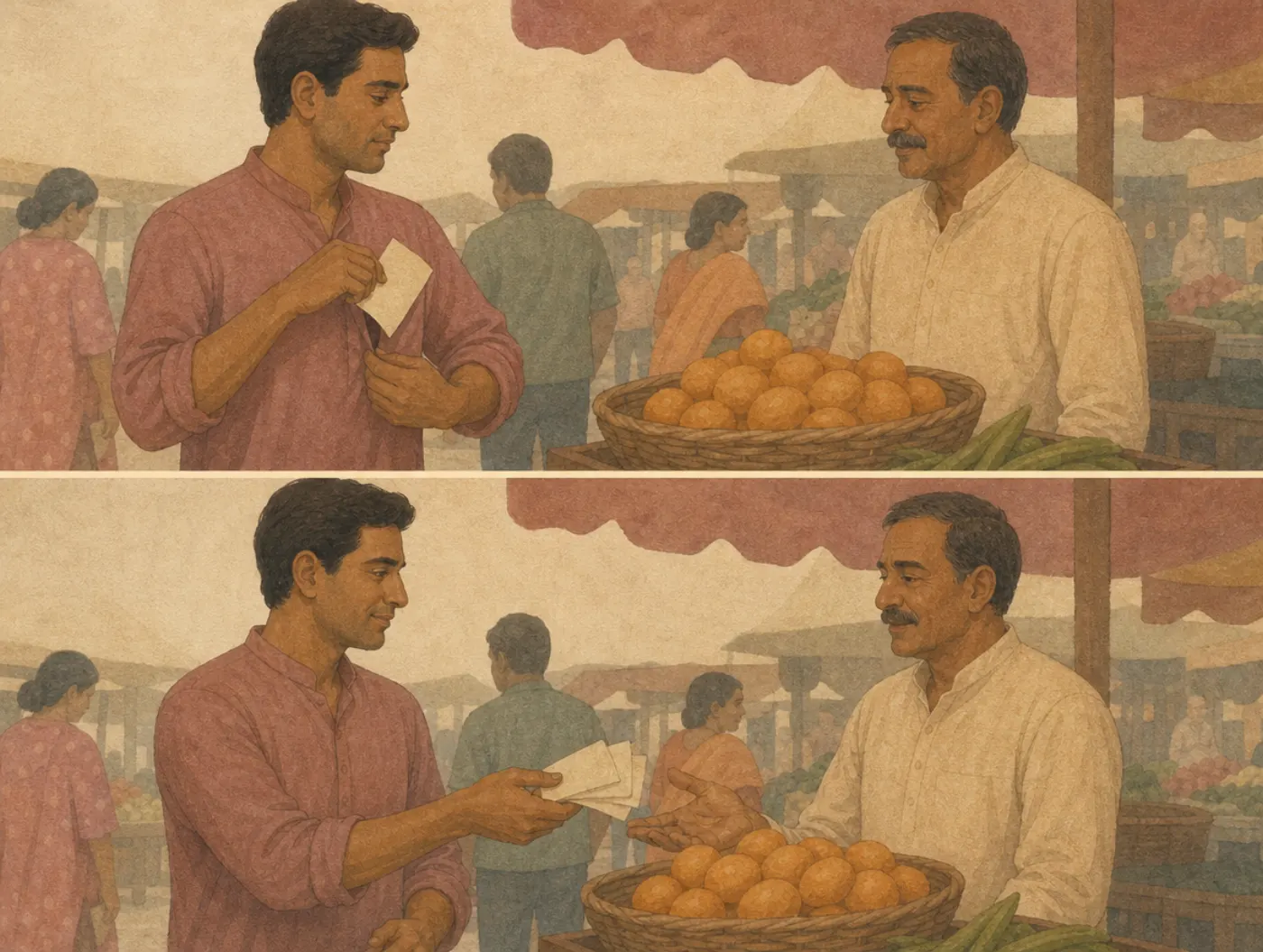
| Situation | What the bias does | What helps |
|---|---|---|
| A 50 dollar bill in a birthday card | It stays in the wallet for weeks while smaller bills from the same week are gone | Decide on the day what the gift is for, and move it there before it is broken |
| Breaking a 20 for a 2 dollar coffee | The change feels like loose money and is spent faster than the 20 would have been | Treat the change as the same 18 dollars; put it back where the 20 was |
| Cash withdrawn as a stack of 20s for a weekend | Each 20 goes without much thought, so the stack empties faster than a budget of the same size held as two 50s and a 20 | Take out the weekend budget in the largest bills the places you are going will accept |
| Tips and small purchases paid from a jar of coins | Coins are spent as if they were worth less than their face value | Count the jar once a month and move the total to an account |
| A child's allowance paid in one bill or in several | The single bill tends to be saved, the several bills spent | Match the form to the lesson: one bill to practice saving, several to practice choosing |
How to counter it
The effect can be put to work as well as corrected; the 2009 paper's participants used large bills on purpose when they wanted to hold on to money.
- When you want to save cash, hold it as the largest bill that is practical. The hesitation before breaking a 100 is the effect doing what you want.
- When you have just broken a large bill, slow down. The money that comes back as change is the same money; the paper found that people who break a large bill tend to spend more once they start.
- Convert small bills and coins into a single sum once in a while, in a count or a bank deposit, so that they are seen as the amount they add up to rather than as loose change.
- Before a purchase paid with small bills, ask whether you would make it if you had to break a 50. If the answer is no, the purchase is being carried by the form of the money.
- Notice when a seller gives change in small bills or offers to break a large one for you. The convenience is real, and so is the effect on how fast the change goes.
Cards and phone payments remove denominations altogether, and with them this particular brake.
What it is not
The denomination effect is specifically about the physical form of the same amount of money. Its neighbors are about how money is categorized, measured or described.
- It is not mental accounting, the habit of sorting money into separate budgets and treating a dollar differently by which budget it sits in. The denomination effect needs no budgets; the same dollars in the same account are spent differently depending on the bills they come in.
- It is not the money illusion, which is thinking in face values rather than purchasing power, so that a raise that matches inflation feels like a gain. Denomination is about the number of pieces, not the number printed on them.
- It is not unit bias, the tendency to treat one portion or one package as the right amount regardless of its size. The two share the idea that a whole unit resists being divided, but unit bias is about consumption and the denomination effect about spending.
Tests and tools that use this
Related biases
Denomination Effect FAQ
What is the denomination effect?
It is the finding that people are less likely to spend a sum of money when they hold it as a single large bill than when they hold the same sum as smaller bills or coins. Raghubir and Srivastava named it in 2009 after three field studies in which students, drivers and shoppers who were given money in small denominations bought something more often than those given the same amount as one bill.
Why is a large bill harder to spend?
The 2009 paper's account is that a large bill is psychologically less fungible: it reads as one whole thing, and breaking it is a decision, while small bills can go one at a time. People use this on purpose. In the paper's scenario study, most participants who were short of a savings goal chose to be paid 100 dollars as a single bill rather than as five 20s, and most who had met the goal chose the 20s.
How did the demo on this page work?
The page assigned you one of two wordings of the same situation using a value kept only in your browser's session storage, so that a reload shows the same version. One version paid you a single 5 dollar bill, the other five singles; the store and prices were identical. Your answer was counted with the others, and once each version has 50 answers the result screen shows how the two groups split.
Is the denomination effect large?
It depends on the setting. In the student study, 63 percent of those holding quarters bought candy against 26 percent of those holding a dollar bill. At the gas station the gap was 24 percent against 16 percent with about 25 people per group; the paper calls that difference marginal, and notes that pooling the coin and single-bill groups leaves no significant difference from the 5 dollar bill group. In China, with 100 yuan, it was 91 percent against 80 percent. The paper rests on the three studies together.
Does the effect mean people with large bills spend less overall?
Not always. The paper found two opposing forces. Large bills made people less likely to spend at all, but among those who did spend, the people breaking a large bill tended to spend more, which the authors connect to a what-the-hell response once the precommitment has failed. The net effect on total spending depended on which of the two forces was stronger in a given study.
Does the denomination effect apply to cards and digital payments?
The studies were about cash, and a card has no denominations to break, so the brake the effect provides disappears. Earlier work by the same authors found that people are more willing to spend with cards and gift certificates than with cash. If you have relied on keeping a large bill to slow spending, moving to a card removes that device rather than replacing it.

References
- Raghubir, P., & Srivastava, J. (2009). The denomination effect. Journal of Consumer Research, 36(4), 701-713. doi.org
- Raghubir, P., & Srivastava, J. (2008). Monopoly money: The effect of payment coupling and form on spending behavior. Journal of Experimental Psychology: Applied, 14(3), 213-225. doi.org
- Mishra, H., Mishra, A., & Nayakankuppam, D. (2006). Money: A bias for the whole. Journal of Consumer Research, 32(4), 541-549. doi.org
- Thaler, R. H. (1985). Mental accounting and consumer choice. Marketing Science, 4(3), 199-214. doi.org
- Tversky, A., & Kahneman, D. (1981). The framing of decisions and the psychology of choice. Science, 211(4481), 453-458. doi.org
Cite this source
Psychology.com. (2026, October 24). Denomination Effect. Psychology.com. https://psychology.com/biases/denomination-effect