
In short
Trait ascription bias is the tendency to describe other people in terms of stable personality traits while describing yourself as variable, responsive to circumstances and hard to pin down. It shows up when a colleague is simply impatient while you were having a difficult week, when a friend's politics are a fixed fact and yours are a nuanced position, and in every personality quiz that feels too crude for you and about right for everyone else.
How trait ascription bias works
You have a great deal of information about yourself and much less about anyone else. You have seen yourself in every situation you have ever been in, cheerful and irritable, bold and timid, and you know what each was a response to. You have seen your friend in the situations you share, a narrow slice, without access to their reasons. From the inside, a life looks like a series of situations met with different responses. From the outside, the same life looks like a pattern, and a pattern invites a trait.
Edward Jones and Richard Nisbett proposed this in 1971, in a monograph titled The Actor and the Observer: Divergent Perceptions of the Causes of Behavior, as part of the actor-observer hypothesis. That monograph is not online; this page follows the account of it given in Nisbett, Caputo, Legant and Marecek's 1973 paper, which tested the trait version. College students described themselves, their best friend, their father and a television newscaster on trait pairs, with the option of saying that it depends on the situation. They ascribed more traits to other people than to themselves. The paper also found that observers expected an actor to behave the same way in the future while the actors did not, and that students explained a friend's choice of major in terms of the friend's qualities and their own in terms of the major.
Daniele Kammer separated two things that the trait-pair method confounds. Saying that a trait describes you strongly and saying that your behavior on that trait is consistent are different claims, and Kammer's 1982 study measured them apart. Kammer's 56 participants judged their friends' behavior as more consistent than their own, as the hypothesis predicts, but ascribed stronger traits to themselves than to their friends. Sande, Goethals and Radloff made the same point in 1988 under the name of the multifaceted self: when offered both poles of a trait pair, such as both serious and carefree, participants chose both for themselves more often than for other people.
Two cautions belong here. Bertram Malle's 2006 meta-analysis of the actor-observer asymmetry in causal explanations found the classic effect small on average and dependent on the kind of event; the trait-ascription finding concerns descriptions rather than explanations and was not what that review tested, but readers should expect smaller and more conditional effects than the textbook version suggests. And a gap between the two sliders above is one person's two ratings. It cannot show that you see others as fixed, only that you gave one of two people more variability.
The original study
Daniele Kammer's "Differences in trait ascriptions to self and friend: Unconfounding intensity from variability" appeared in Psychological Reports in 1982. The problem it addressed was a weakness in the standard method. In the 1973 studies, participants chose between a trait, its opposite and the option that it depends on the situation, so a participant who felt strongly that they were both outgoing and reserved, in different circumstances, had no way to say so except by choosing the situational option, which was then scored as ascribing no trait. Intensity and variability were tangled together in one answer.
Kammer's method asked for both separately: how intensely a trait applies, and how variable the person's trait-related behavior is. Fifty-six participants described themselves and a friend. Two independent groups provided the actor and observer data, so that one group's self-descriptions could be compared with another group's descriptions of friends without the two being made in the same sitting. The friends' behavior was judged more consistent than the participants' own, in line with the actor-observer hypothesis, and participants ascribed higher trait intensities to themselves than to their friends.
Read the diagram and evidence as text
Self and friend encounter the same sun, rain and indoor cues. Self poses change across cues while friend poses repeat inside stable trait outlines. Separate ordinal chevrons show stronger traits ascribed to self and weaker traits to friend, so the drawing distinguishes perceived consistency from trait intensity. Scenes are illustrative, not observations or exact within-person equalities.
Self and friend, two questions apart
Ordering only, from 56 participants; the page gives no scale values.
Same traits, same two questions: how strongly it applies, and how much behavior varies
Describing yourself: Behavior rated more variable; traits rated stronger
Describing a friend: Behavior rated more consistent; traits rated weaker
| Condition | Value and unit | Evidence quote |
|---|---|---|
| Kammer's 1982 sample | 56 participants | 56 participants |
| Own behavior, compared with a friend's | more variable ordinal consistency of behavior | judged their friends' behavior as more consistent than their own |
| A friend's behavior, compared with one's own | more consistent ordinal consistency of behavior | judged their friends' behavior as more consistent than their own |
| Traits ascribed to self, compared with a friend | stronger ordinal trait intensity | ascribed stronger traits to themselves than to their friends |
| Traits ascribed to a friend, compared with self | weaker ordinal trait intensity | ascribed stronger traits to themselves than to their friends |
A second set of descriptions, made by the same people of both self and friend, supported the pattern only partly, which Kammer read as a sign that describing yourself and a friend side by side brings social comparison into the judgment as well. The distinction Kammer drew has been the standard way of stating the effect since: the self is not seen as having fewer traits, but as having traits that apply strongly and behavior that varies with the situation, while others are seen as consistent.
Sande, Goethals and Radloff's 1988 paper extended the result across four experiments. Participants who could choose one pole of a trait pair, the other, or both chose both more often for themselves than for others, a self-perception the authors called multifaceted: someone who can be serious or carefree as the situation requires, where other people are one or the other. A person who has seen themselves in more situations has more evidence of variety.
Everyday examples
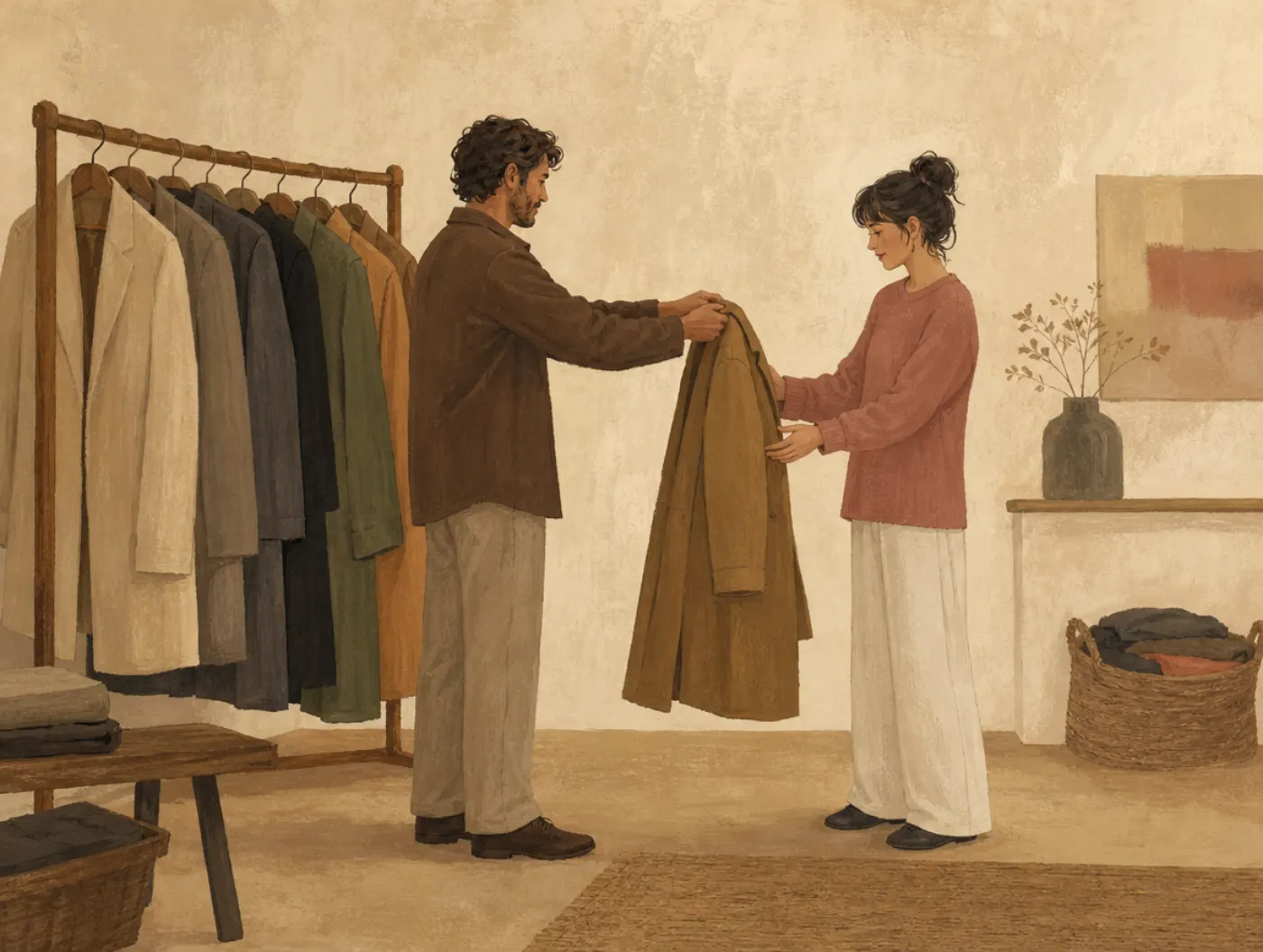
The rows below are illustrations of where one person's variability becomes another person's trait, not findings from the studies cited on this page.
| Situation | What the bias does | What helps |
|---|---|---|
| A colleague snaps in a meeting | They are short-tempered; when you snapped last month, you were under deadline pressure | Ask what their week has been like before deciding what they are like |
| A friend's political views | Theirs are a fixed position; yours are a considered response to each issue | Notice that they would describe the two of you the other way around |
| A personality quiz | The result feels too crude for you and about right for the people you know | Ask how the people you know would rate the quiz's fit to you |
| A performance review | A manager writes traits, reliable or disorganized, where the employee sees a year of circumstances | Describe behavior in specific situations rather than in adjectives |
| Predicting what a relative will do at a family gathering | Others are expected to behave as they always have; you expect to respond to how it goes | Expect their behavior to depend on the room as much as yours does |
How to counter it
The asymmetry comes from a difference in information and vantage point, so the counters add information and shift the vantage point.
- Ask for the situation before assigning the trait. The question you would answer for yourself, what was going on, is available for other people too.
- Collect more situations. A trait judgment from the one context in which you see someone is a judgment of that context; people who know them elsewhere will have different adjectives.
- Describe behavior, not character, when it matters. A sentence about what someone did in a specific situation is checkable, and it leaves room for them to have done otherwise elsewhere.
- Run the reversal. Describe yourself the way an observer with your friend's information would, and your friend the way they would describe themselves.
- Expect others to change with the room. Nisbett and colleagues found that observers predicted actors would behave the same way again while actors did not.
- Keep the finding in proportion. Malle's meta-analysis is a reminder that the asymmetry is smaller and more conditional than its reputation; the goal is accuracy, not a rule that traits are always wrong.
What it is not
Trait ascription bias is one of a cluster of self-other asymmetries, and it is defined by the specific contrast between variability for the self and consistency for others.
- It is not the fundamental attribution error, which is the tendency to explain anyone's behavior by their character rather than their circumstances. Trait ascription bias is the self-other asymmetry in that tendency: traits for them, situations for me.
- It is not quite the actor-observer bias either, though it comes from the same 1971 hypothesis. That bias concerns explanations of particular acts; trait ascription bias concerns descriptions of people, and Kammer's point was that the two can come apart.
- It is not the illusion of asymmetric insight, the belief that you understand other people better than they understand you. That is about knowledge of minds; this is about how much variety each mind is granted.
- It is not the out-group homogeneity bias, in which members of other groups are seen as more alike than members of one's own. That operates between groups; trait ascription bias operates between one person and everyone else, friends included.
Tests and tools that use this
Related biases
Trait Ascription Bias FAQ
What is trait ascription bias?
It is the tendency to see other people as having fixed, predictable personality traits while seeing yourself as variable and responsive to the situation. Nisbett and colleagues showed in 1973 that students ascribed more traits to others than to themselves and chose the option that it depends on the situation more often for themselves. Kammer refined the finding in 1982: people judge their own behavior as less consistent than a friend's but ascribe stronger traits to themselves, not weaker.
Why do people see themselves as more variable than others?
Mostly because of information and vantage point. You have observed yourself in every situation of your life and know what each response was a reaction to; you observe other people in a narrow range of situations and without their reasons, so their behavior looks like a pattern. Jones and Nisbett proposed this in their 1971 monograph The Actor and the Observer, summarized in the 1973 paper cited below. Sande, Goethals and Radloff added in 1988 that people see themselves as multifaceted, both serious and carefree, where others get one pole.
How does the demo on this page work?
You rated how much your own mood varies from day to day and then how much a friend's does, on the same 0 to 100 scale. The page compared the two and recorded whether you gave yourself more variability, your friend more, or the two about the same within five points. One pair of ratings cannot show whether you see others as fixed in general, and a friend's mood may genuinely be steadier than yours. The page reports the gap and nothing more; only the outcome label leaves your browser.
Is trait ascription bias the same as the fundamental attribution error?
They are related but distinct. The fundamental attribution error is the general tendency to explain behavior by character rather than circumstance, applied to anyone. Trait ascription bias is the self-other asymmetry: traits are ascribed to other people more readily than to oneself. The actor-observer bias is the closest relative, concerning explanations of particular actions; trait ascription bias concerns descriptions of people, and the two can come apart, as Kammer showed in 1982.
Is the effect well established?
The self-other difference in trait ascription has been found repeatedly since 1973, and Kammer's 1982 and Sande and colleagues' 1988 studies clarified what it consists of. The broader actor-observer asymmetry in explanations, from which it grew, fared worse in Malle's 2006 meta-analysis, which found it small on average and dependent on whether the event was positive or negative. Readers should expect a real but modest asymmetry rather than the sharp contrast the textbook version suggests.
How can I judge other people more fairly?
Ask about the situation before settling on a trait, since the question you would answer for yourself is available for others too. Gather observations from more than one context, describe specific behavior rather than character when writing reviews or references, and try the reversal: describe yourself as an observer would and your friend as they would describe themselves. Expect other people to respond to circumstances as much as you do, which is what the actors in the 1973 studies correctly expected of themselves.

References
- Kammer, D. (1982). Differences in trait ascriptions to self and friend: Unconfounding intensity from variability. Psychological Reports, 51(1), 99-102. doi.org
- Sande, G. N., Goethals, G. R., & Radloff, C. E. (1988). Perceiving one's own traits and others': The multifaceted self. Journal of Personality and Social Psychology, 54(1), 13-20. doi.org
- Nisbett, R. E., Caputo, C., Legant, P., & Marecek, J. (1973). Behavior as seen by the actor and as seen by the observer. Journal of Personality and Social Psychology, 27(2), 154-164. doi.org
- Malle, B. F. (2006). The actor-observer asymmetry in attribution: A (surprising) meta-analysis. Psychological Bulletin, 132(6), 895-919. doi.org
- Pronin, E. (2008). How we see ourselves and how we see others. Science, 320(5880), 1177-1180. doi.org
Cite this source
Psychology.com. (2026, October 24). Trait Ascription Bias. Psychology.com. https://psychology.com/biases/trait-ascription-bias