
In short
The modality effect in memory is the finding that the last few items of a short list are recalled better when the list is heard, or read aloud, than when it is read silently, while the earlier items are recalled about equally well either way. The same name is used in instructional design for a different finding, that pictures explained by spoken words are learned better than pictures explained by printed words; this page is about the memory effect and names the other sense so the two are not confused.
How the modality effect works
The classic account gives sound a store of its own. When you hear a list, the last item or two linger as a brief trace of the sound itself, before the digits have been identified as digits. Crowder and Morton named this precategorical acoustic storage in 1969 and argued that it is what lifts the end of a heard list: at recall, the final items can be read off the trace, while the same items from a printed list have to be held in the ordinary, more fragile way. The visual trace, by contrast, is too short to help by the time recall begins.
Three findings fit this account. The advantage is confined to the last positions. Reading a printed list aloud produces the auditory pattern, because the reader hears their own voice; that was Conrad and Hull's auditory condition in 1968, Robert Crowder studied it in detail in 1970, and Penney's 1989 review covers the vocalized and mouthed lists studied since. And an irrelevant spoken item after the list, the stimulus suffix, removes most of the auditory advantage while leaving a printed list untouched, which is what a store that holds sound and is overwritten by sound predicts. Each is a laboratory finding about short lists recalled in order, measured in a few positions at the end of the list.
The account has been revised rather than overturned. Penney's 1989 review set out a model in which heard and seen words are processed in separate streams with different properties: auditory items are encoded both as sound and as speech, and successive heard items are strongly linked to one another, while visual items are linked more by appearing together. Later work found that mouthing a list silently, or seeing it as lip movements, produces some of the auditory advantage, which a store for sound alone cannot explain. The shape of the effect is not in dispute; its mechanism is.
The other sense of the term needs stating here. In the cognitive load tradition, Mousavi, Low and Sweller showed in 1995 that geometry worked examples were learned better when the diagram was shown and the explanation was spoken than when both were printed, and called this a modality effect too. That finding is about dividing complex material between the eye and the ear so that neither channel is overloaded, not about the end of a word list, and the two should not be used as evidence for each other.
The original study
Conrad and Hull published "Input modality and the serial position curve in short-term memory" in Psychonomic Science in 1968, a two-page report written to confirm, in a straightforward test, a difference that Corballis and Murray had each come across in 1966 without predicting it. Twenty naval ratings were tested one at a time on seven-digit sequences shown one digit at a time on a display, two digits per second, and wrote each sequence down in order. In the visual condition they read the digits silently; in the auditory condition they read the display aloud, so that the only difference was whether they heard the digits in their own voice. Each person did both conditions, in counterbalanced order.
The curves differed at the end. Plotting errors at each of the seven positions, Conrad and Hull found no difference over the first four; the gap opened over positions five to seven and was statistically significant only at the final position, where the silently read list was recalled far worse. Their summary was that the usual recency, the lift in recall at the end of a list, was almost absent when the list was read silently. They also noted that the curve for reading aloud matched those reported when an experimenter speaks the items: it is sound at the end of the list that preserves the last items, not the reader's own voice in particular.
Read the diagram and evidence as text
Matched silent and aloud list fragments repeat identical early shapes and a triangular final shape. Sound arcs distinguish reading aloud. At retrieval, only the final item has a solid emphasis ring for aloud versus a dashed ring for silent. Shapes stand for positions, not actual digits or counts; an unringed item is not absent.
Same seven digits, read two ways
Positions 1 to 4: the same errors either way. Ordering only
Same seven-digit lists on the same display, written down in order
Read silently: More errors at the final position; recency almost absent
Read aloud, hearing your own voice: Fewer errors at the final position; the usual lift at the end of the list
| Condition | Value and unit | Evidence quote |
|---|---|---|
| Positions 1 to 4, silent or aloud | Same errors in both conditions ordinal error rate | errors were the same over the first four positions |
| Last positions, read silently | More errors at the final position ordinal error rate | the advantage for reading aloud grew over the last three, and it was statistically significant only at the final position |
| Last positions, read aloud | Fewer errors at the final position ordinal error rate | the advantage for reading aloud grew over the last three, and it was statistically significant only at the final position |
Crowder and Morton's 1969 paper in Perception and Psychophysics, "Precategorical acoustic storage (PAS)," turned the finding into a theory. They proposed a brief store for the raw sound of recent speech, drew together the modality effect in recency with the stimulus suffix effect, in which an extra spoken item after a heard list erases the recency advantage, and argued that the two were the same mechanism seen from two sides. The suffix effect has its own page on this site. Murdock and Walker reported in the same year that the auditory advantage also appeared in free recall, where items may be reported in any order.
The page's demo follows the shape of the experiment, one list read silently and one aloud, but two lists of seven digits do not measure a serial position curve, so the memory checks are not scored; they let the two endings be compared from the inside before you predict the two results.
Everyday examples
The rows below are illustrations of where a heard ending outlasts a read one, not findings from the studies cited on this page.
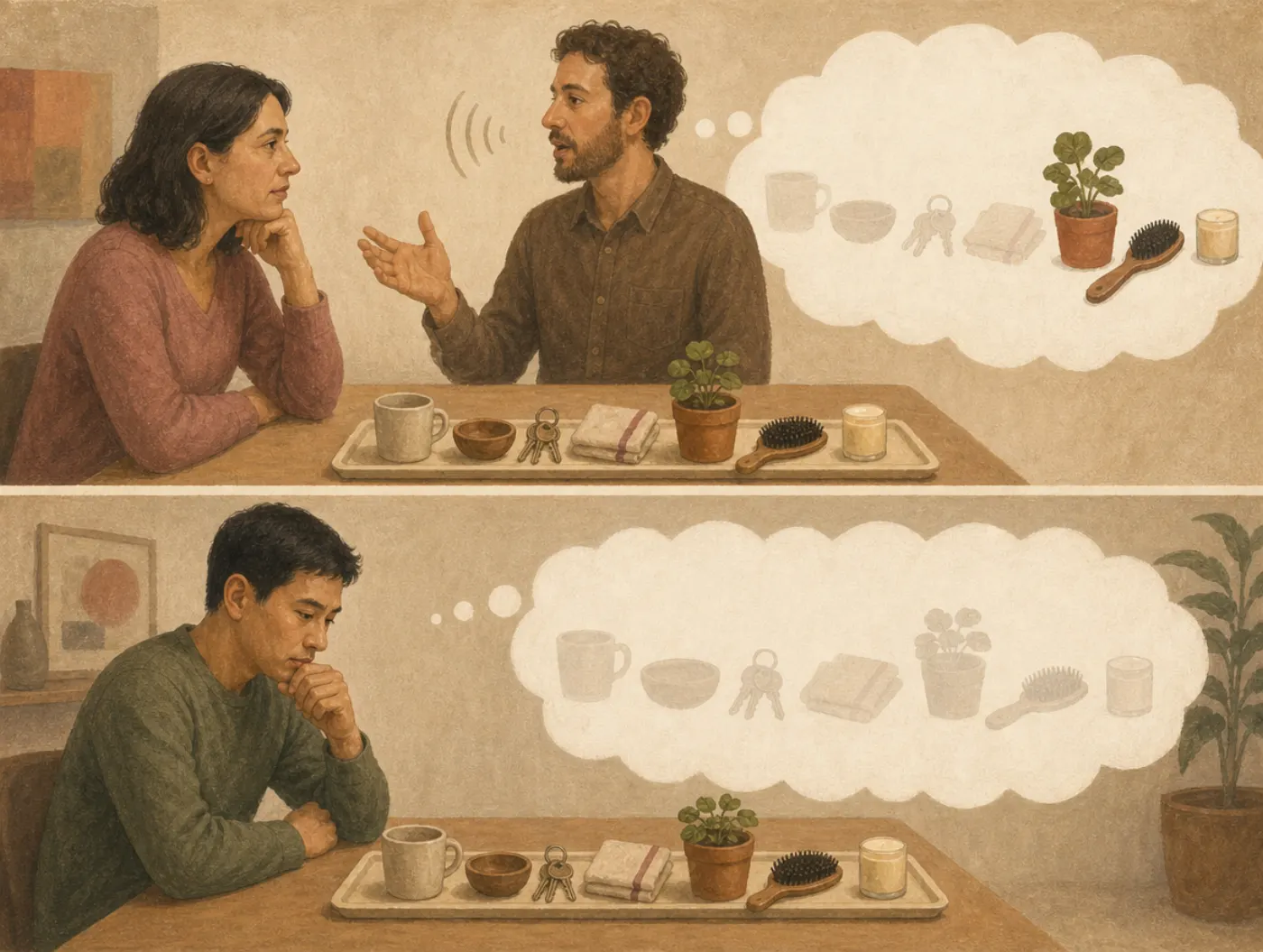
| Situation | What the bias does | What helps |
|---|---|---|
| A phone number given out loud | The last digits can be held long enough to dial, where the same number glimpsed on a screen is gone | Say numbers aloud as you read them; a list read aloud behaves like a heard list at the end |
| Verbal instructions followed by a question | The question, arriving as more speech, overwrites the end of the instructions, like the suffix in the laboratory | Pause after the last step before anything else is said, or ask for the steps in writing |
| Taking a list down over the phone while someone talks nearby | The nearby speech competes for the same brief store the last items depend on | Repeat each item back as it arrives, which both confirms it and refreshes it |
| A lecture with a slide of text and a spoken summary | Students who read the slide silently keep less of its ending than students who hear the same words | Read the key line aloud, or have the speaker read it, before moving on |
| Assuming you are an auditory learner because spoken lists feel easier at the end | A general effect of modality on recency is mistaken for a personal learning style | The effect is found in most people and says nothing about a type; test what you retain, not what feels easy |
How to counter it
The effect is small and mostly harmless, so the counter is to know when the ending of a list is at risk and to shore it up.
- Say the last items aloud. Vocalizing a printed list gives it the auditory ending, as Conrad and Hull's 1968 experiment and Crowder's 1970 experiments showed, and it costs nothing.
- Protect the ending from other speech. An unrelated spoken item right after a heard list is the suffix that erased the advantage in the laboratory; a second of silence before the next thing is said is enough.
- Write it down. The modality effect is a property of short-term retention measured in seconds; a note has no recency problem at all.
- Do not read a general modality effect as a learning style. The advantage appears in most people and concerns the last few positions of a short list, not how anyone learns a subject.
- When you present material for others to learn, use the instructional sense of the term carefully: a diagram with spoken explanation can beat a diagram with printed text, but that is a different finding with its own conditions.
What it is not
The modality effect is one shape of the recall curve. Its neighbors are the curve itself, the thing that destroys the shape, and a different finding that shares its name.
- It is not the serial-position effect or the recency effect as such. Those describe the U-shaped curve and its raised end for lists of any kind. The modality effect is the difference between the raised ends of heard and read lists, present in one and smaller in the other.
- It is not the suffix effect, though the two are two sides of one account. The suffix effect is the loss of the auditory recency advantage when an irrelevant spoken item follows the list; it is the evidence that the advantage depends on a brief store for sound.
- It is not the modality effect of multimedia learning, in which pictures plus speech beat pictures plus text. That finding, from Mousavi, Low and Sweller in 1995 and the work that followed, is about sharing complex material between two channels, not about the end of a list.
Tests and tools that use this
Related biases
Modality Effect FAQ
What is the modality effect?
In memory research it is the finding that the last items of a short list are recalled better when the list is heard, or read aloud, than when it is read silently, while earlier items are recalled about equally well either way. Conrad and Hull reported it in 1968 with seven-digit lists read silently or aloud, and Crowder and Morton explained it in 1969 with a brief store for the sound of recent speech that lifts the end of a heard list.
Why does hearing a list help the last items but not the first?
The standard account is that the sound of the last item or two lingers briefly as a raw acoustic trace, so those items can be read off at recall, while earlier items have already been converted into ordinary memory and get no such help. A printed list leaves a visual trace too short to be useful. An irrelevant spoken word after a heard list overwrites the trace and removes the advantage, which is the suffix effect.
Is the modality effect the same as being an auditory learner?
No. The modality effect is a general property of short-term memory found in most people, and it concerns a few positions at the end of a short list recalled within seconds. Learning styles are claims about how individuals learn whole subjects over time, and the evidence that matching teaching to a preferred style improves learning is weak. Finding spoken lists easier at the end is the normal pattern, not a type.
How does the demo on this page work?
You read one list of seven digits silently and one aloud, each followed by a question about its last two digits, then made two predictions about the published findings: where the auditory advantage sits in the list, and what an extra spoken item does to it. Only the predictions are scored. The page has no audio; reading aloud was Conrad and Hull's own auditory condition in 1968, and Crowder's 1970 experiments confirmed that vocalizing a printed list produces the auditory pattern.
What is the modality effect in multimedia learning?
It is a different finding with the same name. Mousavi, Low and Sweller showed in 1995 that geometry examples were learned better when the diagram was shown and the explanation spoken than when both were printed, and explained it through cognitive load: splitting material between the eye and the ear keeps either channel from being overloaded. It applies to learning complex material and has its own conditions; it is not evidence about the end of a list.
Does the modality effect matter outside the laboratory?
In small ways. A phone number heard can be held long enough to dial where one glimpsed is lost; a question asked right after spoken instructions can overwrite their last step; saying a list aloud as you read it helps its ending. The effect is measured in a few items and a few seconds, so the practical advice is modest: speak the last items, leave a beat of silence after them, and write down anything that matters.

References
- Conrad, R., & Hull, A. J. (1968). Input modality and the serial position curve in short-term memory. Psychonomic Science, 10(4), 135-136. doi.org
- Crowder, R. G., & Morton, J. (1969). Precategorical acoustic storage (PAS). Perception & Psychophysics, 5(6), 365-373. doi.org
- Crowder, R. G. (1970). The role of one's own voice in immediate memory. Cognitive Psychology, 1(2), 157-178. doi.org
- Murdock, B. B., & Walker, K. D. (1969). Modality effects in free recall. Journal of Verbal Learning and Verbal Behavior, 8(5), 665-676. doi.org
- Penney, C. G. (1989). Modality effects and the structure of short-term verbal memory. Memory & Cognition, 17(4), 398-422. doi.org
- Mousavi, S. Y., Low, R., & Sweller, J. (1995). Reducing cognitive load by mixing auditory and visual presentation modes. Journal of Educational Psychology, 87(2), 319-334. doi.org
Cite this source
Psychology.com. (2026, October 24). Modality Effect. Psychology.com. https://psychology.com/biases/modality-effect