
In short
The empathy gap is the difficulty of predicting how a visceral state you are not currently in will change what you do: hunger, pain, fear, embarrassment, fatigue, anger or craving. It shows up when calm planning meets the moment itself, in diets settled right after lunch, promises made a long way from the stage, and in how briskly other people's lapses get judged by people who are not in their position.
How the empathy gap works
A visceral state does not sit beside your preferences; it rewrites them while it lasts. Hunger makes food the most interesting thing in the room, fear makes an audience feel like a threat, and craving makes a rule you set an hour ago sound negotiable. When the state passes, the preferences it produced go with it, and what is left is a memory of the facts without the force. George Loewenstein's term for the resulting mistake is a hot-cold empathy gap: a cold self predicting a hot self, or a hot self predicting a cold one. The phrase "empathy gap" is also used loosely to mean a shortage of concern between groups; this page is about the prediction failure across states, which is the version the research measures.
The gap runs in both directions and produces opposite errors. From cold to hot, people underestimate the pull of the state: they commit to a 6 a.m. run, agree to speak, plan a frugal week, and are surprised by themselves when the moment arrives. From hot to cold, people overestimate how long the state will last, which is why shopping while hungry loads the basket for a hunger that will be over by the time the food is cooked.
The same gap operates between people. Someone who is not in pain, not afraid and not craving anything tends to read another person's lapse as a character trait rather than as what a state does, which is one reason Loewenstein's 2005 review argues that clinicians can undertreat pain and that healthy people underweight risks they have never felt. Van Boven and Loewenstein showed in 2003 that the reverse also happens: people project the state they are in. When participants described how hikers lost without food or water felt, 30 percent of those who had just exercised mentioned only thirst, against 9 percent of those who had not yet exercised.
One limit matters for reading the demo above. Estimating what other people did in a published experiment is a cold judgment about a hot situation, which is the interpersonal half of the gap; it is not a measurement of your own behavior in a hot state.
The original study
The experiment the demo uses is the second of two reported by Leaf Van Boven, George Loewenstein and David Dunning in Organizational Behavior and Human Decision Processes in 2005, under the title "The illusion of courage in social predictions." Students in a large class were offered 5 dollars to dance alone to a song in front of everyone. Some faced the offer for real; others answered the same question hypothetically. Of the students who faced the real choice, 8.33 percent agreed to dance. Of the students answering hypothetically, 31 percent predicted that they themselves would dance and 35.66 percent predicted that other students would. Asked for the smallest payment they would accept, the students facing the real performance named 52.88 dollars, a geometric mean computed from logged amounts, while those answering hypothetically named 21.07 dollars for themselves on the same measure.
Read the diagram and evidence as text
A calm person imagines an open-armed dancer in a dashed thought enclosure; the matched real-offer scene shows a tense person before the same schematic audience. Shared percentage rails show 31% predicting yes and 8.33% agreeing to the real offer of $5. The audience and emotional poses are illustrative, not measured counts or emotion scores.
Dance alone in front of the class for 5 dollars?
Share of students who agreed, or predicted they would
Same offer: 5 dollars to dance alone to a song in front of a large class
Facing the real offer, with the class watching: 8.33% agreed to dance
Considering the offer hypothetically, from a cold state: 31% predicted they would dance
| Condition | Value and unit | Evidence quote |
|---|---|---|
| Payment offered for dancing | 5 dollars | agreed to do it for 5 dollars |
| Students facing the real offer who agreed to dance | 8.33 percent | 8.33 percent of the students who faced a real chance to dance alone to a song in front of a large class agreed to do it for 5 dollars |
| Students answering hypothetically who predicted they would dance | 31 percent | 31 percent of the students considering the same offer hypothetically predicted that they themselves would dance |
The paper's first experiment used the same design with a different task, miming a scene in front of the class for 5 dollars. There, 15.12 percent of the students facing a real performance agreed, while those facing a hypothetical performance predicted 31.03 percent for themselves and 43.33 percent for others. In both experiments the people in the cold condition were not merely wrong about strangers; they were wrong about themselves in the same direction, and their self-predictions statistically accounted for their predictions about others.
The hunger case comes from a separate experiment. Read and van Leeuwen, publishing in the same journal in 1998, asked office workers to choose a snack to be delivered a week later, approaching some of them late in the afternoon when they were hungry and others just after lunch when they were not. The hungry choosers picked more unhealthy snacks for their future selves, and when the week was up and the choice could be remade on the spot, far more unhealthy snacks were taken than had been ordered in advance. This page reports the direction of both effects; the overall choice shares are on the projection bias page.
The thirst experiment is Van Boven and Loewenstein's, in Personality and Social Psychology Bulletin in 2003. Forty-seven people at a campus gym answered a questionnaire about three hikers lost without food or water, either immediately before or immediately after at least 20 minutes of vigorous exercise. Those who had just exercised rated themselves thirstier and were more likely to say thirst, rather than hunger, would be the worse problem for the hikers.
Everyday examples
The gap appears wherever a decision is made in one state and carried out in another. The rows below are illustrations, not findings from the studies cited here.
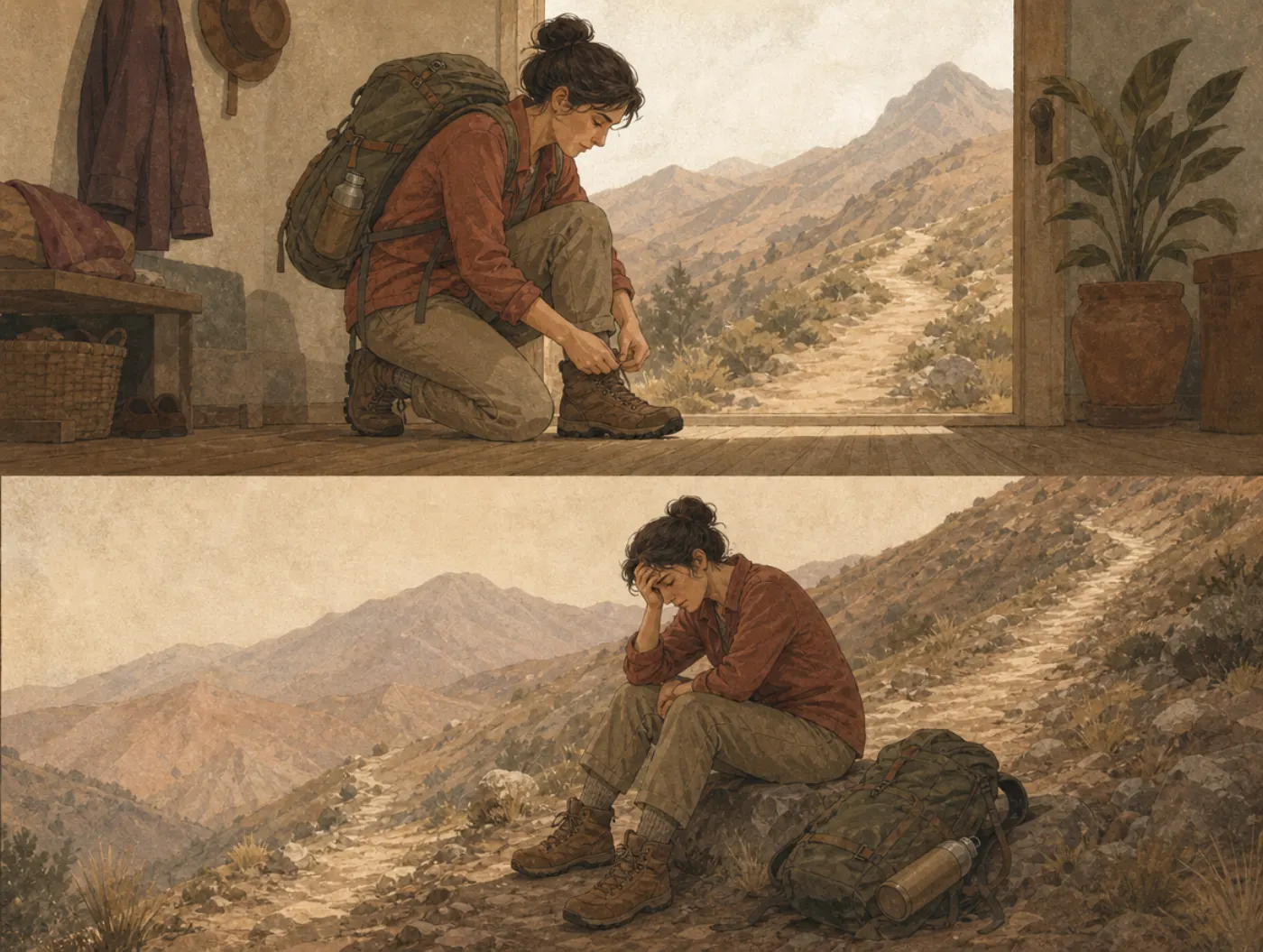
| Situation | What the bias does | What helps |
|---|---|---|
| Shopping for groceries before dinner | A hungry basket is filled for a hunger that will be over by the time the food is cooked | Shop from a written list, after eating something |
| Planning next week's meals right after lunch | Portions and rules are set by a satisfied self who cannot feel 4 p.m. | Decide the plan, then ask what you will do at the moment it gets hard, and write that down too |
| Agreeing months ahead to give a talk | The fear that does the work on the day is not in the room when the invitation arrives | Accept, then rehearse in conditions as close to the real thing as you can arrange |
| Setting an alarm for a 6 a.m. workout | Tonight's intention is made without tomorrow's tiredness in it | Make the first step small and remove the decisions: clothes out, bag packed, destination fixed |
| Judging someone who broke a promise to themselves | A calm observer reads a state as a character flaw | Ask what state the person was in and whether you have ever been in it |
How to counter it
Nothing here makes a cold self able to feel a hot state. The useful moves either move the decision or bind it.
- Decide in the state, or at least sample it. Choose running shoes after a run and groceries after a meal.
- Bind the decision in advance. A standing order, a pre-booked class and a list in your pocket work because they do not require the hot self to agree.
- Write the if-then half. "If I am still at my desk at seven and starving, I will eat the thing I already bought" is a plan the hot self can follow. A resolution without that half is only the cold half.
- Ask someone who is in it. For judgments about other people, the person in the state is a better source than your own simulation.
- Expect the overshoot too. A decision taken at the peak of a state tends to be built for a state that will not last the week, so put a delay between the feeling and anything irreversible.
- Do not read a lapse as a diagnosis. The research describes a prediction error almost everyone makes.
What it is not
Several biases concern the gap between a prediction about a feeling and the feeling itself.
- It is not projection bias, which is assuming your future tastes will match your current ones in general, not only across visceral states. The empathy gap is the version driven by a bodily state, and it is the mechanism most often cited for the broader pattern.
- It is not the impact bias, which is overestimating how long and how intensely a future event will affect your mood. That is a forecast about the size and duration of a feeling; the empathy gap is about failing to simulate a state well enough to predict what you would choose while in it.
- It is not the restraint bias, which is overestimating your own ability to resist a temptation and so walking into it. The restraint bias is one consequence of a cold-to-hot gap rather than a separate account of it.
Tests and tools that use this
Related biases
Empathy Gap FAQ
What is the empathy gap?
It is the difficulty of predicting how a state you are not in will change your choices. Calm, you cannot feel what hunger, fear, pain or craving will do to your preferences, so you plan for a self who is not the one who shows up. The same gap operates between people: someone who is not in the state tends to read another person's behavior in it as a character trait.
What is a hot-cold empathy gap?
It is the same thing under George Loewenstein's name for it. A hot state is a visceral one, such as hunger, arousal, fear, pain or anger; a cold state is the absence of it. Predictions made across the line are systematically wrong: from cold to hot, people underestimate the pull of the state; from hot to cold, they overestimate how long it will last.
How did the demo on this page work?
Three sliders asked what people did when they faced an embarrassing offer for real, and what you would charge to do the same thing. Each slider opens mid-range, so set all three. Each answer was compared with the published figure for that condition. That is a cold prediction about a hot situation, the interpersonal half of the gap; it cannot measure what you would do in the moment, and the result sentence does not claim it does.
Why do I shop badly when I am hungry?
Because hunger changes what looks good and then ends. Read and van Leeuwen found in 1998 that office workers who were hungry when they chose a snack for the following week chose more unhealthy snacks for their future selves, which is the hot self planning for a self who will not be hungry. A written list made while you are not hungry transfers the decision to the better-placed version of you.
Is the empathy gap the same as a lack of empathy?
No. It is not a shortage of concern for other people and it is not a trait. It is a prediction error about states, and it affects predictions about yourself as readily as predictions about others: in the 2005 experiments, the people in the cold condition misjudged their own behavior by about the same margin as they misjudged other people's.
Can you close the gap?
Not by effort of imagination. What works is moving or binding the decision: decide while in the state, sample the state first, set up commitments the hot self does not have to approve, and write an if-then plan for the moment it gets hard. For judgments about other people, ask the person in the state rather than simulating them.

References
- Van Boven, L., Loewenstein, G., & Dunning, D. (2005). The illusion of courage in social predictions: Underestimating the impact of fear of embarrassment on other people. Organizational Behavior and Human Decision Processes, 96(2), 130-141. doi.org
- Van Boven, L., & Loewenstein, G. (2003). Social projection of transient drive states. Personality and Social Psychology Bulletin, 29(9), 1159-1168. doi.org
- Read, D., & van Leeuwen, B. (1998). Predicting hunger: The effects of appetite and delay on choice. Organizational Behavior and Human Decision Processes, 76(2), 189-205. doi.org
- Loewenstein, G. (2005). Hot-cold empathy gaps and medical decision making. Health Psychology, 24(4, Suppl), S49-S56. doi.org
- Van Boven, L., Loewenstein, G., Welch, E., & Dunning, D. (2012). The illusion of courage in self-predictions: Mispredicting one's own behavior in embarrassing situations. Journal of Behavioral Decision Making, 25(1), 1-12. doi.org
Cite this source
Psychology.com. (2026, October 22). Empathy Gap. Psychology.com. https://psychology.com/biases/empathy-gap