
In short
The bike-shedding effect is the tendency of a group to spend far more time and energy on a trivial decision than on a consequential one, because the trivial one is something everyone present can understand and have a view on. The name comes from an email that Poul-Henning Kamp sent to the FreeBSD developers in 1999, weeks into an argument about a tiny change to one command; this page is about that phrase and how it is used in software projects and teams, while the page on the <a href="/biases/law-of-triviality">law of triviality</a> covers C. Northcote Parkinson's original committee parable.
How the bike-shedding effect works
A group gives its time to the questions its members can answer, and almost everyone can answer a question about a shed. That is the whole mechanism. A proposal to rebuild the storage layer, change the pricing model or approve a reactor asks each person to admit the limits of what they know, and most people would rather stay quiet than reveal that; a proposal about a name, a color or a default setting asks nothing of the kind, so the hands go up. Kamp's email put it plainly: a power plant is so vast and complicated that people cannot grasp it and fall back on the assumption that somebody else checked the details, while anyone could build a bike shed over a weekend, so no matter how well prepared the proposal is, somebody will seize the chance to show that they are paying attention.
Kamp called the second motive setting your fingerprint, a Danish phrase for the wish to point somewhere and say that you did that. Weighing in on the trivial item is cheap, visible and safe: nobody will be blamed later for the shed, and the contribution is on the record. Weighing in on the reactor is expensive, slow and risky. The FreeBSD FAQ that preserved the term boiled the pattern down to one line that engineers have repeated since: the amount of noise generated by a change is inversely proportional to the complexity of the change.
The thread that set Kamp off had every feature of the pattern. Someone proposed that the sleep command accept a fraction of a second. The change was small, backward compatible and matched what two sister projects already did, and it still generated weeks of objections, counterproposals and amendments. The proposer held on and the change was committed, but the cost was paid by everyone who read the thread; Kamp's suggested warning for mail programs was that an email to several hundred thousand people consumes at least two man-weeks of reading before anyone decides whether it was worth sending.
Two limits belong here. The bike-shedding effect is an observation from practice, named by an engineer and illustrated by a satirist, and there is no body of controlled experiments measuring how much longer groups spend on trivial items than on weighty ones; the related laboratory work on how groups allocate attention does not use this label. And the shed is not always the wrong place to spend time: a naming decision that will be read a thousand times a day can matter more than it looks. The effect is the mismatch between the time spent and the stakes, not the triviality itself.
The original study
There is no study; there is an email. On Saturday 2 October 1999 Poul-Henning Kamp, one of the most prolific FreeBSD developers, sent a long message to the project's committers and hackers mailing lists with a subject line about a bike shed on greener grass, any color would do. He had not written it in anger; by his own account he needed a couple of days to calm down and a few more to see that his irritation at one thread was a reaction to a pattern he had watched repeat for years.
The thread was about whether sleep, a command that pauses a script for a number of seconds, should accept fractional seconds. Kamp wrote that it had pestered the lists for days, probably already a couple of weeks, and that the proposal was well thought out, gained compatibility with OpenBSD and NetBSD, and remained compatible with every script anyone had ever written. He called it the most blatant example of a bike shed discussion the project had ever had and bowed to the proposer for sticking with it through what he called carpet blanking from the peanut gallery.
Then he explained the phrase. C. Northcote Parkinson's Parkinson's Law and Other Studies in Administration, published in 1957, contains a chapter on what Parkinson called the law of triviality: the time a committee spends on an item is in inverse proportion to the sum involved. Parkinson's invented agenda has a finance committee of eleven wave through a 10,000,000 dollar atomic reactor in two and a half minutes, debate a 2,350 dollar bicycle shed for forty-five minutes, and spend an hour and a quarter on the committee's own refreshments, 4.75 dollars a month, before deferring that item to the next meeting. Kamp, writing from memory, placed the book in the early 1960s and repeated Parkinson's explanation of why: the plant is beyond anyone's grasp, the shed is within everyone's.
Read the diagram and evidence as text
A pipe-filled reactor has a short discussion turn beside it. A smaller bicycle shed is surrounded by a broad looping path with speech shapes. The parable’s costs and durations are printed as labels; loop lengths are not calibrated time or cost.
Parkinson's committee: time against stakes
A parable retold in Kamp's 1999 email, not a measured law
The same committee of eleven at the same meeting; only the item changes
Atomic reactor, 10,000,000 dollars: Approved in two and a half minutes
Bicycle shed, 2,350 dollars: Argued about for forty-five minutes
| Condition | Value and unit | Evidence quote |
|---|---|---|
| Atomic reactor on Parkinson's invented agenda | 10,000,000 dollars sum at stake | approve a 10,000,000 dollar atomic reactor in two and a half minutes |
| Atomic reactor on Parkinson's invented agenda | two and a half minutes committee time | approve a 10,000,000 dollar atomic reactor in two and a half minutes |
| Bicycle shed on Parkinson's invented agenda | 2,350 dollars sum at stake | argue about a 2,350 dollar bicycle shed for forty-five minutes |
| Bicycle shed on Parkinson's invented agenda | forty-five minutes committee time | argue about a 2,350 dollar bicycle shed for forty-five minutes |
The email had, in Kamp's later words, far bigger impact than he expected. Within FreeBSD the bike shed became a yellow card, a word a developer could use to end a thread, and from there it traveled with FreeBSD committers into other projects, into the FreeBSD FAQ under the heading of why you should care what color the bikeshed is, and eventually into general use for any argument whose heat is out of proportion to its stakes.
Everyday examples
The pattern appears wherever a group with mixed expertise meets about a mixed agenda.
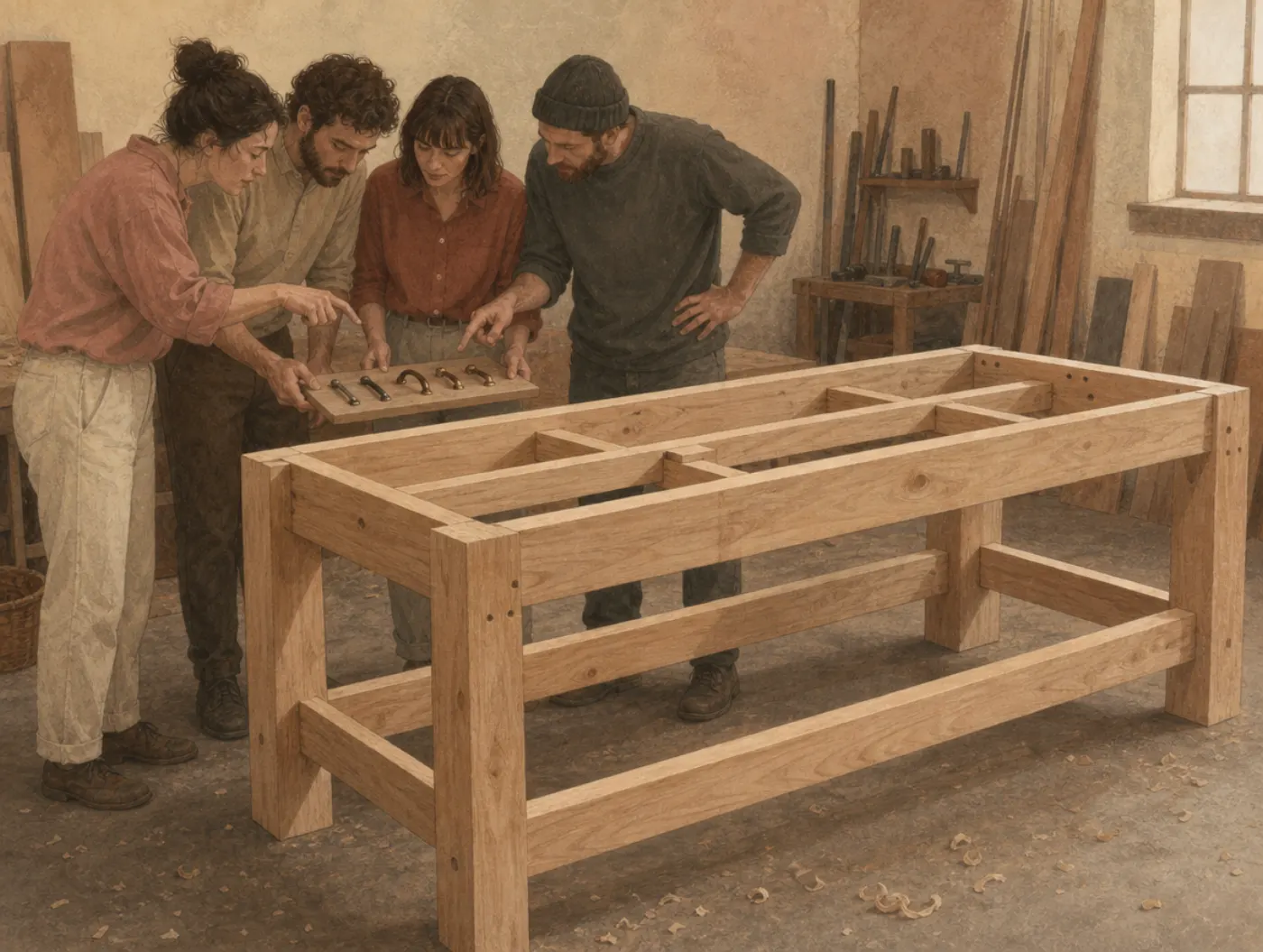
| Situation | What the bias does | What helps |
|---|---|---|
| A code review of a change to the database layer | Thirty comments argue about a variable name and the position of a bracket; two touch the locking logic that could lose data | Separate style, which a formatter can settle, from design, and ask reviewers to read the risky part first |
| A town meeting with a 40 million dollar school bond and a proposal for one new crosswalk | The bond passes in minutes and the crosswalk takes an hour, because everyone drives through that intersection | Timebox each item in advance and send the bond documents out early so people can engage with the big one |
| A product team deciding a pricing model and the color of the sign-up button | The color gets everyone's opinion; the pricing model, which decides whether the company survives, gets nods | Give the button to one designer with the authority to decide, and spend the saved time on pricing |
| A wedding where the venue contract and the font on the invitations are both open | Three evenings go to the font; the contract, with its cancellation terms, is signed unread | Decide who owns each small decision, and read the contract together with a checklist |
| A family buying a house | The paint color of the kitchen is debated for days; the mortgage terms are accepted as offered | Ask what it would cost to be wrong about each item, and give time in that proportion |
How to counter it
The counters work by making the big item approachable and the small item cheap to settle.
- Name it. Kamp's term became a yellow card in FreeBSD because a single word can end a thread without insulting anyone. A team that agrees on the word in advance can call a bike shed when it sees one.
- Give the shed an owner. One person with the authority to decide the color, the name or the default, and the understanding that the decision is reversible, removes the item from the group's agenda altogether.
- Timebox trivial items and put them last. A ten-minute cap announced at the start, with the important items first, means the shed cannot eat the reactor's time.
- Make the big item discussable. The reactor gets two minutes because nobody can engage with it. Pre-reads, a short briefing from someone who understands it, and a list of the three decisions it actually involves give people something to say that is not a bluff.
- Ask the cost of being wrong. A question that takes thirty seconds and reorders most agendas: if this goes badly, what does it cost, and can it be undone?
- Settle style by rule. In software, a formatter and a style guide end the recurring arguments about brackets and names once, so reviews can spend their attention on logic.
What it is not
The bike-shedding effect has a sibling and several neighbors that are easy to confuse with it.
- It is not a different phenomenon from the law of triviality; it is the same pattern named from the other end. The law of triviality is Parkinson's 1957 claim about committees and the arithmetic of his invented agenda; the bike-shedding effect is the phrase that came out of Kamp's 1999 email and the way it is used about projects, code reviews and online debates. Each page tells its own half of the story.
- It is not information bias, the appetite for more information that cannot change a decision. A group painting the shed is not gathering information; it is spending time where it feels competent.
- It is not the planning fallacy, the tendency to underestimate how long a piece of work will take. Bike-shedding describes how a group divides its attention between items, not how it forecasts the work on any one of them.
Tests and tools that use this
Related biases
Bike-Shedding Effect FAQ
What is the bike-shedding effect?
It is the tendency of a group to give far more time and argument to a trivial decision than to an important one, because the trivial one is something everyone can understand and hold an opinion on. The important item passes with little comment because few people feel able to challenge it. The name comes from a 1999 email in the FreeBSD project that retold a parable about a committee, an atomic reactor and a bicycle shed.
Where does the term bike-shedding come from?
From Poul-Henning Kamp's email of 2 October 1999 to the FreeBSD committers and hackers lists, sent after weeks of argument about whether the sleep command should accept fractional seconds. Kamp retold C. Northcote Parkinson's parable of a committee that approves a reactor in minutes and argues about a bicycle shed for most of an hour. The word spread through FreeBSD, into its FAQ, and from there into general use in software and beyond.
Is bike-shedding the same as Parkinson's law of triviality?
They describe the same pattern. The law of triviality is Parkinson's 1957 statement that a committee's time on an item is in inverse proportion to the sum involved, with the reactor and the shed as his invented example. Bike-shedding is the name Kamp's 1999 email gave the pattern, and it is used mostly about software projects, code reviews and mailing lists. Psychology.com gives each its own page because people search for them separately and the stories differ.
Is the bike-shedding effect a scientifically established bias?
No. It is an observation from practice, named by an engineer and illustrated by a satirist, and there is no body of controlled experiments measuring it under that name. The underlying tendencies it describes, people contributing where they feel competent and avoiding questions that would expose what they do not know, are well documented in other contexts, but the specific claim that trivial items reliably take longer than weighty ones rests on experience, not on a study.
How do I stop bike-shedding in code review or in meetings?
Settle style questions once by rule, with a formatter and a style guide, so reviews spend their attention on logic. Give small decisions a single owner with the authority to decide. Timebox trivial agenda items and put the important ones first. Make the big item discussable with a pre-read and a short briefing, so that people have something real to say about it. And agree on the word itself: a team that can call a bike shed can end one quickly.
How does the demo on this page work?
You gave a number of days to two proposals on one mailing list, a rewrite of the disk cache and a one-line change to the sleep command, and the page compared the two: more days for the small change, the same, or more for the rewrite. The reference line is the couple of weeks Kamp said the real sleep thread had already run, his recollection rather than a count, so the result describes your expectation about a mailing list, not your own habits. Only the outcome label leaves your browser.

References
- Kamp, P.-H. (1999, October 2). A bike shed (any colour will do) on greener grass... Email to the FreeBSD committers and hackers mailing lists; reproduced with the author's commentary on his site. phk.freebsd.dk
- Parkinson, C. N. (1957). Parkinson's law, and other studies in administration. Houghton Mifflin. Chapter 3: High finance, or the point of vanishing interest. openlibrary.org
- The FreeBSD Documentation Project. Frequently asked questions for FreeBSD, section 6.11: Why should I care what color the bikeshed is? docs.freebsd.org
Cite this source
Psychology.com. (2026, October 24). Bike-Shedding Effect. Psychology.com. https://psychology.com/biases/bike-shedding-effect