In short
The democratic leadership style, also called participative leadership, means significant decisions are shaped with the group before the leader makes the call. The leader asks real questions, lets the answer be changed by what the team knows, and stays accountable for the outcome. It produces strong commitment, because people execute what they helped decide, and it costs time, which is why it fails in a crisis; it is a situational tool rather than an identity, and no style performs best in every condition. On our Leadership Style Quiz this default shows up as the result called The Democrat.
- Also called
- Participative or consultative leadership
- Core move
- Gather the room before deciding, then own the call
- Best for
- Buy-in, expert teams, decisions people must live with
- Watch for
- Slow decisions, drift, consultation that is already decided
- Opposite end
- Autocratic leadership
- Test
- Leadership Style Quiz, the result called The Democrat
Democratic leadership at a glance
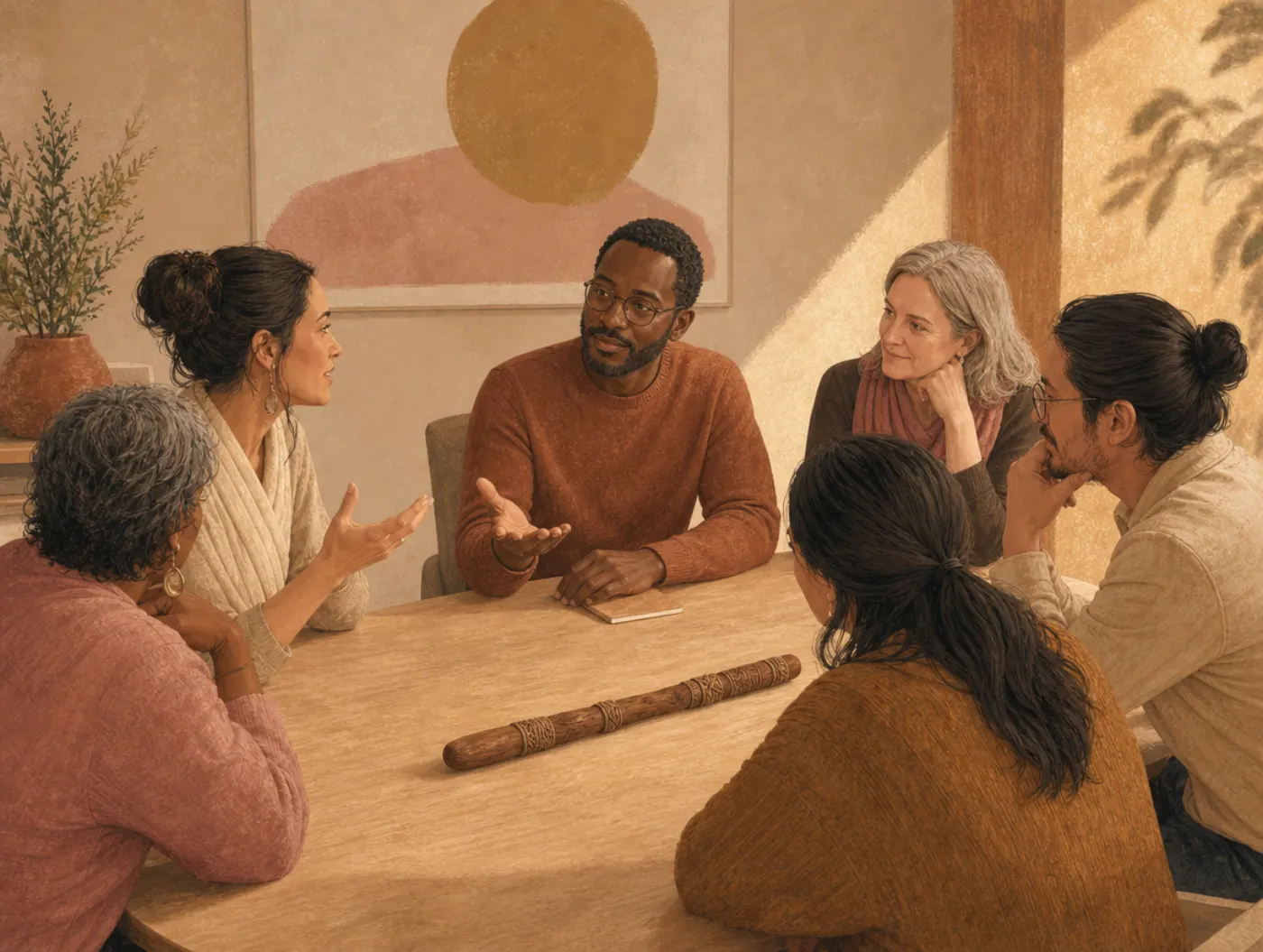
A democratic leader leads by listening. Before a decision of any size, the instinct is to put it in front of the people who will have to carry it: what do you see that I do not, what breaks if we do this, what would you do. The answer that comes out of that conversation is genuinely different from the one the leader walked in with, and that is the point. What does not change is accountability. Participative leadership shares the thinking, not the responsibility.
In the five results our Leadership Style Quiz reports, this default appears as The Democrat, and the description there is the short version of this page: you gather the room, ask real questions, and let the answer be shaped by the people who will live with it. It shines when you need genuine buy-in, when the team holds expertise you do not, and when commitment matters more than speed. It struggles in a crisis and whenever consensus-seeking starts to read as indecision.
The word democratic is doing a lot of work here and it misleads people. This is not a vote, and a team is not a parliament. In almost every workplace version of the style, the leader consults widely and then decides, which is closer to consultative than to majority rule. The confusion matters because a leader who believes the style requires a vote will either hand away a decision that is theirs to make or quietly fake the consultation, and both of those do more damage than simply deciding would have.
Where the democratic style came from
The modern version of the idea starts with a study published in 1939. Kurt Lewin, Ronald Lippitt and Ralph White ran boys' activity clubs in which adult leaders were trained to behave in three deliberately different ways, which the authors called social climates: authoritarian, democratic, and laissez-faire. The democratic leader discussed the group's plans with its members, offered choices, and explained the reasoning behind decisions. The authoritarian leader set the task and the method alone.
What the researchers reported has shaped the conversation for the better part of a century. The democratic groups did not necessarily produce more work than the authoritarian groups, but the work held up better, there was more originality in it, and crucially the group kept working when the leader left the room. The authoritarian groups produced a dependence on the leader, more hostility between members, and activity that collapsed when the leader stepped out. That last detail is still the most practical argument for the style.
Two other traditions feed into what managers now mean by participative leadership. Rensis Likert's work on management systems in the early 1960s treated participation as an organizational design question rather than a personal manner, arguing that firms built around group decision-making outperformed firms built around a chain of orders. And in Daniel Goleman's description of six leadership styles, published in Harvard Business Review in 2000, democratic is one of the six, named for the way a leader builds commitment through participation and consensus, with an overall correlation with organizational climate of .43, positive but below the authoritative style at .54.
None of these three is the same claim. Lewin described a climate created in a controlled setting with children. Likert described whole organizations. Goleman described behaviors that consultants coded in a sample of several thousand executives. A page that treats them as one body of proof is overselling. What they share is a consistent direction: participation buys commitment, and it costs time.
What participative leadership looks like in a normal week
The visible part is the meeting, but the meeting is the least interesting part. A democratic leader's week is mostly made of small acts of information-gathering: a question asked in a corridor, a draft circulated before it is finished, a proposal presented as a proposal rather than as news. By the time a decision reaches a room, half the objections have already been heard and absorbed.
The second signature is how a question is framed. A leader who is genuinely consulting asks something answerable: which of these two approaches would you rather own, what would make this deadline impossible, where is this plan wrong. A leader who has already decided asks something that invites agreement: does anyone have any concerns. The team can tell the difference immediately, and reliably.
The third is what happens to a dissenting answer. In a functioning participative team, the quiet specialist who says the timeline is wrong changes the timeline at least some of the time, and everyone watching learns that speaking up is worth the discomfort. The single fastest way to destroy the style is to collect input and then proceed exactly as planned without saying why. Nothing teaches a team to stay silent faster.
The fourth is a habit of naming the decision rights out loud. The strongest practitioners of this style say which of the three kinds of decision is on the table: one I am making and explaining, one I am making after hearing you, or one the team is making and I will back. Teams led this way describe feeling respected and heard, and their most common complaint is not knowing who will finally decide and when. Saying it in advance removes that complaint entirely.
Strengths of the democratic style
The first strength is commitment, and it is not a soft benefit. People execute what they helped decide with a different quality of attention: they notice problems early, they fix things nobody asked them to fix, and they defend the decision to others instead of distancing themselves from it. A decision made at 80 percent quality with full commitment usually beats a decision made at 95 percent quality that nobody owns.
The second is error-catching. A leader who consults routinely gets told things a leader who does not consult never hears, including the things that would have been embarrassing later. The expertise sitting in a team is almost always broader than the expertise sitting in the leader, and the democratic style is the simplest mechanism for using it.
The third is retention of judgment in the team. Because people are regularly asked to reason about real problems, they get better at it. Groups led this way tend to keep functioning when the leader is away, on holiday, in another meeting, or gone entirely, which is the single most reliable finding to come out of the 1939 climates study.
The fourth is that it makes a leader's own thinking better. Saying a half-formed plan out loud to people who will argue with it is an unglamorous but extremely effective form of quality control, and leaders who default to this style tend to have fewer confidently wrong opinions than leaders who do not.
What it costs: time, drift, and the consultation that was already decided
The honest cost is time, and it compounds. Every decision routed through the group takes longer, and a leader who routes everything through the group spends their week in meetings that each feel justified and collectively eat the capacity to do anything else. Goleman's own account of the style names the same two things, describing endless meetings in which consensus stays elusive, and leaders who use consultation to put off a decision until people feel leaderless.
Drift is the subtler failure. In a long consultation with no stated endpoint, the decision quietly becomes nobody's, and the team starts to experience open questions as permanent weather. The fix is not less consultation, it is a visible deadline: we are gathering views until Thursday, I will decide on Friday, here is how I will weigh it.
The third cost is the vocal minority. Open discussion does not collect views evenly. It collects the views of the people most comfortable speaking in groups, and the quietest person in the room is often the one closest to the work. A leader who equates the loudest consensus with the team's view will make confident decisions on partial information and feel well-consulted doing it. Written input, a round where everyone speaks once, and a private follow-up with two or three people fix most of this.
The fourth cost is the one that does real damage: consultation theater. Asking for input on a decision that is already made burns credibility faster than announcing the decision would have. Teams forgive a leader who says this one is mine and here is why. They do not forget a leader who ran a workshop about a conclusion that was already written down.
How the democratic style lands on a team
People who work for a strongly participative leader usually describe two things at once: a real sense of being respected and taken seriously, and a recurring uncertainty about where the decision actually sits. Both are true, and the second is the price of the first if decision rights are never named.
Senior specialists tend to thrive under this style, because they are finally being asked about the thing they know. Newer team members can find it harder than it looks. Asked what they think about a decision they do not yet have the context to judge, they will produce an opinion anyway, feel exposed, and privately wish someone had just told them what to do. Matching the amount of consultation to how much the person actually knows is not a betrayal of the style; it is the style done well.
Peers and bosses read a participative leader as reasonable and occasionally as slow. In an organization that rewards fast visible calls, the democratic leader's work is partly invisible, because the best outcome of consultation is a problem that never happened. Keeping a short record of what the consultation caught is a practical way to make that visible, and it is also useful evidence when the style needs defending.
Where it fits at work and where it grates
The style fits best where the work is genuinely complex, where expertise is spread across people, and where execution depends on willing judgment rather than compliance: research and engineering teams, clinical teams, creative and editorial groups, cross-functional projects, volunteer organizations and boards, and any group of specialists whose cooperation cannot be ordered. It also fits any decision whose implementation will be done entirely by other people.
It grates in three recognizable places. In an emergency, where the group needs a call and the consultation reads as abdication. In highly standardized or safety-critical work, where the method is not open for debate and the leader's job is to make sure it is followed. And in a team that is new, inexperienced, or in genuine crisis, where people want direction and interpret questions as a sign that nobody is steering.
It also grates in organizations with a severe meeting load already. A participative style layered on top of a calendar that is full is not participation, it is exhaustion. Consulting fewer people more deeply, in writing where possible, usually preserves the benefit at a fraction of the cost.
When to switch out of it
The practical skill in this family is not picking a style, it is noticing when yours has stopped fitting the situation. Four signals are worth watching for. The decision is urgent and reversible: decide now, consult after. The information is already in the room and the discussion is circling: name the decision and close it. The team is split and the split is about values rather than facts: a vote will not resolve it and the leader has to own the answer. And safety or legal exposure is involved: that is not a consultation.
The style most useful to borrow when consultation has run its course is the visionary, or authoritative, approach, which names a destination and lets people find the route. Participation tells people they matter. Direction tells them where all that input is going. Consultation lands best inside a clearly framed destination that the leader is willing to name and own.
The style worth deliberately borrowing in a crisis is the commanding one, described on our page on the autocratic leadership style. Not its harshness, which corrodes a team when it becomes the default, but its clarity: a decision, stated once, with the reasoning compressed into a sentence. A participative leader who can do that for two days and then hand the decisions back is far more useful than one who consults through a fire.
Growth: what helps a democratic leader
Name the decision type before the discussion starts. One sentence at the top of the meeting: this is mine to decide and I want your input, or this one is yours and I will support it. It costs ten seconds and removes the single most common complaint about this style.
Put a clock on the consultation. Say when input closes and when the decision lands, then hold to it. A consultation without an endpoint turns into drift, and drift is read by teams as weakness rather than openness.
Collect the quiet views on purpose. Ask for written input before the meeting, go around the room once before opening general discussion, or ask the two people closest to the work privately afterward. This is the highest-return habit in the whole style, because the information you are missing is rarely held by the person talking most.
Close the loop out loud. When you decide against the room, say so and say why. When the consultation changed your mind, say that too, and name who changed it. Both teach a team that speaking up has consequences, which is the only thing that keeps them doing it.
Practice deciding alone for two days. Pick a low-stakes call, make it without consulting anyone, then explain it clearly afterward. Leaders whose default is participation are often genuinely uncomfortable doing this, and the discomfort is worth getting used to before a real crisis arrives.
If the consultation habit is partly a way of avoiding the discomfort of being the one responsible, that is worth looking at honestly, and it is a common pattern rather than a failing. Our Conflict Style Quiz and the Assertive Communication Worksheet are both useful for separating a genuine preference for participation from a reluctance to hold a position.
Democratic leadership compared with the autocratic style
These two sit at opposite ends of the same axis, which is where the decision gets made. Everything else follows from that. The autocratic or authoritarian style puts the decision with the leader and the execution with the group; the democratic style puts the thinking with the group and the accountability with the leader. One is fast and produces compliance. The other is slower and produces commitment.
The research picture is less lopsided than the popular write-ups suggest. John Gastil's 1994 meta-analysis found no overall relationship between where a leader sat on this axis and group productivity, with a relationship appearing only once study setting and task complexity were taken into account, and it did find a moderate positive relationship between democratic leadership and member satisfaction. Rob Foels and colleagues, revisiting the satisfaction question in 2000, found a small but real satisfaction advantage for democratic leadership, moderated by group size, whether the groups were real or laboratory groups, and other factors.
Read sideways, that is a useful finding rather than a disappointing one. The democratic style does not reliably make a team produce more. It reliably makes a team feel better about the work, keeps capability in the group, and buys willing effort, and those things show up in retention, in error-catching and in what happens when the leader is not there. The comparison below describes typical patterns, not rules about what either leader can achieve.
Two neighbors are worth naming because they are often confused with this style. Collaborative leadership is about building shared work across groups that do not report to you, which is a structural problem rather than a decision-making manner. And laissez-faire leadership looks superficially similar from the outside and is a different thing entirely: the democratic leader is in the room, asking and then deciding. The laissez-faire leader is not in the room.
What the research says
Be clear about what kind of thing this is. Democratic leadership is a well-studied behavioral pattern with a thin predictive record, not a measured trait with established validity. The 1939 climates study is a landmark and it was run on activity groups of children with a handful of leaders. The meta-analyses that followed found a consistent satisfaction benefit and no consistent productivity benefit. The six-styles framework that popularized the name is a practitioner model drawn from consultancy data, and the underlying report has not been independently replicated in the peer-reviewed literature.
Where the evidence in this family is strongest is elsewhere: in the behaviors that make up transformational leadership and in contingent reward, both of which have meta-analytic support for predicting outcomes. Participation overlaps with those behaviors without being identical to them. A page that told you democratic leadership is the best style would be inventing a finding that does not exist, and the honest version is more useful: participation reliably buys commitment, information and capability, and it reliably costs time.
The last thing worth saying is that no style in this family is best in all conditions, and the leaders who come out best in the research are the ones who switch deliberately. A result on a style quiz is a description of what you reach for by default. It is a starting point for reflection, not a diagnosis and not a ceiling.
How to find out if this is your default
Our free Leadership Style Quiz asks how you actually behave when you lead, both day to day and under pressure, and scores you across all five styles rather than assigning you one. If participation is your default, the result you see is The Democrat, with your second-highest bar usually telling you more than the first: a democrat with a visionary second runs consultation inside a clear direction, while a democrat with a coaching second tends to turn every decision into a development conversation, which is a different set of strengths and a different trap.
The result screen explains what your top style does well, where it backfires, and which style is worth borrowing on purpose. An optional in-depth report goes further into your mix across the two situations the quiz asks about, how you lead ordinarily and what happens when the pressure rises, which for many participative leaders is the more revealing of the two.
If the description above sounds close but not quite right, read the two pages on either side of it. If you find yourself making the call and then explaining it, the autocratic leadership style page covers that pattern honestly, including the conditions where it is the right answer. If you mostly hand the work over and stay available, that is closer to delegating leadership than to participation.
| Feature | Democratic (participative) | Autocratic (commanding) |
|---|---|---|
| Where the decision is made | Shaped with the group, called by the leader | Made by the leader, executed by the group |
| Speed | Slow by design, slower as the team grows | Immediate, which is its main advantage |
| What it buys | Commitment and information | Compliance and clarity |
| Best condition | Complex work, spread expertise, willing effort needed | Crisis, safety-critical work, inexperienced team |
| Typical failure | Drift, meeting load, consultation that is already decided | Dependence, silence, bad news that stops traveling up |
| When the leader leaves the room | Work continues, decisions still get made | Activity tends to stall until the leader returns |
| What the team reports feeling | Respected and heard, unsure who finally decides | Safe in emergencies, guarded the rest of the time |
| Style worth borrowing | The visionary, to frame where the input is going | The democratic, to rebuild initiative and honesty |
Key takeaways
- Democratic leadership, also called participative leadership, shapes a decision with the group and leaves the accountability with the leader. It is consultation, not a vote.
- Its reliable payoff is commitment, information the leader would not otherwise hear, and a team that keeps functioning when the leader is absent.
- Its reliable costs are time and drift, and its worst failure mode is consulting on a decision that has already been made.
- Naming the decision type and the deadline at the start of a discussion removes the most common complaint about this style, which is not knowing who decides and when.
- Meta-analyses find a consistent satisfaction advantage for democratic leadership and no consistent productivity advantage, and no style in this family is best in all conditions.
Is participation your actual default?
The free Leadership Style Quiz shows whether The Democrat is your day-to-day default, and which style replaces it the moment a decision gets urgent.
Cite this source
Fontane Pennock, S. (2026, November 8). Democratic Leadership Style. Psychology.com. https://psychology.com/types/democratic-leadership-style
Frequently asked questions
What is the democratic leadership style?
It is a way of leading in which significant decisions are shaped with the people who will carry them out, while the leader remains accountable for the final call. In practice that means asking answerable questions before deciding, letting the answers change the plan, and saying clearly when the decision is yours. It is consultation rather than majority rule, which is why consultative is often the more accurate word.
Is democratic leadership the same as participative leadership?
In everyday use, yes. Participative leadership is the term more common in management research and democratic is the term that came out of the 1939 social climates study, and both describe the same core behavior: involving the group in the thinking before the decision. Some writers reserve participative for a broader organizational design question, following Rensis Likert, and democratic for a personal manner of leading.
What are the disadvantages of democratic leadership?
Time is the main one, and it compounds as the team grows. The others are drift, where a long consultation with no endpoint leaves the decision belonging to nobody; the vocal minority steering a room while quieter experts stay silent; decision fatigue for the leader and the team; and consultation theater, which is asking for input on something already decided. That last one does more damage to trust than simply deciding would have.
When should a democratic leader stop consulting and just decide?
When the situation is urgent, when the discussion has started circling without new information, when the team is split on values rather than facts, and whenever safety or legal exposure is involved. A useful rule is to state the deadline at the start: input closes on this day, the decision lands on that one. Closing a consultation on purpose reads as leadership. Letting it run reads as indecision.
Is democratic leadership the most effective leadership style?
No style is best in all conditions, and the research does not support crowning one. Meta-analytic work finds a consistent satisfaction advantage for democratic leadership over autocratic, and no overall productivity advantage, with productivity effects appearing only once study setting and task complexity are taken into account. The behaviors with the strongest meta-analytic support for outcomes are transformational ones and contingent reward, which overlap with participation without being the same thing.
What is the difference between democratic and laissez-faire leadership?
A democratic leader is present and involved: they ask, they absorb what they hear, and then they decide and own it. A laissez-faire leader has stepped back from the decision entirely. The two look similar from the outside for about a week, and then they diverge sharply, because research on absent leadership finds it associated with role ambiguity, role conflict and conflict between coworkers rather than with freedom.
Can a quiet or introverted person lead democratically?
Often very well. The style rewards asking good questions, listening without interrupting, and noticing who has not spoken, none of which require being the loudest person in the room. The part that tends to need deliberate practice is the ending: stating the decision clearly and holding it when someone pushes back. Writing the closing sentence out before the meeting is a practical way to make that easier.
Related types


References
- Lewin K, Lippitt R, White RK. Patterns of Aggressive Behavior in Experimentally Created Social Climates. The Journal of Social Psychology. 1939;10(2):269-299. doi.org
- Gastil J. A Meta-Analytic Review of the Productivity and Satisfaction of Democratic and Autocratic Leadership. Small Group Research. 1994;25(3):384-410. doi.org
- Foels R, Driskell JE, Mullen B, Salas E. The Effects of Democratic Leadership on Group Member Satisfaction: An Integration. Small Group Research. 2000;31(6):676-701. doi.org
- Goleman D. Leadership That Gets Results. Harvard Business Review. March-April 2000;78(2):78-90. hbr.org
- Likert R. New Patterns of Management. McGraw-Hill; 1961. openlibrary.org
- Judge TA, Piccolo RF. Transformational and Transactional Leadership: A Meta-Analytic Test of Their Relative Validity. Journal of Applied Psychology. 2004;89(5):755-768. doi.org