Psychodrama: Moreno's Method, Roles and Techniques
Psychodrama is a group method in which one person's situation is played out on a stage rather than described from a chair, developed by Jacob Moreno from the 1920s onward. This guide covers the five instruments, the techniques of role reversal, doubling and mirroring, the three-part shape of a session, and a reflection sheet you can use alone.
 Reviewed byMichael Callans, MSW
The five instruments
Stage
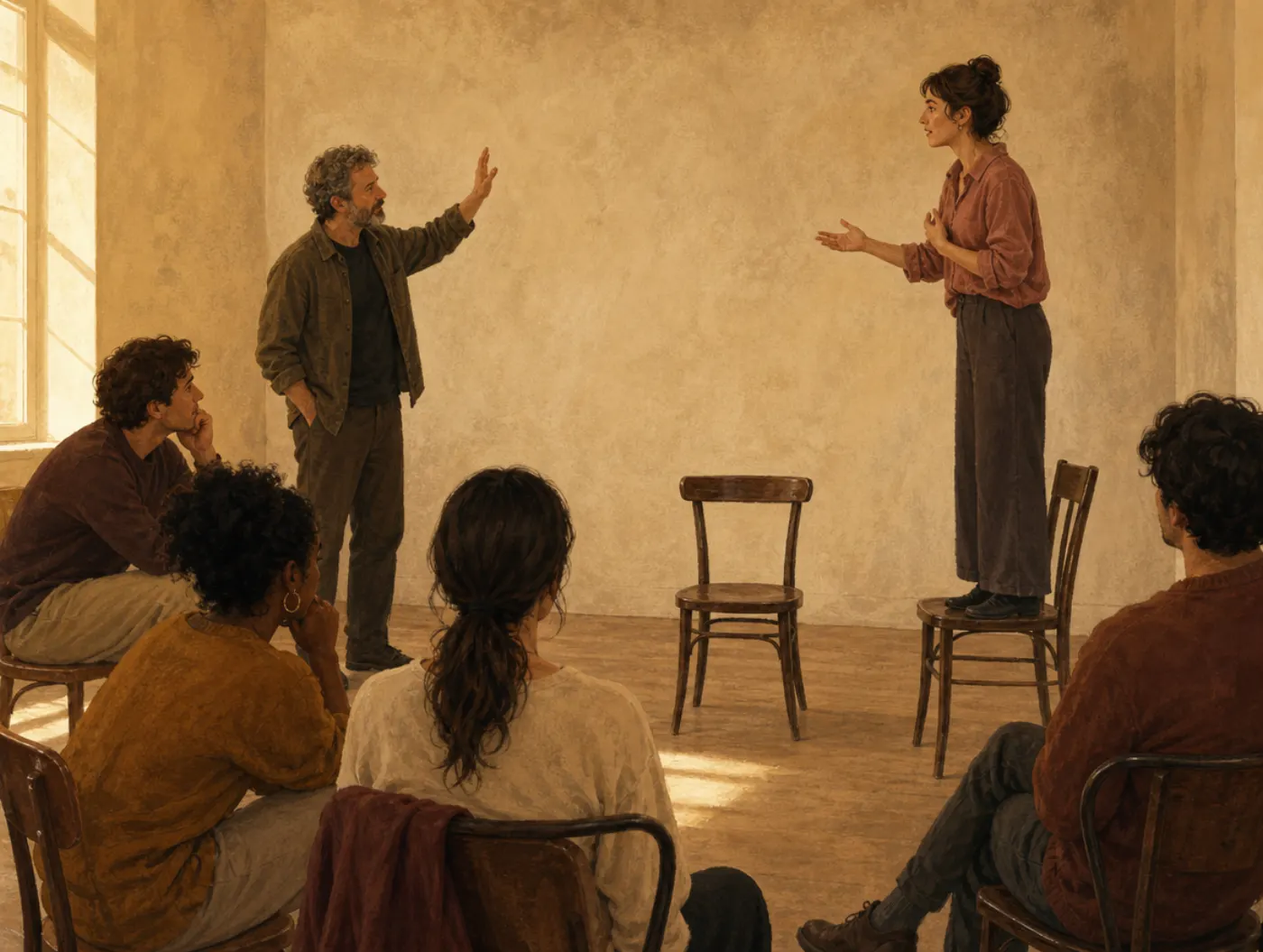
The marked-out space where the scene happens. Moreno built a three-tiered circular stage, but in practice it is a carpet, two chairs and an agreement that this area is the scene and the rest of the room is not.
Protagonist
The group member whose situation is explored. Chosen by the group rather than appointed, and free to stop, slow down or change the scene at any point. One protagonist per enactment.
Director
The trained therapist. Sets up the scene, decides when to introduce a technique, keeps the pace tolerable, de-roles everyone afterward, and carries responsibility for safety throughout.
Auxiliary egos
Group members who play the people, parts and sometimes the objects in the protagonist's world. They take direction and feed back what it was like to stand in that position.
Audience
Everyone not in the scene. Their job is to witness, and then in the sharing phase to speak about what the drama touched in their own lives rather than to interpret the protagonist's.
Core techniques
A role-reversal reflection on paper (about 15 minutes)
- Pick one specific exchange that has stuck: a particular conversation on a particular day, not a general grievance. Write the setting in one line, including where each person was standing or sitting.
- Write the exchange as a script, from your side. Three to six lines each is enough. Use the words actually said, and mark in brackets what you thought but did not say.
- Now reverse. On a fresh page, write the same exchange as the other person, in the first person, as though you were them: what they wanted from the conversation, what they were afraid of, what they thought you meant.
- Stay in their position for one more line and answer this as them: what did you need from me in that moment and not get?
- Come back to your own position and read both pages. Write one sentence on what surprised you, and one on anything you now think they could not have known.
- Finish with the soliloquy: one line you would say if you could replay the scene, written in the plainest words available. Then put the pen down and name out loud that you are yourself, not them. On paper as on a stage, stepping back out is part of the exercise.
The three phases of a session
Warm-up comes first and is not a formality. The group builds enough safety and enough energy to work, usually through movement, through sociometric exercises where people place themselves physically on a question, or simply by going round and naming what is live. Out of this a protagonist emerges, often chosen by the group rather than volunteering in isolation. The enactment follows, typically 30 to 60 minutes, and starts by making the scene concrete: which room, which day, who was where, what was said first. The director then introduces techniques as needed, reversing roles, bringing in a double, pausing for a soliloquy. Sharing closes the session and is the phase newcomers most often underrate. Members speak only about what the drama touched in their own lives. Nobody interprets the protagonist, nobody gives advice, and the effect is that a person who has just been very exposed is returned to the group as one member among others. In training groups a fourth phase, processing, examines the director's choices, and it is held separately from sharing on purpose.
Sociometry and the social atom
Moreno's other invention was a way of measuring the structure a group already has. Ask everyone who they would choose to work with, confide in, or sit beside, and the answers map onto a sociogram: clusters, bridges, mutual pairs, and the people nobody picked. Moreno treated that pattern as clinical information rather than as a social curiosity, since a person's position in a group often explains more about their week than their inner life does. The individual version is the social atom: draw yourself in the middle and place the people who matter in rings by closeness, marking the direction of each tie. It takes ten minutes and tends to be uncomfortable in a useful way, because it shows up thin rings, one-way arrows, and people who are still on the map years after they left your life. Sociometry has long since spread beyond therapy into classroom and organizational work, often used by people who have never encountered psychodrama.
What the evidence shows, and does not
The research base is small and the quality is mixed, which is the fair summary rather than a dismissal. Kipper and Ritchie's 2003 meta-analysis pooled 25 experimentally designed studies published between 1965 and 1999 and reported an overall improvement effect in the range usually found for group psychotherapy generally, with role reversal and doubling standing out among the techniques tested. Its weakness is reporting: later reviewers noted that the paper did not state its search terms or the databases used, so the result is hard to reproduce. Orkibi and Feniger-Schaal's 2019 integrative review covered 31 psychodrama intervention publications from 2007 to 2017, spanning more than 20 outcomes across quantitative, qualitative and mixed-methods designs, and concluded that results were promising across methods while pressing for better methodological quality, better reporting, and research into the mechanisms specific to psychodrama. What follows is modest: enough signal to take the method seriously, not enough to claim superiority over other group therapies, and a real gap in large well-reported trials.
What makes a psychodrama group safe
- A trained director with documented certification, not a facilitator improvising with theater exercises.
- Screening before joining, and a conversation about what you do and do not want to work on.
- A protagonist chosen by the group, who can slow the scene, change it, or stop it at any point without justifying the decision.
- De-roling at the end of every enactment, so the member who played your father says out loud that they are not your father.
- A sharing phase that is never cut for time, and a clear rule against interpretation and advice inside it.
- A director who will decline to run an enactment when it is the wrong week, the wrong group, or the wrong state to be in. Caution from a director is competence, not reluctance.
Related tools
Stuck in the same conversation for years?
Group and action-method therapists work on exactly the exchanges that will not shift. Free to search our directory.
About this tool
Psychodrama is a method of group psychotherapy in which a person's situation is acted out rather than reported. Other group members take the parts of the people involved, a trained director shapes the scene, and the person whose story it is gets to stand inside it, change position, say the unsaid line, or watch it from the outside. It was developed by Jacob Levy Moreno (1889 to 1974), a Viennese physician who ran a theater of spontaneity in Vienna from 1921, emigrated to the United States in 1925, and later built a sanatorium at Beacon, New York, with a purpose-built stage in it. He is credited with coining the term group psychotherapy in the early 1930s.
Moreno's disagreement with the dominant psychotherapy of his day was about position as much as theory. Where analysis asked a person to lie still and recall, he wanted them standing and doing, on the view that insight arrived through action and that spontaneity, a capacity he thought most adults had trained out of themselves, was the thing being repaired. He also moved the unit of treatment from two people in a room to a group, arguing that people get stuck in roles and that roles need other people to be rehearsed differently. Those two moves, action and group, are what psychodrama still rests on.
The method has five named instruments. The stage is the marked-out space where the scene happens, which can be a carpet and two chairs. The protagonist is the group member whose situation is explored, chosen by the group rather than appointed. The director is the trained therapist who sets up the scene, chooses when to intervene, and is responsible for safety. Auxiliary egos are the other members playing the people, parts or even objects in the protagonist's world. The audience is everyone else, who are not passive: their job is to witness and then to speak about what the scene touched in them.
A session has a shape that rarely varies. The warm-up builds the group and surfaces what is live, often through movement, sociometric exercises or simply asking what is pressing. The enactment is the drama itself, usually 30 to 60 minutes with one protagonist, built from a concrete scene rather than a general complaint: not my mother never listens but a particular kitchen, a particular Tuesday. Sharing comes last and is strictly not analysis. Members speak about what the scene stirred in their own lives, which returns the protagonist to the group as one person among others rather than as a specimen.
The techniques are what most people come looking for. Role reversal has the protagonist swap into the other person's position and speak as them, which is the method's signature move and the one Moreno considered most important. Doubling places a group member beside the protagonist to voice what is felt but unsaid. Mirroring has someone else play the protagonist while they watch from outside. Soliloquy asks them to think out loud mid-scene. The empty chair, which has its own page at Empty Chair Technique, lets a person address someone absent. Surplus reality is Moreno's term for scenes that never happened and never could: a conversation with someone who died, a goodbye that was never allowed.
Read the diagram as text
On the left a person sits in a chair and the account is a speech bubble holding four small tokens, three quiet and one dashed: the room, the other person, what was said and what was not said. A brand arrow crosses a dashed divider into a marked-out stage on the right, where the same elements have become positions: the protagonist inside a brand ring, group members standing in the parts with a quiet token each, and the dashed token now an accent token in a brand speech bubble beside the protagonist, said out loud. A row of quiet dots outside the stage is the audience, and a brand path takes the protagonist out past the stage edge to the mirror position. The brand marks the move from telling to standing in it. On the phone canvas the account sits above the stage.
The account, and the scene it becomes
Conceptual selection, not counts
The room it happened in: The stage: a marked-out space, which can be a carpet and two chairs
The other person in it: An auxiliary ego: a group member standing in that person's position
What was said: Said again, inside the scene rather than about it
What was not said: Said out loud, in the place where it could not be said
You, telling it from a chair: The protagonist, standing in the scene instead of describing it
Added to the representation: The mirror position, outside the scene, where someone else plays you and you watch
Added to the representation: The audience, whose job is to witness and then say what the scene touched in them
Added to the representation: The director, who sets the scene up, chooses when to intervene and is responsible for safety
Alongside psychodrama, Moreno built sociometry, a way of measuring the invisible structure of a group: who chooses whom, who gets left out, where the real influence sits. A sociogram maps those choices as a diagram. The social atom is the smaller map of the people who matter to one individual, drawn in rings by closeness, which is a useful exercise on paper even without a group. Sociometry escaped psychotherapy early and is still used in classrooms, teams and organizational work, often by people who have never heard of psychodrama.
The evidence is modest and the literature is small. The main quantitative summary is a 2003 meta-analysis by David Kipper and Timothy Ritchie, which pooled 25 experimentally designed studies published between 1965 and 1999 and reported an overall improvement effect in the range usually reported for group psychotherapy in general, with role reversal and doubling emerging as the most effective of the techniques examined. Later reviewers have pointed out that the paper did not report its search terms or databases, which limits how much weight it can carry. A 2019 integrative systematic review by Hod Orkibi and Rinat Feniger-Schaal found 31 psychodrama intervention publications from 2007 to 2017, covering more than 20 different outcomes and mostly involving adults, and described the results across methods as promising while calling for better methodological and reporting quality.
Enactment is powerful and that cuts both ways. Putting a scene on its feet can reach material that talking has circled for years, and it can also overwhelm someone who was not ready for it. A well-run group handles this with structure rather than with caution alone: the director screens who joins, the protagonist is chosen by the group and can stop at any point, scenes are de-roled at the end so a member who played your father stops being your father, and the sharing phase is never skipped. Psychodrama is a poor fit during acute psychosis, during mania, with unmanaged dissociation, or where someone cannot reliably step out of a role. Those are director decisions, which is exactly why the director's training matters.
Psychodrama is often confused with drama therapy, covered at Drama Therapy, and the two really are different. Psychodrama works with the protagonist's own real life and sits inside psychotherapy; drama therapy works more often through fiction, story, myth and role, and runs in a wider range of settings. Practitioners arrive by different doors too: psychodramatists usually come from a clinical background and drama therapists usually from theater as well as clinical training. In the United States the American Board of Examiners in Psychodrama, Sociometry and Group Psychotherapy certifies practitioners (CP) and trainers (TEP) after documented training hours, supervised practice, work as a protagonist and examination, and other countries have their own boards. The sheet below is our own written exercise in the spirit of role reversal; psychodrama proper needs a group and a director.
References
- Moreno JL. Psychodrama, First Volume. Beacon, NY: Beacon House; 1946.
- Moreno JL. Who Shall Survive? Foundations of Sociometry, Group Psychotherapy and Sociodrama. 2nd ed. Beacon, NY: Beacon House; 1953 (first published 1934).
- Blatner A. Acting-In: Practical Applications of Psychodramatic Methods. 3rd ed. New York: Springer; 1996.
- Kipper DA, Ritchie TD. The effectiveness of psychodramatic techniques: a meta-analysis. Group Dyn Theory Res Pract. 2003;7(1):13-25. doi:10.1037/1089-2699.7.1.13
- Orkibi H, Feniger-Schaal R. Integrative systematic review of psychodrama psychotherapy research: trends and methodological implications. PLoS One. 2019;14(2):e0212575. doi:10.1371/journal.pone.0212575
Cite this source
Psychology.com. (2026, November 6). Psychodrama. Psychology.com. https://psychology.com/tools/psychodrama
Psychodrama FAQ
What is psychodrama?
Psychodrama is a form of group psychotherapy in which one member's situation is acted out instead of described. Other members take the roles of the people involved, a trained director shapes the scene, and the person whose story it is can step into the other side of a conversation, hear their unspoken thought voiced by a double, or watch the whole thing played back from outside. Jacob Moreno developed it from the 1920s on, and it was the setting in which he coined the term group psychotherapy. The working assumption is that insight arrives through doing rather than through recalling.
What are the main psychodrama techniques?
Role reversal is the central one: the protagonist swaps position and speaks as the other person. Doubling puts a group member beside them to voice what is felt but unsaid. Mirroring has someone else play the protagonist while they watch. Soliloquy pauses the scene so they can think out loud. The empty chair lets a person address someone absent, and it is the technique that transferred most widely into individual therapy. Surplus reality covers scenes that never happened and could not, such as a conversation with someone who has died. Concretization gives a physical form to something abstract: a fear becomes a person in the doorway.
Does psychodrama work?
The evidence is promising and limited. A 2003 meta-analysis of 25 experimentally designed studies reported an overall improvement effect in the range usually found for group psychotherapy in general, and identified role reversal and doubling as the most effective techniques examined. Later reviewers noted that the paper did not report its search terms or databases, which weakens it. A 2019 integrative review of 31 publications from 2007 to 2017 found promising results across study designs while asking for better methodological and reporting quality. So psychodrama is worth taking seriously and is not demonstrated to outperform other group therapies. Large, well-reported trials are the gap.
What is the difference between psychodrama and drama therapy?
Psychodrama works with the protagonist's own real life and sits squarely inside psychotherapy: a real scene, real people, usually a real conversation that stalled. Drama therapy works more often through fiction, story, myth, mask and invented roles, and runs in a wider range of settings including schools, hospitals and community programs. The training routes differ as well. Psychodramatists generally come from a clinical background and certify through psychodrama boards; drama therapists hold a master's level qualification that includes substantial theater experience alongside clinical work. The two fields borrow techniques from each other freely, and some practitioners hold credentials in both.
Can psychodrama be overwhelming or retraumatizing?
It can, which is why the structure exists. Putting a scene on its feet reaches material faster than talking does, and speed is exactly the risk. A well-run group screens who joins, lets the group rather than the therapist choose the protagonist, allows the protagonist to slow or stop the scene without explaining why, de-roles every auxiliary at the end, and never cuts the sharing phase for time. Psychodrama is a poor fit during acute psychosis or mania, with unmanaged dissociation, or where someone cannot reliably step back out of a role. A director who declines to run an enactment on a given day is doing the job properly.
Do I need acting experience to take part?
No, and performance is not what is being asked of you. Psychodrama uses the form of theater, not its craft: nobody is judging a performance, there is no audience beyond the group, and auxiliaries are told what to say and how to stand rather than expected to improvise a character. Moreno's interest in spontaneity was about recovering an ordinary human capacity rather than a theatrical one. In practice the most common difficulty for newcomers is not acting but concreteness: a director will keep asking which room, which day, what exactly was said, when you would rather describe the pattern in general.
How do I find a psychodrama group or practitioner?
Look for board certification rather than a workshop description. In the United States the American Board of Examiners in Psychodrama, Sociometry and Group Psychotherapy certifies practitioners (CP) and trainers (TEP) after documented training hours, supervised practice, time as a protagonist and an examination, and most other countries have an equivalent body with a searchable list. Useful questions before joining: how is the group screened, how long has the director been certified, how many sessions is the commitment, and what happens if an enactment opens something that needs individual therapy as well. Many groups run as monthly weekend intensives rather than weekly hours.