Feelings Wheel in Spanish: Printable Wheel, Chart and English Key
A feelings wheel in Spanish is the familiar emotion wheel, six core feelings in the center with finer words in rings around them, drawn with Spanish words so that a Spanish speaker can find the word for a feeling in the language the feeling arrived in. This page gives our own Spanish wheel, a word list with the English beside every word, a blank wheel and a 20-word feelings chart in Spanish, for bilingual families, classrooms and clinicians.

 Reviewed byMichael Callans, MSW
La rueda: six core feelings and their shades
Alegría (Happy)
Contento (Content): tranquilo (calm), sereno (serene), satisfecho (satisfied). Encantado (Delighted): alegre (glad), emocionado (thrilled), eufórico (elated). Juguetón (Playful): divertido (in a fun mood), despreocupado (lighthearted), travieso (mischievous). Agradecido (Grateful): conmovido (touched), afortunado (fortunate), reconfortado (comforted). Orgulloso (Proud): seguro (confident), realizado (accomplished), capaz (capable).
Tristeza (Sad)
Solo (Lonely): aislado (isolated), nostálgico (homesick), desconectado (disconnected). Decepcionado (Disappointed): desanimado (discouraged), desilusionado (disillusioned), abatido (dejected). Afligido (Sorrowful): desconsolado (heartbroken), dolido (hurt), melancólico (melancholy). Arrepentido (Regretful): culpable (guilty), avergonzado (ashamed), pesaroso (rueful).
Miedo (Afraid)
Ansioso (Anxious): preocupado (worried), nervioso (nervous), inquieto (uneasy). Amenazado (Threatened): intimidado (intimidated), alarmado (alarmed), aterrado (terrified). Inseguro (Insecure): indeciso (unsure), expuesto (exposed), vulnerable (vulnerable).
Enojo (Angry)
Frustrado (Frustrated): impaciente (impatient), exasperado (exasperated), irritado (irritated). Ofendido (Offended): insultado (insulted), indignado (indignant), furioso (furious). Resentido (Resentful): amargado (bitter), celoso (jealous), envidioso (envious). In Spain the core word is usually enfado; the shades are the same.
Sorpresa (Surprised)
Asombrado (Amazed): maravillado (awestruck), impresionado (impressed), deslumbrado (dazzled). Sobresaltado (Startled): impactado (shocked), atónito (stunned), conmocionado (shaken). Confundido (Confused): perplejo (puzzled), desconcertado (baffled), desorientado (bewildered).
Asco (Disgusted)
Asqueado (Repelled): repugnado (revolted), horrorizado (horrified), hastiado (fed up). Escandalizado (Appalled): consternado (dismayed), incómodo (uncomfortable), perturbado (disturbed).
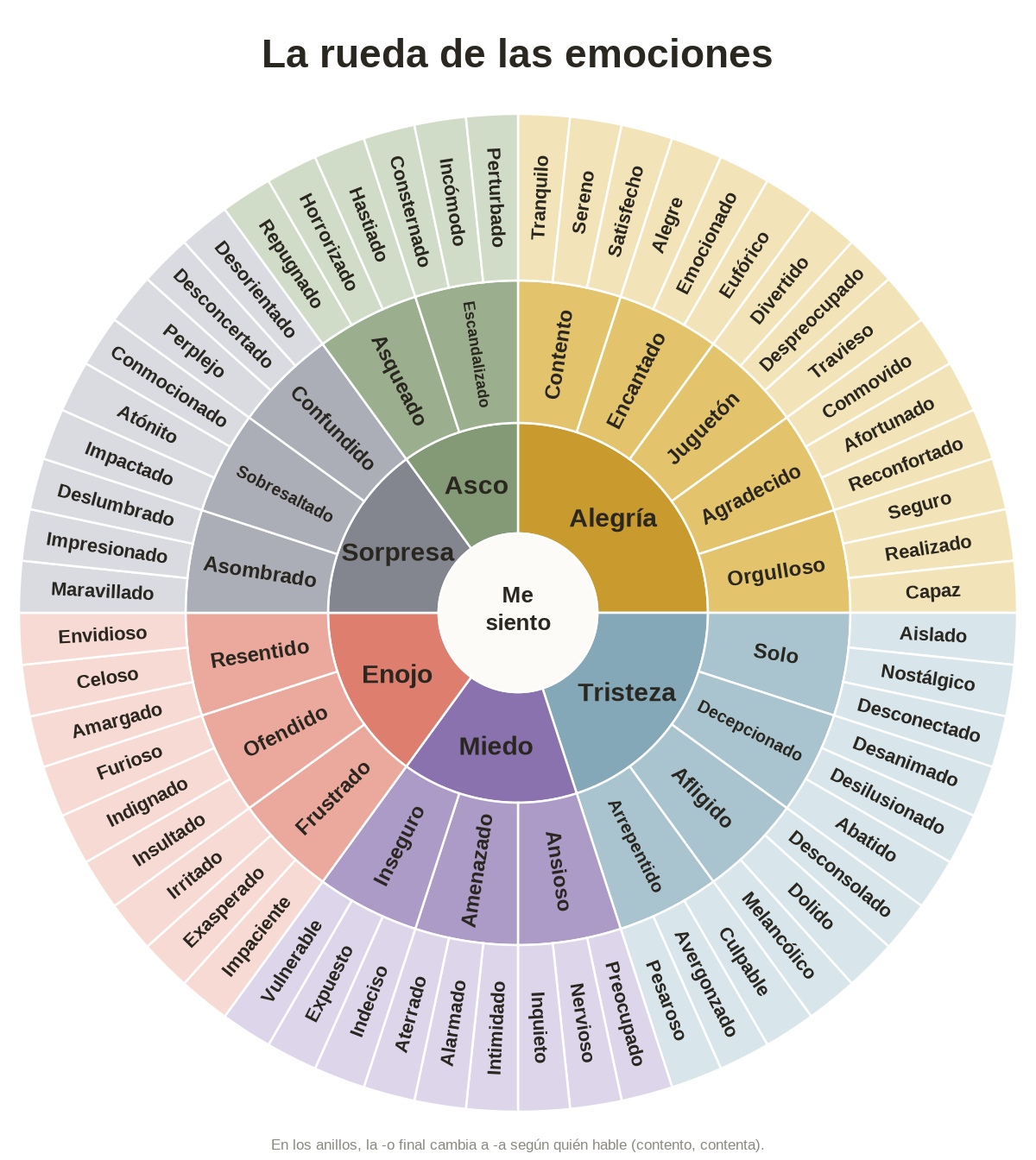
Bilingual key: Spanish word, English word
How to use the wheel
- Start at the center. Which of the six is closest to what you feel right now? Empieza en el centro. De las seis emociones, ¿cuál se parece más a lo que sientes ahora?
- Move out one ring. Read the words in that wedge and stop at the one that fits. Pasa al siguiente anillo. Lee las palabras de esa sección y detente en la que mejor encaje.
- Try the outer ring only if you want a more exact word; the nearest word is good enough. Prueba el anillo exterior solo si quieres una palabra más exacta; la más cercana ya sirve.
- Say it out loud, in the language it comes to you in: me siento, I feel. Dilo en voz alta, en el idioma en que te venga: me siento, I feel.
- If the Spanish word and the English word feel different, say both and notice the gap. Si la palabra en español y la palabra en inglés no te transmiten lo mismo, di las dos y fíjate en la diferencia.
- Ask what it is about and what, if anything, it needs. Pregúntate de qué se trata esa emoción y qué necesita, si es que necesita algo.
Feelings chart in Spanish: 20 everyday feelings with a plain description
- Feliz (happy): me siento bien y ligero; las cosas van bien. Feeling good and light; things are going well.
- Triste (sad): me siento decaído y con el ánimo bajo; a veces quiero llorar. Feeling heavy and low; sometimes wanting to cry.
- Enojado (angry): siento calor y tensión; algo está mal o es injusto. Feeling hot and tense; something is wrong or unfair.
- Asustado (scared): temo que pase algo malo. Afraid that something bad might happen.
- Preocupado (worried): me inquieta algo que todavía no ha pasado. Uneasy about something that has not happened yet.
- Emocionado (excited): tengo mucha energía por algo que va a pasar. Full of energy about something coming.
- Tranquilo (calm): me siento en paz; nada es urgente. At peace; nothing is urgent.
- Frustrado (frustrated): algo no sale como quiero y me siento atascado. Something will not go my way and I feel stuck.
- Solo (lonely): me siento apartado de los demás; quisiera compañía. Feeling apart; wishing for company.
- Avergonzado (embarrassed, ashamed): siento que todos vieron mi error. Feeling that everyone saw my mistake.
- Orgulloso (proud): estoy contento con algo que hice. Pleased with something I did.
- Cansado (tired): me falta energía; necesito descansar. Low on energy; needing rest.
- Aburrido (bored): nada me interesa; me siento inquieto y sin ganas. Nothing holds my interest; restless and flat.
- Confundido (confused): no entiendo lo que pasa. I do not understand what is happening.
- Agradecido (grateful): siento gratitud por algo bueno. Feeling thankful for something good.
- Abrumado (overwhelmed): es demasiado a la vez. It is too much at once.
- Nervioso (nervous): estoy inquieto antes de algo, como un examen. Jumpy before something, like a test.
- Celoso (jealous): temo perder a alguien o que prefiera a otra persona. Afraid of losing someone, or that they prefer someone else.
- Decepcionado (disappointed): no salió como esperaba. It did not turn out as I hoped.
- Ilusionado (hopeful, looking forward): espero algo bueno con ganas. Looking forward to something good with real hope.
Words that do not translate one to one
Vergüenza covers both embarrassment and shame, so avergonzado on the chart can mean either; ask which. In Mexico, Central America, Colombia, Venezuela and the Caribbean the everyday word for embarrassed is apenado. Ilusión, and the adjective ilusionado, is hopeful anticipation of something good, a feeling English describes in a phrase rather than a word. Coraje means courage in most of the Spanish-speaking world but anger in Mexico and parts of the Caribbean, which is why it is not on the wheel. Enojo, enfado and ira are three words for anger at different registers and in different regions; the wheel uses enojo and names enfado for Spain. Extrañar (common in Latin America) and echar de menos (common in Spain) both mean to miss someone; they are verbs, and the rings of the wheel are adjectives, so it carries nostálgico as the nearest one. Ansioso means anxious in most contexts and eager in some, and sensible means sensitive, not sensible. Spanish adjectives agree with the speaker, so every ring word ending in o becomes a when a woman or girl says it, and juguetón becomes juguetona, and the wheel prints the masculine form with a note at the foot. None of these are mistakes in either language; they are places where the two languages cut the same feeling differently, and a bilingual wheel is useful partly because it shows where.
For bilingual homes, classrooms and therapy rooms
- At home: adults name their own feelings from the wheel in both languages, in passing. Estoy frustrado, I am frustrated. Two vocabularies are taught at once, and children hear that either language is allowed for feelings.
- At home: keep the Spanish wheel where the grandparents can see it. A child who can point to triste with an abuela who does not speak English has a shared language for feelings across the generations.
- In a classroom: hang the Spanish wheel beside the English one. A newcomer who speaks Spanish has a way to check in on the first day, and the whole class learns that the first language is welcome.
- In a classroom: use the 20-word chart for daily check-ins and the wheel for writing and reading lessons, where a more exact word is wanted.
- In a therapy room: keep the word list and the bilingual key on the table. When a client reaches for a Spanish word, let them, and ask what the English word would be; the gap between the two is often the material.
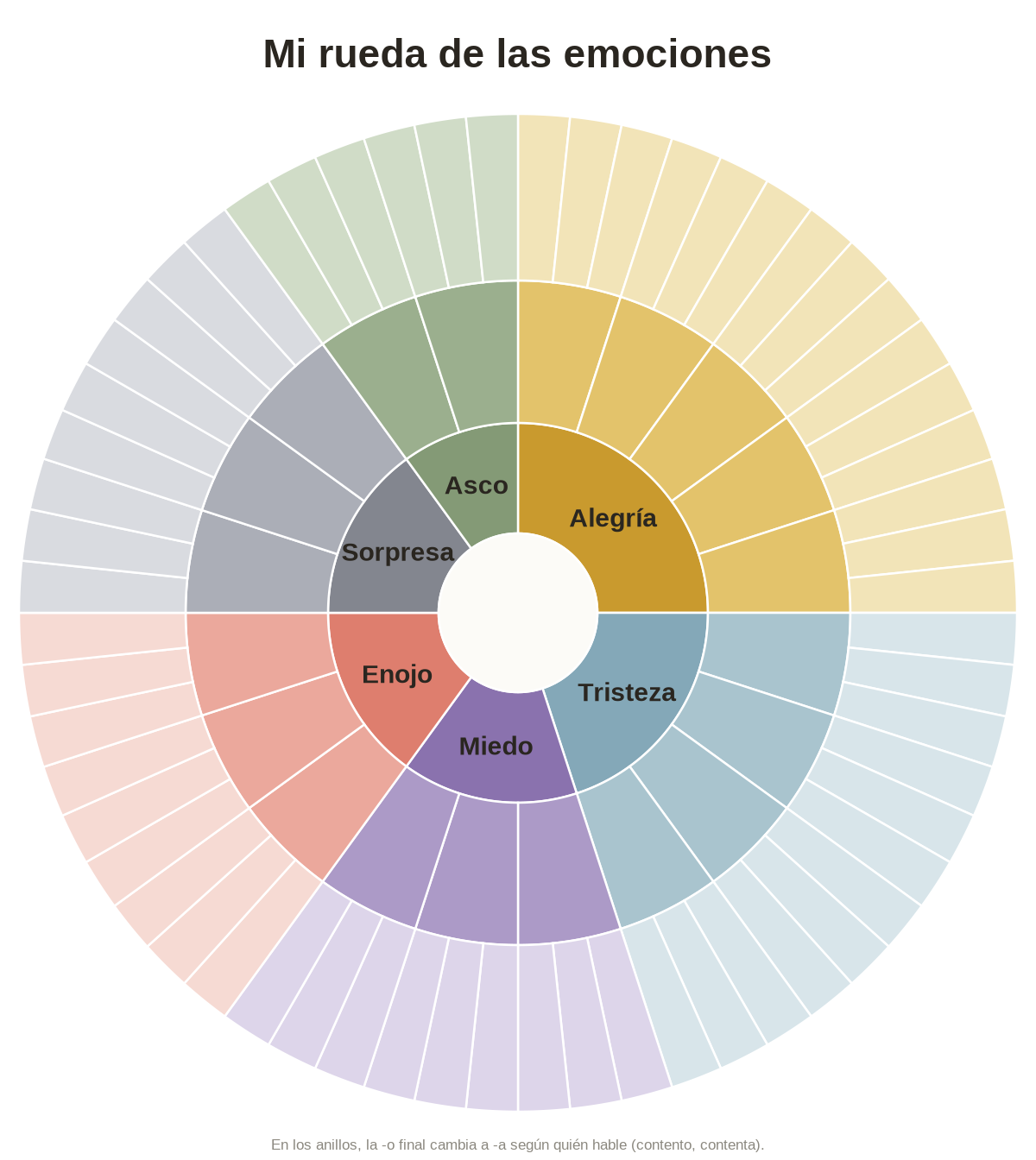
- In a therapy room: use the blank wheel to build the client's own wheel in their own regional Spanish. The printed list is standard usage; the client's words are the ones that matter.
- Everywhere: say the word in the language it arrives in. Translating a feeling before you have felt it is the problem a bilingual wheel is meant to solve.
Related tools
Feelings easier to name in one language than the other?
A bilingual therapist can meet you in the language the feeling arrives in. Free to search our directory.
About this tool
A feelings wheel in Spanish is the emotion wheel most people already know, six core feelings in the center with two rings of finer words around them, with every word in Spanish. It exists because a feeling arrives in a language. A bilingual person who grew up speaking Spanish at home often feels in Spanish and explains in English, and the gap between the two is where the word gets lost. This page gives Psychology.com's own Spanish wheel, la rueda de las emociones, with the English beside every word in a word list, a blank Spanish wheel for writing in your own words, and a plain 20-word feelings chart in Spanish. The page itself is in English, because it is written for the bilingual adult, parent, teacher or clinician who will use the Spanish tool with someone else or with themselves.
The wheel format comes from Gloria Willcox, a therapist who published The Feeling Wheel in the Transactional Analysis Journal in 1982 as a tool for expanding awareness of emotions and increasing spontaneity and intimacy. Her wheel put six core feelings at the center and radiated finer words outward, and many feelings wheels in circulation since, in many languages, follow that idea. The wheel on this page keeps the structure and uses our own selection and arrangement of words, in the same six-core layout as the English Feelings Wheel (Free Printable PDF) on this site. It is not a translation of Willcox's wheel and it does not copy any published Spanish wheel; the word list was built for this page and is printed in full on this page so that it can be checked, corrected and adapted.
Why a wheel in the first language matters is a question linguists have studied. Aneta Pavlenko, reviewing the research on emotion words in bilingual speakers, argued that emotion words form a separate class in the mental lexicon, processed differently from ordinary abstract and concrete words; that emotion concepts differ between languages, so a bilingual's concept of a feeling may not match a monolingual's in either language; and that the emotional force of words varies by language, which shapes which language a bilingual person switches into when feelings run high. In practice this means a Spanish speaker handed an English wheel is being asked to do two jobs at once, translate and feel, and often does neither well. A Spanish wheel removes the first job.
Clinicians who work with Spanish-English bilingual clients have written about the same thing from the therapy room. Azara Santiago-Rivera and Jeanette Altarriba, writing for practicing psychologists in 2002, described how the language a client uses in session shapes what they can reach: memories and feelings tied to childhood often come more easily in the language of childhood, and switching languages mid-session can be a way of approaching or avoiding something. A bilingual feelings wheel on the table lets the client point in either language and lets the clinician see when the Spanish word and the English word are not the same feeling. That is why the key on this page is bilingual rather than a Spanish-only sheet.
A note on the Spanish itself. The core feelings are given as nouns, alegría, tristeza, miedo, enojo, sorpresa and asco, because nouns do not change with the speaker and because Spanish emotion lists conventionally use them. The rings are adjectives, the words that complete me siento, I feel, and Spanish adjectives agree with the speaker: contento for a man or boy, contenta for a woman or girl. The wheel prints the masculine form, as Spanish dictionaries do, with a line at the foot explaining the ending. Some words are regional. Enojo is the general Latin American word for anger and enfado is more common in Spain; both are given. Where a word is used mainly in one region, the key says so.
Some feelings do not translate one to one, and the prose block on this page lists the ones that matter most. Vergüenza covers both embarrassment and shame, which English splits. Ilusión means hopeful excitement about something coming, a feeling English has no single word for. Coraje means courage in most of the Spanish-speaking world and anger in Mexico and parts of the Caribbean. Extrañar and echar de menos, to miss someone, are verbs, so a wheel of adjectives reaches for nostálgico instead. A bilingual wheel is useful partly because it makes these gaps visible: a client who says vergüenza and a clinician who hears embarrassed may be talking about different things, and the wheel is a place to notice that.
How to use it. Print the wheel and keep the word list beside it. Start at the center and ask which of the six is nearest, then move one ring out at a time until a word fits; the finer words are there to be reached for, not to be read through. Say the word in whichever language it comes in, and if the Spanish and English words feel different, say both and notice the gap. With a child, the adult uses the wheel out loud first, in both languages, and lets the child point; the Feelings Wheel for Kids page describes the adult's side of that conversation and applies in any language. The steps block gives the routine in English and in Spanish so that it can be read aloud to a Spanish speaker.
The 20-word feelings chart in Spanish is the simpler tool for people who search for a Spanish feelings chart rather than a wheel: twenty everyday feelings, each with a short plain description in Spanish and the English word, for a fridge, a classroom wall or a waiting room. It overlaps with the wheel on purpose. The chart is where a beginner or a child starts; the wheel is where someone who already has the basic words goes to find a more exact one. Most of its words are on the wheel too: twelve are ring words, and triste and enojado are the adjectives of two center words, while feliz, asustado, cansado, aburrido, abrumado and ilusionado are on the chart only.
For bilingual homes, the wheel works best when the adults use it about themselves, in both languages, in passing. A parent who says estoy frustrado, I am frustrated, the printer again, is teaching two vocabularies at once and showing that feelings can be named in either. For classrooms with Spanish-speaking students, the wheel on the wall beside the English one signals that the first language is welcome and gives a newcomer a way to check in on the first day. For therapy rooms, the word list and the bilingual key are the tool: they let a client who thinks in Spanish and a clinician who works in English meet over the same words.
The wheel is not a test and not a translation service. It will not tell you what someone feels; it gives them more words to choose from and a chance to choose in their own language. Its word list is ours, built for this page and checked for standard usage, but Spanish is an official language in about twenty countries and no single list fits every region; the blank wheel exists so that you can write the words your own family, students or clients actually use. If naming feelings in any language is a daily struggle, or a bilingual child seems stuck between two vocabularies and two homes, a bilingual therapist can help, and the Psychology.com directory is free to search.
References
- Willcox G. The Feeling Wheel: A tool for expanding awareness of emotions and increasing spontaneity and intimacy. Transactional Analysis Journal. 1982;12(4):274-276. doi:10.1177/036215378201200411
- Pavlenko A. Emotion and emotion-laden words in the bilingual lexicon. Bilingualism: Language and Cognition. 2008;11(2):147-164. doi:10.1017/S1366728908003283
- Santiago-Rivera AL, Altarriba J. The role of language in therapy with the Spanish-English bilingual client. Professional Psychology: Research and Practice. 2002;33(1):30-38. doi:10.1037/0735-7028.33.1.30
- Torre JB, Lieberman MD. Putting feelings into words: Affect labeling as implicit emotion regulation. Emotion Review. 2018;10(2):116-124. doi:10.1177/1754073917742706
Cite this source
Psychology.com. (2026, November 27). Feelings Wheel in Spanish. Psychology.com. https://psychology.com/tools/feelings-wheel-spanish
Feelings Wheel in Spanish FAQ
What is a feelings wheel in Spanish?
A feelings wheel in Spanish, la rueda de las emociones or rueda de los sentimientos, is the standard emotion wheel drawn with Spanish words: six core feelings in the center, alegría, tristeza, miedo, enojo, sorpresa and asco, with two rings of finer words around each. It lets a Spanish speaker find the word for a feeling in the language the feeling arrived in, instead of translating first. The one on this page is Psychology.com's own word list in the same structure as our English wheel, printed with a word list that gives the English beside every word, so that bilingual families, classrooms and clinicians can use both languages together.
Is there a feelings wheel in Spanish PDF I can print?
Yes. The PDF on this page carries the Spanish feelings wheel, the word list with the English for every word, the bilingual key, a blank Spanish wheel with the six core feelings printed and the rings left empty for your own words, and the 20-word feelings chart in Spanish. It is free to download and print for home, classroom or clinical use. The wheel prints the masculine form of each adjective with a line at the foot explaining that the ending changes with the speaker, contento or contenta.
Is there a feelings chart in Spanish, simpler than the wheel?
Yes: the 20-word block on this page is a feelings chart in Spanish, twenty everyday feelings, each with a short plain description in Spanish and the English word, for a fridge, a classroom wall or a waiting room. It is the place to start with a child, a beginner in either language or anyone who finds eighty words too many in the moment. The wheel is for the next step, when the basic word is found and a more exact one is wanted. Twelve of its words are also ring words on the wheel, so moving between them starts from words already learned.
Why does the feelings wheel use nouns in the center and adjectives in the rings?
Because the two parts do different jobs. The center names the family of feeling, and Spanish emotion lists conventionally do that with nouns, alegría, tristeza, miedo, which do not change with the speaker. The rings complete the sentence me siento, I feel, which takes an adjective, and Spanish adjectives agree with the speaker: a man says contento, a woman says contenta. The wheel prints the masculine form, as dictionaries do, and explains the ending at the foot of the sheet. If you make your own wheel on the blank sheet, write the words the way the people who will use it say them.
Why are some Spanish feeling words different in Spain and Latin America?
Spanish is an official language in about twenty countries, and feeling words vary by region more than most vocabulary does. Enojo is the general word for anger in Latin America and enfado in Spain; the wheel uses enojo and names enfado. Coraje means courage in most places and anger in Mexico and parts of the Caribbean, so it is left off. Ansioso means anxious almost everywhere and eager in some places. The word list on this page follows standard usage and was checked for it, but no single list fits every region, which is why the blank wheel exists: write the words your own family, students or clients use.
Does naming a feeling in Spanish work differently from naming it in English?
For a bilingual person, often yes. Aneta Pavlenko's review of emotion words in bilinguals found that emotion words are processed as their own class, that emotion concepts differ between languages, and that the emotional force of words differs between a bilingual person's languages. Clinicians such as Santiago-Rivera and Altarriba describe clients reaching childhood feelings more easily in the childhood language. The research on affect labeling, which finds that putting a feeling into words is associated with lower distress, was done mostly with English-speaking adults; it gives a reason to expect naming helps, not proof that it helps equally in both languages. A bilingual wheel lets the person choose.
Can I use the Spanish feelings wheel with my child?
Yes, in the way any feelings wheel is used with a child: the adult does the work. Name your own feelings from the wheel out loud, in both languages, in passing. Bring it out when the child is calm, not mid-meltdown, and invite them to point rather than asking them to explain. Accept whichever word, in whichever language, they choose. For a young child start with the six center words and the 20-word chart, and add the rings as the words fit. The Feelings Wheel for Kids page on this site describes the adult's side of that conversation in detail, and everything on it applies in Spanish.