In short
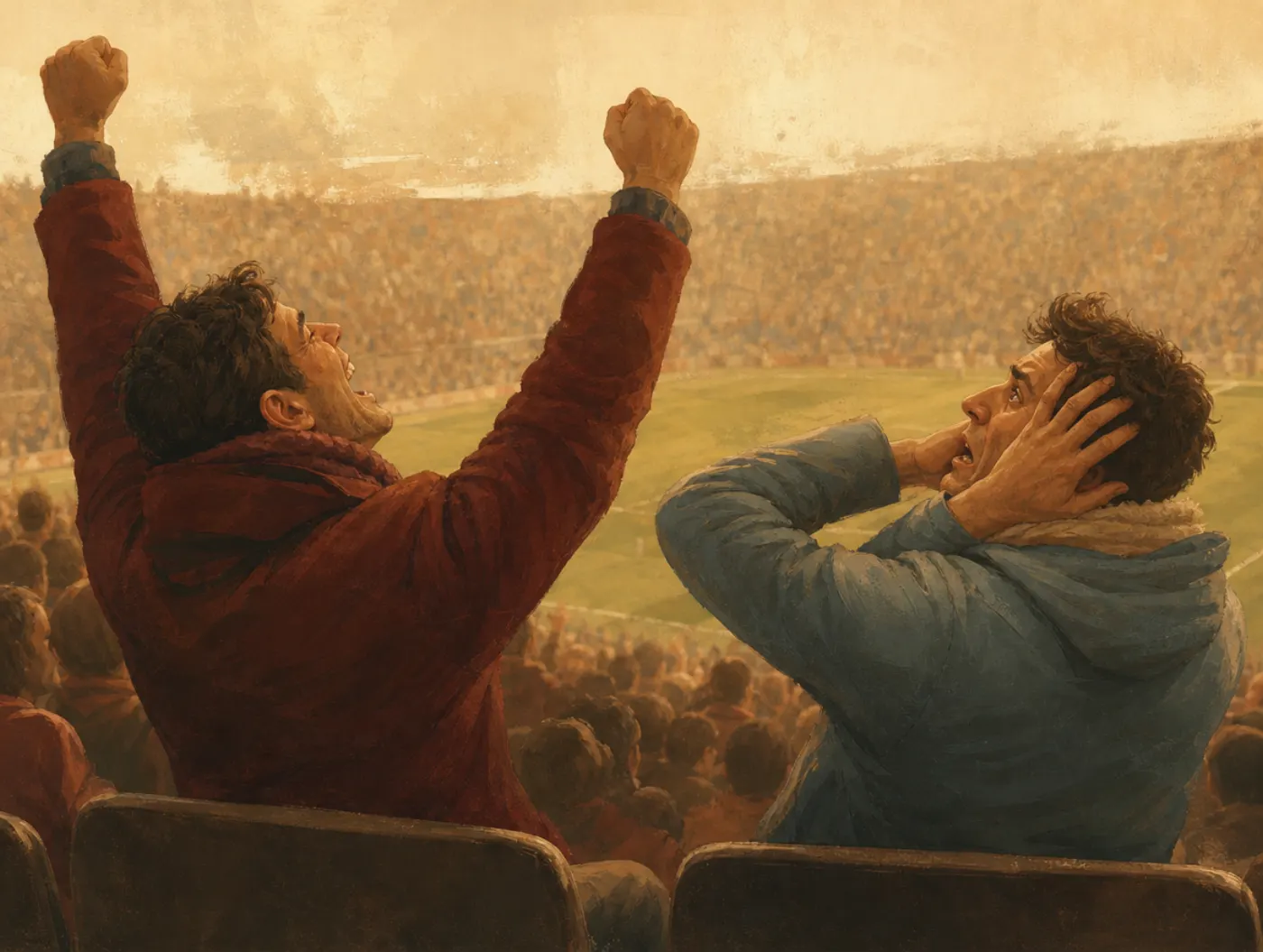
Selective perception is the tendency to notice, interpret and remember the parts of a situation that fit your expectations, loyalties or needs, while the parts that do not fit are overlooked or explained away. It shows up in how fans of two teams describe the same game, how supporters of two candidates hear the same debate, how a manager reads a report that criticizes their project, and how a patient hears a diagnosis they were not expecting.
How selective perception works
Perception is not a recording. What reaches awareness has already been sorted by attention, which goes to some things and not others, and shaped by interpretation, which decides what an ambiguous event means. Both steps are guided by what the perceiver already believes and wants. A fan who expects the other team to play dirty looks for contact by the other team, finds it, and reads it as a foul; the same contact by their own team is a hustle play, or is not noticed at all. Nothing dishonest has happened. Each fan reports what they saw, and they saw different games.
Hastorf and Cantril put the point sharply in 1954: there is no such thing as a game out there that people merely observe. The game exists for a person only as the events they pick out and give meaning to, and those events are selected from a huge field of possible ones. Of the hundreds of collisions in a football game, a spectator notices a few, and which few depends on which team they came to see win. Which side was in fact rougher, the authors wrote, is not a question the study answers.
The same selection runs on expectation as well as loyalty. In Vallone, Ross and Lepper's 1985 study, pro-Israeli and pro-Arab students watched the same network news coverage of the 1982 Beirut massacre, and each group rated it as biased against their own side. The authors suggested that partisans on each side had noticed and remembered more of the content that went against them. A report that strikes both camps as hostile is a sign that the camps are perceiving selectively, not evidence about the report.
Selective perception is cousin to confirmation bias but sits earlier in the process: it is about which parts of a scene reach a person and what those parts seem to be, before any evidence is weighed. The demo above cannot show the attention half of that, since every play is described in full. What it can show is the interpretation half: the same words, read as a foul or as a fair play depending on which side the player wears.
The original study
On November 23, 1951, Dartmouth played Princeton at Princeton's Palmer Stadium. Princeton was unbeaten and its star, Dick Kazmaier, was playing his last game; he left in the second quarter with a broken nose, and a Dartmouth player later left with a broken leg. The game was rough and the penalties heavy, and in the following week the student newspapers of the two colleges accused each other's teams of dirty play. Albert Hastorf of Dartmouth and Hadley Cantril of Princeton saw a natural experiment and published "They saw a game: A case study" in the Journal of Abnormal and Social Psychology in 1954.
The study had two parts. A week after the game, a questionnaire went to 163 Dartmouth and 161 Princeton undergraduates in psychology courses. Asked which team started the rough play, 86 percent of the Princeton students said Dartmouth; among Dartmouth students, 36 percent said Dartmouth and 53 percent said both sides started it. Asked whether the game had been clean and fair or rough and dirty, no Princeton student chose clean and fair and 93 percent chose rough and dirty; Dartmouth students split, with 39 percent writing in an answer of their own, rough and fair.
In the second part, 48 Dartmouth students and 49 Princeton students watched the same film of the game and checked every infraction they saw as it happened, marking each as mild or flagrant. Princeton students saw the Dartmouth team commit 9.8 infractions on average, more than twice the 4.2 they saw their own team commit, and they rated the Dartmouth infractions flagrant about twice as often as mild. Dartmouth students saw 4.3 infractions by Dartmouth and 4.4 by Princeton, about the same number for each side. The two groups had watched the same reel and counted different games.
The paper did not set out to decide who had actually played rough, and its authors said so. Its point was that the game each group reported was a product of what that group brought to it. Vallone, Ross and Lepper's 1985 study of the hostile media phenomenon, with 68 pro-Israeli, 27 pro-Arab and 49 neutral students, is the best known follow-up.
Everyday examples
Selective perception operates wherever people with different stakes look at the same scene. The rows below are illustrations, not findings from the studies cited on this page.
| Situation | What the bias does | What helps |
|---|---|---|
| Two managers read the same customer survey after a product launch one of them led | The one who led the launch notices the praise and treats the complaints as outliers; the other does the reverse | Agree before reading what result would count as a success and what would count as a problem |
| A couple recounts the same argument to a friend | Each remembers the other's sharpest remark and their own as a reasonable reply | Write down what each person said, in order, before interpreting any of it |
| A supporter of each candidate watches a debate | Both come away sure their candidate landed the better points and the moderator favored the other side | Score specific claims against a transcript rather than an overall impression |
| A doctor gives a mixed prognosis | The patient hears the hopeful sentence and misses the caution, or the other way round | Ask for the main points in writing and repeat them back |
| A hiring panel reviews a candidate one member recommended | The recommender notices evidence of fit and reads gaps as fixable; a skeptic notices the gaps | Score each criterion independently before the panel discusses the candidate |
How to counter it
Perceiving selectively is not a choice, so the counter-measures change what gets recorded and who records it.
- Decide the criteria before the event. A list of what would count as a foul, a success or a failure, written down in advance, is much harder to bend to a loyalty than a judgment made on the spot.
- Keep a record that does not depend on memory. A transcript, a video, a tally sheet or a log can be checked by someone with the opposite stake; a recollection cannot.
- Get the opposite stake to look. If two readers with opposing loyalties both find a report fair, that is stronger evidence than one reader's confidence.
- Separate counting from judging. Count every instance of the behavior first, from both sides, and only then decide which ones mattered. Hastorf and Cantril's students did the two together and the counts followed the loyalties.
- Treat your own certainty as a symptom. The feeling of having plainly seen what happened is exactly what both sets of students reported.
What it is not
Selective perception is the front end of a family of biases that keep beliefs in place, and the family members are easily run together.
- It is not confirmation bias, which is about seeking and weighting evidence to support a belief already held. Lord, Ross and Lepper showed the weighing step in 1979, when supporters and opponents of the death penalty each rated the study that favored their side as the better piece of research. Selective perception comes first: it decides which parts of a scene register and what they appear to be, before any weighing is done.
- It is not naive realism, the conviction that you see the world as it is and that anyone who disagrees must be biased or misinformed. That conviction is what makes selective perception hard to notice from the inside, but it is a belief about perception rather than the selection itself.
- It is not attentional bias, the narrower finding that attention is drawn to stimuli linked to a current concern, such as threat words for an anxious person. Selective perception covers interpretation and memory as well as attention, and it is driven by expectations and loyalties rather than by emotional state alone.
Tests and tools that use this
Related biases
Selective Perception FAQ
What is selective perception?
It is the tendency to notice, interpret and remember the parts of a scene that fit what you already expect or want, while the parts that do not fit are missed or explained away. The classic demonstration is Hastorf and Cantril's 1954 study, in which Dartmouth and Princeton students watched the same film of a rough football game and counted very different numbers of fouls by each team, each group seeing the other side as the rougher one.
What did the Dartmouth-Princeton study find?
After a rough 1951 game, 49 Princeton students who watched the film saw the Dartmouth team commit 9.8 infractions on average, while 48 Dartmouth students watching the same film saw 4.3. Dartmouth students saw about the same number for each team. On a questionnaire, 86 percent of Princeton students said Dartmouth started the rough play; most Dartmouth students said both sides did. The authors concluded that each group had, in effect, watched a different game.
How does the demo on this page test selective perception?
You rated three plays twice, once with your side making the contact and once with the rival, with the descriptions identical except for one word. A higher average for the rival's plays runs the way the 1954 counts ran, but one person's six ratings cannot separate loyalty from ordinary variation in how a scale gets used, and reading a play in words is not the same as watching one. The page reports the gap without calling it an error. Only the outcome label leaves your browser.
Is selective perception the same as confirmation bias?
They are related but not the same. Confirmation bias describes how people seek out and weigh evidence once they hold a belief: they look for support and discount the rest. Selective perception operates earlier, in what reaches awareness at all and how an ambiguous event is read in the moment. A fan who never notices their own team's shove is perceiving selectively; a fan who notices it and decides it does not count is confirming.
What is the hostile media effect?
It is the finding, reported by Vallone, Ross and Lepper in 1985, that partisans on opposite sides of an issue both rate the same news coverage as biased against their own side. Pro-Israeli and pro-Arab students watched identical network coverage of the 1982 Beirut massacre and each group saw it as hostile to their position. The authors treated it as a case of selective perception, with each side noticing and remembering the parts of the coverage that went against it.
How can I tell when my own perception is selective?
From the inside you usually cannot, which is why the counter-measures on this page are structural: decide the criteria before the event, keep a record that does not rely on memory, and have someone with the opposite stake look at the same material. A reliable warning sign is the feeling that what happened was obvious and that the other side must be lying or deluded. Both groups of students in 1954 reported exactly that feeling about each other.

References
- Hastorf, A. H., & Cantril, H. (1954). They saw a game; a case study. Journal of Abnormal and Social Psychology, 49(1), 129-134. doi.org
- Vallone, R. P., Ross, L., & Lepper, M. R. (1985). The hostile media phenomenon: Biased perception and perceptions of media bias in coverage of the Beirut massacre. Journal of Personality and Social Psychology, 49(3), 577-585. doi.org
- Lord, C. G., Ross, L., & Lepper, M. R. (1979). Biased assimilation and attitude polarization: The effects of prior theories on subsequently considered evidence. Journal of Personality and Social Psychology, 37(11), 2098-2109. doi.org
Cite this source
Psychology.com. (2026, October 21). Selective Perception. Psychology.com. https://psychology.com/biases/selective-perception