In short
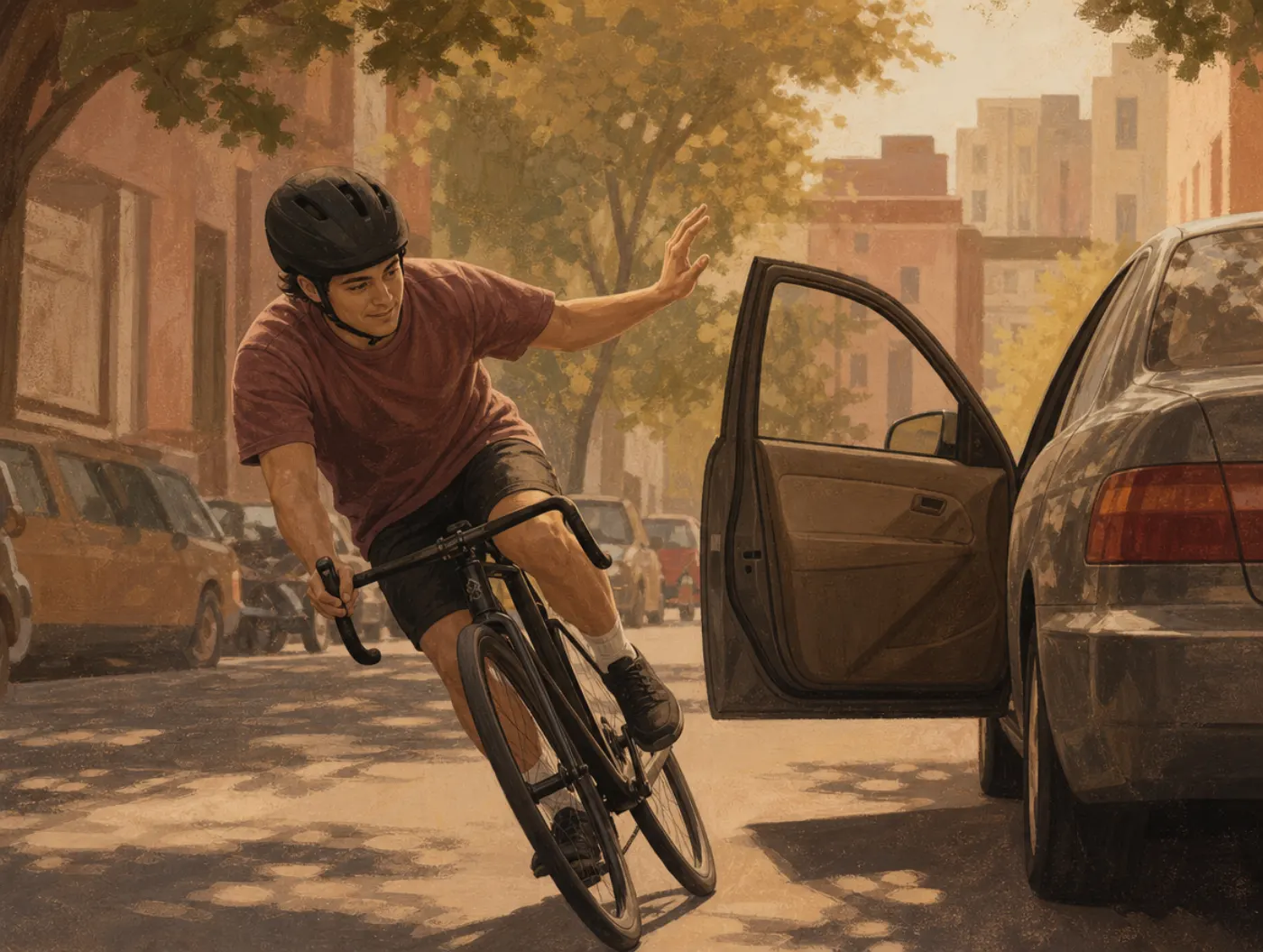
Risk compensation is the tendency to behave less cautiously when something makes a situation feel safer, so that part of the protection a seat belt, a helmet or a better brake provides is spent on speed, closer following or less attention instead of on safety. It shows up in taxi fleets fitted with antilock brakes, in cyclists who ride faster with a helmet on, and in drivers who look at their phones more once the car can brake for them.
How risk compensation works
Risk compensation is the general finding that people respond to feeling safer by accepting a little more risk, and this page is about that finding in behavior: how drivers, cyclists and workers adjust when their protection improves. The related Peltzman effect is the specific economic claim, made about US car safety regulation in 1975, that the adjustment cancels the regulation's benefit; that claim has its own page and its own evidence.
The mechanism is ordinary. A driver chooses a speed and a following distance by weighing how fast the trip goes against how likely a crash feels. Better brakes lower the felt likelihood, and the trade-off resettles at a slightly faster speed or a shorter gap. Nothing about this is irrational in itself. The problem is in the accounting: engineers and regulators estimate a measure's benefit from the physics, as if behavior would hold still, and behavior does not hold still.
The strongest version of the idea is Gerald Wilde's theory of risk homeostasis, published in Risk Analysis in 1982. Wilde argued that each population has a target level of risk it is willing to accept and that the accident rate is governed by that target alone: make the road or the car safer and people adjust until the accident rate returns to where it was. That is a claim of complete offset, and it has not held up. Leonard Evans examined traffic fatality data in 1986 and found every data set he looked at incompatible with the theory; fatalities per mile differ several-fold between road types and have fallen many-fold over decades, which a constant target could not produce. Wilde replied the same year, but the weaker claim is the one that survived: people compensate, the amount varies by measure and setting, and it has to be measured rather than assumed.
Compensation is largest when the protection is noticeable and under the person's control. Antilock brakes announce themselves every time they engage, and a driver can use them to brake later. A stronger roof pillar is invisible and offers nothing to spend, so little compensation is expected.
The original study
The Munich taxi study is the field experiment most often cited for risk compensation, because its design removed the usual objection that cautious drivers are the ones who buy safety equipment. Bernhard Biehl, Michael Aschenbrenner and Gerhard Wurm, in a project for the German federal road research institute, arranged for a Munich taxi company to fit antilock brakes to part of its fleet and to assign drivers to cars at random, so that drivers did not choose whether they drove with ABS. Their report appeared in 1987 in the institute's series Unfall- und Sicherheitsforschung Strassenverkehr; Aschenbrenner and Biehl summarized it in English in 1994 in the volume Challenges to Accident Prevention, edited by Rudiger Trimpop and Gerald Wilde.
The accident analysis covered 1981 to 1983 and compared 21 ABS-equipped taxis with 500 random samples of taxis without ABS drawn from the same fleet. The ABS taxis were not involved in fewer accidents than the comparison vehicles, and the report concluded that under big-city traffic conditions the system showed no safety gain. A second phase, in 1985 and 1986, looked at behavior. Trained observers rode as passengers on 113 drives without the drivers knowing their driving was being rated, and the observers did not know which cars had ABS. The ABS drivers cut curves more, held their lane less precisely, looked less far ahead in traffic, merged with poorer adjustment to other vehicles and created more conflict situations. The 1994 chapter named six mechanisms by which the compensation could happen, including inattentive driving that follows from feeling safer and overestimation of what the system can do in some conditions.
Read the diagram and evidence as text
Matched cars follow the same curved road. A car with an antilock-brake shield takes an accented route closer to the inside hazard boundary. The shield is a protection cue, not a measured safety buffer, and the paths are illustrative, not recorded trajectories. The study reported more curve-cutting and no fewer accidents, not accident rates.
Where a brake's safety gain went
Direction only; no accident rates in the page claim
Antilock brakes fitted: Assigned to the car, not chosen by the driver
The car feels safer: A crash feels less likely
Less cautious driving: Cut curves, held the lane less precisely, more conflict situations
Accident record: Not involved in fewer accidents
Antilock brakes fitted → announces itself each time it engages → The car feels safer
The car feels safer → the margin is spent on speed and attention → Less cautious driving (error transition)
Less cautious driving → the safety gain is used up → Accident record
| Condition | Value and unit | Evidence quote |
|---|---|---|
| ABS taxi drivers, 113 observed drives | Cut curves, held the lane less precisely, more conflict situations ordinal driving behavior, versus drivers without ABS | in 113 observed drives their drivers cut curves, held their lane less precisely and created more conflict situations than the drivers without ABS |
| 21 ABS taxis against 500 random samples of conventional taxis, 1981 to 1983 | Not involved in fewer accidents ordinal accident involvement, versus conventional taxis | the ABS taxis were not involved in fewer accidents |
The study has limits worth stating plainly. Twenty-one cars is a small treatment group, the result is about taxis in one city, and the behavioral observations came two years after the accident data. The reason it matters is the random assignment: the drivers who drove more aggressively had not chosen the safer car, so the car changed the driving. That is the pattern risk compensation names, measured in traffic rather than in a questionnaire.
Everyday examples
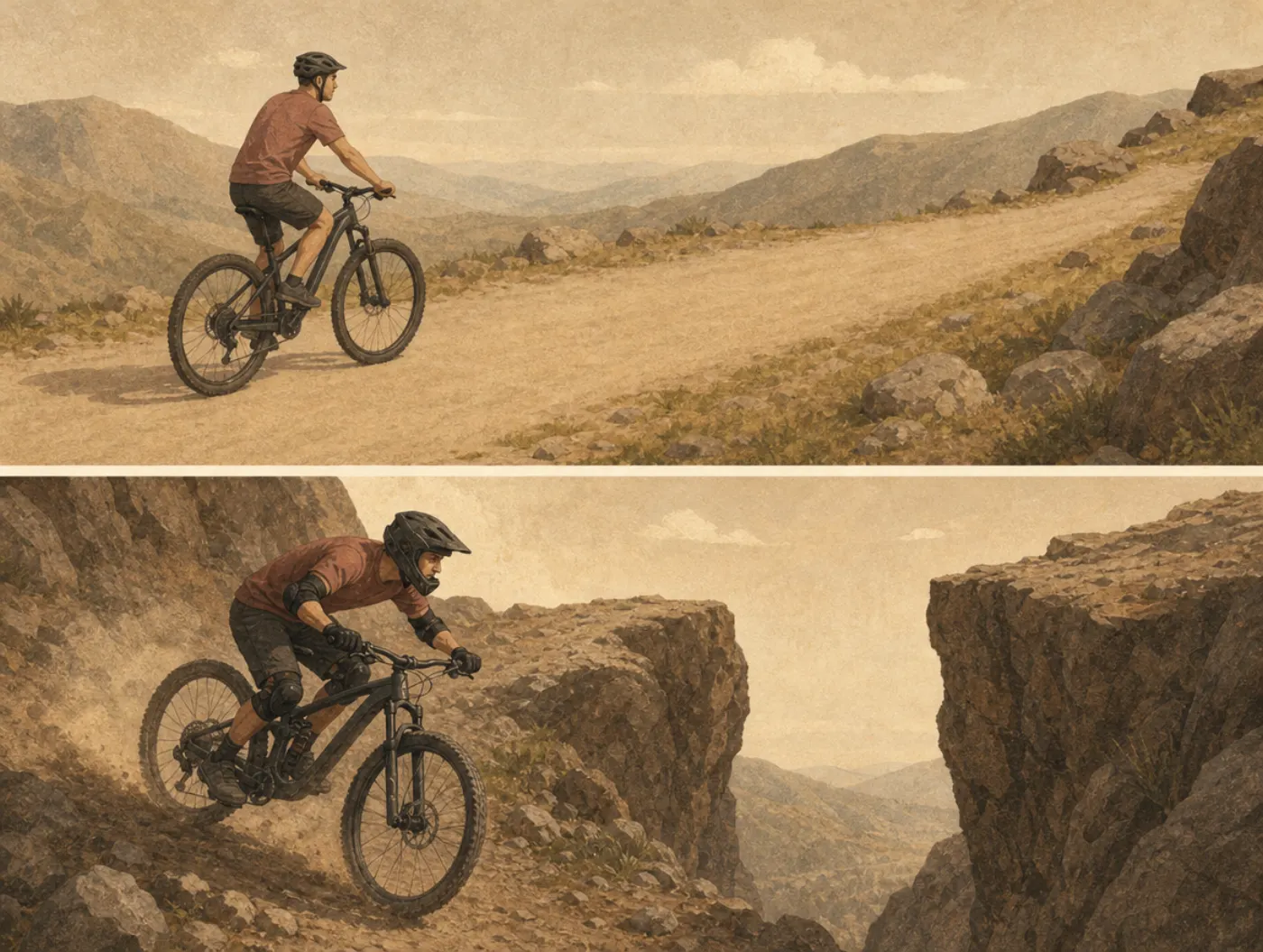
The pattern appears wherever a safety measure is visible to the person it protects. The rows below are illustrations, not findings from the cited studies.
| Situation | What the bias does | What helps |
|---|---|---|
| A driver's new car brakes automatically and keeps its lane | Attention drifts to the phone or the dashboard screen because the car seems to be watching | Treat the systems as a second line of defense, and keep the phone out of reach for the trip |
| A cyclist buys a helmet | Routes and speeds that felt too risky bareheaded start to feel acceptable | Decide the route and the speed before putting the helmet on, and keep them |
| A hiker carries a satellite messenger with an emergency button | Later starts, thinner margins and routes beyond the group's experience | Plan the trip as if rescue were not available, then carry the device anyway |
| A workplace installs a guard on a machine | Operators reach closer to the blade or skip the lockout step, trusting the guard | Keep the procedure fixed and audit it after the guard goes in, not only before |
| A skier wears a helmet on a crowded run | Speed creeps up on the sections where a fall used to feel costly | Set a speed rule for the run itself, and notice when the helmet is the reason for breaking it |
How to counter it
Risk compensation cannot be switched off, because it is a reasonable response to a real change. What can be managed is how much of a safety gain gets spent.
- Separate the decision from the equipment. Choose your speed, your following distance and your route as a rule for the road, and let the protection be a margin on top of the rule rather than a license to move it.
- Notice the sentence "it can handle it." When the justification for doing something riskier is the equipment rather than the conditions, that is compensation talking.
- Prefer protection that offers nothing to spend. Measures people cannot feel, such as a stronger structure or a better-designed intersection, tend to deliver their full engineering benefit.
- Measure after the change. For a fleet or a workplace, the question is not whether the device works in a test but what the accident and near-miss record looks like six months after people have adjusted to it.
- Keep the limits in view. The compensation happens most easily when the protection is felt and its limits are not; a driver who knows that antilock brakes help only when the gap in front is kept is in a position to keep the gap.
What it is not
Risk compensation sits in a family of ideas about safety and behavior, and the neighbors differ in what they claim.
- It is not the Peltzman effect, the specific 1975 claim that US car safety regulation produced no net reduction in deaths because drivers offset the gain. The Peltzman effect is risk compensation applied to regulation and pushed to a complete offset, and that strong version is the part the later data rejected. This page is about the general finding and the partial adjustments it describes.
- It is not optimism bias, the tendency to rate your own chance of a bad outcome below other people's. A compensating driver may be accurate about the risk and still choose to spend part of the new margin on speed; the adjustment is a preference, not a misestimate.
- It is not the illusion of control, which is overestimating your influence over an outcome governed by chance. A driver who follows closer because the brakes are better is responding to a real change in control; the error, if there is one, is in how large the change is and in forgetting that other road users got none of it.
Tests and tools that use this
Related biases
Risk Compensation FAQ
What is risk compensation?
It is the tendency to behave less cautiously when something makes a situation feel safer, so that part of the protection is spent on speed, closer following, a harder route or less attention. The Munich taxi study of the 1980s is the standard example: taxis fitted with antilock brakes were not involved in fewer accidents, and observers rated their drivers as more aggressive than drivers of the same fleet's conventional cars.
Is risk compensation the same as risk homeostasis?
No. Risk homeostasis is Gerald Wilde's 1982 theory that each population has a target level of risk and adjusts its behavior until the accident rate returns to that target, so that no safety measure can lower it for long. That is a claim of complete offset. Risk compensation is the weaker and better-supported claim that people adjust partially, by an amount that depends on the measure and has to be measured. Leonard Evans showed in 1986 that traffic fatality data are incompatible with the complete-offset version.
Does wearing a bicycle helmet make people ride more dangerously?
The evidence points to a modest shift in risk appetite rather than reckless riding. In Gamble and Walker's 2016 laboratory study, adults who wore a helmet as an eye-tracker mount pumped a cartoon balloon further for money than adults wearing a cap, a mean risk score of 40.40 against 31.06, though the helmet could protect them from nothing in the task. Radun and Lajunen noted in 2018 that the experimenter was not blind to the condition. Helmets still reduce head injury in a crash.
How does the demo on this page work?
You answered three questions about what you would do when the protection improved: following distance after antilock brakes, route choice after a helmet, phone use in a car that brakes for you. Choosing the closer gap, the faster road or the extra glance in any one of them counts as the compensation pattern; the same behavior in all three counts as keeping the gain. It is a self-report, not a measurement of your driving. Only the outcome label leaves your browser.
Does risk compensation mean safety measures do not work?
No. Seat belts, airbags and helmets reduce injury in crashes, and the panel studies that followed Peltzman's 1975 claim found that seat belt laws saved most of the lives the engineering predicted. What risk compensation means is that the realized benefit of a measure can be smaller than its benefit on a test track, by an amount that is larger for protection people can feel and use, such as antilock brakes, and close to zero for protection they cannot, such as a stronger roof.
How do I avoid compensating for safety equipment?
Fix the behavior rule before the equipment arrives: a following distance, a speed for a particular descent, a phone-away rule for the drive. Then treat the equipment as a margin above the rule rather than a reason to change it. Listen for the phrase "it can handle it," which is usually the compensation speaking. For organizations, measure the accident and near-miss record after people have adjusted to a new device, not only its performance in trials.

References
- Aschenbrenner, K. M., & Biehl, B. (1994). Improved safety through improved technical measures? Empirical studies regarding risk compensation processes in relation to anti-lock braking systems. In R. M. Trimpop & G. J. S. Wilde (Eds.), Challenges to accident prevention: The issue of risk compensation behaviour (pp. 81-89). Groningen: Styx Publications. trid.trb.org
- Biehl, B., Aschenbrenner, M., & Wurm, G. (1987). Einfluss der Risikokompensation auf die Wirkung von Verkehrssicherheitsmassnahmen am Beispiel ABS. Unfall- und Sicherheitsforschung Strassenverkehr, 63, 65-70. Bundesanstalt fur Strassenwesen. trid.trb.org
- Wilde, G. J. S. (1982). The theory of risk homeostasis: Implications for safety and health. Risk Analysis, 2(4), 209-225. doi.org
- Evans, L. (1986). Risk homeostasis theory and traffic accident data. Risk Analysis, 6(1), 81-94. doi.org
- Gamble, T., & Walker, I. (2016). Wearing a bicycle helmet can increase risk taking and sensation seeking in adults. Psychological Science, 27(2), 289-294. doi.org
- Radun, I., & Lajunen, T. (2018). Bicycle helmets and the experimenter effect. Psychological Science, 29(6), 1020-1022. doi.org
- Peltzman, S. (1975). The effects of automobile safety regulation. Journal of Political Economy, 83(4), 677-725. doi.org
Cite this source
Psychology.com. (2026, October 23). Risk Compensation. Psychology.com. https://psychology.com/biases/risk-compensation