In short
The gambler's fallacy is the belief that after a run of one outcome from a random process, the opposite outcome has become more likely, as if chance kept accounts and owed a correction. It shows up at roulette tables and lottery counters, in parents who expect a girl after three boys, and in investors and sports fans who read a streak as a sign that a reversal is overdue.
How the gambler's fallacy works
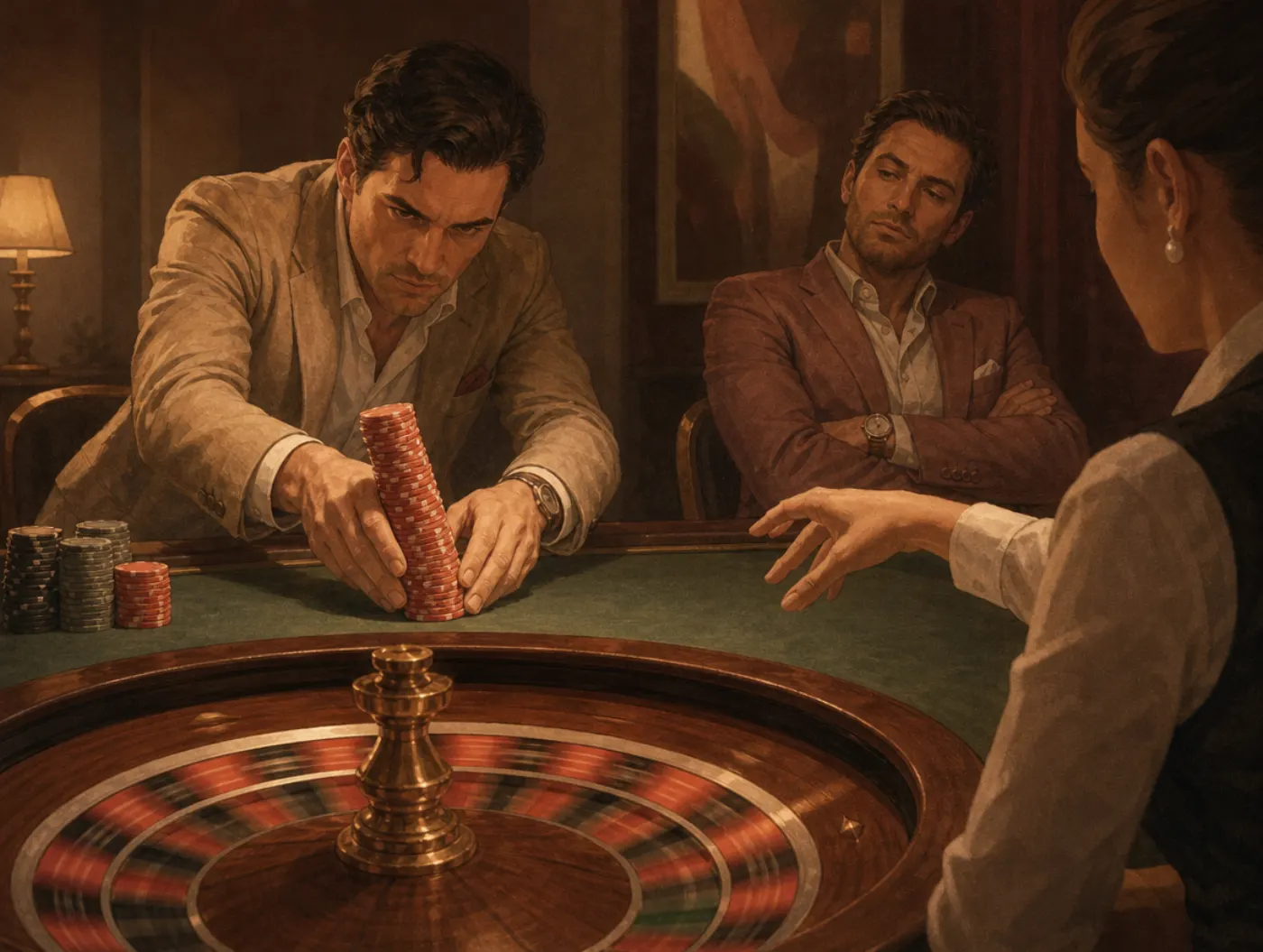
A fair wheel has no memory. The probability of red on the sixth spin is the same as on the first, whatever the previous five showed, because nothing about the wheel, the ball or the croupier is changed by the earlier results. Each spin is independent. The fallacy is to treat the sequence as if it were a single draw from a fixed supply, so that five reds have used up red's share and black must now come up to restore the balance.
Tversky and Kahneman traced the error to a belief they called the law of small numbers: the intuition that a short sequence should look like the long-run proportion it comes from. Over a million spins, red and black will each be close to half. People expect the same of six spins, so a run of five reds looks like a deviation that the process is obliged to correct. The correction is real, but it works by dilution rather than by compensation: the five reds become a smaller and smaller share of a growing total, and no individual spin leans the other way.
The same intuition produces the opposite error. When people believe that the process is not random, for example that a basketball player can be hot, the same streak is read as a signal that the next outcome will match it. Croson and Sundali found both patterns in one casino: roulette bettors, who know the wheel is random, bet against streaks, while the same players' betting on their own luck showed the hot hand pattern, placing more bets after a win.
In the casino data the fallacy grew with the length of the streak. It is also easier to fall into when past outcomes are displayed in a row, which is why the demo above shows the five spins one after another and why casinos put recent results on a board above the wheel. Knowing that the spins are independent does not switch the intuition off; it has to be managed, which is what the counter-measures below are for.
The original study
The name is older than the research. The usual origin story is a long run of black at the Monte Carlo casino, usually dated to 1913, with players betting ever larger sums on red as it went on; the account comes from later retellings rather than from casino records. Laplace had described the error in his Philosophical Essay on Probabilities, cited below in its 1825 edition, in men who, wanting a son, believed that the boys already born that month made a girl more likely next. Controlled experiments on how people read random sequences were under way by the 1950s and 1960s. The most influential account of the fallacy is Tversky and Kahneman's 1971 paper "Belief in the law of small numbers" in Psychological Bulletin, which showed that even research psychologists expected small samples to mirror the population they came from, the intuition that makes a run look like a deviation in need of a correction.
The cleanest field evidence is Rachel Croson and James Sundali's 2005 paper in the Journal of Risk and Uncertainty, which analyzed security camera footage of 18 hours of play at a Nevada casino, covering 139 roulette players and 24,131 recorded bets. For each spin they classified the bets placed on even-money outcomes (red or black, odd or even, high or low) as with the streak or against it, as a function of how long the streak had run.
After a streak of one or two the bets were evenly split. As the streak lengthened, bets moved against it: after five of one outcome roughly two-thirds of the bets were on the other, and after six or more, 85 percent of the bets went against the streak. The same players also bet more numbers after winning a spin and fewer after losing, the hot hand belief about their own luck sitting alongside the gambler's fallacy about the wheel.
A 2016 study of asylum judges, loan officers and baseball umpires by Chen, Moskowitz and Shue found a related pattern outside gambling: a decision in one direction made the next decision somewhat less likely to go the same way, even when the cases were unrelated. The authors read this as the gambler's fallacy at work, while allowing that a contrast between consecutive cases could play a part.
Everyday examples
The fallacy appears wherever independent events are watched in sequence.
| Situation | What the bias does | What helps |
|---|---|---|
| A lottery player picks numbers that have not come up in months | Treats overdue numbers as more likely, though every draw is independent and every combination equally likely | Ask whether anything about the machine remembers past draws; it does not |
| Parents of three boys feel sure the fourth will be a girl | Expects the sex ratio to balance within one family | The chance is close to 50-50 each time, whatever the siblings are |
| An investor sells a fund after five up months because a fall is due | Reads a run as evidence of reversal without any information about the asset | Decide on fundamentals and a plan, not on the length of the run |
| A loan officer has approved four applications in a row | Treats a fifth qualified applicant as less likely to deserve approval after four yeses, though the files are independent | Score each file against fixed criteria and review approval rates in batches |
| A football team has lost three coin tosses | Captain feels this toss is theirs | Notice the feeling, then call it anyway; the odds are unchanged |
How to counter it
The fallacy is an intuition, and intuitions are not reliably removed by knowing better. They are managed.
- Ask the memory question. Does anything about this process carry information from the last outcome to the next? A wheel, a coin, a lottery machine: no. A tired goalkeeper, a depleted inventory, a pitcher's arm: perhaps. Only in the second case can a streak mean anything.
- Think in single events rather than sequences. The probability of black on this spin is a fact about this spin. The run of reds is a fact about the past.
- Expect streaks. In 100 fair coin flips, a run of five or more of one side is very likely to occur somewhere. A streak is what randomness looks like, not a departure from it.
- Fix the decision rule in advance. A loan officer with a written scoring sheet, or an investor with a rebalancing rule, has nothing to correct for.
- Be suspicious of the word due. It almost always marks the fallacy, in your own thinking or in someone else's pitch.
What it is not
Several biases involve streaks and patterns in random data. They differ in what the person expects next and in whether the process is believed to be random.
- It is not the hot-hand fallacy, which is the mirror image: expecting a streak to continue because the person or process is on a run. The two coexist, and Croson and Sundali found both in the same players, one about the wheel and the other about their own luck.
- It is not the clustering illusion, which is seeing a pattern in random data that is not there at all, rather than expecting a correction to a pattern that is there by chance.
- It is not the illusion of control, the belief that one's own actions influence a chance outcome. A gambler who blows on the dice shows illusion of control; one who switches to red after five blacks shows the gambler's fallacy.
Tests and tools that use this
Related biases
Gambler's Fallacy FAQ
What is the gambler's fallacy?
It is the belief that after a run of one outcome from a random process, the other outcome has become more likely. After five reds on a roulette wheel, black feels due. The wheel has no memory, so the chance of black on the next spin is exactly what it was on the first. The name comes from casinos, but the same error appears in lottery choices, family planning, investing and professional judgment.
Why is it called the Monte Carlo fallacy?
The name comes from the story of a long run of black at the Monte Carlo casino, usually dated to 1913, during which players bet larger and larger sums on red, convinced that the imbalance had to correct itself. The story appears in later popular accounts rather than in the research literature, and the details vary with the telling. The error itself is older: Laplace described it in his Philosophical Essay on Probabilities, cited below in its 1825 edition.
Is the gambler's fallacy the same as the hot hand?
No, they point in opposite directions. The gambler's fallacy expects a streak to reverse because the process is random and seems owed a correction. The hot hand expects a streak to continue because the person or process is believed to be on a run. Croson and Sundali found both in the same casino: roulette players bet against streaks on the wheel while betting more after their own wins.
How does the demo on this page work?
Five spins are shown landing on red, then you call the sixth and set a confidence level. The sixth spin is drawn at random by your browser with equal odds, so the demo cannot be gamed and the result does not depend on anything stored. Your call, not the spin, determines the outcome label: black counts as the fallacy, red as the hot-hand belief, and no preference as resisting both. Only that label is added to the aggregate counter.
Does the gambler's fallacy ever make sense?
Only when the events are not independent. Drawing cards from a deck without replacement changes the odds with every draw, so expecting a red card after several black ones is correct. A fatigued athlete or a machine that is wearing out can also make a reversal more likely. The test is whether the process carries information from one outcome to the next. Wheels, coins and dice do not, and neither do separate lottery drawings once the full set of balls is back in the machine.
How common is the gambler's fallacy?
Common enough to show up in casino records: in the 2005 study, 85 percent of the even-money bets placed after a streak of six or more went against the streak. A related pattern appears in judges, loan officers and umpires making sequences of unrelated decisions, which suggests it is a general feature of how people read sequences rather than a quirk of gamblers. The demo on this page adds your own call to the count.

References
- Croson, R., & Sundali, J. (2005). The gambler's fallacy and the hot hand: Empirical data from casinos. Journal of Risk and Uncertainty, 30(3), 195-209. doi.org
- Tversky, A., & Kahneman, D. (1971). Belief in the law of small numbers. Psychological Bulletin, 76(2), 105-110. doi.org
- Chen, D. L., Moskowitz, T. J., & Shue, K. (2016). Decision making under the gambler's fallacy: Evidence from asylum judges, loan officers, and baseball umpires. Quarterly Journal of Economics, 131(3), 1181-1242. doi.org
- Laplace, P. S. (1825/1995). Philosophical essay on probabilities (A. I. Dale, Trans., from the 5th French ed.). Springer, Sources in the History of Mathematics and Physical Sciences, 13. doi.org
Cite this source
Psychology.com. (2026, October 20). Gambler's Fallacy. Psychology.com. https://psychology.com/biases/gamblers-fallacy