
In short
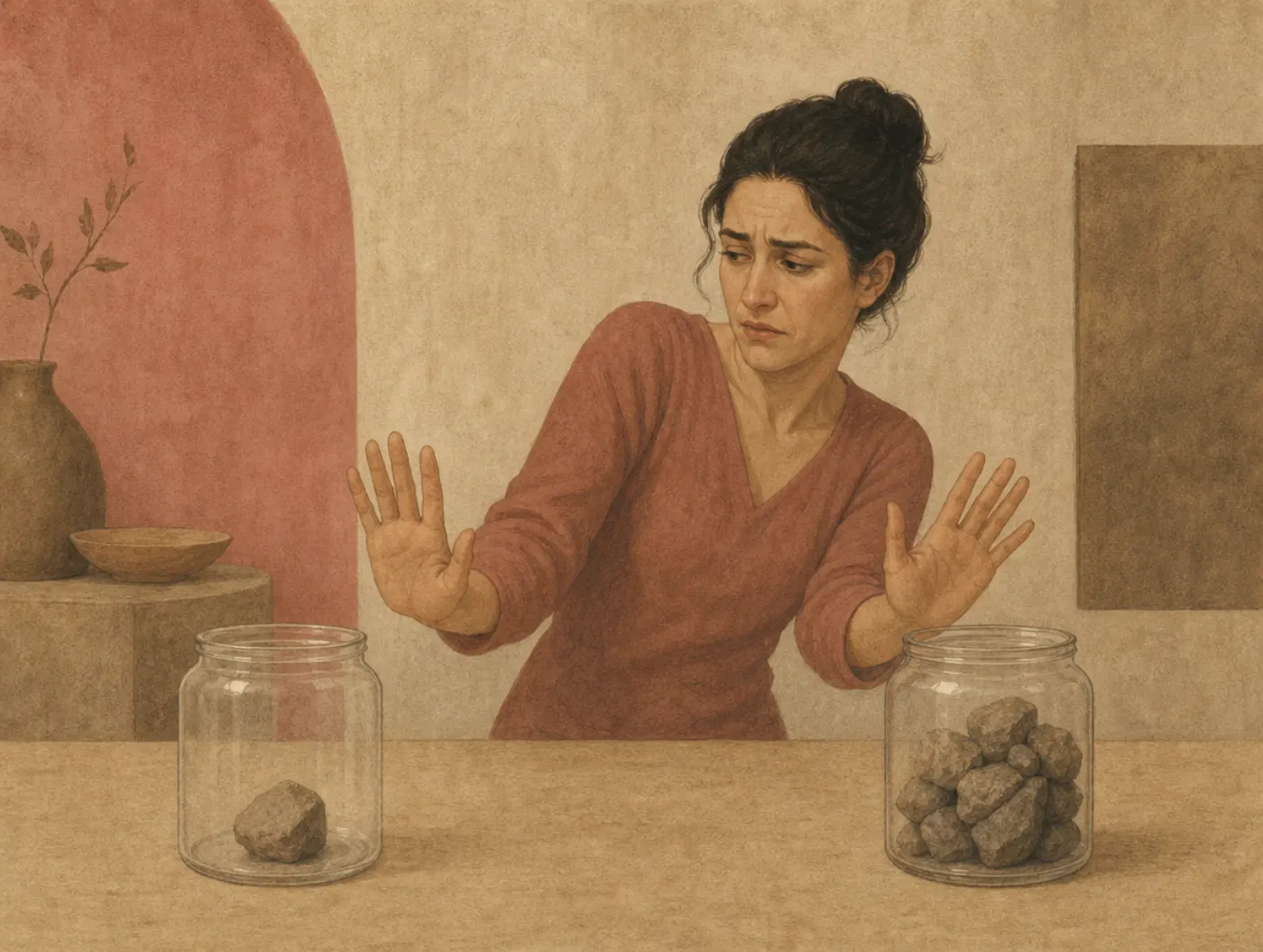
Neglect of probability is the tendency, when an outcome carries strong feeling, to respond to the possibility of the outcome and hardly at all to its likelihood, so that a 1 in 100 chance and a 99 in 100 chance of the same frightening thing are treated almost alike. It shows up in fear of flying and of shark attacks, in the price people will pay to remove a tiny chance of a vivid harm, in lottery tickets, and in the way a single dramatic case can reorder public spending.
How neglect of probability works
Probability is a number, and feeling does not read numbers well. When an outcome is pallid, such as losing $20, the price people will pay to avoid it rises steeply with the chance of it happening. When the outcome is vivid, such as a painful shock or a plane going down, the picture of the outcome arrives first and carries most of the weight, and the probability attached to it moves the response only a little.
Rottenstreich and Hsee put this in the language of prospect theory. Kahneman and Tversky had described a weighting function that treats small probabilities as larger than they are and large ones as smaller, with a jump near impossibility and another near certainty. Rottenstreich and Hsee proposed that the shape depends on the outcome: for affect-rich outcomes the function is flatter in the middle and steeper at the ends, so people are very sensitive to the difference between no chance and some chance, and between some chance and certainty, and nearly insensitive to everything in between.
The broader account is the risk-as-feelings view set out by Loewenstein, Weber, Hsee and Welch in 2001. Emotional reactions to a risk respond to vividness, immediacy and personal experience rather than to stated probabilities, and when feeling and evaluation diverge the feeling tends to win. Hsee and Rottenstreich extended the pattern from probability to quantity in 2004: when people value by feeling, they are sensitive to the presence or absence of something and insensitive to how much of it there is.
Two limits belong with the finding. The 2001 shock result compares groups who each saw one probability, so it describes how prices moved across people rather than one person's inconsistency, and its figures are medians from a single experiment with a hypothetical payment. And refusing any chance of a shock can be a reasonable preference about the kind of experience one will accept. The error is in the comparison, when the same budget goes to a 1 percent risk as to a 99 percent one and nothing is left for the risks that are actually large.
The original study
Yuval Rottenstreich and Christopher Hsee published "Money, kisses, and electric shocks: On the affective psychology of risk" in Psychological Science in 2001. The paper's first demonstration set an affect-rich prize against an affect-poor one of about the same monetary value, a kiss from a favorite movie star against $50 in cash. When the prizes were certain, more participants preferred the cash. When each was offered as a 1 percent chance, the preference reversed and more chose the chance of the kiss.
The experiment this page reproduces turned the design to losses. Participants were asked to imagine taking part in an experiment that carried some chance of a bad outcome and to state the most they would pay to avoid participating. For some the bad outcome was a $20 cash penalty; for others it was a short, painful but not dangerous electric shock. Across groups the chance of the bad outcome was 1 percent, 99 percent or certain. For the cash penalty the median payments tracked the probability: $1 to avoid a 1 percent chance and $18 to avoid a 99 percent chance. For the shock the probability made little difference: $7 to avoid a 1 percent chance and $10 to avoid a 99 percent chance.
Read the diagram and evidence as text
A narrow and a wide likelihood opening both lead to the same large ringed shock symbol. The opening widths are schematic, not probability estimates. Hypothetical median payments are stated as text: shock $7 versus $10, cash loss $1 versus $18. No proportional payment bars or certainty claim is drawn.
A vivid outcome and a pallid one, at 1 in 100 and 99 in 100
Medians; each group saw one probability. Text, not scaled bars
Same question every time: the most you would pay to avoid taking part
Painful shock, 1 percent chance: Would pay $7 to avoid it
Painful shock, 99 percent chance: Would pay $10 to avoid it
$20 cash penalty, 1 percent chance: Would pay $1 to avoid it
$20 cash penalty, 99 percent chance: Would pay $18 to avoid it
| Condition | Value and unit | Evidence quote |
|---|---|---|
| Shock, 1 percent chance | 7 dollars, median payment to avoid | the median participant would pay $7 to avoid a 1 percent chance of a short, painful but not dangerous electric shock |
| Shock, 99 percent chance | 10 dollars, median payment to avoid | $10 to avoid a 99 percent chance of it |
| $20 cash penalty, 1 percent chance | 1 dollars, median payment to avoid | for a $20 cash penalty the medians were $1 to avoid a 1 percent chance |
| $20 cash penalty, 99 percent chance | 18 dollars, median payment to avoid | $18 to avoid a 99 percent chance |
Cass Sunstein built on the result in a 2002 Yale Law Journal essay that gave the pattern its common name, probability neglect, and reported a study of his own. Eighty-three law students stated the most they would pay to eliminate a cancer risk from arsenic in drinking water. For some the risk was one in a million and for others one in a hundred thousand; for half of each group the cancer was described plainly, and for the other half as very gruesome and intensely painful. With the plain description the tenfold increase in probability raised mean willingness to pay from $71.25 to $194.44; with the vivid description it rose from $132.95 to $241.30, a smaller proportional increase. Sunstein reported that the difference between the two increases was not statistically significant, and offered it as suggestive rather than conclusive.
The essay's larger argument was about regulation: public fear tracks the vividness of a harm rather than its frequency, lawmakers respond to the fear, and both can be exploited. The demo's four sliders follow the 2001 design in miniature, with one person answering all four questions rather than four groups answering one each.
Everyday examples
The rows below are illustrations of where a vivid outcome crowds out its probability, not findings from the studies cited on this page.
| Situation | What the bias does | What helps |
|---|---|---|
| Fear of flying after a crash in the news | The picture of the crash sets the fear; the one-in-millions chance per flight barely registers | Compare the risk per mile with the drive to the airport, in numbers, before deciding how to travel |
| Buying insurance against a dramatic but rare loss | The premium is judged by the awfulness of the loss rather than its likelihood, so unlikely harms get overinsured and common ones underinsured | Ask what the expected loss is and whether you could absorb it, before asking how bad it would feel |
| A parent weighing a vivid stranger danger against road traffic | Spending and worry flow to the frightening story and away from the common hazard | Put the two frequencies side by side; the common hazard usually wins the comparison |
| Lottery tickets | The picture of winning carries the decision; a one in 300 million chance feels like a chance | Translate the odds into a comparison you can picture, such as the number of weeks of buying it would take on average |
| A screening result described as a possibility of cancer | The word sets off a response that a 1 percent and a 50 percent chance would share | Ask for the number, and for what the number would be if the test were negative |
How to counter it
The counter is to make the probability as vivid as the outcome, since the outcome will not become less vivid on its own.
- Write the two numbers side by side. The chance of the frightening outcome and the chance of a common one, in the same units, is the comparison feeling cannot make and arithmetic can.
- Convert probabilities to frequencies you can picture: one person in a town of ten thousand, one flight in several million. Stated this way the small number regains some of its smallness.
- Price the risk before you picture it. Decide what a given reduction is worth in general terms, then apply it, rather than letting the image set the price.
- Notice when a description is doing the work. Gruesome detail in a warning, an advertisement or a news story is there to make the probability irrelevant; ask for the base rate.
- Keep the lesson in both directions. Neglect of probability makes rare vivid risks loom large and can make common dull ones vanish; the same habit of checking the number corrects both.
What it is not
Several entries are about how chances are misjudged. Neglect of probability is the case where the chance is barely consulted at all.
- It is not zero-risk bias, the preference for removing one risk completely over a larger reduction in total risk. That bias depends on noticing the numbers and overvaluing the last step to zero; probability neglect is a failure to weigh the numbers in the first place, driven by the outcome's vividness.
- It is not the availability heuristic, which inflates the judged frequency of events that come easily to mind. Availability gets the probability wrong; neglect of probability sets the probability aside even when it is stated correctly.
- It is not the base-rate fallacy, in which specific evidence about a case swamps the background rate. That is an error in combining two numbers; here there is only one number, and it is not used.
Tests and tools that use this
Related biases
Neglect of Probability FAQ
What is neglect of probability?
It is the tendency, when an outcome carries strong feeling, to respond to whether the outcome is possible and hardly at all to how likely it is. In Rottenstreich and Hsee's 2001 experiment, the median payment to avoid a painful shock was $7 at a 1 percent chance and $10 at a 99 percent chance, while for a $20 loss the medians were $1 and $18. Sunstein named the pattern probability neglect in 2002.
Why does probability matter less for frightening outcomes?
Because feeling and calculation respond to different things. An emotional reaction to a risk is driven by how vivid, immediate and personal the outcome is, not by a stated chance, and Loewenstein and colleagues argued in 2001 that when feeling and evaluation diverge, feeling tends to decide. Rottenstreich and Hsee described the result as a flatter weighting of probabilities for affect-rich outcomes: very sensitive near zero and near certainty, nearly flat in between.
How does the demo on this page work?
You set the most you would pay to be excused from four hypothetical experiments: a 99 percent and a 1 percent chance of a brief shock, and the same two chances of losing $20. The result compares your two shock answers and reports which was higher, with the 2001 medians drawn beside all four. The point is the size of the gap: the odds differ 99-fold, and in the study the median price moved from $7 to $10.
Does paying almost the same for both shock chances mean I am irrational?
Not on its own. Refusing any chance of a painful experience can be a reasonable preference, and the 2001 figures compare different people who each saw one probability, so they describe a pattern across a group rather than an inconsistency in one person. The trouble starts when the same budget is spent on a 1 percent risk as on a 99 percent one, because then nothing is left for the risks that are actually large. The demo shows you the gap so you can judge it.
What did Sunstein find about probability neglect?
In a study of 83 law students reported in his 2002 essay, a tenfold increase in a cancer risk from arsenic in water raised mean willingness to pay from $71.25 to $194.44 when the cancer was described plainly, and from $132.95 to $241.30 when it was described as gruesome and intensely painful, a smaller proportional rise. He reported that the difference between the two increases was not statistically significant and presented it as suggestive, alongside the stronger 2001 shock result.
How is neglect of probability different from zero-risk bias?
Zero-risk bias is a preference for eliminating one risk entirely over a larger cut in total risk; it depends on the numbers being noticed, because the appeal is in the last step down to nothing. Neglect of probability is the failure to weigh the number at all when the outcome is vivid. Both can push spending toward small risks, but through different routes: one overvalues certainty, the other never gets as far as the odds.

References
- Rottenstreich, Y., & Hsee, C. K. (2001). Money, kisses, and electric shocks: On the affective psychology of risk. Psychological Science, 12(3), 185-190. doi.org
- Sunstein, C. R. (2002). Probability neglect: Emotions, worst cases, and law. The Yale Law Journal, 112(1), 61-107. doi.org
- Loewenstein, G. F., Weber, E. U., Hsee, C. K., & Welch, N. (2001). Risk as feelings. Psychological Bulletin, 127(2), 267-286. doi.org
- Hsee, C. K., & Rottenstreich, Y. (2004). Music, pandas, and muggers: On the affective psychology of value. Journal of Experimental Psychology: General, 133(1), 23-30. doi.org
- Slovic, P., Finucane, M. L., Peters, E., & MacGregor, D. G. (2004). Risk as analysis and risk as feelings: Some thoughts about affect, reason, risk, and rationality. Risk Analysis, 24(2), 311-322. doi.org
- Kahneman, D., & Tversky, A. (1979). Prospect theory: An analysis of decision under risk. Econometrica, 47(2), 263-291. doi.org
Cite this source
Psychology.com. (2026, October 24). Neglect of Probability. Psychology.com. https://psychology.com/biases/neglect-of-probability