In short
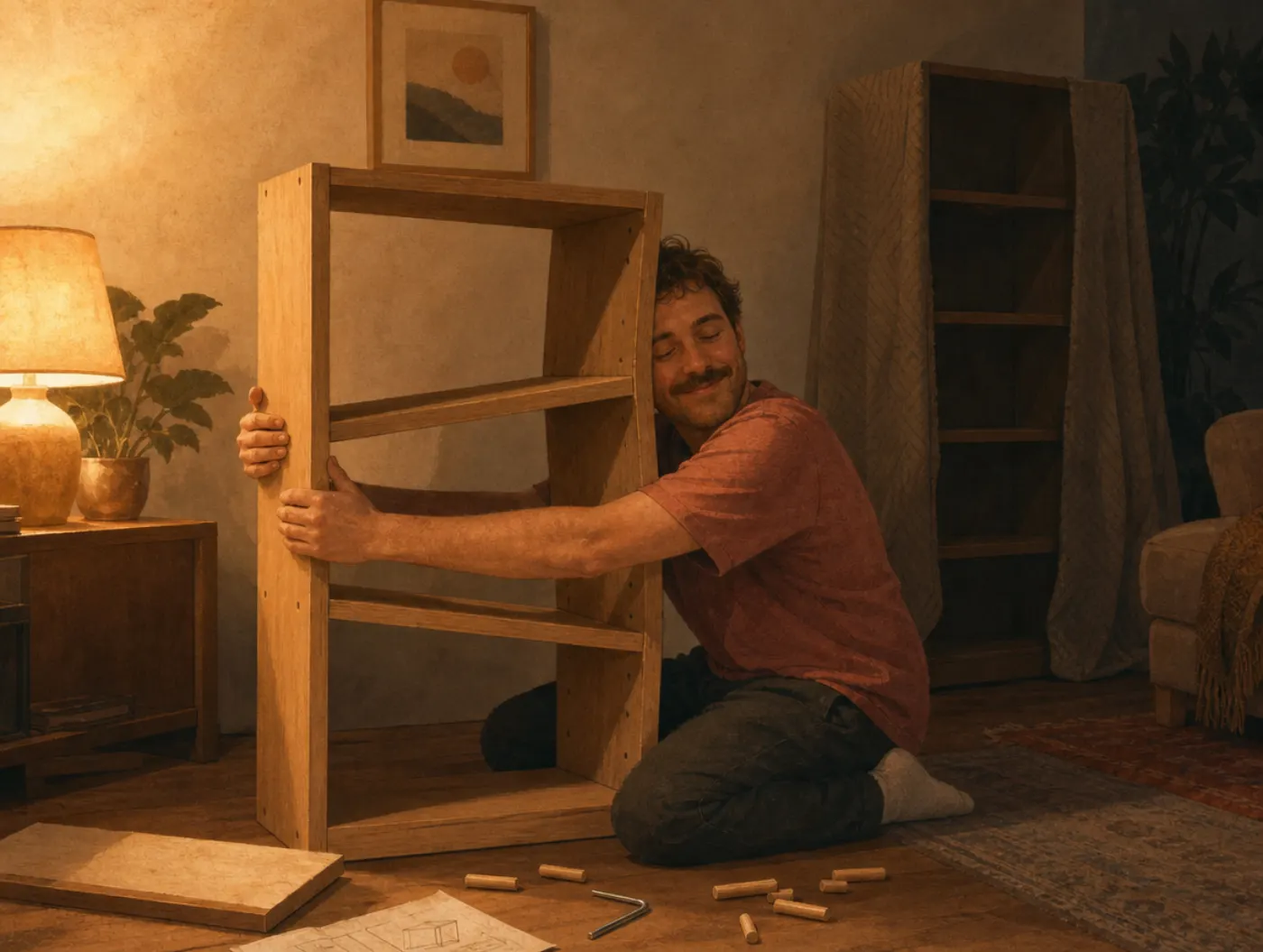
The IKEA effect is the tendency to place a higher value on things you have partly made yourself, from flat-pack furniture to a folded paper frog, than on identical things made by someone else, even when your own work is amateurish. It shows up in the owner who will not part with a wobbly bookcase, in the manager who favors the plan the team drafted over a better one bought in, and in the price people set on anything they have labored over.
How the IKEA effect works
Labor changes the laborer's view of the product. Michael Norton, Daniel Mochon and Dan Ariely, who named the effect in 2012, proposed that completing a task is a signal of competence and that the finished object carries the signal: it is evidence of what you can do, and such evidence is not easily sold. The effect does not depend on the object being good: in the origami experiment, builders priced their crumpled frogs and cranes at nearly the level outside bidders set for expert work, and expected other students to value them about as highly.
Two conditions matter. The first is completion. Participants who built a storage box valued it at more than twice the price set by participants stopped two steps short of finishing it, and participants who built a Lego set and then took it apart lost the premium that intact builders showed. Effort alone is not enough; finished effort is what the mind credits. The second is success, which these studies arranged by giving everyone instructions they could follow, and Mochon, Norton and Ariely's 2012 follow-up found that the desire to build was stronger in people whose sense of competence had just been threatened.
Older findings point the same way. Elliot Aronson and Judson Mills showed in 1959 that people who went through a severe initiation to join a discussion group liked it more than those who went through a mild one, the effort justification result. Nikolaus Franke, Martin Schreier and Ulrike Kaiser found in 2010 that customers who designed their own version of a product through a customization tool would pay more for it than for an identical design by someone else, and that the premium depended on feeling the result was their own accomplishment.
The effect has a cost side. Managers who built a plan are poor judges of it, founders overrate the product they built, and anyone pricing something they made is pricing their own competence along with it. The name is a joke at the furniture company's expense, but the company benefits: a customer who has assembled a bookcase has become invested in it.
The original study
Norton, Mochon and Ariely published "The IKEA effect: When labor leads to love" in the Journal of Consumer Psychology in 2012. Their first experiment used the furniture itself. Fifty-two students were paid five dollars and assigned either to assemble a plain black IKEA storage box from its instructions or to inspect an identical box already assembled. Each then bid for the box under a procedure in which a random price was drawn and the box sold to anyone whose bid met it, so that honest bidding was the best strategy. Builders bid an average of 78 cents; non-builders bid 48 cents.
The origami experiment is the one the demo reproduces. One hundred and six people in a university student center took part, divided among three conditions. Builders were given an instruction sheet and a square of origami paper, asked to fold a frog or a crane, and then to bid up to one dollar to keep it. Non-builders who did not know the builders bid on those same creations, and the third condition bid on frogs and cranes folded by two experienced research assistants. Builders bid an average of 23 cents for their own work; non-builders bid 5 cents for it, and 27 cents for the experts' figures. The builders' bids and the expert bids did not differ statistically. A separate group of 14 builders estimated what the average student would pay for their creation and gave figures close to their own bids, 21 cents against 19.
Read the diagram and evidence as text
A hand, sheet and fold trail reach an origami crane enclosed by a valuation ring. An outsider’s eye sees the same crane without that enclosure. Mean bids are labels, 23 cents for makers and 5 cents for outsiders viewing the same creations. A separate note gives outsiders’ 27-cent bids for expert work, a different set of objects. The crane and trail are illustrative.
Same origami figure. Who folded it?
Bids in cents as labels, not bars; experts' figures drew 27 cents from outside bidders
The same amateur frog or crane, bid on by its builder and by a stranger
You folded it yourself: Bid 23 cents to keep it
Someone else folded it: Bid 5 cents for the same figure
| Condition | Value and unit | Evidence quote |
|---|---|---|
| Builders bidding to keep their own frog or crane | 23 cents | In Norton, Mochon and Ariely's 2012 origami experiment, builders bid an average of 23 cents to keep the frog or crane they had just folded, other participants bid 5 cents for those same creations, and 27 cents for the same figures folded by experts. |
| Other participants bidding for the builders' creations | 5 cents | In Norton, Mochon and Ariely's 2012 origami experiment, builders bid an average of 23 cents to keep the frog or crane they had just folded, other participants bid 5 cents for those same creations, and 27 cents for the same figures folded by experts. |
| Other participants bidding for expert-folded figures | 27 cents | In Norton, Mochon and Ariely's 2012 origami experiment, builders bid an average of 23 cents to keep the frog or crane they had just folded, other participants bid 5 cents for those same creations, and 27 cents for the same figures folded by experts. |
Two further experiments tested what the effect needs. In one, 118 people built Lego sets of 10 to 12 pieces, received pre-built sets, or built sets and took them apart, then bid on their own set and a partner's. Only builders who kept their sets intact bid significantly more for their own, about twice their bid for the partner's; unbuilding removed the gap. In the last experiment, 39 people assembled an IKEA box or were stopped two steps before the end. Those who finished bid an average of 1 dollar 46 cents; those who did not finish bid 59 cents.
The amounts are small because the objects were, and the demo's options are scaled to match. The claim is that the premium is large relative to the object's value and survives visibly amateur work.
Everyday examples
The pattern appears wherever people finish something themselves and then have to judge it. The rows below are illustrations, not findings from the studies cited on this page.

| Situation | What the bias does | What helps |
|---|---|---|
| Selling a home with renovations you did yourself | The asking price includes the weekends spent on the deck, which buyers do not see | Get an independent valuation before setting the price and treat the gap as information |
| A meal-kit dinner or a cake from a mix | The meal tastes better for having been assembled, and the kit earns loyalty that a ready meal of the same quality would not | Nothing needs fixing here; it is the same effect working for you |
| A team plan drafted in-house against a better proposal from outside | The team's plan is defended for having been built, and the comparison is never made on the merits | Have both plans assessed blind by someone who worked on neither |
| A founder's first product | The product is overvalued against the market and criticism is read as a failure to understand it | Test with people who have no stake in the building and count what they do, not what they say |
| A customized product you configured online | Your version is worth more to you than the identical configuration chosen by someone else | Decide whether the premium you are paying is for the product or for the sense of having made it |
How to counter it
The effect is harmless at home and expensive in business, so the counters are for the moments when your own work has to be priced or judged.
- Separate the maker from the judge. The person who built the plan, the product or the deck cannot price it. Ask someone who did not.
- Compare against the alternative on the same terms. Put your own version and the bought-in version in front of the same people, without labels, and count the result.
- Expect the premium and discount for it. If you know you overvalue what you built, you can adjust: a maker's estimate of value is a ceiling, not a midpoint.
- Use completion deliberately. The effect depends on finishing, so a stalled project carries less attachment than it will once done; that is the moment to ask whether it should be done at all.
- Let the effect work where it helps. Assembling, customizing and cooking all raise the value of what you end up with at no cost to anyone, and the lift is larger when competence feels in doubt.
What it is not
The IKEA effect belongs to a family of findings about effort, ownership and attachment.
- It is not the endowment effect, in which owning something raises its value to the owner. The IKEA effect requires labor, not just possession: in the Lego experiment, people given pre-built sets showed no significant premium for their own set over a partner's, while builders did.
- It is not effort justification, the older finding that people value a goal more after suffering to reach it. Effort justification is about reducing the dissonance of a costly choice; the IKEA effect attaches value to a made object and depends on successful completion rather than on cost.
- It is not the sunk cost fallacy, which is continuing a course of action because of what has already been spent. The sunk cost fallacy looks forward and asks whether to keep going; the IKEA effect looks at a finished thing and asks what it is worth.
Tests and tools that use this
Related biases
IKEA Effect FAQ
What is the IKEA effect?
It is the tendency to value things more when you have put your own labor into making them, even when the result is objectively worse than a version made by someone else. Norton, Mochon and Ariely named it in 2012 after experiments with IKEA boxes, origami and Lego in which builders bid far more for their own creations than other people would pay for them. The effect depends on finishing the task successfully.
What is an example of the IKEA effect?
In the 2012 origami experiment, people who folded a frog or a crane from instructions bid an average of 23 cents to keep it, while other participants bid 5 cents for those same figures and 27 cents for figures folded by experts. The builders' amateur work was, to them, worth nearly what expert work was worth to everyone else. Outside the laboratory, the home renovator's asking price and the manager's attachment to the in-house plan are the same effect.
How does the demo on this page work?
The page assigns you one of two versions at random. In one you fold a paper frog from six steps and say what you would pay to keep it; in the other you price a frog folded by an expert. It records only the version and the answer, and once each version has 50 or more responses it shows the live split. The page cannot check whether you folded anything, and the expert frog is described rather than shown, so the split is an illustration rather than a measurement.
Why does the IKEA effect happen?
The authors' account is that successfully completing a task signals competence, and the finished object carries that signal, so parting with it feels like giving up evidence of what you can do. Two findings support this. The effect disappears when the task is left unfinished or the creation is taken apart, and it is stronger in people whose sense of competence has recently been threatened. Older work on effort justification points in the same direction.
Is the IKEA effect the same as the endowment effect?
No. The endowment effect is the extra value people place on things simply because they own them, with no work involved. The IKEA effect needs labor and successful completion. In the Lego experiment, participants handed a pre-built set did not bid significantly more for it than for a partner's, while participants who built their own set bid about twice as much for it, and that gap vanished when builders were asked to take their set apart.
How can I avoid overvaluing my own work?
Have it judged by someone who did not make it, on the same terms as the alternative and without labels. Treat your own estimate of its value as an upper bound rather than a best guess. If a project has stalled, decide its fate before finishing it, since completion is what fixes the attachment. And let the effect work for you where it costs nothing: assembling, customizing and cooking things yourself make you like them more, which is sometimes exactly the point.

References
- Norton, M. I., Mochon, D., & Ariely, D. (2012). The IKEA effect: When labor leads to love. Journal of Consumer Psychology, 22(3), 453-460. doi.org
- Mochon, D., Norton, M. I., & Ariely, D. (2012). Bolstering and restoring feelings of competence via the IKEA effect. International Journal of Research in Marketing, 29(4), 363-369. doi.org
- Aronson, E., & Mills, J. (1959). The effect of severity of initiation on liking for a group. Journal of Abnormal and Social Psychology, 59(2), 177-181. doi.org
- Franke, N., Schreier, M., & Kaiser, U. (2010). The "I designed it myself" effect in mass customization. Management Science, 56(1), 125-140. doi.org
- Kahneman, D., Knetsch, J. L., & Thaler, R. H. (1990). Experimental tests of the endowment effect and the Coase theorem. Journal of Political Economy, 98(6), 1325-1348. doi.org
Cite this source
Psychology.com. (2026, October 21). IKEA Effect. Psychology.com. https://psychology.com/biases/ikea-effect