In short
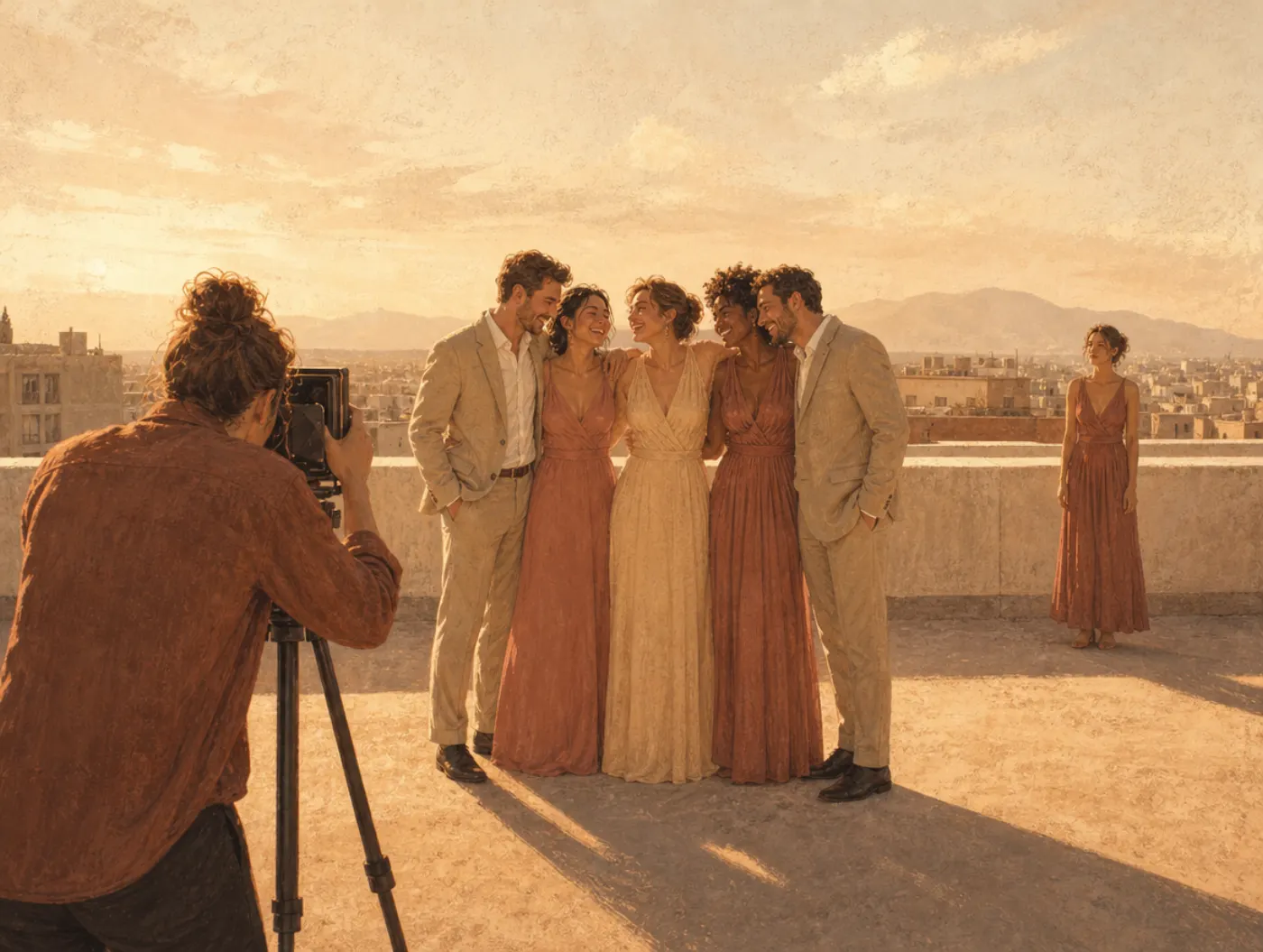
The cheerleader effect is the finding that the same face is rated as more attractive when it is seen in a group of other faces than when it is seen alone, by a small but reliable margin. It shows up in profile photos, team pages, wedding pictures and class photographs, and it took its name from a television joke before Drew Walker and Edward Vul measured it in 2014.
How the cheerleader effect works
The explanation Walker and Vul offered joins three findings that were already established separately. The first is ensemble coding: shown a group of faces for a moment, the visual system quickly extracts an average of them, the average identity, expression or gender. The second is hierarchical encoding in visual memory: individual items are stored in relation to the group summary, so that each face is remembered as somewhat closer to the group average than it actually was. The third is that average faces are attractive, a finding Langlois and Roggman reported in 1990: composite faces made by blending many individuals were rated higher than most of the faces that went into them.
Put together, the three predict the cheerleader effect. A face seen in a group is pulled, in memory, toward the group's average face; the average face is more attractive than the typical member; so the remembered face gains a little attractiveness it did not have on its own. The gain should be small, because the pull toward the average is small, and it is: about 1.5 to 2 percent of the rating scale in Carragher and colleagues' 2018 and 2019 measurements.
Whether that is the right explanation is less settled than the effect itself. Carragher, Thomas, Gwinn and Nicholls tested it directly in 2019 by varying what the group was made of. Groups that could be summarized into an average face produced the largest effect, as the account predicts. But faces shown among non-face images also gained a little, which averaging into a face cannot explain, and the authors concluded that the evidence for hierarchical encoding is limited. The effect is real; the mechanism is a live question.
Two things follow. A point or two on a hundred-point scale is unlikely to change who in a photo looks attractive; the studies measured an average over many ratings. And in Carragher's 2018 experiments the effect appeared wherever the other faces were placed, so position in the photo does not matter to it. Whether the companions' looks change the size of the gain is a separate question those experiments left open.
The original study
Drew Walker and Edward Vul published "Hierarchical encoding makes individuals in a group seem more attractive" in Psychological Science in 2014, online in October 2013. The name of the effect came from a 2008 episode of the television comedy How I Met Your Mother, in which a character claims that a group of women looks attractive together and less so one by one; the paper tested whether the claim was true for individual faces.
Across five experiments, participants rated the attractiveness of faces presented either alone or in a group of the same gender. The design was within-subject: each target face was rated twice by the same rater, once in its group photograph and once as a cropped portrait, with the two presentations separated in the session. The faces were rated higher in the group. The paper reports the increase as consistent across experiments that varied the group's size and composition, and the authors interpreted it through the three-part hierarchical encoding account described above.
The effect has since been reproduced by independent laboratories, though not every attempt succeeded: Ojiro and colleagues ran two direct replications of Walker and Vul's fourth experiment with Japanese participants in 2015 and found a pattern resembling the original in one of them, small and not significant. Carragher, Lawrence, Thomas and Nicholls reported in 2018 that target faces were rated significantly more attractive in every group arrangement they tested, with the increase in the range of 1.5 to 2 percent of the scale. Carragher, Thomas, Gwinn and Nicholls followed in 2019 with three experiments that reproduced the effect at the same size while finding only limited support for the averaging mechanism.
Read the diagram and evidence as text
Matched photograph frames contain exactly the same target portrait, alone or flanked by other faces. The solo frame has a baseline rating cue; the group frame has an upward evaluation cue. The arrow indicates higher ratings only, not a magnitude or a measured trajectory.
One face, two photographs
Ordering only; a small, reliable rise
Same face, same rater; only the company changes
Seen alone, as a cropped portrait: Baseline rating
Seen in a same-gender group: Rated higher: about 1.5 to 2% of the scale
| Condition | Value and unit | Evidence quote |
|---|---|---|
| Same face seen alone, cropped portrait | Baseline rating ordinal attractiveness rating | people rated the attractiveness of the same faces presented alone and in same-gender groups, and the faces were rated higher in the group; Carragher and colleagues, replicating the effect in 2018 and 2019, measured the rise at about 1.5 to 2 percent of the rating scale |
| Same face seen in a same-gender group | Rated higher ordinal attractiveness rating | people rated the attractiveness of the same faces presented alone and in same-gender groups, and the faces were rated higher in the group; Carragher and colleagues, replicating the effect in 2018 and 2019, measured the rise at about 1.5 to 2 percent of the rating scale |
| Low end of the rise in group, Carragher and colleagues 2018 and 2019 | 1.5 percent of rating scale | people rated the attractiveness of the same faces presented alone and in same-gender groups, and the faces were rated higher in the group; Carragher and colleagues, replicating the effect in 2018 and 2019, measured the rise at about 1.5 to 2 percent of the rating scale |
| High end of the rise in group, Carragher and colleagues 2018 and 2019 | 2 percent of rating scale | people rated the attractiveness of the same faces presented alone and in same-gender groups, and the faces were rated higher in the group; Carragher and colleagues, replicating the effect in 2018 and 2019, measured the rise at about 1.5 to 2 percent of the rating scale |
A related but distinct finding, from van Osch, Blanken, Meijs and van Wolferen in 2015, is that a group as a whole is rated more attractive than the average of its members' individual ratings, with a medium to large effect across 33 comparisons. That is a judgment of the group, not of a face within it, and the authors attributed it to attention settling on the most attractive members.
Everyday examples
The effect concerns ratings of faces in photographs, and the examples below stay close to that. They are illustrations, not findings from the studies cited here.

| Situation | What the bias does | What helps |
|---|---|---|
| Choosing a profile photo for a dating app | The group shot feels more flattering, and on average it is, by a point or two | Weigh the small gain against a viewer not knowing which person you are |
| A company team page shows staff in one group photograph | Each person gains slightly from the ensemble, a point or two on average | Decide on clarity and recognizability; the effect is too small to be a design criterion |
| Looking back at a class or wedding photo | Everyone seems to have looked good that day | Notice that the same faces cropped out one by one would be rated a little lower, which says more about the viewer than the day |
| A casting director reviews headshots and group stills | Candidates seen in ensemble stills are rated a touch higher than in headshots | Compare like with like: headshots against headshots |
| A friend tells you to stand next to less attractive people in photos | The advice assumes a comparison effect; the studies measured a gain from being in a group and did not test whether companions' looks change it, and the gain is small either way | Stand wherever you are comfortable; the photo will not change who you are |
How to counter it
There is little to counter in a one- or two-point effect, and little to exploit. The habits below are about reading faces and research honestly.
- Compare faces in the same format. If you are judging between people, as an interviewer or a casting director, look at single portraits for everyone or group shots for everyone, not a mixture.
- Keep the size in mind. An effect of 1.5 to 2 percent of a scale is a small average shift across many ratings; claims that a group makes a person look much better are not what the research found.
- Do not take the mechanism as settled. The averaging account is elegant and partly supported; the 2019 tests found effects it cannot explain.
- Separate the two findings. A group rated as more attractive than its average member is a different result from a face rated higher inside a group, with a different proposed cause.
- Notice when a television joke is doing the work. The effect got its name from a comedy and its evidence from a laboratory, and the show's version, that a group looks good and its members do not, is not what the study showed.
What it is not
Several effects concern how context changes the judgment of a face, and the cheerleader effect is often described in terms that belong to its neighbors.
- It is not the halo effect, in which one favorable quality of a person, such as warmth or looks, raises judgments of unrelated qualities. The cheerleader effect changes the rating of one quality, attractiveness, by changing what surrounds the face.
- It is not the contrast effect, in which a face looks better or worse next to a comparison. The cheerleader effect compares a face in a group with the same face alone, not with its neighbors. Contrast may still contribute: the 2019 study drew companions at random and could not test it, and its authors noted that the companions' attractiveness may change the size of the gain.
- It is not the mere exposure effect, in which repeated viewing makes a face more liked. In the 2014 design every face was seen alone and in a group, so exposure was equal.
- It is not the group attractiveness effect of van Osch and colleagues, a judgment of a whole group rather than of a member within it, though the two are often run together in popular accounts.
Tests and tools that use this
Related biases
Cheerleader Effect FAQ
What is the cheerleader effect?
It is the finding that the same face is rated as a little more attractive when seen in a group of other faces than when seen alone. Walker and Vul established it in 2014 in five experiments in which participants rated faces presented alone and in same-gender groups; Carragher and colleagues, replicating it in 2018 and 2019, measured the rise at roughly 1.5 to 2 percent of the rating scale. The name comes from a television comedy; the laboratory effect is far smaller than the joke.
Is the cheerleader effect real?
Yes, as a small average effect. Walker and Vul reported it across five experiments in 2014, and Carragher and colleagues reproduced it in 2018 and 2019 with new faces and raters, finding the same 1.5 to 2 percent increase in every group arrangement they tested. What is less settled is why it happens: the original averaging explanation received only limited support in the 2019 tests, which found a smaller effect even for faces shown among images that were not faces.
Why do people look more attractive in groups?
Walker and Vul's explanation has three parts: the visual system automatically computes an average of the faces in a group, individual faces are remembered as slightly closer to that average than they were, and average faces are attractive, as Langlois and Roggman showed in 1990 with blended composites. Each face therefore borrows a little of the average's appeal. The account fits the small size of the effect, but the 2019 experiments found effects it cannot explain, so the mechanism is still open.
How does the demo on this page work?
The page cannot show you faces, so it asks you to predict the experiment instead. You said whether a face rated in a group scored higher than the same face alone, how large the difference was, and why. Predicting a rise of a point or two counts as matching the measured result; expecting no rise, or a large one, does not. The question about the mechanism is not scored, because the mechanism is contested. The demo measures your expectations about the effect, not whether your own ratings would show it.
Should I use a group photo as my profile picture?
The research gives a small reason for and a practical reason against. On average a face in a group is rated a point or two higher out of a hundred, a small difference. Against that, a viewer of a group photo has to work out which person you are. If the photo's job is to show your face clearly, a clear single portrait does that job, and the effect is too small to change the answer.
What is the difference between the cheerleader effect and the group attractiveness effect?
The cheerleader effect is about an individual: the same face rated higher in a group than alone. The group attractiveness effect, reported by van Osch and colleagues in 2015, is about the group: a photograph of several people is rated as more attractive than the average of the individual ratings of the people in it, with a medium to large effect across 33 comparisons. The authors attributed that to attention settling on the most attractive members. The two are often described together, but they measure different judgments.

References
- Walker, D., & Vul, E. (2014). Hierarchical encoding makes individuals in a group seem more attractive. Psychological Science, 25(1), 230-235. doi.org
- Carragher, D. J., Thomas, N. A., Gwinn, O. S., & Nicholls, M. E. R. (2019). Limited evidence of hierarchical encoding in the cheerleader effect. Scientific Reports, 9, 9329. doi.org
- Carragher, D. J., Lawrence, B. J., Thomas, N. A., & Nicholls, M. E. R. (2018). Visuospatial asymmetries do not modulate the cheerleader effect. Scientific Reports, 8, 2548. doi.org
- Ojiro, Y., Gobara, A., Nam, G., Sasaki, K., Kishimoto, R., Yamada, Y., & Miura, K. (2015). Two replications of "Hierarchical encoding makes individuals in a group seem more attractive (2014; Experiment 4)". The Quantitative Methods for Psychology, 11(2), r8-r11. doi.org
- van Osch, Y., Blanken, I., Meijs, M. H. J., & van Wolferen, J. (2015). A group's physical attractiveness is greater than the average attractiveness of its members: The group attractiveness effect. Personality and Social Psychology Bulletin, 41(4), 559-574. doi.org
- Langlois, J. H., & Roggman, L. A. (1990). Attractive faces are only average. Psychological Science, 1(2), 115-121. doi.org
Cite this source
Psychology.com. (2026, November 1). Cheerleader Effect. Psychology.com. https://psychology.com/biases/cheerleader-effect