In short
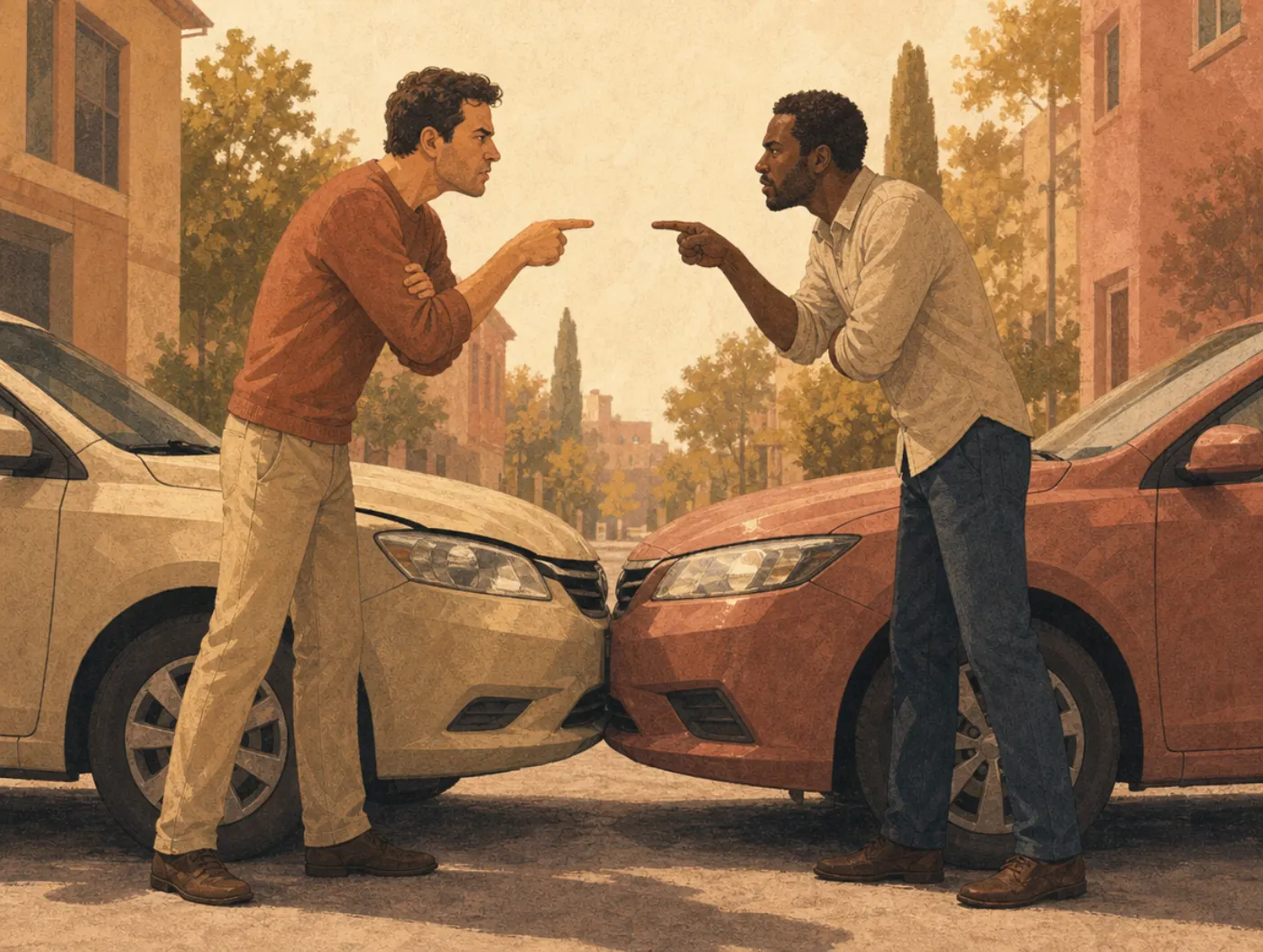
The bias blind spot is the tendency to recognize biases at work in other people's judgment more readily than in your own. It is a bias about biases: it is why a list like this one reads as a description of other people, and why hiring panels, investors, reviewers and arguing partners each see the distortion on the other side.
How the bias blind spot works
The blind spot comes from using two different kinds of evidence for the same question. Asked whether you are biased, you look inward and search for a biased motive or a thumb on the scale, and you do not find one, because biases do not announce themselves while they operate. Asked whether somebody else is biased, you have only their behavior and their conclusion to go on, and a conclusion that leans is easy to spot. Emily Pronin and Matthew Kugler called this the introspection illusion in 2007, and showed that it can be moved: participants who read a short article about the influence of unconscious processes afterward claimed less immunity than those who had not.
Self-esteem plays a part too, since being biased is held to be a defect. But motive cannot be the whole story, and the 2002 paper contains the evidence for that. When the same participants were asked about three shortcomings they were likely to notice in themselves at the time, procrastination, fear of public speaking and the planning fallacy, the asymmetry vanished: they rated themselves 5.68 against 5.05 for their classmates, slightly worse rather than better. The blind spot attaches to the biases you cannot feel working, not to every unflattering trait.
Being clever is no protection. Richard West, Russell Meserve and Keith Stanovich tested this directly in 2012 and found the blind spot was, if anything, larger among participants who scored higher on cognitive ability and on measures of reflective thinking, and that those participants were not in fact less susceptible to the biases they were denying. Irene Scopelliti and colleagues built a scale for individual differences in 2015 and found the people who scored highest on it were the least responsive to training designed to reduce a different bias.
The finding generalizes widely. Pronin and Lori Hazel's 2023 review counts replications across more than 50 different biases, in samples from several countries and in children, and notes that it appears whether people rate themselves and others separately or compare the two on a single scale, as the demo above does. The same review reports a study of forensic examiners in 21 countries in which 71 percent agreed these biases were a problem for forensic science and 26 percent thought they affected their own judgments.
One thing the blind spot cannot tell you is who is actually biased. Occasionally a person really is less affected than the average person in a particular domain, and the research cannot rule that out case by case. What it establishes is that the self-other gap is far too consistent, and far too large, for most of the claims to be true.
The original study
Emily Pronin, Daniel Lin and Lee Ross named the effect in "The bias blind spot: Perceptions of bias in self versus others," published in Personality and Social Psychology Bulletin in 2002. The first study was a set of three surveys.
In the first survey, 24 Stanford students read descriptions of eight biases documented in the research literature, written with the neutral words effect and tendency rather than bias: self-serving attributions, liking an option more after choosing it, the positive halo effect, biased assimilation of new evidence, reactive devaluation of an opponent's proposal, seeing media coverage as hostile to one's own side, explaining a victim's situation by their character, and letting self-interest shape judgments about the greater good. For each one they rated how much it applied to them and how much it applied to the average American, from 1 for not at all to 9 for strongly. The average for themselves was 5.31 and for the average American 6.75, a gap that held for every one of the eight biases taken on its own. They also rated one of their parents as less susceptible than the average American.
Read the diagram and evidence as text
Matched people carry the same illustrative zigzag flaw. A magnifying lens masks its center for self but exposes it for others; the flaw’s ends remain visible outside both lenses. Labels give mean bias ratings of 5.31 for self and 6.75 for the average American. The equal flaws are a metaphor, not measured actual bias or an assertion that everyone is equally biased.
Same eight biases, two targets
Means on a 1 to 9 scale, shown as labels rather than bars
The same eight documented biases, rated by the same 24 students from 1 for not at all to 9 for strongly
Applied to myself: Mean rating 5.31
Applied to the average American: Mean rating 6.75
| Condition | Value and unit | Evidence quote |
|---|---|---|
| Students in the first survey | 24 students | 24 students rated how much eight documented biases affected them |
| How much the eight biases affected the rater | 5.31 mean rating on a 1 to 9 scale | the average rating for themselves was 5.31 and for the average American 6.75 |
| How much the same eight biases affected the average American | 6.75 mean rating on a 1 to 9 scale | the average rating for themselves was 5.31 and for the average American 6.75 |
The second survey, with 30 students from the following year's class, replaced the average American with the average student in their own seminar, a comparison group they knew. The gap narrowed but held, 5.05 for themselves against 5.85 for their classmates. The third survey took a longer list of 18 items to travelers at San Francisco International Airport, a less selected population, and found the asymmetry again.
The paper's second and third studies moved into the laboratory so that a real bias could be observed rather than described. In one, participants were prompted about the better-than-average effect immediately after producing the self-ratings that displayed it; in the other, they rated the validity of a test on which they had just succeeded or failed and then judged whether their own and a peer's validity ratings had been self-serving. In both cases people who had just shown the bias were readier to see it in the other person than in themselves.
Everyday examples
The blind spot does its damage wherever someone is relied on to check their own judgment. The rows below are illustrations, not findings from the studies cited on this page.

| Situation | What the bias does | What helps |
|---|---|---|
| A hiring manager told to watch for bias | Introspection finds no bad intent, so the warning is filed under other people's problem | Use structured questions and scores set before the interview, which do not depend on self-insight |
| A political argument between two informed people | Each side explains the other's position by its motives and its own by the evidence | State the other side's best argument until they agree it is their argument |
| A doctor accepting a drug company lunch | The influence is granted in colleagues and denied in oneself | Rely on disclosure rules and formularies rather than on personal resistance |
| A peer reviewer who dislikes a paper's conclusion | The objections feel purely methodological | Write the review, then ask what you would have said if the result had gone the other way |
| A team that has just completed bias training | Everyone leaves better at naming other people's biases | Pair the training with a procedure: blind review, second scorer, decision log |
How to counter it
Looking harder inside does not work, because the thing being looked for is not visible from there. What works is either changing the evidence you use or taking the judgment out of your hands.
- Judge your own reasoning the way you would judge a stranger's. Pronin and Hazel's review describes an experiment in which people who first saw another person's biased answer then avoided the same error themselves.
- Read about how unconscious influences work rather than about which biases exist. In Pronin and Kugler's 2007 study that was what reduced the blind spot; a list of named biases gives you better vocabulary for other people.
- Prefer procedures to resolve. Blind review, structured scoring, a second rater, a decision written down before the outcome is known. None of these require you to detect your own bias.
- Ask what you would have concluded if the evidence had pointed the other way, and whether you would have accepted the same method.
- Get the outside view from someone with no stake, and take seriously that their account of your reasoning has information yours does not.
- Expect no protection from being smart. The 2012 study found the blind spot was larger, not smaller, among the people who scored highest on cognitive ability and were no less biased in fact.
What it is not
Several findings describe the gap between how people see themselves and how they see others.
- It is not naive realism, the broader assumption that you see the world as it is, so that disagreement must come from the other person's ignorance or bias. The blind spot is the measurable consequence of that assumption when people are asked about bias directly.
- It is not the illusion of asymmetric insight, the belief that you know other people better than they know you. That is a claim about knowledge; the blind spot is a claim about distortion.
- It is not illusory superiority, rating yourself above average on desirable qualities. In the 2002 surveys the asymmetry did not appear for shortcomings people can feel at the time, such as procrastination, which is what separates the two.
Tests and tools that use this
Related biases
Bias Blind Spot FAQ
What is the bias blind spot?
It is the tendency to see cognitive and motivational biases more readily in other people than in yourself. Pronin, Lin and Ross named it in 2002, when 24 students rated eight documented biases as applying to them at 5.31 on a nine-point scale and to the average American at 6.75. The same students rated themselves no better than their classmates on shortcomings they could notice at the time.
Why can't people see their own biases?
Because they look for the wrong evidence. Judging yourself, you search your own thoughts for a biased motive and find none, since biases work without announcing themselves. Judging someone else, you have only their behavior and their conclusion, where a lean is visible. Pronin and Kugler called this the introspection illusion in 2007 and showed that teaching people about unconscious influence reduces the gap.
Does being intelligent protect you from the bias blind spot?
No. West, Meserve and Stanovich found in 2012 that the blind spot was if anything larger among participants with higher cognitive ability and a stronger tendency to think reflectively, and that those participants were not actually less susceptible to the biases in question. Scopelliti and colleagues found in 2015 that people who scored high on a bias blind spot scale responded least to training meant to reduce a different bias.
How did the demo on this page work?
You compared yourself with the average American on the same eight tendencies used in the 2002 survey, on a single scale where 50 means the same as them. The result counts how many of the eight you placed below 50. The midpoint is a reference line, not a measured value: the page cannot know how biased you are. The 2023 review notes that the effect shows up on both separate and single-scale ratings.
Can learning about biases make the blind spot worse?
It can leave it untouched while improving your ability to name other people's errors, which is why education alone is a weak intervention. Scopelliti and colleagues found the strongest blind spot predicted the weakest response to debiasing training. What has worked in experiments is teaching the mechanics of unconscious influence, having people inspect someone else's biased reasoning first, and replacing judgment calls with procedures.
Is the bias blind spot the same as denial?
No. Denial implies the information is available and rejected. In these studies the information is not available: participants reported honestly on an introspective search that returns nothing, because bias is not experienced as bias. That is also why the asymmetry disappeared for procrastination and stage fright, which people feel happening, and held for the biases that operate quietly.

References
- Pronin, E., Lin, D. Y., & Ross, L. (2002). The bias blind spot: Perceptions of bias in self versus others. Personality and Social Psychology Bulletin, 28(3), 369-381. doi.org
- Pronin, E., & Kugler, M. B. (2007). Valuing thoughts, ignoring behavior: The introspection illusion as a source of the bias blind spot. Journal of Experimental Social Psychology, 43(4), 565-578. doi.org
- West, R. F., Meserve, R. J., & Stanovich, K. E. (2012). Cognitive sophistication does not attenuate the bias blind spot. Journal of Personality and Social Psychology, 103(3), 506-519. doi.org
- Scopelliti, I., Morewedge, C. K., McCormick, E., Min, H. L., Lebrecht, S., & Kassam, K. S. (2015). Bias blind spot: Structure, measurement, and consequences. Management Science, 61(10), 2468-2486. doi.org
- Pronin, E., & Hazel, L. (2023). Humans' bias blind spot and its societal significance. Current Directions in Psychological Science, 32(5), 402-409. doi.org
Cite this source
Psychology.com. (2026, October 22). Bias Blind Spot. Psychology.com. https://psychology.com/biases/bias-blind-spot