Genogram: How to Map a Family Across Generations
A genogram is a family diagram that shows members across at least three generations together with the quality of their relationships and the patterns that repeat. This guide covers creating one step by step, and the worksheet gathers what you need to draw it.
 Reviewed byMichael Callans, MSW
About this tool
A genogram is more than a family tree. A family tree records who is related to whom; a genogram records what the relationships are like. Standard notation, set out by Monica McGoldrick and Randy Gerson, puts men in squares and women in circles, the index person with a double outline, ages inside the shape, and lines between people whose style tells you whether the relationship is close, distant, conflictual, cut off, or fused. Reading one, a clinician sees a family system in a few seconds.
The symbols are worth learning before you draw. A solid horizontal line joins a married couple, with the marriage year above it; a dashed line joins unmarried partners who live together. One slash through the line means separation, two mean divorce. Children hang below in birth order, oldest on the left. A cross through a shape means the person has died, with the year. Between people, a double line is close, a triple line is fused or enmeshed, a jagged line is conflict, a dotted line is distant, and cutoff is drawn as the line interrupted by one or two short perpendicular bars. Notation varies between sources, so follow one key and say which you used; ours is the symbols key linked below.
Genograms are used in family therapy, in clinical intake, in medical genetics and increasingly in nursing and social work training, usually for the same reason: patterns that are invisible in a narrative become obvious in a diagram. Three generations of men who left, a repeated pattern of eldest daughters who hold the family together, an illness that runs down one side. The point is not to diagnose the family, it is to make the pattern discussable.
If you are building one for yourself rather than for a client, go three generations if you can and accept gaps. Most people do not know their grandparents' sibling order or cause of death, and the blanks are themselves information about how the family passed things on. Mark what you are unsure about rather than guessing, and expect the exercise to raise feelings, particularly around cut off and loss.
A genogram maker helps you organize a family map showing who is connected, how relationships feel, and which experiences recur across generations. This worksheet collects the details needed to draw that map, so family history becomes easier to discuss without treating a repeated pattern as a diagnosis. A genogram is a multigenerational map of a family that records not just who is related to whom, but the emotional and relational patterns running through the system: closeness and conflict, cutoffs and alliances, and repeating themes such as illness, addiction, loss, or caretaking roles. It is a core tool in family and systemic therapy, and it is useful in any modality for understanding the context a client lives within. Mapping three or more generations often reveals patterns a client has never connected before.
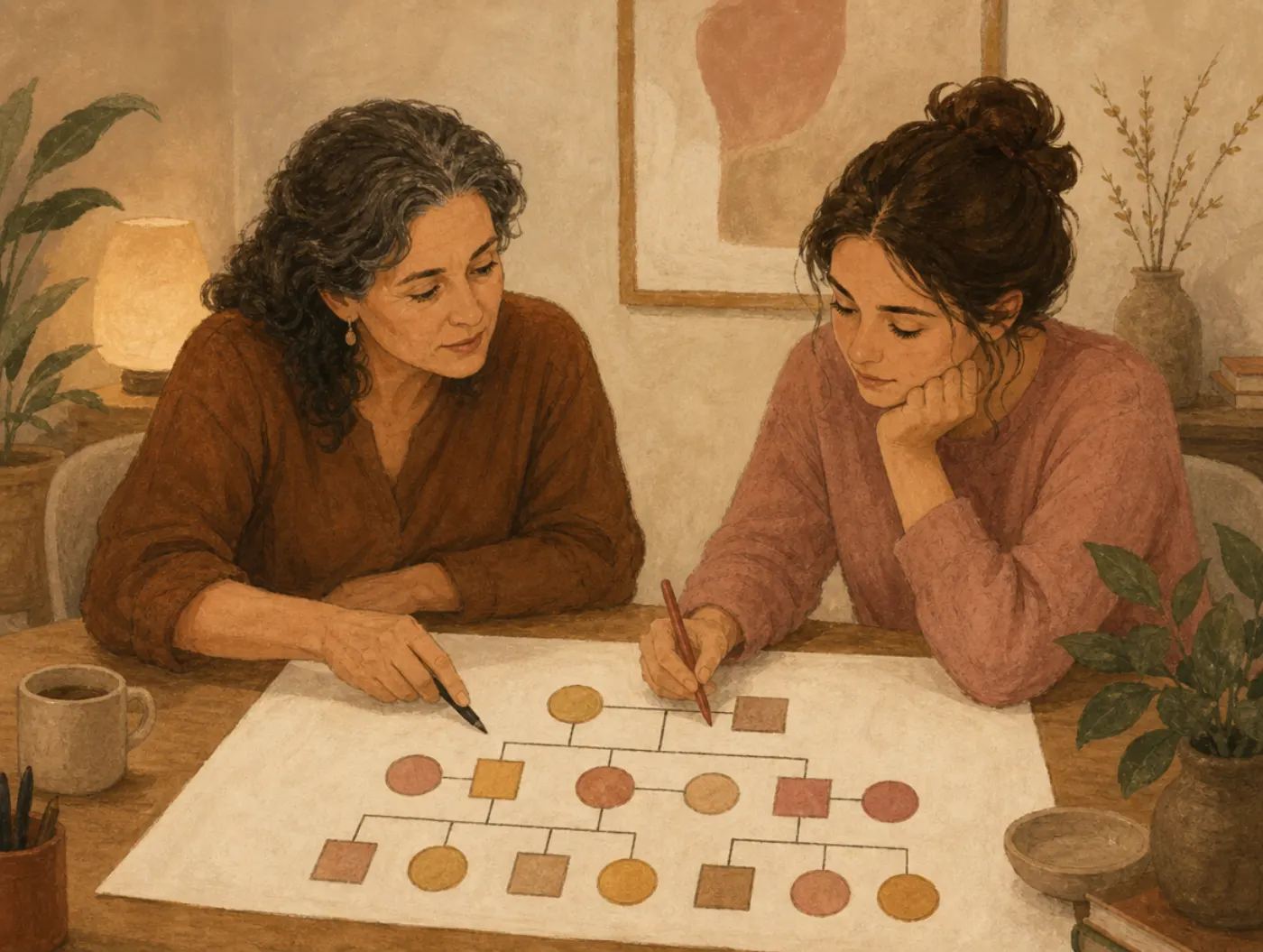
This tool helps you assemble the information a genogram captures. You record family members across generations, the structural relationships between them (partnerships, children, separations), and the quality of the emotional bonds. Building it collaboratively with the client is itself therapeutic: the act of mapping externalizes patterns, prompts reflection, and frequently surfaces strengths and resources alongside the difficulties.
When you translate this information into a drawn diagram, use the standard symbols so the chart is legible to other clinicians. Squares and circles represent individuals, structural lines connect partners and children, and distinct line styles capture close, distant, conflictual, cutoff, or enmeshed relationships. Our Genogram Symbols Reference is a printable key to that notation. Layering the emotional lines over the structure is where a genogram earns its clinical value.
Use the finished genogram to inform your case conceptualization and treatment plan. Intergenerational patterns often explain a presenting problem in ways a symptom list cannot, and they frequently point toward both the obstacles and the resources in a client's wider system. Revisit and revise the genogram as you learn more over the course of treatment.
Genograms grew out of family systems theory and were formalized into the notation clinicians use today by family therapists Monica McGoldrick and Randy Gerson. Their text, now in its fourth edition, remains the field's standard reference for symbol conventions and interviewing approach (McGoldrick, Gerson, and Petry, 2020). Most clinical genograms cover three generations, the client, their parents, and their grandparents, which is usually enough to surface repeating patterns; extend further back when a specific pattern, such as a hereditary illness, seems to trace to an earlier generation.
The most common mistake is stopping at the structural facts, names, ages, and family structure, without adding the emotional relationship lines. Structure alone produces a family tree; the emotional layer is what makes it a genogram and what generates clinical hypotheses. It also helps to note the date of each major event (a death, a diagnosis, a move) next to the person it belongs to, since timing often explains why a symptom appeared when it did. If you are mapping your own family for personal insight rather than as part of clinical work, patterns like repeated estrangement, addiction, or abuse can surface strong feelings; a licensed therapist can help you make sense of what the map shows, and the Psychology.com therapist directory is a place to find one.
Clinical descriptions published by the American Academy of Family Physicians explain how a genogram brings family relationships and medical history into a shared visual record. That supports its use for organizing an assessment; it does not establish that filling out this particular worksheet improves symptoms. Treat possible connections as questions to explore with the person whose history is being mapped, and keep alternative explanations open.
For example, if caregiving appears repeatedly, record who provided care, what support they had, and whether the role felt chosen or expected. A repeated caregiving role does not by itself establish an unhealthy relationship. Include sources of comfort, reliable relatives, chosen family, cultural expectations, and changes in circumstances so the map reflects resources as well as strain.
When accounts differ, note whose perspective each description represents. Ask permission before discussing painful events, allow people to leave details blank, and avoid contacting estranged relatives just to complete the sheet. An unfinished map can still support a useful conversation. Describe relationships in the language the person uses, and add a clear legend when standard symbols do not fit their family or identity.
Choose a practical next step from the finished map, such as asking for help with caregiving or discussing a recurring conflict in therapy. The Attachment Style Test offers a separate self-assessment of relationship tendencies; it cannot verify a family story or establish why a relationship developed. Keep any screening result separate from factual family history.
References
- McGoldrick M, Gerson R, Petry S. Genograms: Assessment and Treatment. 4th ed. W.W. Norton; 2020.
- American Psychiatric Association. Diagnostic and Statistical Manual of Mental Disorders. 5th ed, text revision (DSM-5-TR). American Psychiatric Association Publishing; 2022.
- Gotler, R. S., et al. (2001). Focus on the Family, Part I: What Is Your Family Focus Style? Family Practice Management. https://www.aafp.org/fpm/2001/0300/p49
Cite this source
Psychology.com. (2026, October 19). Genogram. Psychology.com. https://psychology.com/tools/genogram
Genogram FAQ
What is a genogram used for in therapy?
It maps a family across generations along with the emotional patterns within it, revealing intergenerational themes such as conflict, cutoff, addiction, illness, and caretaking roles. It informs assessment, case conceptualization, and treatment, especially in family and systemic work. Use it to develop questions and recognize support networks; the map itself does not diagnose anyone or prove that family history caused a current difficulty.
How do I turn this into a drawn diagram?
Use the standard symbols. Draw squares for males and circles for females, connect partners and children with structural lines, then layer emotional relationship lines on top. Our Genogram Symbols Reference is a printable key to all the notation. Explain your notation in a legend, and ask how each person wants their identity and relationships represented.
Should I build the genogram with the client?
Yes, where appropriate. Constructing it together is therapeutic in itself: it externalizes patterns, prompts reflection, and often surfaces strengths and resources alongside the difficulties. Ask permission before exploring sensitive events, and accept unknown or omitted details. Check that the final descriptions reflect the client's perspective rather than a clinician's assumptions, especially when relatives describe the same relationship differently.
Is anything I type stored here?
No. The tool runs entirely in your browser. Nothing is uploaded or saved, and the PDF is generated on your own device. Store completed records in a HIPAA-compliant system.
Is this genogram maker free to use?
Yes. The tool is free, runs in your browser, and lets you download a PDF of your notes with no account or sign-up required. Nothing you type is stored on our servers, so treat the exported PDF as your only saved copy, and store it in a HIPAA-compliant system if you use it in clinical practice.
What is the difference between a genogram and a family tree?
A family tree records who is related to whom and how: births, marriages, and descent. A genogram includes that same structure but adds the emotional and relational layer, closeness, conflict, cutoffs, and recurring patterns like addiction or caretaking roles across generations. That emotional layer is what makes a genogram useful in therapy.
How many generations should a genogram include?
Most clinical genograms cover three generations: the client, their parents, and their grandparents, which is usually enough to reveal repeating patterns. Extend further back if a specific pattern, such as a hereditary illness or a repeated event, seems to trace to an earlier generation.
What is the difference between a genogram and an ecomap?
A genogram maps inside the family: who is related to whom across generations, and what those relationships are like. An ecomap maps outward from a person or household to everything around them, such as school, work, faith community, healthcare and friends, showing which connections give energy and which drain it. Clinicians often draw both, because a family can look stable on a genogram while the ecomap shows almost no outside support.