 Reviewed by
Key facts
- A personality disorder is a lasting pattern of thinking, feeling, and behaving that differs from cultural expectations and causes distress or impairment. APA: definition
- The DSM-5 describes ten personality disorders, grouped into three clusters (A, B, and C). APA: types
- Patterns usually become recognizable in adolescence or early adulthood. APA: assessment
- Psychotherapy is the main treatment, and approaches such as DBT and schema therapy help many people improve. APA: psychotherapy
- NIMH reports that 9.1% of U.S. adults had a personality disorder in the past year in its historical National Comorbidity Survey Replication data. NIMH: prevalence and methods
- DBT was developed for borderline personality disorder and teaches skills for managing emotions and relationships. The best therapy depends on the individual diagnosis and needs. NIMH: borderline personality disorder treatment
What are personality disorders?
A personality disorder is a mental health condition defined by an enduring pattern of inner experience and behavior that differs markedly from what a person's culture expects. This pattern is pervasive across situations, stable over time, and leads to distress or problems in relationships, work, and daily life. It typically touches how a person thinks about themselves and others, how they feel and regulate emotion, how they relate to people, and how they control impulses. Assessment considers a person's developmental history and cultural context, as well as how patterns affect their life across settings.
These patterns usually take shape by adolescence or early adulthood and tend to feel like part of who the person is, which can make them hard to recognize from the inside. As the Mayo Clinic explains, a personality disorder is diagnosed only when these traits are inflexible and cause significant difficulty, not when someone simply has a strong or unusual personality.
Clinicians diagnose personality disorders using the criteria in the Diagnostic and Statistical Manual of Mental Disorders (DSM-5), published by the American Psychiatric Association. A diagnosis depends on a long-standing, pervasive pattern that deviates from cultural norms in areas such as cognition, emotion, interpersonal functioning, and impulse control, and that causes meaningful distress or impairment, after other causes are ruled out. A qualified professional considers this framework alongside the person's history and current needs. Personality disorders often co-occur with mood disorders, anxiety, and substance use.
Types and clusters
The DSM-5 organizes ten personality disorders into three clusters based on shared features.
Cluster A (odd or eccentric):
- Paranoid: pervasive distrust and suspicion of others.
- Schizoid: detachment from relationships and limited emotional expression.
- Schizotypal: discomfort with closeness, eccentric behavior, and unusual beliefs or perceptions.
Cluster B (dramatic, emotional, or erratic):
- Borderline: instability in emotions, self-image, and relationships, with fear of abandonment and impulsivity.
- Narcissistic: a pattern of grandiosity, need for admiration, and difficulty with empathy.
- Antisocial: disregard for the rights of others and for social rules.
- Histrionic: excessive emotionality and attention seeking.
Cluster C (anxious or fearful):
- Avoidant: social inhibition, feelings of inadequacy, and sensitivity to criticism.
- Dependent: an excessive need to be cared for and difficulty making decisions alone.
- Obsessive-compulsive personality disorder: preoccupation with order, perfectionism, and control (distinct from OCD).
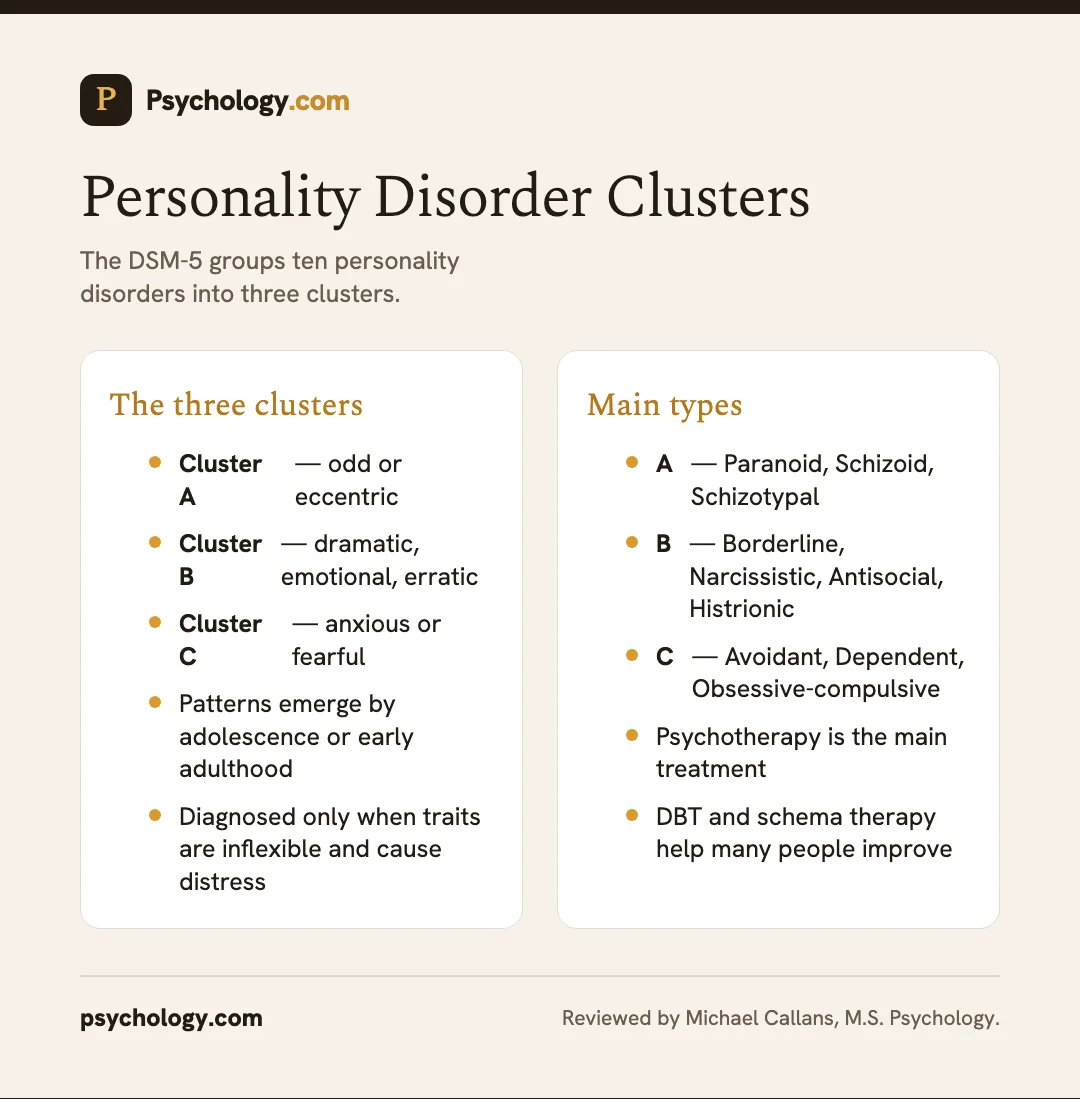
| Cluster | Shared theme | Disorders included | Common thread in daily life |
|---|---|---|---|
| Cluster A | Odd or eccentric | Paranoid, schizoid, schizotypal | Distrust, detachment, and discomfort with closeness |
| Cluster B | Dramatic, emotional, or erratic | Borderline, narcissistic, antisocial, histrionic | Intense emotions, impulsivity, and unstable relationships |
| Cluster C | Anxious or fearful | Avoidant, dependent, obsessive-compulsive personality disorder | Anxiety-driven patterns of avoidance, dependence, or control |
Symptoms
Symptoms vary by type, but common threads run through many personality disorders:
- Difficulty forming or keeping stable relationships
- Rigid, recurring patterns of thinking and behavior
- Trouble managing emotions or impulses
- A self-image that is distorted, unstable, or excessively dependent on others
- Frequent conflict, misunderstanding, or distance in close relationships
- Difficulty understanding how one's behavior affects others
Because these patterns feel familiar and longstanding, people often seek help for a related concern, such as depression, anxiety, or relationship breakdown, rather than for the personality disorder itself. A skilled clinician can identify the underlying pattern and tailor treatment accordingly.
By the numbers
9.1%of U.S. adults had a personality disorder in the past yearNIMH
1.4%of U.S. adults had borderline personality disorder in the past yearNIMH
Co-occurring conditionsare common among people with personality disorders and should be assessed alongside personality symptomsNIMH
39.0%of adults with a personality disorder received mental health treatment in the past yearNIMH
Causes and risk factors
There is no single cause. Personality disorders usually develop from a combination of factors that shape personality over time:
- Genetics: a family history of personality disorders or other mental health conditions raises risk.
- Temperament: inborn differences in how a person reacts to the world.
- Early environment: childhood trauma, abuse, neglect, or unstable, unpredictable caregiving.
- Life experience: ongoing stress or invalidating relationships during formative years.
These influences interact. Borderline personality disorder, for example, is linked to a combination of genetic vulnerability and adverse early experiences. Having risk factors does not make a personality disorder inevitable, and understanding them helps guide effective, compassionate treatment.
How personality disorders are treated
“Talk therapy, also known as psychotherapy, is the main treatment for personality disorders.”
Psychotherapy is the cornerstone of treatment, and the outlook is far more hopeful than it once was. Specialized, structured therapies help many people reduce symptoms, manage emotions, and build healthier relationships.
Dialectical behavior therapy (DBT)
Developed for borderline personality disorder, DBT teaches concrete skills in related areas: mindfulness, distress tolerance, emotion regulation, and interpersonal effectiveness. It has strong evidence for reducing self-harm, emotional instability, and crisis behavior.
Schema therapy
Schema therapy combines elements of cognitive, behavioral, and attachment-based approaches to identify and change deep-rooted patterns (schemas) formed early in life. It is used across several personality disorders and aims for lasting change in self-image and relationships.
Other psychotherapies and medication
Mentalization-based therapy, transference-focused therapy, and standard cognitive behavioral therapy also help, depending on the diagnosis and the person. No medication treats a personality disorder directly, but a prescriber may use medication to address co-occurring depression, anxiety, or other symptoms. Treatment usually takes time and consistency, and progress is real and worth it.
Does this sound familiar? Looking back over the years rather than just recent weeks, notice which of these patterns feel familiar.
Free, confidential, brief to complete, with an instant plain-language result and a PDF you can bring to a professional. A screening is not a diagnosis.
Free tools and worksheets
Practical, printable exercises from our free library that people managing personality disorders often find useful. No signup needed.
When to seek help
Reach out to a mental health professional if long-standing patterns in how you think, feel, or relate to others are causing repeated distress, conflict, or difficulty at work or in relationships. Seek help right away if you are struggling with self-harm or thoughts of suicide. A clinician experienced with personality disorders can assess what is happening and connect you with the right form of therapy. Help is available, and meaningful change is possible.
Frequently asked questions
Can a personality disorder be treated?
Yes. While personality disorders were once thought to be fixed, evidence now shows that psychotherapy helps many people. Approaches like dialectical behavior therapy and schema therapy reduce symptoms and improve relationships and quality of life over time. Treatment is tailored to the diagnosis, the person's priorities, and any co-occurring conditions, with progress reviewed over time.
What causes a personality disorder?
There is no single cause. Personality disorders usually develop from a mix of genetics, temperament, and early life experiences, including trauma, neglect, or unstable relationships during childhood and adolescence. Risk factors do not determine a person's future. A clinician explores these influences without assuming that every person has experienced trauma.
Is a personality disorder the same as having a difficult personality?
No. A personality disorder is a recognized mental health condition with an enduring pattern of inner experience and behavior that causes real distress and impairment. A diagnostic label should guide support and treatment while respecting the person's dignity. The diagnosis describes patterns that need care and is made through assessment in the person's cultural and developmental context.
Can you have more than one personality disorder?
Yes. Traits often cross cluster lines, and it is possible to meet criteria for more than one personality disorder at the same time. NIMH data also show that most people with a personality disorder have at least one other mental health condition, such as depression or anxiety. A thorough assessment maps the full picture so treatment can target what matters most.
How is a personality disorder diagnosed?
A mental health professional makes the diagnosis through in-depth clinical interviews, sometimes with input from people who know you well. Using DSM-5 criteria, they look for long-standing, inflexible patterns in thinking, emotion, relationships, and impulse control that show up across situations and cause real distress or impairment. They also rule out other explanations, including mood disorders, substance use, and medical conditions. An online borderline personality disorder test can support discussion, while diagnosis requires this broader assessment.
At what age can a personality disorder be diagnosed?
Personality patterns usually take shape by adolescence or early adulthood, and that is when most diagnoses are made. Clinicians are generally cautious about diagnosing before age 18, since personality is still developing, though a diagnosis can be made earlier when a pattern is clearly persistent and impairing. Whatever the age, earlier support tends to make treatment more effective.
Related conditions
Therapists who specialize in personality disorders
Connect with a licensed therapist on Psychology.com who works with personality disorders.
- Advance Thru Psychotherapy and Family Development
- Amanda P Bailey
- Arlyn P. Stern LCSW
- Asktheinternettherapist.com
- Beth Britton
- Candice Edelbaum
Finding the right help
When you are ready to take the next step, these guides walk you through finding and starting with the right therapist.
- Getting started with therapy
- How to find the right therapist
- Find a therapist who takes insurance
- Free & low-cost therapy
References
- National Institute of Mental Health (NIMH): Personality Disorders statistics
- Mayo Clinic: Personality disorders
- American Psychiatric Association (APA): What are personality disorders?
- NHS: Personality disorder
- Cleveland Clinic: Personality disorders overview
- MedlinePlus: Personality disorders
- NIMH: Borderline Personality Disorder, treatment and assessment
Personality disorder tests and clinical assessment
A borderline personality disorder test or avoidant personality test can help identify experiences to discuss with a clinician. Scores can overlap with other conditions and cannot establish a diagnosis. Bring examples from different settings and describe how long the pattern has affected you. Avoid using a questionnaire to label a partner or family member.
For a practical starting point, the emotion regulation worksheet helps organize feelings and coping responses. Explore the conditions hub, mood disorders, and anxiety to understand related concerns. A clinician can explain which difficulties need attention first and how treatment will be reviewed.
The prevalence and treatment figures above come from survey data collected from 2001 to 2003. They describe groups in a historical survey and cannot predict an individual's diagnosis or recovery. NIMH: data sources and methods.
