 Reviewed by
Key facts
- Mood disorders include depressive disorders and bipolar disorders. Bipolar assessment considers episodes of increased energy and elevated or irritable mood as well as depression. NIMH: bipolar symptoms.
- Depression can affect people of any age and background. A major depressive episode involves depressed mood or loss of interest with other symptoms for at least two weeks. NIMH: depression.
- Mood disorders involve health, biological, psychological, and environmental factors. Symptoms deserve care, and family history alone cannot determine whether someone will develop a disorder. NIMH: contributing factors.
- Psychotherapy and medication are established treatment options. For bipolar disorder, antidepressants alone can trigger mania or rapid cycling, so medication choices require a prescriber familiar with bipolar care. NIMH: treatment.
What are mood disorders?
The term mood disorder covers several diagnoses rather than describing every emotional fluctuation. Recording changes in sleep, activity, concentration, and mood can help a clinician distinguish depression from bipolar episodes and from physical or substance-related causes.
A mood disorder is a mental health condition in which your emotional state is disturbed for a sustained period in a way that interferes with everyday life. Mood naturally shifts in response to events, but with a mood disorder the change is more intense, lasts much longer, and is harder to shake. The two broad patterns are depression, marked by persistent low mood and loss of interest, and mania or hypomania, marked by abnormally elevated or irritable mood and energy. Some conditions involve one pattern, and some involve both.
Mood disorders are common. The National Institute of Mental Health (NIMH) reports that mood disorders affect a substantial share of U.S. adults over the course of a lifetime, and the World Health Organization (WHO) describes depressive disorders as a leading cause of disability globally. If you are living with one, you are in very large company.
Clinicians diagnose mood disorders using the criteria in the Diagnostic and Statistical Manual of Mental Disorders (DSM-5), published by the American Psychiatric Association. In broad terms, a diagnosis depends on the type, duration, and intensity of mood symptoms, the presence or absence of manic episodes, and the degree to which symptoms disrupt daily functioning, after a clinician has ruled out a medical cause, medication effect, or substance use. A qualified professional assesses the full symptom history and context before making a diagnosis.
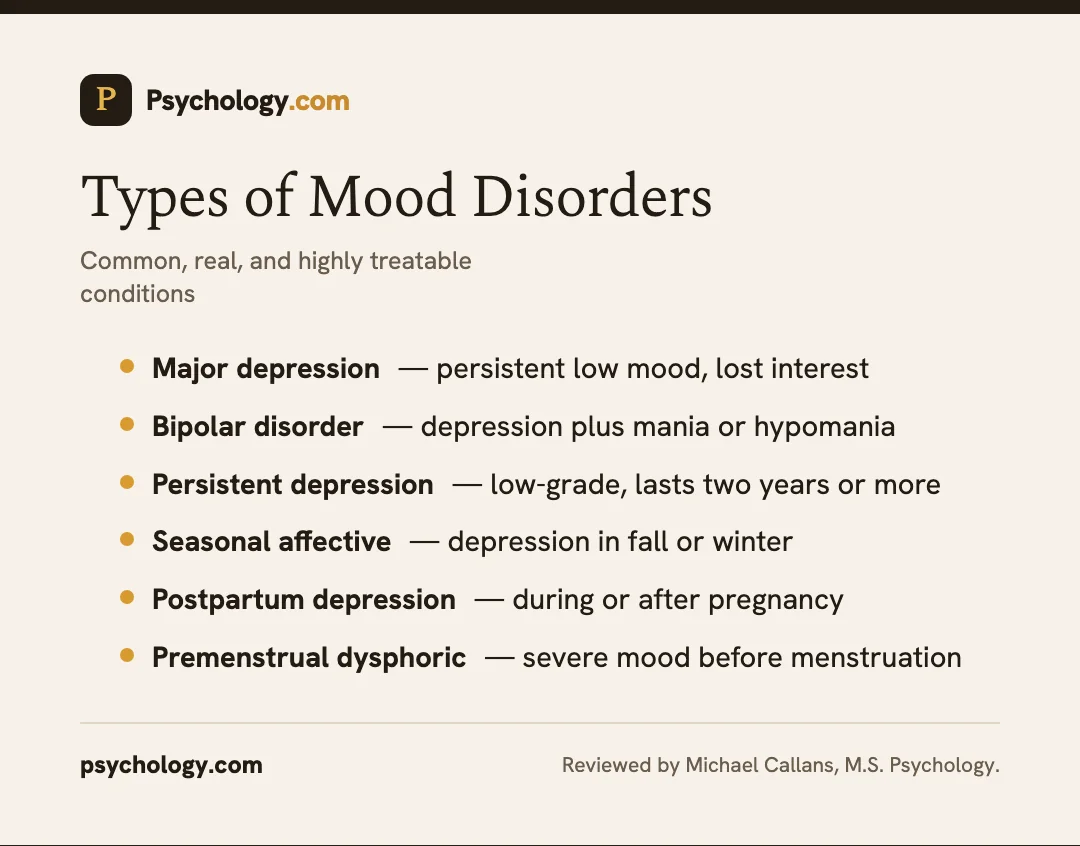
Types of mood disorders
Mood disorders cover several distinct conditions. The most common include:
- Major depressive disorder: episodes of persistent low mood, loss of interest, and physical and cognitive changes lasting two weeks or more. See our full guide to depression.
- Bipolar disorder: episodes of mania or hypomania and, commonly, depression, with changes in mood, energy, sleep, and judgment. Episodes need not follow an alternating sequence. See our guide to bipolar disorder.
- Persistent depressive disorder (dysthymia): a persistent form of depression that typically lasts at least two years in adults. Severity can vary and symptoms may be substantial.
- Seasonal affective disorder: depression that follows a seasonal pattern, most often beginning in fall or winter. See seasonal affective disorder.
- Postpartum depression: a depressive episode during pregnancy or in the weeks and months after childbirth.
- Premenstrual dysphoric disorder: severe mood symptoms before menstruation that improve after it begins. NIMH describes this menstrual-cycle pattern.
| Condition | Core pattern | Typical duration | Key difference |
|---|---|---|---|
| Major depressive disorder | Episodes of persistent low mood and lost interest | Two weeks or longer per episode | No manic or hypomanic episodes |
| Persistent depressive disorder | Lower-grade but long-lasting depression | Two years or more | Persistent symptoms whose severity can vary; major depressive episodes may also occur |
| Bipolar I disorder | Full manic episodes, commonly with depressive episodes | Mania lasts a week or more, or requires hospital care | Mania can be severe and disruptive, sometimes with psychosis |
| Bipolar II disorder | Depression alternating with hypomania | Hypomania lasts at least four days | Elevated periods are milder and never reach full mania |
The duration examples above describe adult diagnostic patterns, not a waiting period before seeking help. NIMH depression guidance supports the depression time frames; American Psychiatric Association bipolar guidance explains manic and hypomanic episode criteria. Depression is common in bipolar I but is not required for that diagnosis.
Symptoms
Symptoms depend on whether the mood is low, elevated, or shifting between the two. Depressive symptoms include:
- Persistent sadness, emptiness, or hopelessness
- Loss of interest or pleasure in usual activities
- Changes in sleep, appetite, or weight
- Fatigue and low energy
- Difficulty concentrating or making decisions
- Feelings of worthlessness or guilt
- Thoughts of death or suicide
Manic or hypomanic symptoms, which appear in bipolar disorder, include:
- Abnormally elevated, expansive, or irritable mood
- Increased energy and reduced need for sleep
- Racing thoughts and rapid speech
- Inflated self-confidence or grandiosity
- Impulsive or risky behavior
When these symptoms persist, represent a clear change from your usual self, and interfere with daily life, they may point to a mood disorder. As the Mayo Clinic notes, mood disorders can affect children, teenagers, and adults differently, and symptoms range from mild to severe.
By the numbers
21.4%estimated lifetime prevalence of mood disorders among U.S. adults in the National Comorbidity Survey Replication, conducted from 2001 to 2003NIMH
9.7%estimated past-year prevalence of mood disorders among U.S. adults in the survey conducted from 2001 to 2003NIMH
21.0 millionU.S. adults had at least one major depressive episode in 2021, or 8.3% of all adultsNIMH
322 millionpeople worldwide were estimated to have depression in 2023, according to WHOWorld Health Organization
Causes and risk factors
There is no single cause. Mood disorders usually arise from a combination of factors:
- Biology: brain chemistry, hormones, and genetics. Mood disorders, especially bipolar disorder, often run in families.
- Life events: trauma, loss, chronic stress, or major change.
- Health: chronic illness, chronic pain, thyroid problems, and some medications can contribute.
- Substance use: alcohol and drugs can trigger or worsen mood symptoms.
These factors interact rather than act alone. A genetic vulnerability may stay quiet until a stressful period or hormonal shift brings symptoms forward. Mood disorders frequently appear alongside anxiety, and the two can be treated together. Because some physical conditions can mimic a mood disorder, a medical evaluation is part of a thorough assessment.
How mood disorders are treated
“There is effective treatment for mild, moderate and severe depression.”
Mood disorders are highly treatable. Most people improve substantially with treatment, and a combination of approaches often works best. The right plan depends on the specific diagnosis, its severity, and your preferences, so it is worth discussing the options with a professional.
Psychotherapy
Talk therapy helps you understand and manage the thoughts, behaviors, and relationship patterns tied to your mood. Cognitive behavioral therapy (CBT) helps you recognize and reframe unhelpful thinking. Interpersonal therapy addresses relationship and role changes that can feed low mood. For bipolar disorder, approaches that focus on stabilizing daily routines and sleep, alongside medication, are particularly helpful.
Medication
Tell the prescriber about any past periods of unusually high energy, reduced need for sleep, or impulsive behavior, including times that felt productive. NIMH explains that missed hypomania can lead to a depression-only diagnosis and a medication plan that needs reconsideration.
Medication is often central, especially for moderate to severe conditions. Antidepressants, including selective serotonin reuptake inhibitors (SSRIs), are commonly used for depressive disorders. Mood stabilizers, such as lithium and certain anticonvulsants, are mainstays for bipolar disorder, where antidepressants alone can be problematic. Medication should always be managed by a prescriber. Learn more about antidepressants.
Lifestyle and self-care
Consistent sleep, regular physical activity, social connection, and limiting alcohol all support stability. For bipolar disorder in particular, keeping a steady daily rhythm helps reduce the risk of mood episodes. These measures complement, but do not replace, professional treatment.
Does this sound familiar? Take a quiet moment and notice which of these feel familiar from the past few weeks.
Free, with a plain-language result and a PDF you can bring to a professional. Take the time you need to consider each answer. A screening is not a diagnosis.
Free tools and worksheets
Practical, printable exercises from our free library that people managing mood disorders often find useful. No signup needed.
When to seek help
Reach out to a doctor or mental health professional if changes in your mood last more than two weeks, feel out of proportion to events, or interfere with work, relationships, or daily life. Seek help immediately if you have thoughts of harming yourself or notice periods of unusually high energy, little need for sleep, and risky behavior. Mood disorders are treatable, and getting help early makes recovery easier.
Frequently asked questions
What is the difference between a mood disorder and just feeling moody?
Everyone has mood changes that pass as circumstances shift. A mood disorder involves a more sustained or severe change in mood, energy, sleep, and functioning. Episodes can last days, weeks, or longer, depending on the condition. A clinician considers the pattern and its consequences, including changes in judgment or safety, rather than relying on feeling moody alone.
Are mood disorders treatable?
Yes. Mood disorders have effective treatments, including psychotherapy, medication, or a combination tailored to the diagnosis. Many people achieve meaningful improvement and ongoing stability. Bipolar disorder usually needs continuing care even between episodes. Discuss benefits, side effects, sleep routines, and warning signs with your clinician, and avoid changing prescribed medication without their guidance.
Can a mood disorder be inherited?
Genetics play a meaningful role, especially in bipolar disorder. Having a close relative with a mood disorder raises your risk, but it is not a guarantee. Life events and biology interact, so family history is one factor among several. Share relevant family history with the clinician assessing your symptoms.
What is the difference between bipolar I and bipolar II disorder?
Bipolar I involves at least one full manic episode, a period of abnormally elevated mood and energy severe enough to disrupt life or require hospital care. Bipolar II involves hypomania, a milder form of elevated mood, along with episodes of major depression. Both are treatable mood disorders, and a clinician distinguishes them by the intensity and duration of the elevated episodes.
How is a mood disorder diagnosed?
A clinician, usually a psychiatrist, psychologist, or physician, diagnoses a mood disorder through a detailed interview using DSM-5 criteria. They look at the type, duration, and intensity of mood symptoms, whether manic episodes have occurred, and how much daily life is disrupted. A medical evaluation is often included, because thyroid problems, medications, and substance use can produce similar symptoms.
Do mood disorders look different in children and teenagers?
They can. In younger people, depression often shows up as irritability, school problems, or physical complaints rather than obvious sadness, and mood episodes can be harder to separate from typical adolescent changes. Any persistent shift in a child's mood, sleep, energy, or interests that lasts weeks and disrupts school or friendships deserves a professional evaluation.
Related conditions
- Depression
- Bipolar Disorder
- Seasonal Affective Disorder
- Depression Statistics 2026
- Bipolar Disorder Statistics 2026
Therapists who specialize in mood disorders
Connect with a licensed therapist on Psychology.com who works with mood disorders.
- 180 Wellness
- A FAMILY MATTER
- Advance Thru Psychotherapy and Family Development
- Amy Keller
- Arlyn P. Stern LCSW
- Asktheinternettherapist.com
Finding the right help
When you are ready to take the next step, these guides walk you through finding and starting with the right therapist.
- Depressed or just sad?
- Getting started with therapy
- How to find the right therapist
- Find a therapist who takes insurance
- Free & low-cost therapy
Visit the conditions hub for related guides, including depression or ordinary sadness and seasonal affective disorder. If you use the mood tracker, bring notes on sleep, energy, medications, and daily activities to your appointment. The depression screening can help organize concerns; a clinician still needs to assess possible past mania or hypomania.
References
- National Institute of Mental Health (NIMH): Depression
- National Institute of Mental Health (NIMH): Any Mood Disorder statistics
- National Institute of Mental Health (NIMH): Bipolar Disorder
- Mayo Clinic: Mood disorders
- World Health Organization (WHO): Depressive disorder (depression) fact sheet
- American Psychiatric Association (APA): What is depression?
- NIMH: Depression, diagnostic duration and treatment
- NIMH: Bipolar Disorder, diagnosis and treatment
- American Psychiatric Association: What Are Bipolar Disorders?
