

Key facts
- Marriage and family therapy (MFT) treats problems in the context of relationships and family systems. AAMFT: marriage and family therapy
- A licensed marriage and family therapist (LMFT) is trained specifically in this systemic approach. AAMFT Code of Ethics
- Sessions may include a whole family, a couple, a parent and child, or an individual. AAMFT: marriage and family therapy
- It is brief and goal-oriented for many concerns, and is recognized as a core mental health profession. AAMFT: marriage and family therapy
What is marriage and family therapy?
Marriage and family therapy, often shortened to MFT, is a branch of psychotherapy built on a simple but powerful idea: people exist within relationships, and our difficulties are shaped by the systems we live in. Rather than treating a person in isolation, an MFT considers the family, the couple, and the wider network of connections around the individual. When one part of a system changes, the whole system responds. The therapist and participants agree on practical goals, such as improving communication about parenting, managing conflict, or adapting to a family transition.
This is known as the systemic approach. A child's behavior, a teenager's withdrawal, or a partner's frustration is considered alongside the interactions and circumstances around them. This adds context to an individual assessment and helps identify changes the family can practice. The work focuses on shifting those patterns so the whole system functions better. According to the American Association for Marriage and Family Therapy (AAMFT), this relational focus is what distinguishes the profession, and research shows MFT is effective and often brief.
What is an LMFT?
A licensed marriage and family therapist (LMFT) is a mental health professional licensed by their state to diagnose and treat mental and emotional disorders within the context of relationships. Becoming an LMFT requires a master's or doctoral degree in marriage and family therapy or a closely related field, a substantial period of supervised clinical experience (with duration and required hours set by the licensing jurisdiction), and passing a state or national licensing exam.
LMFTs are one of the core mental health professions in the United States, alongside psychologists, clinical social workers, professional counselors, and psychiatrists. What sets them apart is their training in systemic and relational therapy. An LMFT is qualified to work with individuals, couples, and families, and they treat the same range of mental health concerns as other therapists, with particular strength in relationship and family dynamics.
What it treats
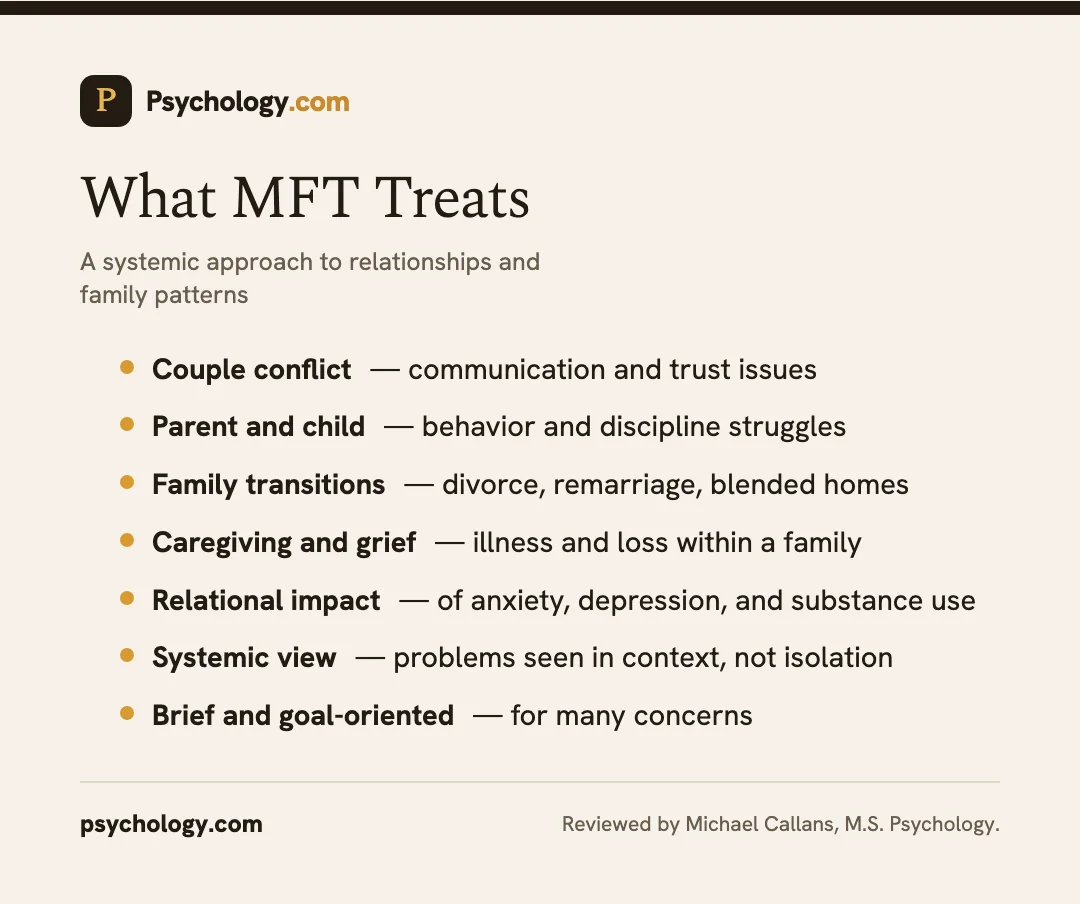
Marriage and family therapists help with a broad range of concerns, including:
- Marital and couple conflict, including communication and trust issues
- Parent and child difficulties, behavioral concerns, and discipline struggles
- Family transitions such as divorce, remarriage, blended families, and relocation
- Caring for an aging parent or a family member with illness
- Grief and loss affecting a family
- The relational impact of anxiety, depression, trauma, and substance use
- Adolescent issues, school problems, and conflict between siblings
Because the approach is relational, MFT is especially helpful when an individual's struggle is tangled up with the people around them, or when the family itself is the source of stress. For couples specifically, couples counseling applies many of the same principles to the partnership.
Family dynamics and the systemic view
At the heart of MFT is attention to family dynamics: the often unspoken roles, rules, and patterns that govern how a family operates. A therapist might notice that one child has become the family's focus of worry, that a couple's conflict pulls children into the middle, or that a pattern of avoidance has passed down through generations.
By making these patterns visible, the therapist helps the family understand how their interactions maintain a problem, and how small changes can break a cycle. The goal is to help family members respond more flexibly, communicate their needs, and support healthier relationships while recognizing each person’s responsibility for their behavior. This perspective also recognizes strengths, drawing on the family's own resources and resilience to create change.
What to expect in sessions
Therapy usually begins with an assessment, where the therapist learns about the family's history, the presenting concern, and how members relate to one another. They may ask everyone to attend the first session or start with the couple or individual most affected. Who attends each session can shift over time depending on the focus.
In session, the therapist guides conversation, points out patterns as they happen, and coaches family members toward clearer communication and repair. The approach is typically active and goal-oriented, often briefer than open-ended individual therapy. Many families are given things to practice at home, since change takes root in everyday life. Sessions are confidential within the limits of the law, and the therapist works to keep the space fair and safe for everyone present.
Finding a qualified provider
Look for a licensed marriage and family therapist (LMFT) or another licensed clinician with specific training in systemic and family work. It is reasonable to ask about their credentials, their experience with your particular concern, and how they involve different family members. A good fit matters for everyone attending, so it is fine to meet more than one therapist before deciding. If your main concern is supporting children through a separation, parenting resources and divorce counseling can complement family therapy.
Frequently asked questions
What is the difference between an LMFT and other therapists?
A licensed marriage and family therapist (LMFT) is a mental health professional trained specifically in systemic therapy, which views problems in the context of relationships and family systems. They complete a master's or doctoral degree, supervised clinical hours, and a licensing exam, and they are qualified to treat individuals, couples, and families.
Does the whole family have to attend every session?
No. Marriage and family therapists often work with the whole family, but sessions may also include just a couple, a parent and child, or an individual. The therapist decides who to involve based on the issue, and the makeup of sessions can change over the course of treatment.
What issues can marriage and family therapy treat?
It addresses a wide range of concerns, including couple conflict, parenting struggles, family transitions, communication breakdowns, and the relational impact of issues like anxiety, depression, grief, and substance use. The focus is on improving the relationships and patterns that surround a problem.
Where can I find marriage communication tools in PDF format?
The Couples Communication Worksheet offers printable prompts for discussing a concern, listening to each other, and agreeing on a practical next step. Use it when both partners feel safe and willing to participate, and bring difficult patterns to a therapist. Worksheets can support practice between appointments. They cannot assess relationship safety or replace professional help with persistent conflict.
What happens in the first marriage and family therapy session?
The therapist usually asks what brought you in, how the problem affects daily life, and what each person hopes will change. You may discuss family history, current stressors, and who should attend future sessions. Before sharing sensitive information, ask about confidentiality, private conversations with individual members, and how records are handled. The first meeting also helps you assess whether the therapist feels like a suitable fit.
Related conditions
Therapists who specialize in marriage and family therapy
Connect with a licensed therapist on Psychology.com who works with marriage and family therapy.
- 180 Wellness
- A FAMILY MATTER
- Advance Thru Psychotherapy and Family Development
- Amy Keller
- Arlyn P. Stern LCSW
- Asktheinternettherapist.com
Finding the right help
When you are ready to take the next step, these guides walk you through finding and starting with the right therapist.
- Getting started with therapy
- How to find the right therapist
- Find a therapist who takes insurance
- Free & low-cost therapy
References
- American Association for Marriage and Family Therapy (AAMFT): About marriage and family therapists
- AAMFT: Couples and family therapy
- American Psychological Association (APA): Families
- HelpGuide: Finding a therapist who can help you heal
- MedlinePlus: Family issues
- AAMFT Code of Ethics
- National Domestic Violence Hotline
Planning family therapy and practice at home
Agree on a concern you want help with, such as arguments about parenting or difficulty adjusting after a separation. Ask the therapist how they will set goals with people who want different outcomes. Discuss privacy before individual conversations: what is kept confidential, what may be shared with other participants, and how the therapist handles records. AAMFT Code of Ethics requires therapists to explain confidentiality limits and obtain informed consent.
For marriage communication tools in PDF format, use the printable Couples Communication Worksheet. The communication style self-check can prompt a discussion about everyday habits; it does not diagnose a relationship or decide who is right. The therapies hub, couples counseling guide, and divorce counseling guide explain related options.
If a partner uses threats, coercion, or violence, seek individual support and safety planning before joint sessions. The National Domestic Violence Hotline advises against couples counseling with an abusive partner because disclosures can increase risk and abuse requires a different response from ordinary relationship conflict.