

Key facts
- Every developmental stage brings predictable challenges, from toddler tantrums to teen independence. CDC: development and expectations
- Parent training programs have strong evidence for improving behavior and the parent-child bond. CDC: evidence-informed parenting
- Seeking support early gives families time to practice clear expectations and consistent responses before struggles become entrenched. CDC: consistent family rules
- Caring for your own mental health supports your ability to care for your child and respond with patience. HHS: parental mental health
- CDC's free Essentials for Parenting materials are designed for caregivers of children ages 2 to 4. CDC: who the resource serves
- Specific praise tells a child which behavior to repeat; predictable rules help caregivers respond consistently. CDC: praise; CDC: family rules
Overview
Parenting is one of the most meaningful roles a person can take on, and also one of the most demanding. It asks you to be patient when you are exhausted, calm when you are frustrated, and consistent across years of constant change. There is no single correct way to do it, and the strategies that work for one child may not work for another, even within the same family. Useful support starts with a specific concern, such as difficult bedtimes, school refusal, or repeated arguments, and helps your family choose a manageable next step.
Parenting support is the broad set of resources that help you meet these demands: parenting classes, parent coaching, family therapy, behavioral strategies, peer support groups, and guidance from pediatricians and mental health professionals. The goal is to give you practical tools, a clearer understanding of your child's development, and support for your own well-being so that family life feels steadier and warmer. You can adapt those tools as your child's needs and your circumstances change.
Reaching for help is increasingly normal. Many parents today are raising children far from extended family, juggling work and caregiving, and navigating challenges, from screen time to anxiety, that previous generations did not face in the same way. Support exists precisely because parenting was never meant to be done alone.
Common challenges across ages
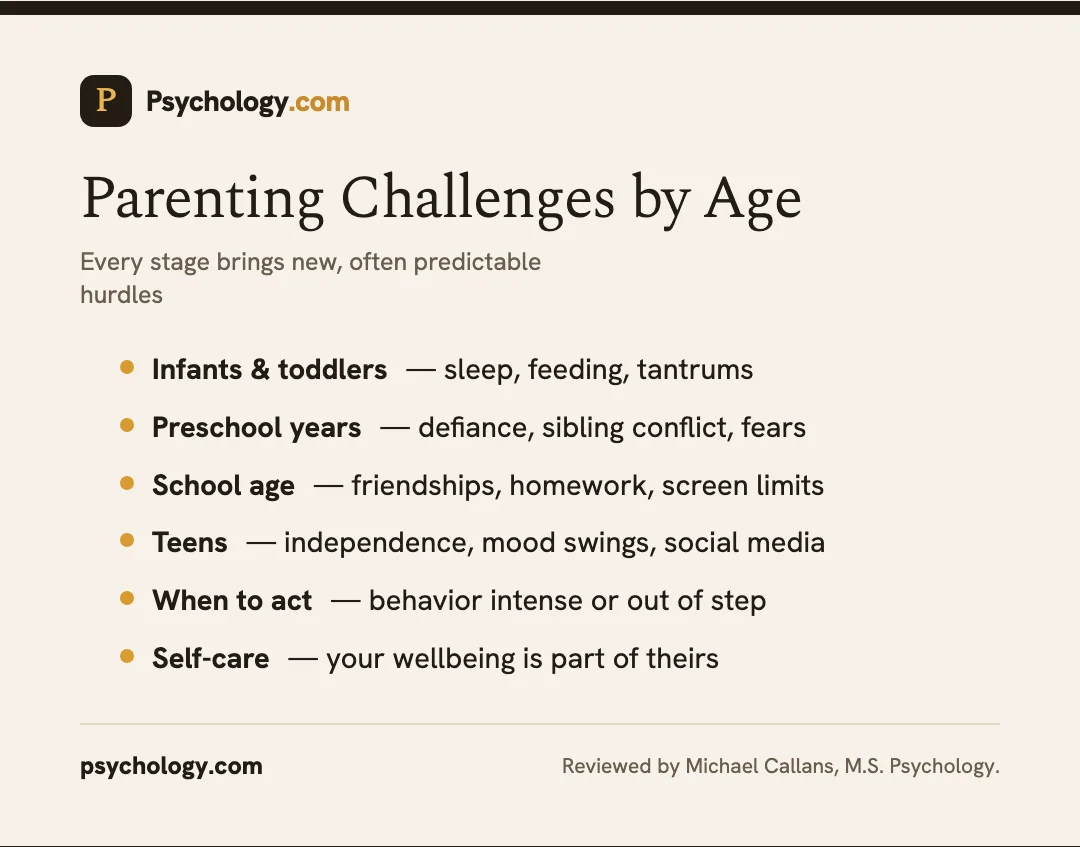
Children change quickly, and the issues that feel urgent at one stage often fade as the next arrives. Recognizing what is typical for each age can lower the pressure and help you respond rather than react.
- Infants and toddlers: sleep struggles, feeding worries, separation anxiety, tantrums, and testing limits. Much of this reflects normal development as a child learns independence and big feelings outpace their words.
- Preschool and early school years: defiance, sibling conflict, fears, trouble with transitions, and the early signs of attention or learning differences. This is often when parents first wonder whether a behavior is a phase or something that needs attention.
- School age: friendship struggles, homework battles, self-esteem, screen and gaming limits, and managing emotions at school and home.
- Adolescents and teens: the push for independence, mood swings, social media pressures, risk-taking, identity questions, and pulling away from parents. Conflict often peaks here even in strong relationships.
When difficult behavior is intense, frequent, or out of step with a child's age, it can sometimes point to an underlying issue worth a closer look. Our guide to child behavior disorders explains the difference between ordinary acting out and patterns that may benefit from professional assessment.
When to seek support
There is no need to wait for a crisis. Many parents seek support simply to feel more confident and less alone. It is especially worth reaching out when:
- Daily routines such as mealtimes, bedtime, or getting out the door feel like constant battles.
- Your child's behavior is not improving despite your best and most consistent efforts.
- A child seems persistently sad, anxious, withdrawn, or angry, or their functioning at school or with friends is slipping.
- Conflict between you and your child, or between parents, is escalating.
- Parenting is taking a clear toll on your own mood, sleep, relationships, or sense of self.
Your pediatrician or family doctor is a good first stop. They can rule out health factors, offer guidance, and refer you to a child therapist, a family therapist, or a parenting program suited to your situation.
How coaching and therapy help
Different forms of support suit different needs. Many families combine them.
Parent coaching and parent training
Structured programs teach concrete, evidence-based strategies: setting clear and consistent expectations, using praise and attention to encourage the behavior you want, staying calm during conflict, and applying predictable, fair consequences. Approaches such as parent management training and parent-child interaction therapy have decades of research behind them and are among the most effective tools for reducing difficult behavior in younger children.
Family therapy
When patterns of conflict, communication, or stress involve the whole household, family therapy can help. A licensed therapist works with parents and children together to improve how the family relates, resolves disagreements, and supports one another through change such as divorce, illness, or a new sibling.
Individual therapy for your child or for you
Sometimes a child benefits from their own therapist, and sometimes a parent does. Both are valid. A child struggling with anxiety, big emotions, or a behavioral challenge may do well in child-focused therapy, while a parent carrying stress, guilt, or their own history may find individual counseling steadies the whole family.
Behavioral strategies you can use at home
Small, consistent habits make a large difference: predictable routines, clear and brief instructions, catching your child being good, natural consequences, and repair after conflict. The strategies are learnable, and they tend to work better when used calmly and consistently rather than only in moments of frustration.
Wondering where you stand? Take the parenting style quiz or the communication style quiz: free, confidential, brief to complete, with an instant plain-language result and a PDF you can bring to a professional. A quiz is a starting point for reflection, not a verdict.
Parental self-care
Parents need opportunities to rest and recover, and children can be sensitive to a parent's stress. Protecting your own well-being is part of effective parenting, not a luxury set apart from it. That means guarding sleep where you can, accepting help, keeping at least one connection or activity that is yours, and treating your own anxiety, low mood, or burnout as worth attention. Postpartum and early-parenting periods carry particular risk, and conditions such as postpartum depression are common and treatable. If parenting is leaving you depleted, reaching out for support is one of the most caring things you can do for your child.
Frequently asked questions
How do I know if I need parenting support?
Consider support if everyday routines feel like a constant struggle, if your child's behavior is not improving despite your efforts, or if parenting is affecting your own mood, sleep, or relationships. Needing help is common and does not mean you are failing. Bring a concrete example to your pediatrician or a parenting professional, including what happens before and after the difficult moment.
What is the difference between parent coaching and family therapy?
Parent coaching focuses on practical skills and strategies for managing behavior and routines. Family therapy involves a licensed therapist working with parents and children together to improve relationships and resolve deeper conflicts. Many families benefit from one or both. Ask about the provider's training, whether children attend, and how progress will be reviewed at home.
Does parenting support actually work?
Yes. Structured parenting programs and parent training have strong research support for reducing difficult behavior and improving the parent-child relationship. The strategies are learnable, and most parents see meaningful change with practice. Choose a program suited to your child's age and needs, and ask how the provider helps families practice between appointments.
Can a parenting style quiz help me choose support?
A parenting style quiz can help you reflect on patterns such as warmth, expectations, and responses to conflict. It cannot diagnose a child or determine whether you are a good parent. Use the results to identify situations you want to handle differently, then discuss those examples with a parenting professional. Your child's development and your family's circumstances matter.
Related
- Child Therapy
- Child Behavior Disorders
- Adolescent and Teen Therapy
- Teen Mental Health Statistics 2026
- Postpartum Depression Statistics 2026
Therapists who specialize in parenting
Connect with a licensed therapist on Psychology.com who works with parenting.
- A FAMILY MATTER
- A. Nires
- Advance Thru Psychotherapy and Family Development
- Amanda P Bailey
- Amy Keller
- Arlyn P. Stern LCSW
Finding the right help
When you are ready to take the next step, these guides walk you through finding and starting with the right therapist.
- Getting started with therapy
- How to find the right therapist
- Find a therapist who takes insurance
- Free & low-cost therapy
References
- CDC: Essentials for Parenting Toddlers and Preschoolers
- American Psychological Association (APA): Parenting
- American Academy of Pediatrics: HealthyChildren.org
- HelpGuide: Parenting tips and support
- NHS: Children's behaviour and development
- CDC: Essentials for Parenting Toddlers and Preschoolers, current resource
- CDC: Tips for Creating Rules
- CDC: Tips for Using Praise and Rewards
- U.S. Surgeon General: Parental Mental Health and Well-Being
Putting parenting support into practice
Choose a routine that feels difficult and describe what you want your child to do in observable terms. For example, asking a child to place shoes beside the door is clearer than asking them to be responsible. Match expectations to their abilities, explain the routine calmly, and notice their effort when they follow it. Agree with other caregivers on how to respond. CDC guidance on clear rules.
Use the parenting worksheets to organize a plan or the parenting style quiz for reflection. If difficulties extend beyond routines, read about child therapy and family therapy. The life and relationships hub covers related family concerns.
At a consultation, ask how the professional adapts advice for disability, sensory differences, language, and cultural expectations. Describe pressures such as housing, work schedules, or limited childcare so the plan fits what your family can realistically do.