 Reviewed by
In short
EMDR therapy, or Eye Movement Desensitization and Reprocessing, is a structured psychotherapy for trauma and PTSD. A trained therapist helps you briefly focus on distressing memories while following guided eye movements or other alternating cues. Treatment aims to reduce the memories' emotional impact through preparation, processing, and review.
Key facts
- EMDR is a structured, eight-phase therapy designed to help the brain reprocess traumatic memories. The protocol includes preparation and review as well as memory processing. EMDRIA: the eight phases.
- It is endorsed by the World Health Organization and the American Psychological Association as a treatment for PTSD. Its strongest evidence concerns PTSD, and suitability depends on assessment. VA: EMDR for PTSD.
- You do not need to describe the trauma in detail or do homework between sessions. Your clinician may still suggest coping practice or tracking reactions between appointments. VA: EMDR for PTSD.
- Sessions use bilateral stimulation, such as guided eye movements, while you hold a memory in mind. A full course also includes history taking, preparation, closure, and reevaluation. EMDRIA: the eight phases.
What is EMDR?
EMDR is a form of psychotherapy developed by psychologist Francine Shapiro in the late 1980s to help people recover from trauma and other distressing life experiences. The name stands for Eye Movement Desensitization and Reprocessing. The central idea is that when something overwhelming happens, the brain may not fully process the memory, leaving it stored with the original images, emotions, and body sensations intact. Years later, a reminder can bring all of that flooding back as if the event were happening again. This explanation of memory processing is a treatment model; researchers continue to study the mechanisms behind symptom improvement. Preparation and ongoing assessment are part of the treatment itself. EMDRIA: the eight phases.
EMDR aims to help the brain finish processing those stuck memories. During a session you briefly call a difficult memory to mind while the therapist guides you through sets of bilateral stimulation, most often side-to-side eye movements, though taps or tones may also be used. This dual attention, focusing inward on the memory while tracking an external cue, appears to lower the emotional charge of the memory so it can be filed away like an ordinary one. People often describe the event afterward as something that happened in the past rather than something that still feels present.
EMDR keeps you awake and engaged, and you can ask the therapist to pause or stop at any point. Unlike many talk therapies, it does not require you to describe the event in detail, analyze it, or complete tasks between sessions. The American Psychological Association recognizes it as an evidence-based option for trauma.
What it helps with
EMDR is best known and most studied as a treatment for post-traumatic stress disorder, including PTSD from a single event such as an assault, accident, or disaster, as well as more complex trauma built up over time. It is widely used with survivors of abuse, combat veterans, first responders, and people coping with grief or sudden loss.
Clinicians also apply EMDR to a broader range of concerns connected to painful experiences, including:
- Anxiety and panic linked to specific events or triggers
- Phobias and performance anxiety
- Depression tied to loss or unresolved experiences
- Distress after a medical diagnosis or procedure
- The lingering effects of childhood adversity
EMDR is not a fit for every situation, and a therapist will assess whether it is appropriate for you, sometimes recommending it alongside or instead of other approaches.
The eight phases
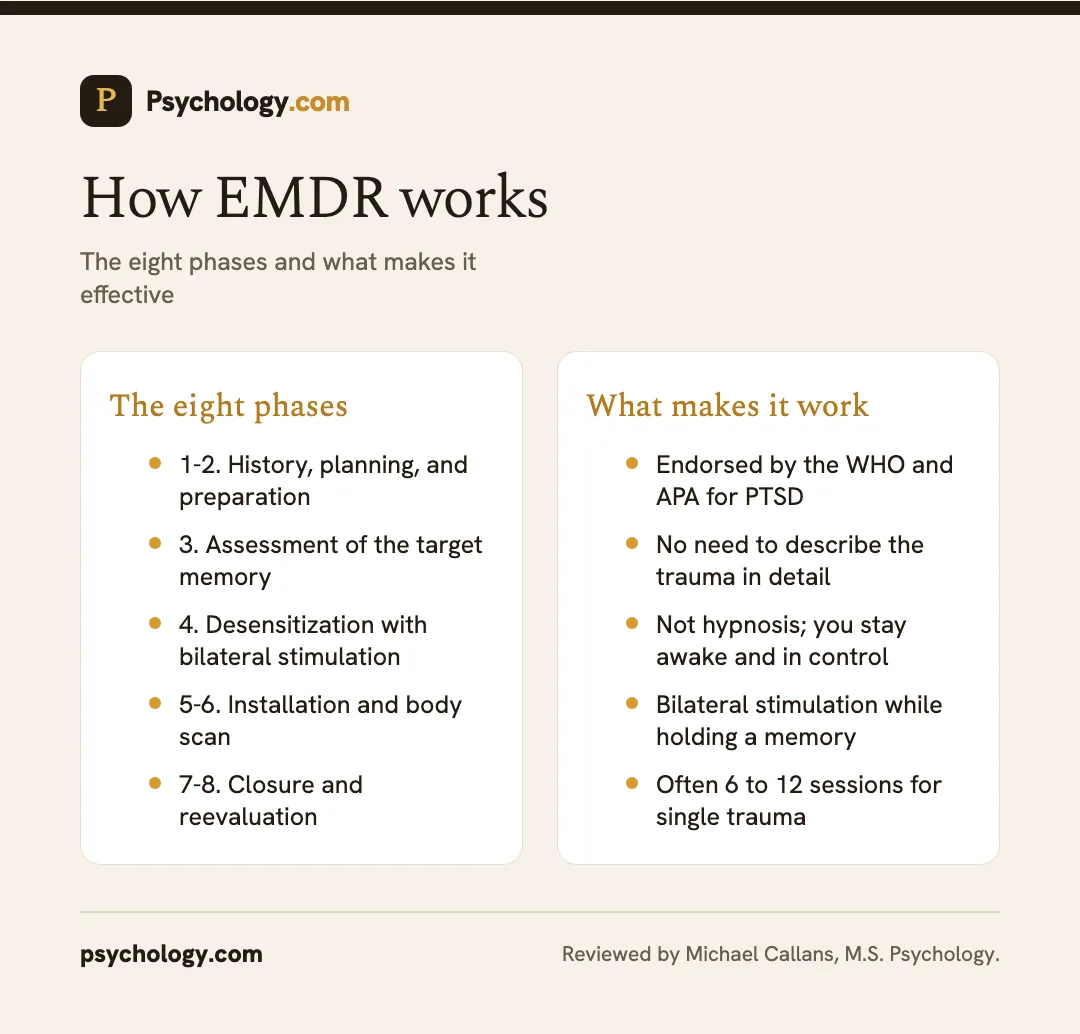
EMDR follows a standardized eight-phase protocol. The phases are not all separate appointments; several often happen within one session.
- 1. History and treatment planning: the therapist gathers your background and identifies the memories to target.
- 2. Preparation: you learn what to expect and practice calming and grounding techniques you can use anytime.
- 3. Assessment: you identify a specific memory, the negative belief attached to it, and a positive belief you would prefer.
- 4. Desensitization: you hold the memory in mind during sets of bilateral stimulation until its distress fades.
- 5. Installation: the positive belief is strengthened and linked to the memory.
- 6. Body scan: you notice and clear any remaining physical tension connected to the memory.
- 7. Closure: the therapist helps you return to a calm, stable state before the session ends.
- 8. Reevaluation: at the next session, you and the therapist review progress and decide what to target next.
What to expect in sessions
A course of EMDR usually begins with one or more sessions focused on history and preparation, before any memory is reprocessed. This groundwork matters: your therapist will make sure you have reliable ways to calm yourself first, so the reprocessing work feels manageable.
During reprocessing, you bring a target memory to mind and then follow the therapist's hand, a light bar, or another cue with your eyes in short sets, pausing between each to notice whatever comes up. There is no right or wrong response. Thoughts, images, emotions, and body sensations may shift on their own, and the therapist follows where your mind goes rather than steering it. Many people feel tired after a session and lighter over the following days as the memory settles.
The VA describes a typical course as about 3 months of weekly 50- to 90-minute sessions. The number of appointments depends on the treatment goals and the preparation needed; complex trauma involving many experiences may require more time. VA: EMDR for PTSD. Your therapist will set realistic expectations once they understand your history.
Does it work
EMDR has a strong evidence base for PTSD. Numerous randomized controlled trials have found it reduces trauma symptoms, and it is endorsed in major clinical guidelines. The World Health Organization recommends trauma-focused therapies including EMDR for PTSD, and the American Psychological Association lists it among recommended treatments. For PTSD specifically, research generally finds EMDR comparable in effectiveness to trauma-focused cognitive behavioral therapy.
Researchers still debate exactly why the eye movements help, and the evidence is strongest for trauma and PTSD rather than for every condition it is sometimes used to treat. What is clear is that, delivered by a trained clinician using the full protocol, EMDR is a legitimate, well-supported option, not a quick fix or a fringe technique.
Finding a qualified provider
EMDR should be delivered by a licensed mental health professional, such as a psychologist, counselor, or clinical social worker, who has completed formal EMDR training. Reputable training follows the standards set by bodies such as the EMDR International Association (EMDRIA). When you contact a therapist, it is reasonable to ask where they trained in EMDR, how much experience they have with your type of concern, and whether they are EMDRIA certified.
A good fit matters as much as the method. You want a clinician you feel safe with, since trauma work depends on trust. If you are not sure where to start, your primary care doctor can help, and our therapist directory lets you search for providers who offer EMDR.
Frequently asked questions
Does EMDR really work?
Yes. EMDR is recognized by the World Health Organization and the American Psychological Association as an effective treatment for post-traumatic stress disorder, supported by many controlled studies showing it reduces trauma symptoms. The strongest evidence concerns PTSD; results for other problems are less established.
Do I have to talk about the trauma in detail during EMDR?
No. Unlike some talk therapies, EMDR does not require you to describe the event in detail or explain why you feel the way you do. You hold the memory in mind while following a back-and-forth cue, and the therapist guides the process.
How many EMDR sessions will I need?
It varies. A single trauma may resolve in a handful of sessions, while complex or repeated trauma can take longer. Your therapist will set expectations after the early assessment phases. The VA describes a typical course as about 3 months of weekly appointments, with individual needs affecting the pace. VA: EMDR for PTSD.
Related
- PTSD
- Anxiety
- Hypnotherapy
- Jungian Therapy
Therapists who specialize in emdr
Connect with a licensed therapist on Psychology.com who works with emdr.
- Anne Ciota
- Asktheinternettherapist.com
- Beth Britton
- Christine E Roslund
- Diana J. Goldstein
- Diane M. Berry
Finding the right help
When you are ready to take the next step, these guides walk you through finding and starting with the right therapist.
- Getting started with therapy
- How to find the right therapist
- Find a therapist who takes insurance
- Free & low-cost therapy
References
- American Psychological Association (APA): Eye Movement Desensitization and Reprocessing (EMDR) Therapy
- U.S. Department of Veterans Affairs: EMDR for PTSD
- Cleveland Clinic: EMDR Therapy
- World Health Organization (WHO): Mental Health Gap Action Programme
- American Psychological Association (APA): Clinical Practice Guideline for PTSD
EMDR preparation and self-help
What is an EMDR safe place script?
An EMDR safe place script guides imagery associated with calm or safety during preparation. A therapist can adapt the exercise if imagining safety feels difficult. It helps develop a coping resource before memory work. A downloadable script is a preparation aid; trauma processing requires assessment and guidance. EMDRIA glossary.
Can I do EMDR myself at home?
EMDR involves clinical assessment, preparation, memory processing, and follow-up with a trained therapist. Moving your eyes or tapping along with a video does not provide that full treatment. Ask your clinician which calming exercises are suitable between sessions and how to respond if distress rises. EMDRIA explains the protocol.
Compare approaches in our therapy hub, and read about signs of childhood trauma and OCD and PTSD differences. A PTSD screening can organize symptoms for a clinical conversation. Our grounding techniques worksheet offers present-focused coping exercises to discuss with your provider.