 Reviewed by
Key facts
- Internet addiction describes compulsive online use that disrupts sleep, relationships, school, or work. APA: scope and impairment
- It is not yet a single formal diagnosis, though gaming disorder is recognized by the WHO. WHO: gaming disorder
- The amount of time online matters less than whether use is compulsive and harmful. WHO: clinical criteria
- Cognitive behavioral therapy and treating underlying conditions are the main approaches. CBT clinical trial
- A randomized trial found that a structured CBT program improved internet and computer game addiction outcomes compared with a waiting list. Participants were men, which limits generalization to everyone with problematic online use. Wölfling and colleagues: clinical trial
What is internet addiction?
Internet addiction is a pattern of compulsive online activity that a person finds hard to control and that interferes with everyday life. It is an umbrella term that can include excessive gaming, social media use, streaming, online shopping, pornography, or simply endless browsing. Loss of control and the harm that follows are the central concerns across these activities.
When online life starts to take over. Internet addiction, often called problematic internet use, describes compulsive online behavior that harms daily life. Its clinical definition is still evolving, but the distress it causes is real and treatable.
Because the internet is woven into work, school, and social life, heavy use is normal for most people and is not a problem on its own. Internet addiction refers to something more specific: use that is compulsive, crowds out other priorities, and continues despite negative consequences. Researchers often prefer the term problematic internet use, which captures the spectrum of difficulty without overstating the evidence. This places it among the behavioral patterns sometimes compared to addiction, while acknowledging that the science is still developing.
Part of what makes online platforms hard to step away from is that many are designed to be engaging. Features like infinite scroll, autoplay, notifications, and variable rewards tap into the same reward circuitry involved in other compulsive behaviors. This does not mean everyone who enjoys the internet is at risk, but it helps explain why some people find it unusually difficult to log off, and why building boundaries can take real effort and support.
Signs
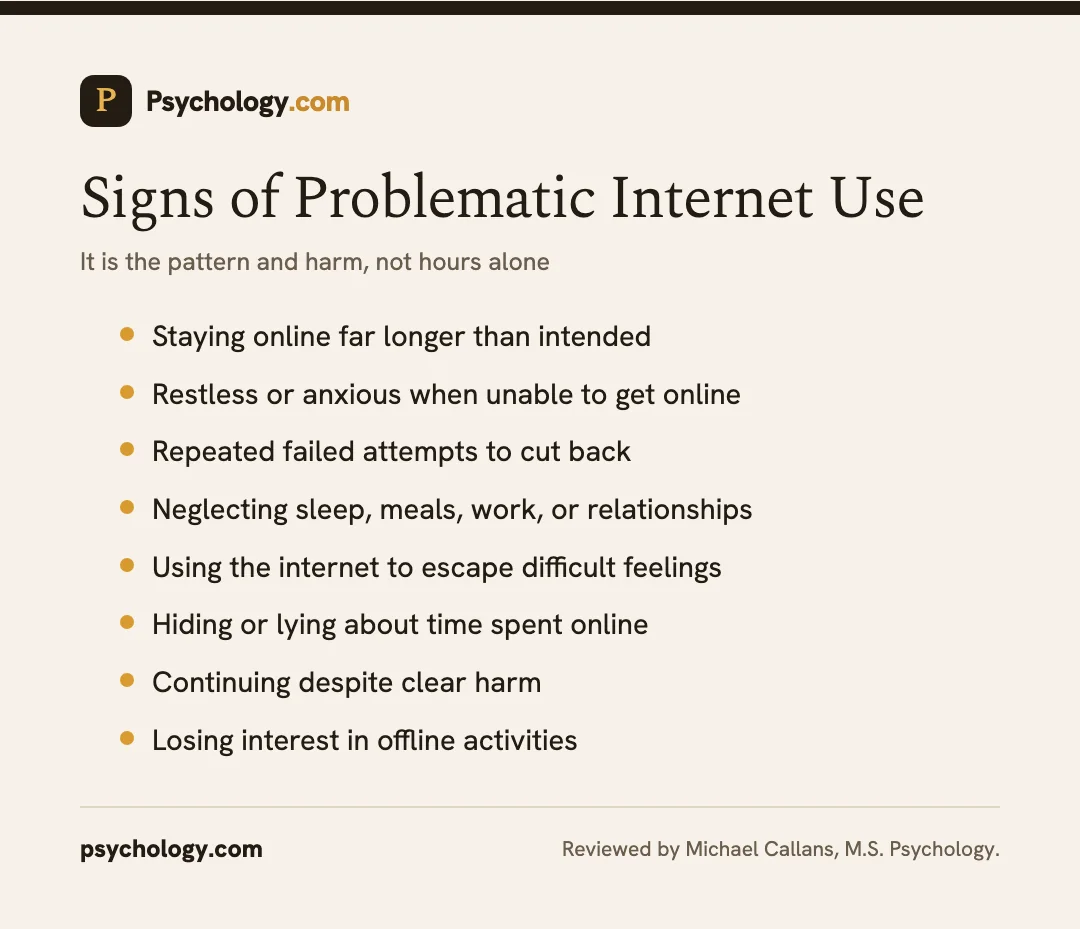
Problematic internet use tends to show up in behavior, mood, and daily functioning. Common signs include:
- Losing track of time online and staying on far longer than intended
- Feeling restless, irritable, or anxious when unable to get online
- Repeated unsuccessful attempts to cut back
- Neglecting sleep, meals, work, school, or relationships
- Using the internet to escape difficult feelings or stress
- Hiding or lying about how much time is spent online
- Continuing despite clear harm to health, grades, or relationships
- Loss of interest in offline activities that once mattered
As with other behavioral patterns, it is the cluster of signs and their impact, not a single late night online, that signals a problem worth addressing.
| Healthy screen use | Problematic use | |
|---|---|---|
| Control | Can log off when something else needs attention | Staying on far longer than intended, again and again |
| Purpose | Chosen activities with a clear point | Endless scrolling to escape stress or difficult feelings |
| Daily life | Fits around sleep, meals, work, and people | Sleep, meals, work, and relationships get crowded out |
| Mood offline | Comfortable being unreachable for a while | Restless, irritable, or anxious when unable to get online |
| Honesty | No urge to hide screen time | Hiding or minimizing how much time is spent online |
| Offline life | Hobbies and friendships still hold their pull | Loss of interest in offline activities that once mattered |
Who is affected
Problematic internet use can affect anyone, but adolescents and young adults appear to be most vulnerable, partly because their brains are still developing impulse control and because online gaming and social media are central to their social lives. It frequently overlaps with other mental health conditions. Many people who struggle with compulsive internet use also live with depression, anxiety, ADHD, or social difficulties, and online life can become a way to cope with those underlying challenges. For young people in particular, the patterns often respond well to support, especially when families are involved. Our guide to adolescent therapy covers how counseling can help teens.
A note on its clinical status
Internet addiction is widely discussed, and its broad clinical definition remains unsettled. Clinicians assess the specific online activity, its consequences, and other possible explanations for the difficulties. The American Psychiatric Association's DSM-5-TR lists internet gaming disorder as a condition requiring further study rather than an established diagnosis. The World Health Organization went a step further: its ICD-11 classification recognizes gaming disorder as a formal condition, while broader internet or social media addiction remains an area of active research. Experts continue to debate how to define and measure these behaviors. Clinicians can address the distress and functional problems while researchers continue to refine diagnostic categories.
By the numbers
11%of adolescents surveyed across 44 countries and regions in Europe, central Asia, and Canada showed signs of problematic social media behaviorWHO/Europe
7% to 11%is how far problematic social media use among adolescents rose between 2018 and 2022WHO/Europe
12%of adolescents in the same survey were at risk of problematic gamingWHO/Europe
13% vs 9%girls report higher levels of problematic social media use than boysWHO/Europe
How it is treated
“Studies suggest that gaming disorder affects only a small proportion of people who engage in digital- or video-gaming activities.”
Treatment focuses on restoring balance and addressing what drives the behavior, rather than demanding that someone give up the internet entirely, which is rarely realistic.
Cognitive behavioral therapy
CBT is a studied approach with clinical trial evidence, although results depend on the population and treatment program. It helps people understand their triggers, set realistic limits, manage urges, and replace compulsive use with healthier routines. A version known as CBT for internet addiction has been developed specifically for these patterns.
Treating underlying conditions
Because problematic internet use so often sits on top of anxiety, depression, or ADHD, treating those conditions is central. When the underlying distress eases, the pull toward compulsive use often eases with it.
Family involvement and structure
For children and teens, involving parents and caregivers is key. Clear, consistent boundaries around devices, screen-free times, and shared offline activities help rebuild balance. Family therapy can support the whole household.
Practical strategies
Scheduling device-free periods, using app timers and blockers, keeping screens out of the bedroom, and rebuilding offline hobbies and relationships all support recovery and tend to work best alongside professional guidance.
Does this sound familiar? If you have been wondering whether your time online is still working for you, these prompts offer a kind place to check in. They are reflections, not a diagnosis.
Free, with a plain-language result and a PDF you can bring to a professional. Review the site's privacy information before entering sensitive details. A screening is not a diagnosis.
Free tools and worksheets
Practical, printable exercises from our free library that people managing internet addiction often find useful. No signup needed.
When to seek help
Consider talking to a mental health professional if internet or gaming use is harming sleep, relationships, school, or work, if attempts to cut back keep failing, or if going offline brings strong distress. For a child or teen, reach out if online use is displacing school, sleep, and in-person friendships. Early support is easier than waiting for a crisis, and treatment is effective.
Frequently asked questions
Is internet addiction an official diagnosis?
Internet addiction as a broad term is not yet a formal diagnosis. The DSM-5-TR lists internet gaming disorder as a condition for further study, and the WHO's ICD-11 recognizes gaming disorder. Researchers continue to debate how to define problematic internet use overall.
How much screen time counts as an addiction?
There is no set number of hours. What matters is whether internet use is compulsive and harming your sleep, relationships, work, or well-being, and whether you struggle to cut back. A high number of hours alone does not establish addiction. An internet addiction test can organize your concerns, but a clinician needs the context behind your answers to assess what is happening.
How is problematic internet use treated?
Cognitive behavioral therapy can help people identify triggers, manage urges, set boundaries, and rebuild offline routines. A randomized clinical trial supports a structured CBT approach, with limits on how broadly the findings apply. Clinicians also assess anxiety, depression, ADHD, and other concerns that may affect online behavior. Family involvement can help tailor a plan for young people.
Is internet addiction the same as phone addiction?
They overlap heavily but are not identical. Internet addiction is an umbrella term for compulsive online behavior of any kind, including gaming, social media, streaming, and browsing. Phone addiction describes the same loss of control centered on the device most people carry everywhere. In practice the patterns, the underlying drivers, and the approaches that help are largely the same for both.
Can adults have problematic internet use, or is it mainly a teen issue?
Adults absolutely can. Adolescents and young adults appear most vulnerable because impulse control is still developing and online life is central to their social world, but adults show the same patterns with social media, gaming, shopping, and endless browsing. The markers are identical at any age: compulsive use, failed attempts to cut back, and real harm to sleep, work, or relationships.
What can parents do about a teen's screen use?
Start with curiosity rather than confrontation, since online life is often where a teen's friendships live. Agree on clear, consistent boundaries such as screen-free meals and no devices in the bedroom overnight, and model them yourself. Rebuild appealing offline time together. If use keeps displacing sleep, school, or in-person friendships despite structure, a therapist who works with adolescents can help.
Related conditions
- Addiction
- Gambling Addiction
- Adolescent Therapy
- Social Media Addiction Statistics 2026
Therapists who specialize in internet addiction
Connect with a licensed therapist on Psychology.com who works with internet addiction.
- 180 Wellness
- A FAMILY MATTER
- Advance Thru Psychotherapy and Family Development
- Amy Mayo
- Arlyn P. Stern LCSW
- Asktheinternettherapist.com
Browse all therapists →
Finding the right help
When you are ready to take the next step, these guides walk you through finding and starting with the right therapist.
- Getting started with therapy
- How to find the right therapist
- Find a therapist who takes insurance
- Free & low-cost therapy
References
- World Health Organization (WHO): Gaming disorder (ICD-11)
- American Psychiatric Association (APA): Internet Gaming
- HelpGuide: Smartphone and Internet Addiction
- CDC: Social Media and Youth Mental Health
- NHS: Mental health conditions

Using an internet addiction test to plan your next step
The internet addiction test can help you describe patterns such as staying online longer than intended or missing sleep. Treat the result as a prompt for discussion. It cannot distinguish gaming disorder from depression, anxiety, required work use, or other reasons for spending time online.
Bring examples of what has changed and what you have already tried. Record the activity, the feeling that came before it, and the consequence afterward in a habit tracker. A useful goal might be protecting bedtime, finishing a task before opening social media, or reconnecting with an offline activity. Choose a goal that preserves necessary work, school, and social access.
The existing survey figures describe different patterns of problematic use among adolescents in the surveyed regions. They are not diagnostic rates for all internet users or estimates for the United States. Explore the Conditions hub and our guides to gambling addiction and adolescent therapy if those concerns fit your situation.