
Key facts
- Domestic abuse is about power and control and includes physical, emotional, financial, and sexual abuse, plus coercive control. Controlling access to money or support can limit a survivor's options. National Domestic Violence Hotline.
- Abuse can happen without any physical violence and still cause deep harm. Threats and intimidation can occur alongside periods of affection. Hotline explanation of abuse.
- It is never the survivor's fault, and leaving safely often takes time and support. An advocate can discuss choices without requiring you to leave immediately. National Domestic Violence Hotline support.
- Confidential help is available 24/7, and trauma-informed therapy supports recovery. In the United States, call 1-800-799-7233 or text START to 88788 when safe to do so. Hotline contact information.
What is domestic abuse?
Domestic abuse, sometimes called domestic violence or intimate partner violence, is a pattern of behavior in a relationship used to gain or keep power and control over another person. It can occur between current or former partners and within families, and it affects people of every gender, age, income, and background. A pattern in which one person dominates, frightens, or controls another is a central warning sign. Physical or sexual assault can be abusive even when it happens once. A single assault or threat can also be serious and warrants support. You can talk with an advocate about what happened even if you are unsure what to call it or have never sought help before.
Abuse takes many forms, and they often overlap:
- Physical abuse: hitting, pushing, choking, restraining, or any use of force or threat of force.
- Emotional and psychological abuse: constant criticism, humiliation, name-calling, gaslighting, threats, and blame.
- Financial abuse: controlling money, blocking access to bank accounts, sabotaging work, or creating debt in the survivor's name.
- Sexual abuse: any sexual contact or coercion without freely given consent.
- Coercive control: a pattern of isolation, surveillance, intimidation, and micromanaging that strips away a person's freedom and sense of self, even without physical violence.
Coercive control is increasingly recognized as one of the most damaging forms of abuse precisely because it is invisible from the outside. The National Domestic Violence Hotline describes abuse as a deliberate effort to gain power over a partner, and understanding that pattern helps explain behaviors that might otherwise seem disconnected.
Recognizing the signs
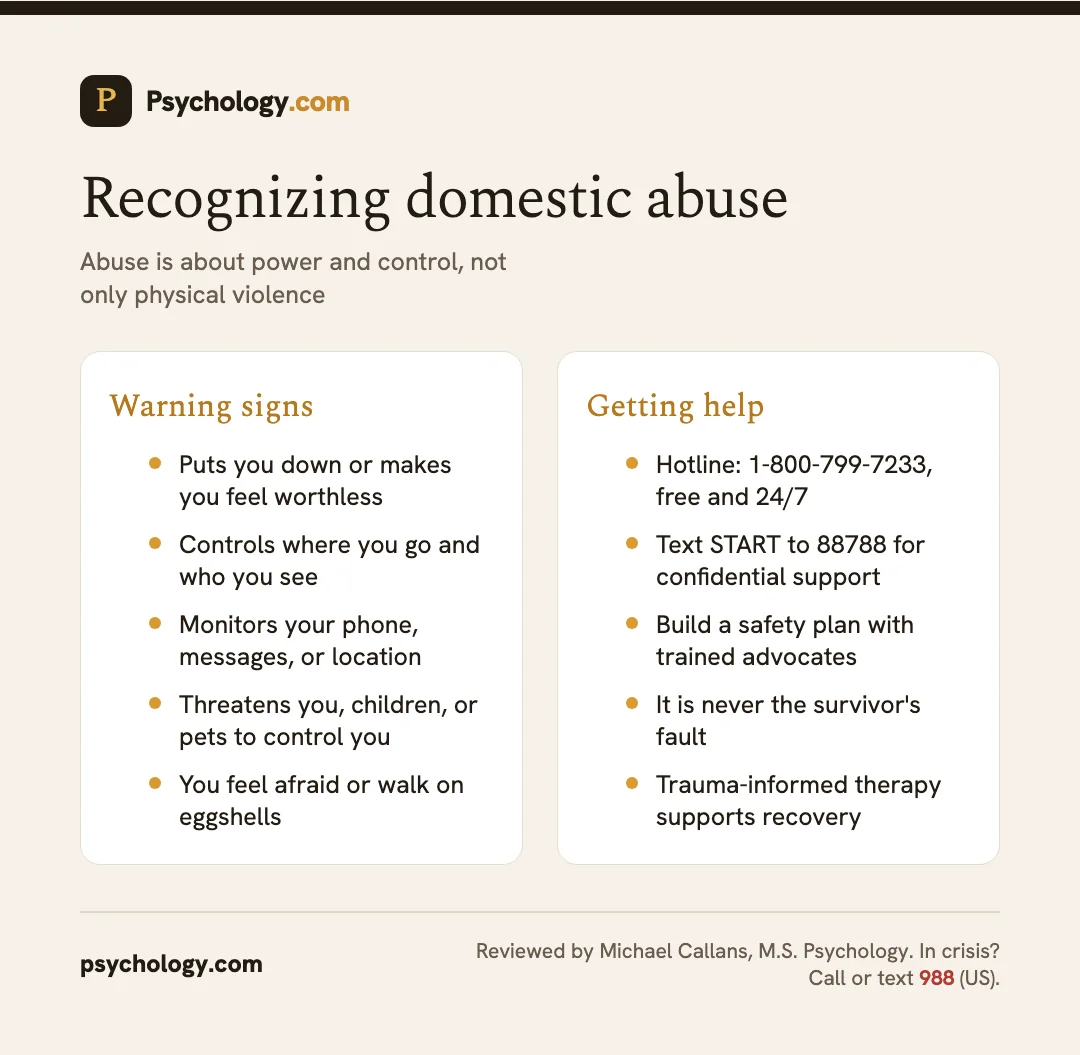
Abuse can be hard to name, especially when it builds slowly or there are no bruises. You may be experiencing abuse if a partner or family member regularly does any of the following:
- Puts you down, embarrasses you, or makes you feel worthless
- Controls where you go, who you see, and what you wear
- Monitors your phone, messages, or location
- Threatens you, your children, your pets, or themselves to keep you in line
- Controls the money or prevents you from working
- Blames you for their behavior or makes you doubt your own memory
- Frightens you, so that you change your behavior to avoid setting them off
One reliable inner signal is fear. If you feel afraid of a partner or find yourself constantly walking on eggshells, that is worth taking seriously, whatever else is happening. Trusting that feeling is not an overreaction.
The cycle of abuse
Many abusive relationships follow a recognizable pattern, sometimes called the cycle of abuse. Tension builds, then an incident of abuse occurs, often followed by a period of apology, affection, and promises to change, sometimes called the honeymoon phase, before tension begins building again. This cycle is part of why abuse is so confusing and so hard to leave. The kindness in the calm phase feels real and can renew hope, even as the harmful pattern continues underneath. Not every relationship follows this cycle exactly, and over time the calm phases often shrink while the abuse intensifies. Recognizing the pattern can help a person see the relationship clearly rather than blaming themselves for the next incident.
Effects on health and wellbeing
Living with abuse takes a heavy toll on the mind and body. Survivors commonly experience anxiety, depression, sleep problems, chronic stress, and low self-worth. Many develop symptoms of post-traumatic stress, including flashbacks, hypervigilance, and emotional numbness. Our guide to PTSD explains how trauma can affect the nervous system long after the danger has passed. The Centers for Disease Control and Prevention documents links between intimate partner violence and a wide range of physical and mental health problems. These effects are normal responses to an abnormal and harmful situation. They are not signs of weakness, and they can heal with the right support.
Safety planning and getting help
If you are experiencing abuse, your safety comes first. A safety plan is a personalized set of steps to help you stay safer whether you stay, prepare to leave, or have already left. It might include identifying safe places to go, keeping important documents and a small amount of money accessible, agreeing on a code word with someone you trust, and considering access to a safer device with an advocate. Clearing browser history may leave traces and may be noticed by someone monitoring you. Advocates can help you build a plan tailored to your situation.
You do not have to figure this out alone. The National Domestic Violence Hotline (1-800-799-7233, text START to 88788) offers free, confidential support around the clock, including help with safety planning and connections to local shelters and services. Calling does not commit you to any decision. It is simply a way to talk things through with someone who understands. Leaving an abusive relationship can be the most dangerous time, which is exactly why doing it with the help of trained advocates matters so much.
Wondering where you stand? Take the emotional abuse test or the narcissistic partner test: free, confidential, with an instant plain-language result and a PDF you can bring to a professional. A screening is not a diagnosis.
How trauma-informed therapy helps
Therapy is a powerful part of recovery, often working alongside the practical support of advocates and shelters. A trauma-informed therapist understands how abuse affects the mind and body and creates a safe, nonjudgmental space where you set the pace. The work might involve making sense of what happened, rebuilding the self-worth that abuse erodes, learning to trust your own perceptions again, and treating the anxiety, depression, or PTSD that frequently follow. Evidence-based trauma therapies, including cognitive processing therapy and EMDR, help the brain process traumatic memories so they lose their grip.
Good therapy respects a survivor's choices and places responsibility for abuse on the person causing harm. A skilled therapist meets you where you are, respects your decisions, and helps you reconnect with your own strength. Recovery can include reclaiming safety, confidence, and a life that belongs to you while processing memories at your own pace.
Frequently asked questions
Is it still abuse if my partner has never hit me?
Yes. Abuse includes power and control through physical and nonphysical behaviors. Emotional abuse, financial control, isolation, threats, and coercive control are all forms of domestic abuse and can be just as damaging, even when there is no physical injury. An advocate can help you discuss concerns and consider safer options.
Why is it so hard to leave an abusive relationship?
Leaving is complicated and often dangerous. Fear, financial dependence, children, isolation from support, love for the person, and the very real risk that abuse escalates after leaving all play a part. Needing time and help to leave safely is not a weakness.
How can therapy help a survivor of domestic abuse?
Trauma-informed therapy offers a safe space to process what happened, rebuild self-worth, and treat the anxiety, depression, or PTSD that often follow abuse. It works alongside practical safety and advocacy support to help survivors recover and move forward. Ask about experience with coercive control and how the therapist protects communication about appointments.
What does a cycle of abuse wheel show?
A cycle of abuse wheel illustrates a possible pattern of tension, an abusive incident, reconciliation, and calm. Some relationships follow a different pattern or involve ongoing control without a calm phase. The cycle of abuse tool can help you reflect on patterns, but a diagram cannot determine your safety. A single violent incident or threat is enough reason to seek support from a domestic abuse advocate.
Is couples counseling safe when there is domestic abuse?
The National Domestic Violence Hotline advises against couples counseling with an abusive partner. An abusive partner may use what is said in sessions to retaliate or shift blame. Seek confidential individual support and safety planning with an advocate instead. A therapist experienced in domestic abuse can support your recovery and discuss safe ways to access care, including communication arrangements that reduce the chance of your partner discovering appointments.
Related
Therapists who specialize in domestic abuse
Connect with a licensed therapist on Psychology.com who works with domestic abuse.
- 180 Wellness
- A FAMILY MATTER
- Advance Thru Psychotherapy and Family Development
- Arlyn P. Stern LCSW
- Asktheinternettherapist.com
- Barbara L Edwards
Finding the right help
When you are ready to take the next step, these guides walk you through finding and starting with the right therapist.
- Getting started with therapy
- How to find the right therapist
- Find a therapist who takes insurance
- Free & low-cost therapy
References
- National Domestic Violence Hotline
- National Domestic Violence Hotline: Understand relationship abuse
- Centers for Disease Control and Prevention (CDC): Intimate partner violence
- U.S. Office on Women's Health: Domestic or intimate partner violence
- World Health Organization (WHO): Violence against women fact sheet
- HelpGuide: Domestic violence and abuse
- National Domestic Violence Hotline: Internet safety
- National Domestic Violence Hotline: Couples therapy with an abusive partner
Safer access to support
If you think your phone or computer is monitored, consider accessing help from a device the abusive person cannot access. The Hotline explains that private browsing and deleting history cannot fully erase online activity. Sudden changes to accounts or browsing habits may also be noticed. An advocate can help you consider technology risks as part of your safety plan.
Use the emotional abuse questionnaire only if it is safe to open and store the result. A score cannot judge immediate danger or determine whether you deserve help. Avoid saving worksheets or messages where someone monitoring you could find them. If you are in immediate danger, contact emergency services when it is safe to do so.