

Key facts
- Crisis counseling is immediate, short-term support for an urgent emotional or mental health crisis.
- In the US, you can call or text 988 any time to reach the Suicide and Crisis Lifeline.
- You do not have to be suicidal to reach out. Crisis lines help with any overwhelming distress.
- It is the first step, not the whole journey. Ongoing care often follows. See suicide prevention.
What is crisis counseling?
Crisis counseling is immediate, short-term mental health support for someone going through an acute emotional crisis. The goal is not to solve every problem in one conversation. It is to help you get through the moment safely, calm an overwhelming situation, and connect you with the next step. A crisis can be triggered by a sudden event such as a loss, an assault, or a disaster, or it can build from mounting distress until you feel you cannot cope.
A trained crisis counselor listens without judgment, helps you feel less alone, and works with you to lower the intensity of what you are feeling. They focus on safety first, then on practical, here-and-now steps. Crisis counseling is delivered by phone, text, and online chat through services like the 988 Lifeline, and also in person through hospital emergency departments, mobile crisis teams, and community crisis centers.
When to use it
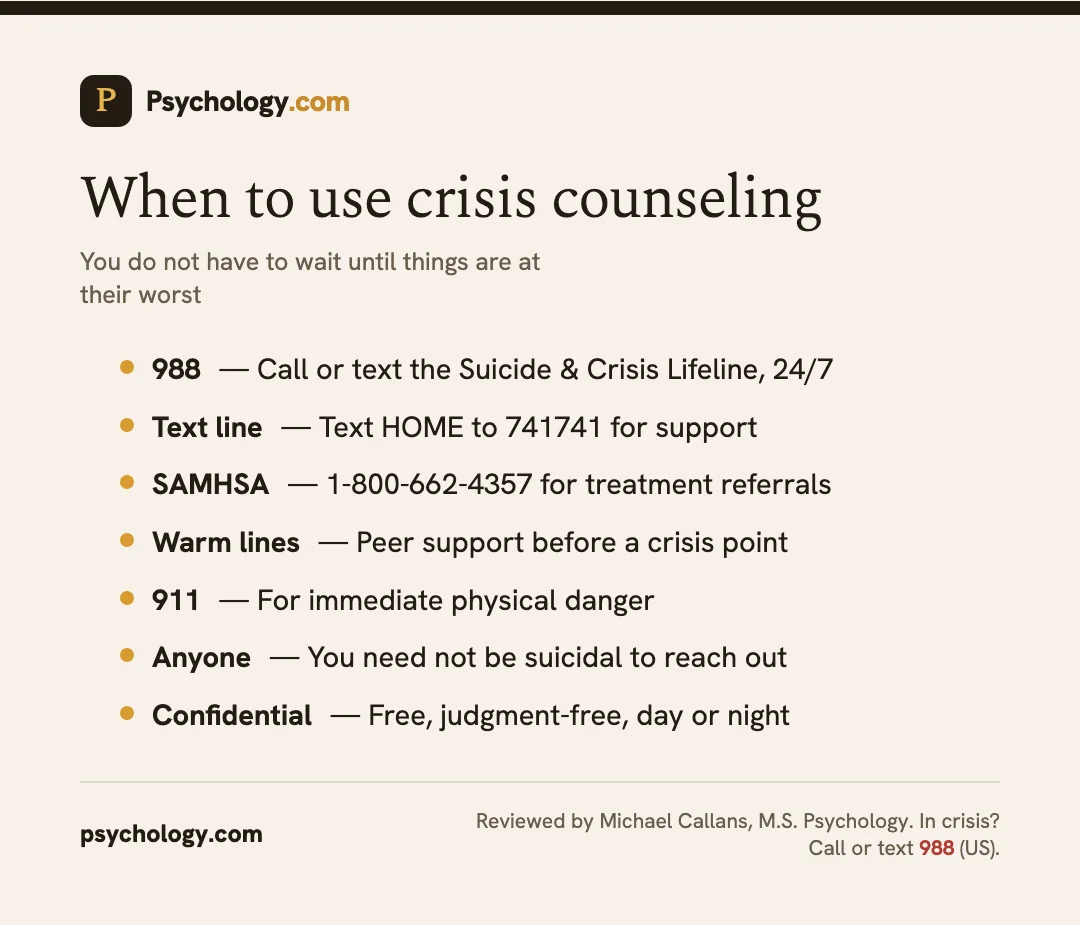
Reach out for crisis support whenever distress feels like more than you can handle on your own. You do not need to wait until things are at their worst. Common reasons people use crisis counseling include:
- Thoughts of suicide or self-harm, or worry that you might act on them
- Feeling completely overwhelmed, hopeless, or unable to cope
- A panic attack or acute anxiety that feels unbearable
- The aftermath of trauma, abuse, assault, or sudden loss
- A mental health or substance use emergency, in yourself or someone you love
- Simply needing to talk to someone right now, when no one else is available
If you are unsure whether your situation counts as a crisis, that uncertainty is itself a good reason to reach out. Crisis lines exist precisely so you do not have to make that judgment alone.
988, hotlines and warm lines
The 988 Suicide and Crisis Lifeline is the central crisis resource in the United States. You can call or text 988, or chat online at 988lifeline.org, to reach a trained counselor any time, free and confidential. The Lifeline serves anyone in a mental health, substance use, or emotional crisis, not only people thinking about suicide. There are dedicated options too, including support for Veterans (press 1) and Spanish-language services.
Other resources fill specific needs:
- Crisis Text Line. Text HOME to 741741 to reach a crisis counselor by text.
- SAMHSA National Helpline. Call 1-800-662-4357 for free, confidential help with mental health and substance use, including treatment referrals.
- Warm lines. Many states run warm lines, staffed by trained peers, for emotional support when you are struggling but not in immediate danger. They are a gentler option for hard moments that have not reached a crisis point.
If you or someone near you is in immediate physical danger, call 911 or go to the nearest emergency room. For more on staying safe and helping others, see our guide to suicide prevention.
What to expect
Reaching out for crisis help is simpler than it can feel. When you call or text 988, you will usually hear a brief greeting and may wait a short time to be connected to a counselor. The counselor will listen, ask gentle questions to understand what is happening, and take your safety seriously. You are in control of the conversation, and you can share as much or as little as you want.
Most crisis contacts are resolved by talking. The counselor helps de-escalate the moment, works with you on a simple plan to stay safe, and connects you to follow-up resources such as local services or ongoing therapy. Emergency services are involved only when there is imminent danger to life. The aim throughout is to support you, not to take over, and the conversation is confidential.
How it differs from ongoing therapy
Crisis counseling and ongoing therapy serve different purposes, and both matter. Crisis counseling is immediate and short-term, focused on safety and getting through an acute moment. It does not require an appointment, insurance, or a diagnosis, and it is often delivered by phone or text in a single contact.
Ongoing therapy is a longer-term process. You meet regularly with a licensed therapist to understand underlying issues, treat conditions such as depression or anxiety, and build lasting skills. For a fuller picture of that side of care, see our overview of psychotherapy and counseling. The two work together. Crisis counseling stabilizes the present and often becomes the bridge that leads someone into the ongoing care that helps them heal over time.
Frequently asked questions
What is the 988 Suicide and Crisis Lifeline?
The 988 Suicide and Crisis Lifeline is a free, confidential service available 24 hours a day across the United States. You can call or text 988, or chat online, to reach a trained crisis counselor for support during any mental health, substance use, or emotional crisis, including thoughts of suicide.
Do I have to be suicidal to call a crisis line?
No. Crisis lines are for anyone in emotional distress, not only people thinking about suicide. You can reach out if you feel overwhelmed, panicked, in despair, or worried about someone else. You do not need to be at the worst possible moment to deserve support.
How is crisis counseling different from regular therapy?
Crisis counseling is short-term, immediate support focused on safety and stabilizing the present moment. Ongoing therapy is a longer-term process that explores underlying issues and builds lasting skills. Crisis counseling often bridges to ongoing care once the immediate danger has passed.
Related
Therapists who specialize in crisis counseling
Connect with a licensed therapist on Psychology.com who works with crisis counseling.
Finding the right help
When you are ready to take the next step, these guides walk you through finding and starting with the right therapist.
- Getting started with therapy
- How to find the right therapist
- Find a therapist who takes insurance
- Free & low-cost therapy
References
- 988 Suicide and Crisis Lifeline
- SAMHSA: 988 Suicide and Crisis Lifeline
- SAMHSA: National Helpline
- National Institute of Mental Health (NIMH): Suicide prevention
- Centers for Disease Control and Prevention (CDC): Suicide prevention resources