Key facts
- Sexual abuse is never the survivor's fault. Responsibility lies entirely with the person who caused harm.
- Trauma reactions such as anxiety, numbness, flashbacks, and shame are normal responses to an abnormal event.
- Effective trauma therapies include EMDR and trauma-focused cognitive behavioral therapy.
- Healing is possible at any age and no matter how long ago the abuse happened.
You are not alone
Sexual abuse is any unwanted sexual contact or activity that happens without consent, including assault in adulthood and abuse experienced as a child. It is far more common than most people realize. According to RAINN, millions of people in the United States have survived sexual violence. If this happened to you, you are part of a vast community of survivors, many of whom have found their way to recovery. Reaching this page is itself a step, and there is no wrong time or way to begin.
It is not your fault
This deserves to be said plainly. No matter the circumstances, what you wore, whether you had been drinking, whether you knew the person, whether you froze or could not say no, the abuse was not your fault. The only person responsible for sexual abuse is the person who chose to commit it.
Many survivors carry shame and self-blame, and abusers often encourage that. It can help to understand that the body has automatic survival responses. Alongside fight and flight, there is freeze and a form of collapse sometimes called fawn, where a person becomes still or compliant to survive a threat. These are reflexes, not choices, and they are not consent. If you have blamed yourself, please know that response is common and that you did nothing wrong.
How sexual abuse can affect you
Sexual trauma can affect the mind, body, and relationships, sometimes immediately and sometimes years later. There is no single right way to react, and reactions can change over time. Common experiences include:
- Anxiety, panic, hypervigilance, or feeling constantly on edge
- Flashbacks, intrusive memories, or nightmares
- Emotional numbness, dissociation, or feeling disconnected from your body
- Depression, hopelessness, or thoughts of self-harm
- Shame, guilt, or a damaged sense of self-worth
- Difficulty trusting others or with intimacy and sex
- Sleep problems, startle responses, and physical tension
For some survivors these reactions develop into post-traumatic stress disorder. Our guide to PTSD explains those symptoms in more detail. Whatever you are feeling, it is a normal response to something that should never have happened, and it can ease with support.
Trauma therapies that help
Trauma-focused therapy is effective, and survivors do recover. The goal is not to forget what happened but to process it so that it loses its grip on the present. Evidence-based approaches include:
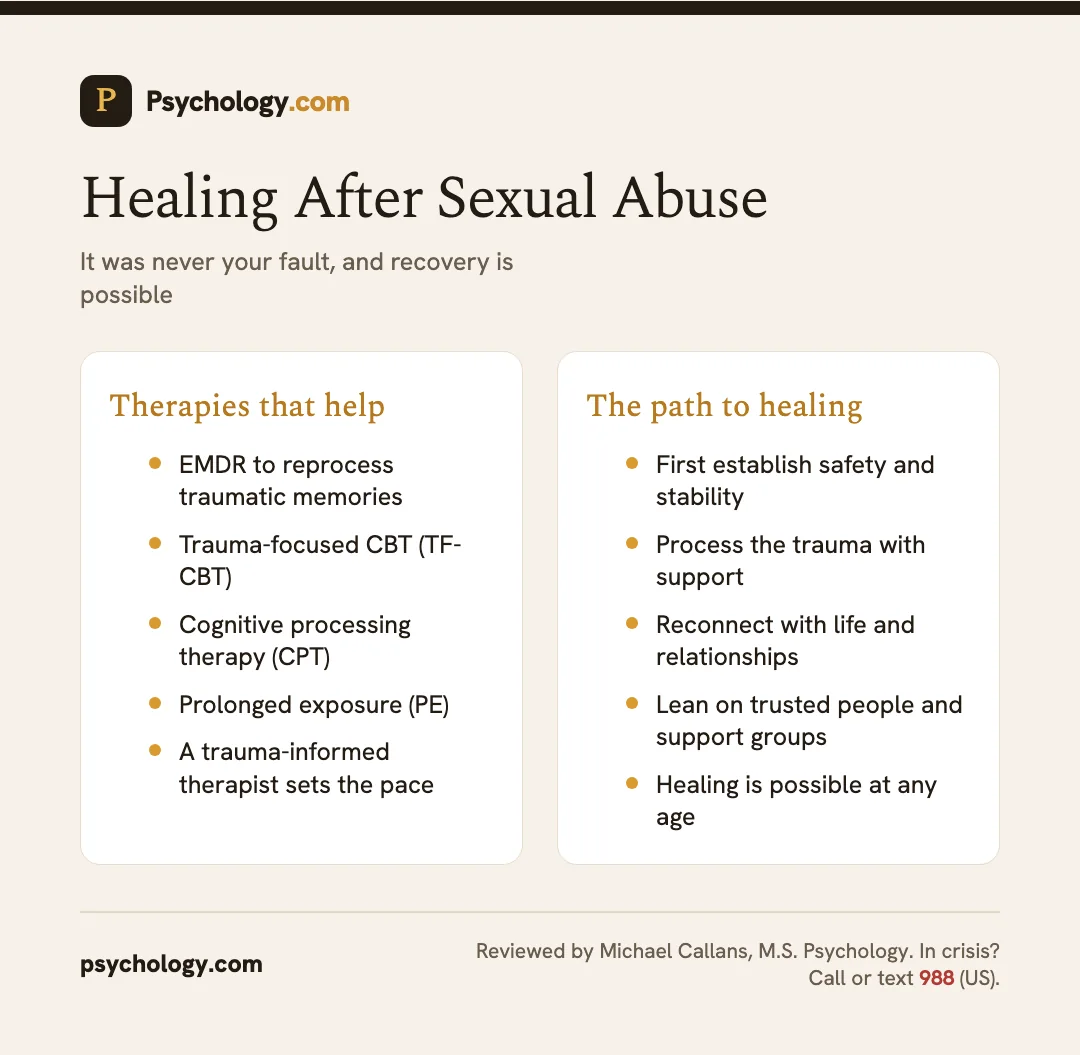
- EMDR (eye movement desensitization and reprocessing): a structured therapy that helps the brain reprocess traumatic memories so they feel less raw and intrusive. Learn more about EMDR.
- Trauma-focused cognitive behavioral therapy (TF-CBT): a well-researched approach, especially for children and adolescents, that addresses trauma-related thoughts, feelings, and behaviors with support from a caregiver when appropriate.
- Cognitive processing therapy (CPT) and prolonged exposure (PE): structured therapies that help survivors safely process the memory and shift the beliefs trauma can leave behind.
A trauma-informed therapist will prioritize safety, establish coping skills first, and let you set the pace. You remain in control of what you share and when. Therapy can also address related anxiety and depression that often accompany sexual trauma.
One honest note about talk therapy: verbalizing very upsetting experiences in detail can itself be painful, which makes purely talk-based approaches challenging for many survivors, especially early on. Performed well, an approach such as EMDR can feel more tolerable, and it often helps you arrive at your own insights and solutions rather than being told what to think by a therapist.
The path to healing
Recovery is rarely a straight line, and it does not have a fixed timeline. Many survivors describe healing in phases: first establishing safety and stability, then processing the trauma with support, and finally reconnecting with life, relationships, and a sense of self beyond what happened. Progress can come in waves, with better stretches and harder ones, and that is normal rather than a sign of failure.
Alongside therapy, things that support healing include leaning on trusted people, joining a survivor support group to reduce isolation, grounding and relaxation practices for moments of overwhelm, and patience with yourself. You get to define what healing means for you. Many survivors go on to live full, connected lives, and reclaiming that future is not only possible but common.
Resources and support
You do not have to navigate this alone, and support is free and confidential. RAINN (the Rape, Abuse and Incest National Network) operates the National Sexual Assault Hotline at 1-800-656-4673 and an online chat, connecting you with trained staff and local services. A trauma-informed therapist can guide longer-term recovery, and survivor support groups offer connection with people who understand. Reaching out for any of these is a sign of strength, not weakness.
Frequently asked questions
Was the abuse my fault?
No. Sexual abuse is never the fault of the person it happens to. Responsibility lies entirely with the person who chose to harm. Survival responses such as freezing, staying silent, or being unable to fight back are normal and are not a form of consent.
Is it too late to get help if the abuse happened years ago?
It is never too late. Many survivors begin healing long after the abuse, sometimes decades later. Trauma therapies are effective regardless of how much time has passed, and reaching out at any point is a valid and worthwhile step.
What therapies help with sexual abuse trauma?
Trauma-focused approaches with strong evidence include EMDR, trauma-focused cognitive behavioral therapy (TF-CBT), prolonged exposure, and cognitive processing therapy. A trauma-informed therapist can help you choose an approach and move at a pace that feels safe.
Related topics
Therapists who specialize in sexual abuse
Connect with a licensed therapist on Psychology.com who works with sexual abuse.
- 180 Wellness
- A FAMILY MATTER
- A. Nires
- Advance Thru Psychotherapy and Family Development
- Amy Keller
- Arlyn P. Stern LCSW
Finding the right help
When you are ready to take the next step, these guides walk you through finding and starting with the right therapist.
- Getting started with therapy
- How to find the right therapist
- Find a therapist who takes insurance
- Free & low-cost therapy
References
- RAINN: Rape, Abuse & Incest National Network
- RAINN: Victims of Sexual Violence statistics
- National Institute of Mental Health (NIMH): Post-Traumatic Stress Disorder
- U.S. Department of Veterans Affairs: Trauma-Focused Cognitive Behavioral Therapy
- American Psychological Association (APA): Trauma
- SAMHSA: National Helpline