 Reviewed by
In short
Self-esteem is your overall sense of personal worth. Low self-esteem can appear as harsh self-criticism, difficulty accepting praise, people-pleasing, and avoiding challenges because you expect to fail. Therapy can help you examine these beliefs, practice assertiveness, and build a more balanced view of yourself through everyday experiences and supportive relationships.
Key facts
- Self-esteem is your overall sense of your own value and worth. The Rosenberg Self-Esteem Scale uses 10 statements about these feelings; see the Rosenberg scale instructions hosted by Saint Louis University.
- Low self-esteem is common and is not a permanent trait; it can change with effort and support. Recognizing negative beliefs and gathering evidence for a fairer view are practical steps in NHS self-esteem guidance.
- It is closely linked to anxiety and depression, and these difficulties can reinforce one another. Persistent self-criticism and avoidance can contribute to distress; NHS self-esteem guidance describes this relationship.
- Therapy, including CBT and self-compassion approaches, can support healthier self-worth by addressing self-critical thinking and behavior. A review of CBT for low self-esteem found improvement in self-reported self-esteem, while noting uncertainty about how distinct the benefits were from improvement in depression.
What is self-esteem?
Self-esteem is the overall opinion you hold of yourself, your sense of your own value, competence, and worth. Healthy self-esteem means you can accept your strengths and limitations, treat yourself with basic respect, and recover from setbacks without concluding that you are fundamentally flawed. It does not mean thinking you are perfect or better than others. It means having a stable, realistic, and reasonably kind relationship with yourself. A useful distinction is that confidence often concerns a particular skill, while self-esteem concerns your overall worth. You can feel uncertain about a task and still treat yourself with respect as you learn.
Low self-esteem is the opposite pattern: a persistent belief that you are inadequate, incapable, or undeserving of care. It tends to color how you interpret events, so neutral or even positive experiences get filtered through a harsh inner voice. Self-esteem is not fixed. It develops over a lifetime and can move in either direction, which means it can also be rebuilt. As HelpGuide notes, self-worth is shaped over time and is responsive to new experiences and to deliberate change.
Signs of low self-esteem
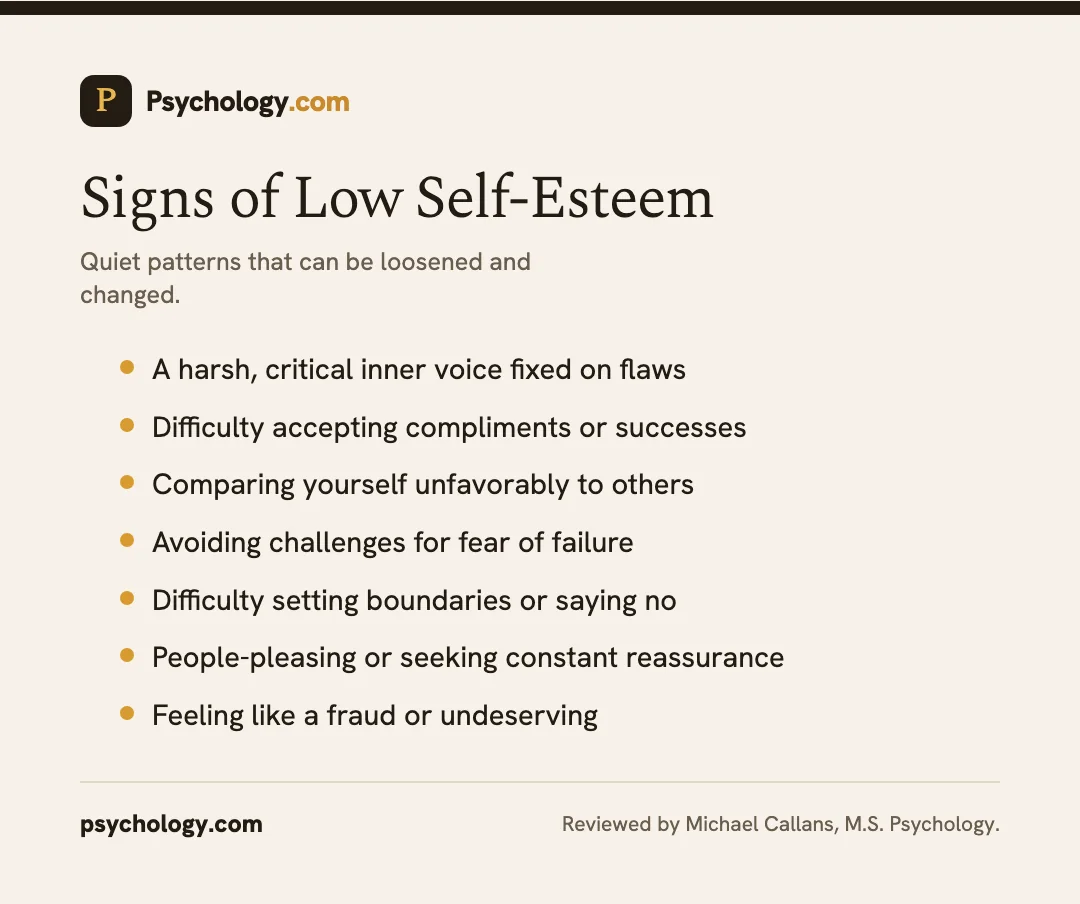
Low self-esteem can be quiet and easy to overlook because it often feels like simple honesty about yourself. Common signs include:
- A harsh, critical inner voice that focuses on flaws and mistakes
- Difficulty accepting compliments or believing in your own successes
- Comparing yourself unfavorably to others
- Avoiding challenges or new opportunities for fear of failure
- Difficulty setting boundaries or saying no
- People-pleasing or seeking constant reassurance
- Feeling like a fraud, or that you do not deserve good things
- Withdrawing from relationships or social situations
These patterns can feed on themselves. Avoiding challenges, for example, removes the chance to gather evidence that you are capable, which keeps self-doubt in place. Recognizing the pattern is the first step toward changing it.
Where low self-esteem comes from
Self-esteem is built from experience, especially early experience. Common roots of low self-worth include:
- Childhood environment: harsh criticism, neglect, conditional approval, or unstable caregiving.
- Bullying or rejection: at school, at home, or in relationships.
- Trauma or abuse: experiences that send the message that you are not safe or not valued.
- Repeated setbacks: ongoing failure, loss, or difficulty without support.
- Comparison and social pressure: measuring yourself against others, including idealized images online.
These experiences shape core beliefs about the self that then operate automatically in adulthood. Understanding where low self-esteem came from helps explain why familiar beliefs feel convincing. Recognizing those patterns can make it easier to respond to setbacks with greater flexibility and compassion.
How it affects mental health
Self-esteem and mental health are deeply connected. Low self-worth is a well-established risk factor for depression and anxiety, and those conditions in turn drag self-esteem down further, creating a cycle. A persistent belief that you are inadequate can fuel chronic worry, social withdrawal, and hopelessness. Low self-esteem is also linked to difficulty in relationships, vulnerability to unhealthy or controlling dynamics, and a higher risk of turning to alcohol or other substances to cope.
The encouraging news is that this connection runs both ways. Strengthening self-esteem often improves mood, reduces anxiety, and makes relationships healthier, which is why it is frequently an important focus within broader mental health treatment.
How therapy helps
Self-esteem can be rebuilt, and therapy is one of the most effective ways to do it. A therapist offers a supportive, nonjudgmental space and proven tools for changing the beliefs and habits that keep self-worth low.
Cognitive behavioral therapy (CBT)
CBT helps you notice the automatic self-critical thoughts that drive low self-esteem, examine the evidence for and against them, and replace them with more balanced, realistic appraisals. Over time, this reshapes the deeper beliefs you hold about yourself and builds confidence through real-world experience.
Self-compassion approaches
A growing body of research, much of it associated with psychologist Kristin Neff, shows that self-compassion, treating yourself with the same kindness you would offer a friend, builds resilience and emotional wellbeing. Self-compassion practices help replace harsh self-judgment with a steadier and more supportive inner stance, which research links to lower anxiety and depression.
Other supportive work
Therapy may also include building assertiveness and boundary-setting skills, addressing underlying trauma, and reconnecting with values and activities that create a genuine sense of competence. When low self-esteem accompanies depression or anxiety, treating both together tends to work best.
Wondering where you stand? Take the Rosenberg self-esteem test (RSES) or the locus of control test: free, confidential, at your own pace, with an instant plain-language result and a PDF you can bring to a professional. A quiz is a starting point for reflection, not a verdict.
Finding the right therapist
If low self-esteem is holding you back at work, in relationships, or in how you feel day to day, working with a therapist can help. Look for a licensed professional, such as a psychologist, counselor, or clinical social worker, with experience in CBT, self-compassion, or related approaches. A good fit matters: you should feel safe, respected, and able to speak honestly. The pace of change depends on your goals, circumstances, and any other mental health concerns. Review concrete signs of progress with your therapist, such as speaking up more often or recovering more easily from setbacks.
Frequently asked questions
What causes low self-esteem?
Low self-esteem usually grows out of early experiences such as criticism, neglect, bullying, or trauma, combined with later setbacks and ongoing self-critical thinking. It can also be both a cause and a result of conditions like anxiety and depression. Current relationships, stress, and how you interpret setbacks can also reinforce the pattern. A therapist can help identify which influences are most relevant to you.
Can therapy improve self-esteem?
Yes. Therapy, especially cognitive behavioral therapy and self-compassion approaches, helps people identify and change harsh self-critical thinking, build more balanced self-beliefs, and develop a steadier sense of self-worth over time. For example, you might practice asking for help, setting a boundary, or trying an activity you usually avoid, then review what actually happened. Progress involves changes in daily choices as well as feelings.
Is low self-esteem a mental illness?
Low self-esteem describes a pattern of self-evaluation rather than a diagnosis. It is closely tied to mental health and can be a focus of professional support. It can contribute to and worsen conditions such as anxiety and depression, and addressing it is often an important part of treatment and recovery. Seeking help is reasonable when self-criticism interferes with relationships, work, or everyday decisions, even without a diagnosis.
What is the Rosenberg self-esteem scale?
The Rosenberg Self-Esteem Scale is a questionnaire about general feelings of self-worth. Its 10 statements include positive and negative views of yourself, with responses ranging from strongly agree to strongly disagree. The Rosenberg scale instructions hosted by Saint Louis University explains its format. Our self-esteem test uses this measure to support reflection; a score cannot diagnose a mental health condition.
Can a test tell me if I have low self-esteem?
A self-esteem test can help you notice a pattern of negative self-beliefs and put those experiences into words. Interpret your result alongside daily life: whether you avoid opportunities, struggle with boundaries, or dismiss positive feedback. A clinician can explore these patterns and any depression or anxiety symptoms. You can seek support whenever self-criticism is causing distress.
What are useful self-esteem journal prompts?
Useful self-esteem journal prompts ask for specific evidence: What did I handle today? Which strength did I use? What would I say to a friend in the same situation? Use the self-esteem journal to record examples and a balanced response to self-criticism. Keep entries realistic and kind, and bring recurring patterns to therapy if you want help understanding them.
Related conditions
- Anxiety
- Depression
- Relationships
Therapists who specialize in self esteem
Connect with a licensed therapist on Psychology.com who works with self esteem.
- A FAMILY MATTER
- A. Nires
- Advance Thru Psychotherapy and Family Development
- Anne Ciota
- Arlyn P. Stern LCSW
- Asktheinternettherapist.com
Finding the right help
When you are ready to take the next step, these guides walk you through finding and starting with the right therapist.
- Getting started with therapy
- How to find the right therapist
- Find a therapist who takes insurance
- Free & low-cost therapy
References
- Kolubinski and colleagues: Systematic review of CBT interventions for low self-esteem
- Saint Louis University: Rosenberg Self-Esteem Scale and scoring instructions
- American Psychological Association (APA): Self-esteem topic page
- HelpGuide: Improving your self-esteem
- NHS: Raising low self-esteem
- Mind: Self-esteem
- Cleveland Clinic: How to improve your self-esteem
Practicing a balanced view of yourself
Choose a recent moment when you judged yourself harshly. Write down what happened, the conclusion you drew about yourself, and the evidence that supports a more complete picture. For example, forgetting an appointment might call for a reminder system and an apology. It does not establish that you are unreliable in every part of your life.
The self-esteem worksheet provides space for strengths, self-critical thoughts, and balanced responses. Pair reflection with an action you can observe, such as asking a question at work or declining a request you cannot reasonably manage. Notice the outcome and what you learned. NHS self-esteem guidance recommends challenging negative beliefs and practicing assertiveness.
Self-esteem work should allow room for difficult feelings and real constraints. If criticism comes from an unsafe or controlling relationship, discuss safety and support with a qualified professional. Our guides to relationships and anxiety explain related concerns, and the Life & Relationships hub offers further reading.